Can you use a hot tub with a pacemaker?
Can you use a hot tub with a pacemaker? Learn why your heart condition matters more than the device, how heat strains the heart and what to ask your team.
Many people can use a hot tub with a pacemaker, but the answer depends far more on the heart condition behind the pacemaker than on the device itself. Hot water makes your heart work harder, so check with your cardiology team or pacing clinic before your first soak after the implant.
This guide explains what heat does to your circulation, which conditions and medicines need extra care, and what to ask your team. It also covers sensible habits for every soak and the signs that mean you should get out straight away.
This article is general information, not medical advice.
Using a hot tub with a pacemaker: is it the device or the heart condition?
A pacemaker is fitted because something in the heart's own electrical system needs support. Common reasons include a slow heart rate, heart block or certain rhythm problems. Some people also have other heart conditions, such as heart failure, valve disease or coronary heart disease, alongside the rhythm problem.
When people ask whether a hot tub is safe, they usually worry about the device. In practice, the bigger question is how well your heart and circulation cope with heat. Two people with the same pacemaker can get very different advice because their underlying conditions are different.
We are hot tub people, not cardiologists, so this article makes no claims about how any particular pacemaker behaves in or near a hot tub. Your device manufacturer's patient guide and your pacing clinic are the right sources for that. What we can explain is what hot water does to the body, and how to soak more carefully once your team has said yes.
The NHS has a clear overview of what pacemaker implantation involves and how recovery works, which is worth reading alongside the advice from your own hospital.
What does hot water do to your heart?
Sitting in water at 37-40°C (99-104°F) raises your body temperature far faster than sitting in warm air. Water carries heat into the body very efficiently, and most of your body is submerged, so you cannot cool down by sweating in the usual way. Your body has to work to get rid of that extra heat.
Blood vessels widen and blood pressure can fall
To shed heat, the blood vessels near your skin widen. This is called vasodilation. More blood flows to the skin, and less is available elsewhere, so blood pressure often drops. Many people notice this as a light, relaxed feeling, but for some it becomes dizziness.
The drop is often most noticeable when you stand up to get out. Blood has pooled in the legs and skin, and the heart has to catch up quickly. This is the moment when fainting and falls are most likely. Our guide to using a hot tub with high blood pressure covers this effect in more detail.
The heart beats faster and works harder
To keep blood pressure up while vessels are wide open, the heart normally beats faster and pumps more blood with each beat. A healthy heart manages this easily for a short soak. A heart that is already weakened or narrowed has less spare capacity, so the same soak is a bigger effort.
Sitting in water above about 38°C (100°F) can raise the heart rate by roughly 20-30 beats per minute, even in healthy adults. For a heart that is already compromised, that extra demand is a much bigger ask.
A pacemaker sets a minimum heart rate, and many pacemakers can also raise the rate when your body needs it. How well that matches the demands of heat depends on your device settings and your heart, which is exactly why your team should give the answer, not a general article.
A rate-responsive pacemaker may speed your heart up in response to heat stress. Some people feel this as an odd fluttering or a 'spasm' in the chest. Do not assume an unusual sensation is harmless: get out of the water and report it to your clinic.
You lose fluid without noticing
You sweat in a hot tub even though you cannot feel it, because the sweat goes straight into the water. Losing fluid lowers the volume of blood in circulation, which adds to the drop in blood pressure. Drinking water before and after a soak helps, unless your team has told you to limit fluids.
Which heart conditions and medicines need extra care?
The table below shows how the reason for your pacemaker, and what else is going on, changes the picture. It is a starting point for a conversation with your team, not a decision.
Your situation | Why heat matters | What to do |
|---|---|---|
Pacemaker for a slow rhythm only, otherwise well | Heart may cope well once the wound has healed | Ask your clinic, then start cool and short |
Heart failure or a weak heart muscle | Less spare pumping capacity for heat | Ask your cardiology team before any soak |
Narrowed valves or angina | Low blood pressure can reduce blood flow to the heart | Ask your cardiology team before any soak |
Recent implant or device change | Wound needs time to heal and stay clean | Wait until your team says the wound has healed |
Fainting, dizzy spells or falls in the past | Heat makes dizziness more likely | Ask your team and never soak alone |
ICD or CRT device rather than a standard pacemaker | Usually linked to more serious heart conditions | Ask your team specifically about hot tubs |
Atrial fibrillation or another rhythm problem | Heat stress can make it worse | Mention it to your cardiology team |
Diabetes with nerve damage | You may not feel how hot the water is | Ask your diabetes team and cardiologist |
Heart conditions that change the advice
Heart failure, narrowed heart valves (especially aortic stenosis), angina, a recent heart attack and some types of cardiomyopathy all make sudden changes in blood pressure harder to tolerate. If any of these apply to you, your team may advise against hot tubs altogether, or suggest a much cooler and shorter soak.
A pacemaker does not treat every rhythm problem. Atrial fibrillation and some other irregular rhythms can be made worse by the stress of heat. If you have one of these alongside your pacemaker, mention it when you ask about hot tubs.
Diabetes can cause nerve damage (neuropathy) that dulls your sense of temperature, especially in the feet and hands. You may not notice that the water is too hot. If this applies to you, check with your diabetes team as well as your cardiologist, and always measure the water temperature rather than trusting how it feels.
Age on its own is not a reason to avoid a hot tub. What matters is your health. Older adults are more likely to have heart conditions, take medicines that lower blood pressure or feel dizzy on standing, so the same careful approach makes sense.
Medicines that add to the effect
Many heart medicines lower blood pressure or slow the heart. These include beta blockers, ACE inhibitors, diuretics (water tablets) and nitrates. Each can add to the drop in blood pressure caused by heat, which makes dizziness on standing more likely.
If you take an anticoagulant, a knock against the steps or the edge of the tub can bruise or bleed more than usual. Our article on using a hot tub on blood thinners covers this. Your pharmacist can tell you whether any of your medicines make heat exposure riskier.
When can you use a hot tub after a pacemaker is fitted?
The first weeks after an implant are about letting the wound heal and the leads settle in place. Hospitals usually give clear written instructions on keeping the wound dry and avoiding certain arm movements. Follow those instructions rather than any general timescale.
Hot tub water is warm and shared, so it is not a good place for a wound that has not fully closed. Even well-balanced water, kept at free chlorine 3-5 ppm or bromine 3-5 ppm, is not sterile. Wait until your team has confirmed the wound is fully healed before you get in.
If your pacemaker was fitted within the last six months, ask your team specifically whether sitting in hot water is appropriate yet. The implant site may still be healing on the inside even when the skin looks fine.
Climbing into a tub often means gripping the edge and lifting yourself, which uses the shoulder on the side of the implant. If you have been told to limit arm movement on that side, ask how long that applies and plan an easy way in and out.
Do not use a hot tub until your cardiology team or pacing clinic has confirmed your wound has healed and that hot water is suitable for your heart condition. If you are unsure, wait and ask.
What should you ask your cardiology team?
Clinic appointments can feel rushed, so it helps to write your questions down beforehand. Tell the team you have a hot tub at home, how hot you normally keep it and how long you usually stay in.
- Is my heart condition one where hot water could be a problem?
- Is there a maximum water temperature or session length you would suggest for me?
- Do any of my medicines make dizziness or low blood pressure more likely in heat?
- Has my wound healed enough for me to sit in shared warm water?
- My pacemaker was fitted recently: is sitting in hot water appropriate yet?
- Does my device use bipolar sensing?
- Is there anything in my device's patient guide I should check about pumps, motors or heaters?
- Do I have a rhythm problem, such as atrial fibrillation, that heat could make worse?
- Should I limit how much I drink, or should I drink extra water around a soak?
- Is my pacemaker MRI-conditional?
- Which symptoms would you want me to report to the clinic?
Asking about bipolar sensing is useful because the answer tells you how little a hot tub's electrics are likely to matter for your device. If you take water tablets (diuretics), agree your fluid targets for hot tub days with your cardiologist.
If you have an ICD (implantable cardioverter defibrillator) or a CRT device, mention that clearly. These devices are usually fitted for more serious heart conditions, and your team may want to give you specific advice.
Do you need to worry about electrical interference?
Most pacemakers made since around 2000 use bipolar sensing. This makes them much less sensitive to outside electrical noise than older designs. Device makers generally do not treat a domestic hot tub pump motor as a concern, so for most people, electrical interference is far less worrying than heat.
Pacemaker makers and pacing clinics give advice on keeping some electrical equipment at a distance from the device. The details differ between manufacturers and between devices, so your patient guide and your clinic are the sources to trust. If your guide mentions motors, pumps or heating equipment, ask your clinic how that applies to a hot tub.
Your hot tub itself should be installed and maintained properly, with the electrics protected by an RCD. Before any maintenance, switch off at the isolator, and leave any electrical repairs to a qualified technician or electrician.
Everyday habits with a pacemaker
Common everyday advice from pacing clinics and device makers includes the following. Your own guide may differ, so treat this as a reminder to check, not a rulebook.
- Keep your mobile phone at least 15 cm (6 inches) from the device, and do not carry it in a pocket directly over it.
- Hold the phone to the ear on the opposite side from your pacemaker.
- Keep a hair dryer, electric razor and similar handheld appliances at least 15 cm from the implant, and do not hold them over it.
- Keep strong magnets, including those in some speakers and headphones, away from your chest.
- Walk through shop security gates at a normal pace without lingering in them.
- Carry your device identification card and show it at airport security and to anyone treating you.
- Tell any doctor, dentist or scanner team that you have a pacemaker before a procedure.
Ordinary household appliances such as microwaves, televisions, computers and electric blankets are fine with sensible positioning. You do not need to avoid them.
Medical treatments and workplaces to mention
- MRI scans: tell the care team beforehand. Only pacemakers labelled 'MRI-conditional' can be scanned, and only under specific protocols.
- Surgery: tell the surgical team, because electrocautery used to control bleeding can interact with pacemaker function.
- TENS units and diathermy treatment: check with your clinic before using them, as these can also interact with the device.
- Arc welding and industrial generators: these can interfere even with modern devices. Keep at least 60 cm (2 feet) away and raise it with your clinic if your job involves them.
End-of-life arrangements
A pacemaker must be removed before cremation, because the battery can explode at very high temperatures. That can injure crematorium staff and damage the equipment. Burial does not require the device to be removed.
If you are making end-of-life arrangements, for yourself or for a relative, tell the funeral director about any implanted device. They will arrange its removal if it is needed, so it helps to record the device in your wishes or with your next of kin.
Food, drink and medicines
A pacemaker itself does not usually come with food rules. Your underlying condition might, though. People with heart failure are often asked to limit salt and fluids, and people on warfarin need a steady intake of vitamin K. Follow the advice you were given for your condition.
Excess alcohol can affect heart rhythm and interact with heart medicines. Grapefruit and grapefruit juice can interfere with some antiarrhythmic drugs. Ask your pharmacist how these apply to the medicines you take.
If you wear other medical devices, such as a continuous glucose monitor, check the guidance for each one separately. Our guide to using a hot tub with a Dexcom or other CGM shows the kind of questions to ask.
How can you use a hot tub more safely with a heart condition?
Once your team has said a hot tub is fine for you, these steps reduce the strain of each soak. They also follow the general hot tub safety rules everyone should know.
- Lower the temperature. Never go above 40°C (104°F). Many people with heart conditions find 37-38°C (99-100°F) more comfortable, but ask your team what suits you.
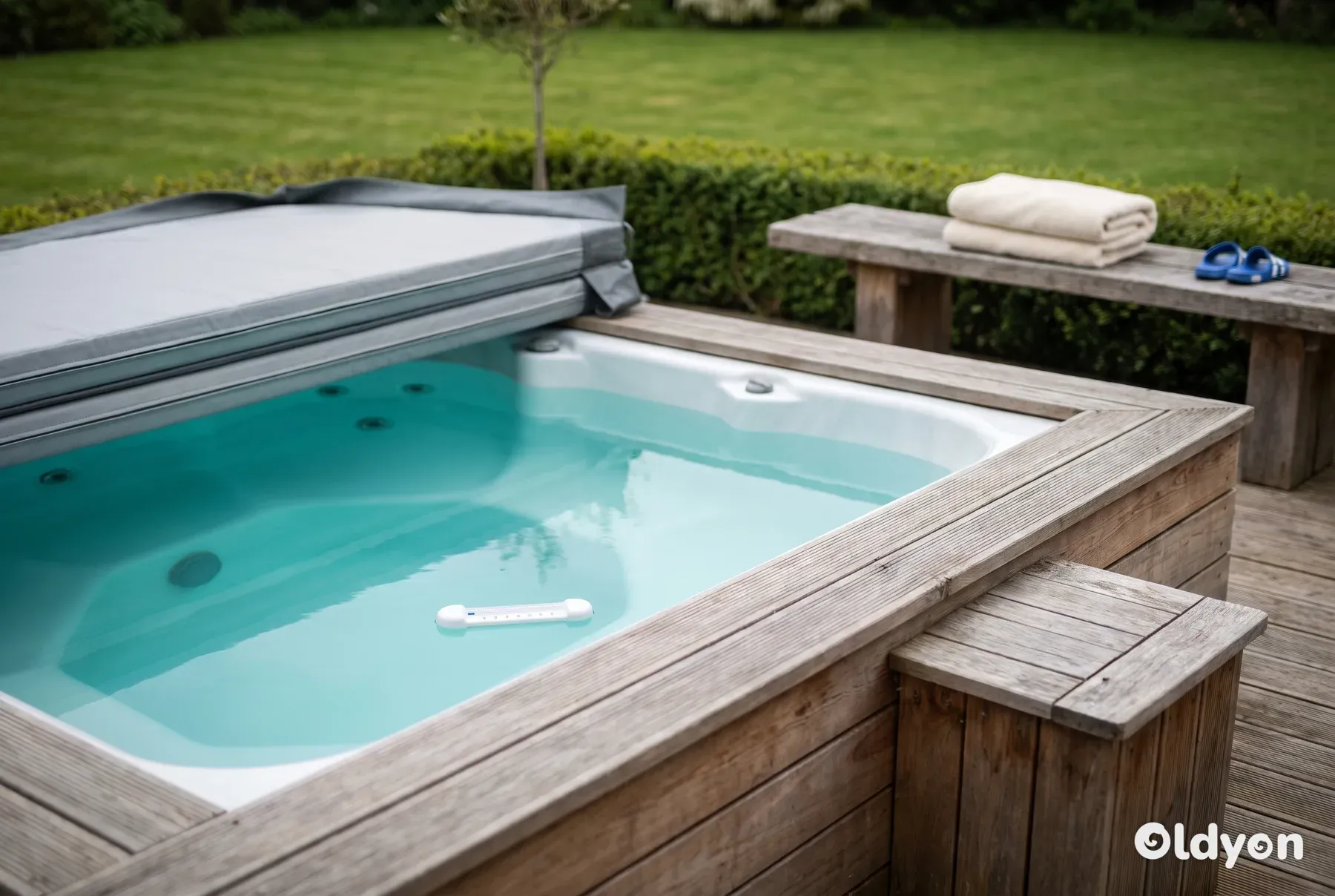
- Check the real water temperature with a reliable thermometer before every soak. Thermostats can drift, and sun-warmed water can rise above the setting. If it reads above 40°C, wait for it to cool.
- Drink about 240 ml (8 fl oz) of water before you get in, unless you have been told to limit fluids.
- Make sure someone else is at home and knows you are in the tub. Never soak alone. Tell them you have a pacemaker and exactly what to do: if you seem confused, lose consciousness or suddenly ask to get out, they should help you out straight away and call 999 (or 112 in Europe).
- Get in slowly and sit so that your chest stays partly above the water if your team has advised it.
- Sit so the jets point at your legs, back or shoulders rather than your chest. Avoid sustained high-pressure water on the implant site below the collarbone, especially after a recent implant. This is a precaution rather than a proven risk.
- Keep the first sessions short. Start with 5-10 minutes and only build up if you feel completely well.
- Cap every soak at about 10-15 minutes, even if you feel fine. Heat builds up gradually, and symptoms such as dizziness or tingling can appear suddenly rather than slowly.
- Set a waterproof timer, or ask your companion to keep track of the time, and get out when the limit is reached.
- Stand up slowly. Sit on the edge or the step for a minute with your feet in the water before climbing out.
- Hold the handrail or edge with both hands as you step out, and have a non-slip mat and a towel within reach.
- Cool down gradually, drink another 240 ml of water within 30 minutes of getting out and sit quietly for a few minutes before moving around.
If you take water tablets (diuretics), the hydration amounts above may not suit you. Agree your fluid targets with your cardiologist.
Avoid alcohol before and during a soak. Alcohol widens blood vessels and causes fluid loss, so it adds to both of the effects that make heat harder for the heart. Avoid soaking straight after a heavy meal or hard exercise too.
Session length matters as much as temperature. Our guide on how long you should stay in a hot tub explains how time and temperature work together.
Choosing a hot tub when you have a pacemaker
If you are buying a tub, a few features make careful soaking much easier. None of them replaces your team's advice, but they help you follow it.
- An accurate digital thermostat that displays the real water temperature, not just the setting.
- Built-in steps and sturdy grab bars for getting in and out slowly.
- Sides firm enough to grip when you stand up.
- Adjustable or individually switchable jets, so you can steer water away from your chest.
A reputable, qualified spa dealer can visit to assess your home setup and safety needs, such as access, steps, lighting and where the tub will sit. They can advise on suitable models and installation. Use their advice alongside your cardiology team's guidance on whether and how you should soak, not instead of it.
Which warning signs mean you should get out?
Get out slowly and carefully if you notice any of the following. Sit down somewhere cool, drink some water and ask someone to stay with you.
- Dizziness, light-headedness or feeling faint
- A pounding, racing or unusually irregular heartbeat
- An odd fluttering or 'spasm' in the chest
- Any chest tightness, heaviness or pressure: get out straight away and call 999 if it persists
- Breathlessness that is worse than usual
- Tingling in the hands, feet or face, which can signal reduced blood flow from widened vessels and low blood pressure
- Heavy legs, or struggling to take your own weight: get out and sit on the edge of the tub until it passes
- Nausea or feeling generally unwell
- Headache or confusion
- Unusual tiredness or weakness
- Pain, swelling or redness around the device site
Call 999 (or 112 anywhere in Europe) if you have chest pain, severe breathlessness, collapse, or symptoms that do not settle quickly after leaving the water. Do not drive yourself to hospital.
If symptoms have not settled within about five minutes of leaving the water, call emergency services. Do not get back in during that session, and speak to your cardiologist before your next soak.
If you feel faint, lie down with your legs raised if you can do so safely. The NHS explains what to do if you or someone else faints. Report any episode to your pacing clinic or GP, even if you recover quickly, because it may mean your device settings or medicines need reviewing.
Report warning symptoms to your doctor even when they pass quickly. A pattern across several sessions shows your team how your heart responds to heat.
Do not try to work out for yourself whether a symptom comes from the pacemaker or from the heat. That needs a clinical assessment, so describe what you felt and when, and let your team decide.
When might a hot tub not be right for you?
Some people will be told that hot tubs are not a good idea, at least for now. That is more likely with advanced heart failure, significant valve narrowing, unstable angina, a recent heart attack or regular fainting. The advice can change as your condition and treatment change, so ask again at future reviews.
If you have decompensated heart failure, meaning it is unstable or getting worse, hot tubs are generally ruled out until you are stable and your cardiologist clears you. A short, lukewarm bath at around 36-37°C (97-99°F) may be an alternative to discuss with them.
Do not assume a past all-clear lasts forever. A new medicine, a cardiac event or a device adjustment all mean you should ask your team again before returning to the tub.
If full soaks are off the table, you may still enjoy the tub in a gentler way. Some people turn the temperature down to around body temperature and use the tub for a short, relaxing sit rather than heat. Others sit on the edge with only their feet and lower legs in the water. Check either option with your team first.
Other people in your household can keep using the tub as normal. If you share it, agree a temperature that suits everyone, or lower it before your sessions. Remember that most tubs take a while to heat back up, so plan ahead.
The short version
- A hot tub with a pacemaker is possible for many people, but the decision depends on your heart condition, not just the device.
- For most modern pacemakers, heat is a far bigger concern than the tub's electrics.
- Heat widens blood vessels, lowers blood pressure and makes the heart work harder.
- Heart failure, valve disease, angina, untreated rhythm problems and some medicines make that strain more significant.
- Wait until your wound has fully healed and your team has said yes.
- Check the water is no hotter than 40°C (104°F), cap soaks at about 10-15 minutes, stand up slowly and never soak alone.
- Get out at the first sign of dizziness, palpitations, tingling or breathlessness, and call 999 for chest pain.
Frequently asked questions
Do I need to tell my pacing clinic that I use a hot tub?
Yes, it is worth mentioning at your next check. Your clinic reviews how your heart and device respond to everyday activities, and regular heat exposure is part of that picture. Tell them the usual water temperature, how long you stay in and whether you have felt dizzy or breathless afterwards. That information helps them give advice that fits your device settings and your condition.
Can I use a sauna or steam room with a pacemaker?
Saunas and steam rooms raise body temperature and widen blood vessels in a similar way to a hot tub, so the same questions apply. Your heart condition and medicines matter more than the device. Ask your cardiology team before using one, keep sessions short, stand up slowly and avoid going straight from intense heat into very cold water, which puts a sudden strain on the heart.
Can I use a hot tub at a hotel or spa abroad?
The same advice applies anywhere, but you have less control over a hot tub you do not own. You may not know the water temperature or how well it is maintained. Ask staff about the temperature, keep sessions short and make sure someone is with you. Carry your device identification card while travelling, and know the local emergency number, which is 112 across Europe.
Is it safe to keep my phone on the side of the hot tub?
Keeping a phone at least 15 cm (6 inches) from your pacemaker is common advice, so leaving it on the side of the tub, away from your chest, follows that guidance. Do not hold it against your chest or rest it on your shoulder above the device. A phone nearby is also useful for calling for help, as long as it is kept safely away from the water.
Will the hot tub damage my pacemaker if I sit in it for too long?
Pacemakers are sealed inside the body, and the main concern with long soaks is the effect of heat on your heart and blood pressure. For any question about how your specific device copes with heat or water, check the manufacturer's patient guide or ask your pacing clinic. Whatever the answer, long soaks increase the risk of dizziness and dehydration, so keep sessions short.
Should someone stay with me while I use the hot tub?
It is a good habit for anyone with a heart condition. You do not need someone sitting beside you, but another adult should be at home, know you are in the tub and check on you. The greatest risk is feeling faint when you stand up to get out. Having help nearby means a fall or a dizzy spell can be dealt with quickly.
Filed under