Hot tub not heating up? What to check first
Hot tub not heating up? Check settings, 13 amp jet limits, filter and flow, thermostat, heater and RCD in order, plus why inflatables struggle in the cold.
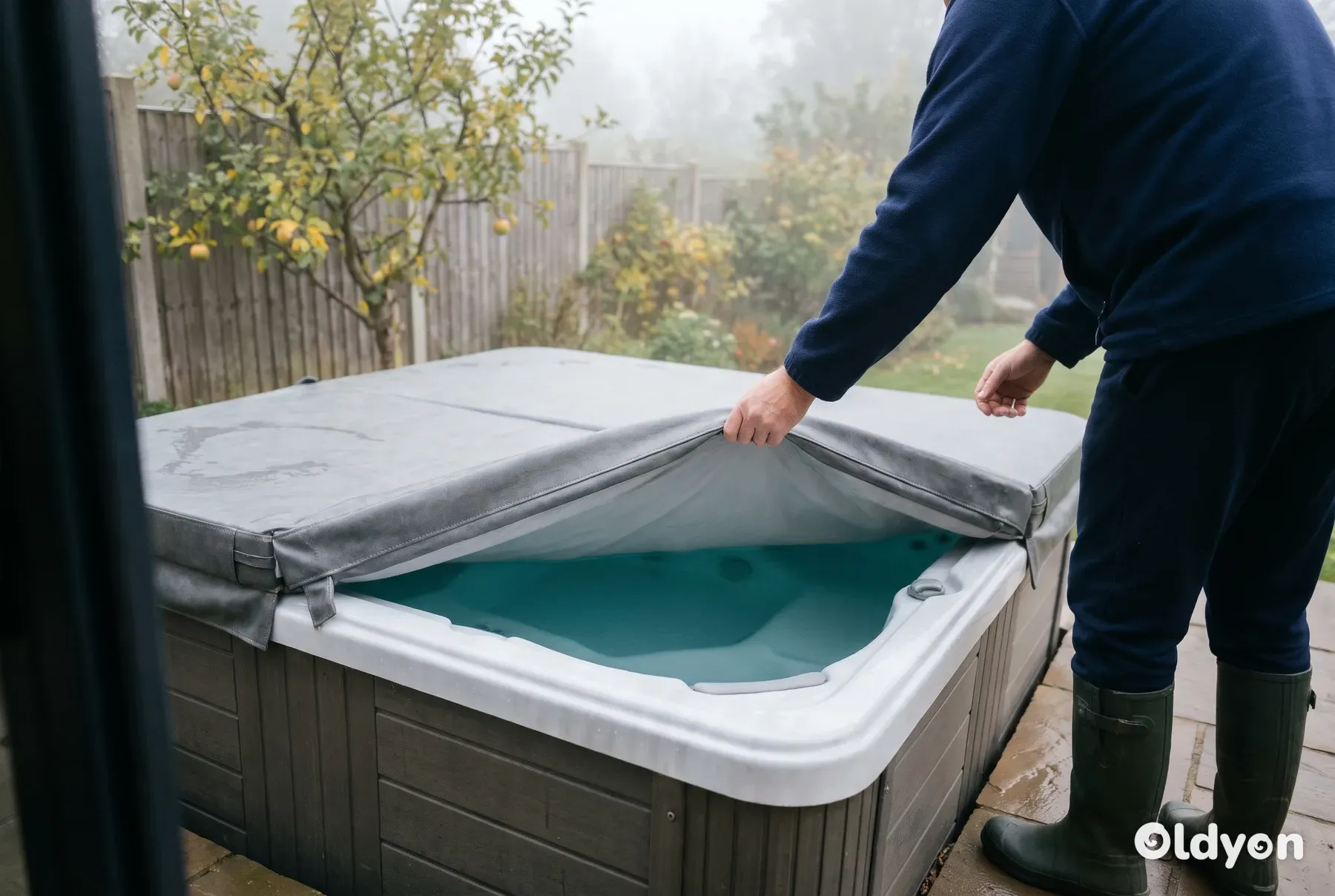
If your hot tub is not heating up, start with the simple things before you suspect a broken part. Check the set temperature and heating mode, make sure the jets are not switching the heater off, then look at the filter, water level and flow. Only after that should you test the thermostat, heater element and RCD.
Most heating complaints turn out to be settings, a dirty filter or an air lock, and you can fix those yourself in under an hour. The checks below follow the order a technician would use, from free and quick to the jobs that need a qualified person.
Before you open any cabinet panel, touch wiring or remove the heater cover, switch the hot tub off at its isolator switch and make sure nobody can turn it back on. Mains electricity and water together can kill. If you are not confident, stop and call a technician or a registered electrician.
Is the hot tub actually set to heat?
It sounds obvious, but a wrong setting is the most common reason for cold water. Press the temperature button once to see the set point, not the current water temperature. On many control panels the first press shows the actual temperature and the next press lets you change the target, so it is easy to misread.
Set the target a couple of degrees above the current reading. If you hear the heater relay click and the heat indicator lights up, the system is asking for heat. The recommended maximum for a hot tub is 40°C (104°F), and most owners are comfortable between 37°C and 39°C.
Do not set the temperature below the current water temperature. The heater only starts when the set point is above the actual reading, so if the target is at or under the water temperature, the heater stays off and there is no error to warn you.
Check the hot tub's own circuit breaker
If the control panel is blank or the tub seems dead, go to your consumer unit. Most hard-wired hot tubs have their own circuit breaker (MCB), usually labelled Spa or Hot Tub. A tripped breaker sits in the off or middle position.
If it has tripped, switch it fully off, wait about 10 seconds, then switch it back on. Then go to the tub and look at the control panel for any error codes, and note them down. If the breaker or the RCD trips again, read the RCD section further down before you try anything else.
Economy, rest and sleep modes
Many hot tubs have an energy-saving mode. Depending on the maker it may be called economy, rest, sleep or away mode. In these modes the tub may only heat during filter cycles, or it may hold the water several degrees below the set point to save electricity.
In economy mode, many tubs only heat during their scheduled filter cycles. These are often set to run just twice a day for one to two hours each, so outside those windows the heater will not run, even though the tub looks normal and the panel shows no fault.
Sleep mode works differently on different tubs. On many models it only heats enough to stop the water freezing, so the tub will never reach your set temperature while sleep mode is active.
If your water only warms up during certain hours, check which mode is active and when the filter cycles run. Switch to the standard or ready mode while you diagnose the problem. Names and behaviour differ between control systems, so your manual is the best guide here.
To see which mode is active, press the Mode or Temp button on the panel. On most panels you then cycle through the options with the same button until Standard, usually shown as STD, appears on the display. If your panel has no Mode button, the manual will show the button sequence for your control system.
- Confirm the set temperature, not just the displayed water temperature.
- Make sure the set temperature is above the current water temperature.
- Check for economy, rest, sleep or holiday mode.
- Check the filter cycle times if heating only happens at certain hours.
- Look for a child lock or panel lock that stops your changes being saved.
- On inflatables, make sure the heater button is on as well as the filter pump.
How to do a full power reset
A reset clears temporary faults and forces the control system to restart its checks. It is worth doing once, but if the same problem returns, a reset is only hiding the cause.
A full power reset can also clear a situation where the heater icon is lit but the water is not getting warmer. This can happen when the control board has stalled after a power cut or a brief fault.
- Switch the hot tub off at the isolator or unplug it, if it is a plug-in model.
- Wait at least 60 seconds so the control board can fully discharge. Some manufacturers suggest a few minutes, so check your manual.
- Check the water level is above the minimum line, usually around the middle of the skimmer opening.
- Switch the power back on and let the tub run its start-up or priming routine without pressing any buttons. This self-check usually takes about 30 to 90 seconds.
- Set your target temperature again and put the cover on.
- Allow 20 to 30 minutes, then check whether the heat indicator is on and the heater has started.
- Check the temperature again after an hour to see if it is rising.
To reset an inflatable hot tub, unplug it from the wall socket, wait 60 seconds and plug it back in. Then switch the filter pump and heater back on at the control panel.
On many inflatables, the heater icon blinks during the warm-up cycle. This is normal and is not a fault. Your manual will explain what each icon and light pattern means for your model.
Are the jets switching the heater off?
This catches out a lot of owners with plug-and-play tubs. A standard UK 13 amp socket can supply roughly 3 kW at 230 volts. A typical hot tub heater uses close to that on its own, so there is no spare capacity to run the jet pump on high speed at the same time.
To protect the supply, most 13 amp tubs have a heater interlock. When you turn the jets on high, the control system turns the heater off, and it only comes back on when the jets drop to low speed or stop. If you sit in the tub with the jets running for an hour, the water will cool, especially in winter.
Inflatable hot tubs work the same way. On most models the heater and the bubble blower cannot run together, so using the bubbles pauses heating.
Many hard-shell tubs can also be wired on a dedicated circuit, often 32 amps, which lets the heater and jets run together. Converting a 13 amp tub usually means a new circuit and a setting change in the control pack, and not every tub supports it. That is a job for a registered electrician, and the manufacturer's manual will say whether your model can be converted.
For a quick test, turn the jets off, set the temperature a few degrees higher, put the cover on and leave it for a couple of hours. If the water warms up normally, the heater works and the interlock was the reason. Our guide on how long a hot tub takes to heat up explains what a normal rate looks like.
Could poor water flow be stopping the heater?
A hot tub heater must have water moving past it. Without flow, the element would overheat in seconds, so every control system uses a flow switch, a pressure switch or temperature sensors to check that water is moving. If flow is weak, the heater stays off, often without any obvious warning.
Check the water level and the filter
Low water lets the skimmer suck air, which reduces flow and can trigger a fault. Top up to the level marked in your manual, usually about halfway up the skimmer opening.
After topping up, wait about 5 minutes and check the control panel again. If the low water was the cause, the error should clear and heating should resume.
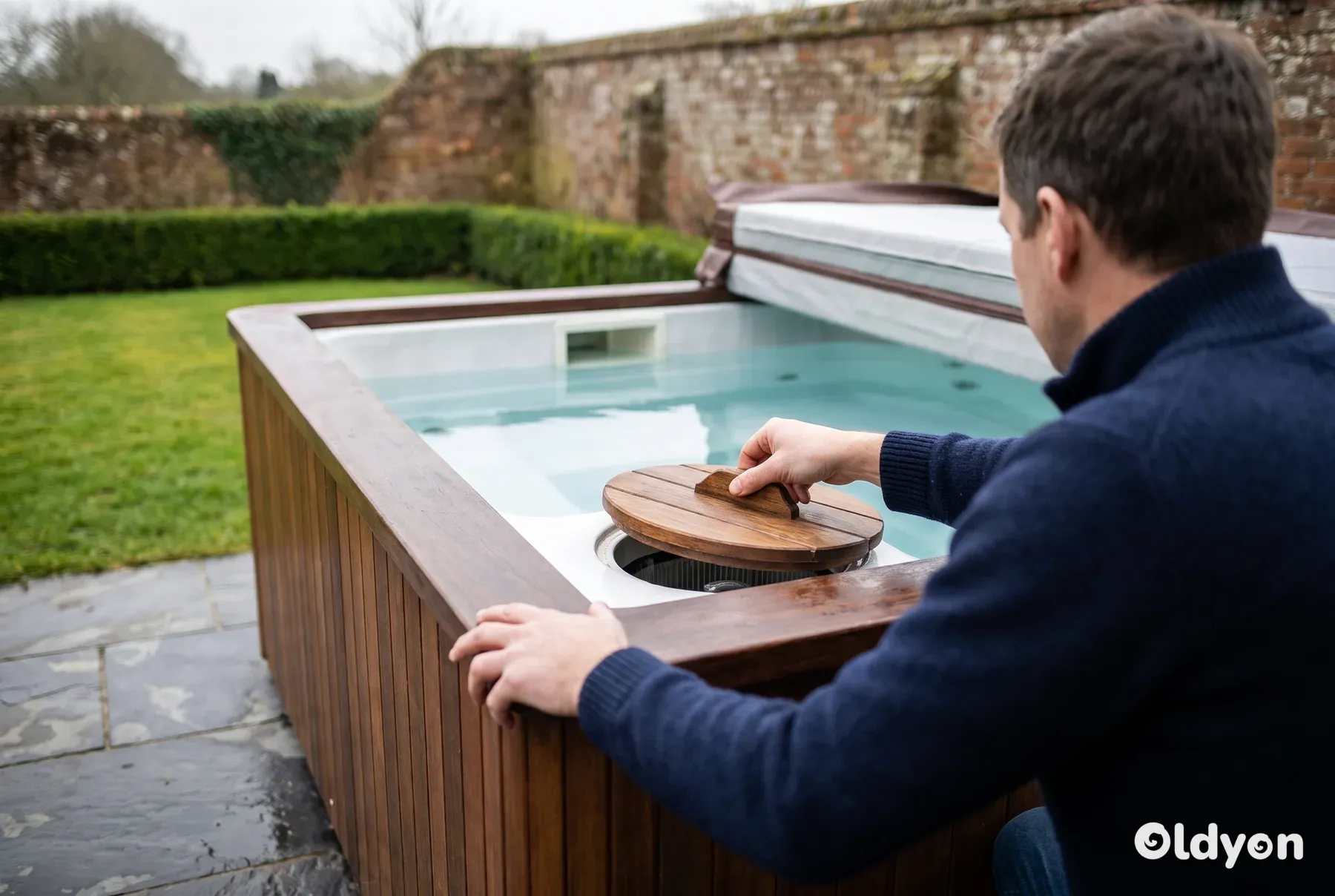
A dirty filter is the next suspect. Take it out and run the tub briefly without it. If the heater starts working, the filter was restricting flow. Rinse it with a hose from the top down, between each pleat, and soak it in a filter cleaner every few weeks. Most cartridges need replacing about once a year, though this depends on how much the tub is used.
To take the filter out and put it back:
- Turn the jets off.
- Find the filter housing. On many tubs it is a screw-top canister near the skimmer, but some designs hold the cartridge behind the skimmer basket instead.
- Unscrew the cap of the housing and lift the cartridge straight out.
- Rinse or replace the cartridge, then refit it and screw the cap back on firmly.
- Switch the jets back on if needed and allow 20 to 30 minutes for the heater to start.
It helps to keep a spare filter cartridge to hand, especially if yours is more than 12 months old. You can swap it in straight away during troubleshooting, then clean the old one without leaving the tub unfiltered.
When you rinse, hold the hose at an angle of about 45 degrees to the pleats. This flushes debris out of the folds rather than pushing it deeper into the material. For a deeper clean, soak the cartridge in diluted filter cleaner for about an hour, following the product label, then rinse it a second time.
Some filters are past saving. Replace the cartridge straight away, rather than cleaning it again, if:
- The pleats are torn, split or flattened.
- The material is permanently discoloured brown or grey and does not come clean after soaking.
- The cartridge is more than about 12 months old.
Do not run the tub without a filter for long. Debris can get into the pump and heater, and on some tubs it can damage the impeller.
Why does the tub stall at about 34°C (94°F)?
A tub that heats part of the way and then stops climbing at about 34°C (94°F) is a classic sign of a clogged filter. As the filter restricts flow, the flow safety device cuts the heater, so the water never reaches the set point. Economy mode is the second most likely cause, because it often holds the water below your target.
- Clean the filter, or replace it if it is worn out.
- Switch the tub from economy or rest mode to standard mode.
- Put the cover on and allow 30 to 60 minutes for the temperature to start climbing again.
If the temperature still stops at the same point, a partly tripped high limit can cause the same pattern. The thermostat section below explains how to check it.
Check the valves and jets
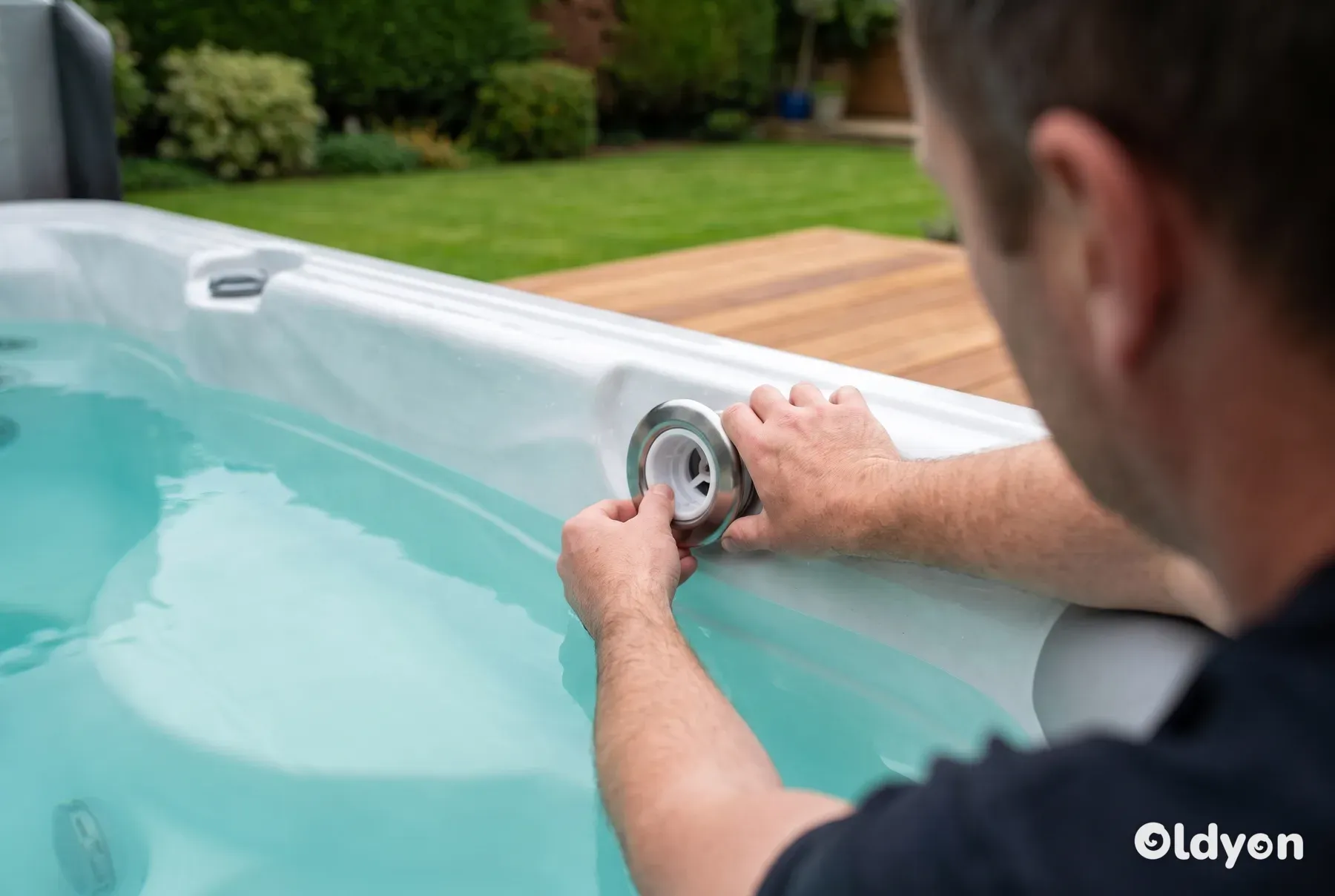
Some hot tubs have slice valves or gate valves on the pipework near the pump. If one has been partly closed, perhaps after a repair or when the tub was drained, flow drops. Open every valve fully. Also check that most of the jets are open, because closing too many can reduce flow through the heater on some designs.
On a typical flow or slice valve, the valve is fully open when the handle lies parallel to the pipe. If the handle sits across the pipe or at an angle, the valve is closed or partly closed.
How to clear an air lock
Air locks often happen after you drain and refill the tub. A bubble of air sits in the pump or heater, the pump hums but moves little water, and the heater stays off. You may also see weak or surging jets.
- Switch the hot tub off at the isolator.
- Open the cabinet panel nearest the pump.
- Slowly loosen the union nut on the pump outlet, or the bleed screw on top of the heater if your tub has one, until air hisses out and water starts to trickle.
- Tighten the nut or screw again by hand once water flows steadily.
- Switch the power back on and run the jets in short bursts of about 10 to 15 seconds.
- If the jets are still weak, briefly open and close each jet valve one at a time, so that trapped air can escape through the pipework.
- Repeat if the jets are still weak. Wipe up any water inside the cabinet before you close it.
Filling the tub through the filter housing, rather than straight into the footwell, helps push air out of the pipes and makes air locks less likely next time.
Look for slow leaks
A slow leak can lower the water below the level the heater needs. This often causes heating that works some days and fails on others, because the level drops a little between top-ups.
With the power off, look under and around the cabinet for puddles, damp patches or a white mineral crust left by dried water. Open the cabinet and check the pipe unions near the pump and heater for drips.
A small leak at a union nut can sometimes be stopped by tightening it by hand. Larger leaks, or leaks at glued or fixed joints, need a technician.
Flow error codes
When flow is the problem, the panel will often show a code. Common examples include FLO, FL, LF, HFL or dr, but the letters vary between control system makers and even between models. If a code keeps coming back after you have cleaned the filter and bled the air, the flow or pressure switch itself may be faulty. Look the code up in your manual or on the control system maker's website.
On some control systems, a pressure switch fault shows as Pr or Prr, and an FL1 code can mean the flow switch is reading open, so the board receives no flow signal. Before you suspect the switch itself, check the filter and make sure the pump is primed and free of air.
To clear a flow code that keeps returning, work through this sequence:
- Clean the filter, or replace it if it is worn.
- Bleed any air from the pump and heater.
- Confirm the water level is above the minimum line.
- Do a full power reset.
- Only if the code still returns, suspect the flow switch or pressure switch itself.
On some control systems, a dr code means dry heater: no water is detected in the heater. Refill the tub to the correct level and clear any air lock before you reset.
An HH code on some systems means the sensor is reading water above a safe temperature. Switch the tub off, let the water cool and, with the power still off, check that the sensor wires are firmly plugged in.
An OH overheat code is often cured by lowering the set temperature by a few degrees and cleaning the filter to restore flow. Weak flow lets the water around the heater get hotter than the rest of the tub, which triggers the overheat protection.
A flow or pressure switch can fail in two ways. If it fails open, it never tells the board that water is flowing, so the heater never turns on and you get a persistent flow error even with a clean filter. If it fails closed, the heater may never turn off, which is dangerous. A technician can test the switch for continuity while the pump is running.
Short heating cycles can also be caused by the pump switching on and off. If that sounds familiar, read why your hot tub pump keeps turning on and off.
Is the thermostat or temperature sensor at fault?
Most modern hard-shell tubs use electronic temperature sensors rather than a traditional thermostat. The control board reads the sensor and decides when to heat. If the sensor reads too high, the board thinks the water is already warm and never turns the heater on.
To check, run the jets for a few minutes so the water is well mixed. Then compare the panel reading with a reliable floating thermometer. A difference of a degree or so is normal. A difference of several degrees points to a sensor problem.
Sensor error codes
Codes such as SnA and SnB, or Err1 and Err2 on some systems, usually mean a temperature sensor has failed or become disconnected. The heater will not run without a valid reading, so the water stays cold.
Balboa and Gecko are two of the most common control systems on hard-shell tubs, and each has its own set of codes. For example, SnA and SnB are Balboa sensor codes, while Err1 and Err2 appear on some Gecko systems. Find out which system your tub has, usually from a label on the control pack or the topside panel, before you look up any code.
Before you buy a new sensor, switch off at the isolator and check the sensor wire connections in the equipment bay. A plug that has worked loose is a common cause and costs nothing to fix.
If you refill with very cold water in winter, the panel may show a dash or a very low reading. This means the sensors are reading below their minimum range. Leave the tub running until the water reaches roughly 10°C (50°F) before you expect normal heating and a normal display.
The high limit has tripped
Every heater has a high limit, a safety device that cuts the heater if the water near it gets too hot. On some tubs it is a small red reset button on the heater housing. On others it is a sensor, and the panel shows a code such as OH, OHH or HL.
A high limit trip is usually a symptom, not the cause. Poor flow, an air lock or a faulty sensor are the usual reasons. Sort out the flow first, then reset the high limit as your manual describes. If it trips again straight away, the sensor or board needs checking by a technician.
A typical high limit trips at around 44°C (112°F). On many tubs it works as a one-time protection that must be reset or replaced after it trips. A more serious overheat lockout, shown as OHH on some systems, can occur at about 48°C (118°F). In that case, let the tub cool fully before you reset it. Trip points vary between makers, so check your manual.
If your heater has a small high-limit reset button, switch off at the isolator first. Then press the button firmly with the tip of a pen. If it trips again, check for a stuck thermostat or blocked flow before you replace the switch.
Sensors are plugged into the control board and are usually cheap and easy to swap, but always fit the exact part for your control system. A wrong sensor can give false readings.
How do you know if the heater element has failed?
If the settings are right, the flow is good and the panel shows that it is calling for heat, but the water still does not warm, the element may have burnt out. Elements fail over time, and poor water balance speeds this up. Scale from hard water and corrosion from low pH both attack the element.
Signs of a failed element include:
- The heat indicator is on but the water temperature does not rise at all over several hours.
- The RCD trips as soon as the heater switches on.
- Brown or black marks, melted plastic or a burning smell around the heater housing or terminals.
- A heater error code that returns straight after a reset.
Tools you may need
The first checks in this guide, such as settings, heating mode and the filter, need no tools at all. For the deeper checks, it helps to have:
- A garden hose for rinsing the filter.
- A multimeter, which is inexpensive, for testing the element.
- A screwdriver to remove the equipment bay access panel.
- A torch for looking inside the cabinet.
- A spare filter cartridge.
Where to find the heater
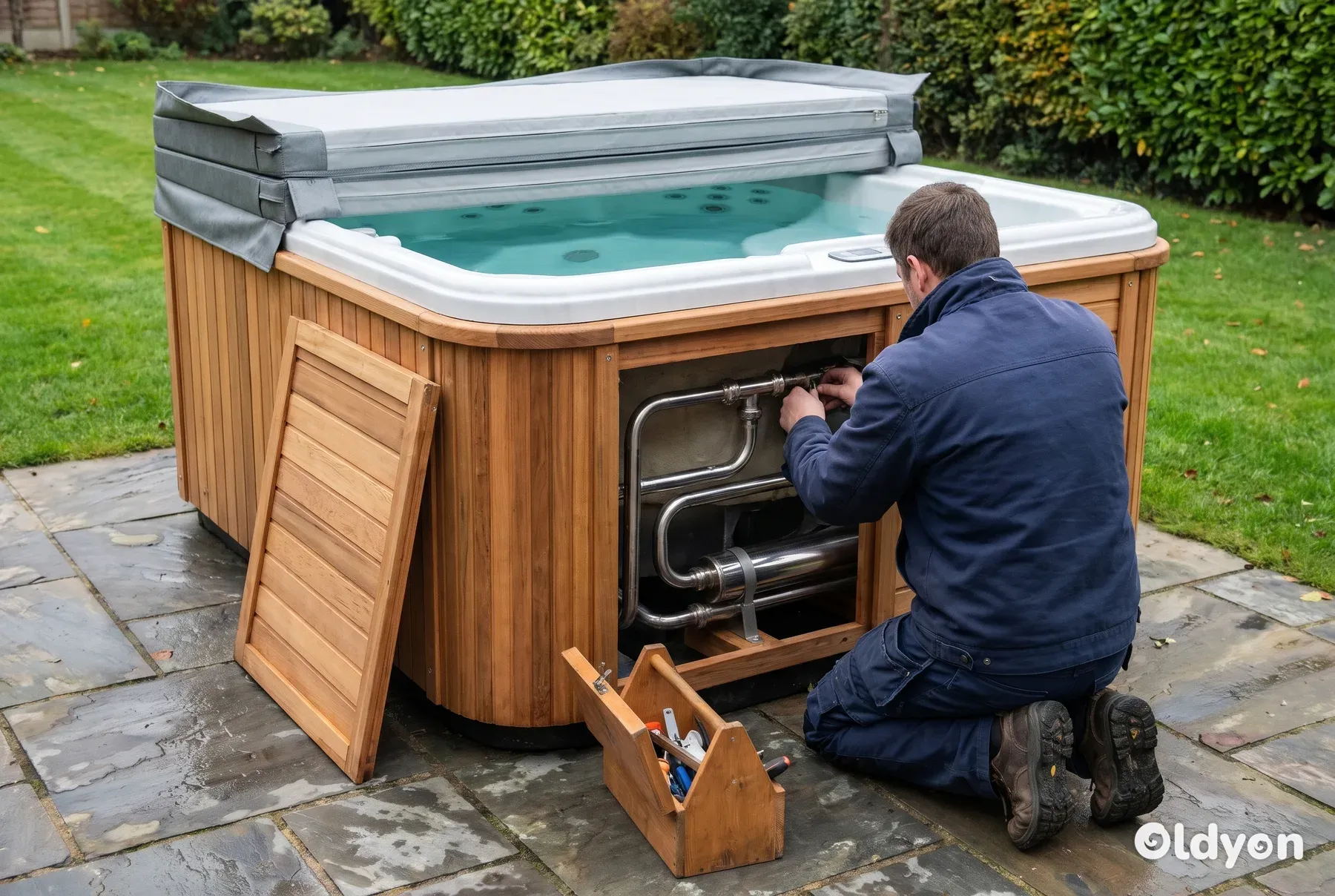
The heater element sits inside a metal cylindrical housing in the equipment bay, usually close to the pump. The housing is often roughly 10 to 15 cm across, though sizes vary between designs, with two wires fixed to terminals at one end. Knowing what it looks like helps you find it quickly when you inspect it.
Do a visual inspection first
With the power off at the isolator, use a torch to look carefully inside the cabinet and at your consumer unit. Look for:
- Black char marks, melted insulation or corroded terminals on the heater.
- Frayed or discoloured wiring anywhere in the equipment bay.
- Burnt components or a burning smell on the control board.
- Discolouration or scorch marks at the consumer unit.
If you find any of these, stop. Leave the power off and call a professional before the tub is used again.
A technician will test the element with a multimeter after isolating the power and disconnecting it. They measure resistance across the terminals and also test between each terminal and the metal sheath for a leak to earth. As a guide, a 3 kW element designed for 230 volts should read close to 18 ohms. An open circuit or a reading near zero means the element has failed.
If the element tests as shorted, or there is any reading between a terminal and the metal housing other than an open circuit, the heater is an active electrical hazard. Stop there, leave the power off and call a professional.
Before anyone disconnects anything on the heater, photograph the wiring from a couple of angles. This makes it much easier to reconnect every wire to the correct terminal.
This test involves working on mains equipment inside the cabinet. If you are not experienced with electrical testing, leave it to a professional. For more on how elements, heat pumps and inflatable heaters differ, see our guide to hot tub heaters explained.
Do not replace a heater element yourself unless you are experienced with electrical work. Incorrect fitting risks electric shock and fire, and a DIY repair can void your warranty.
Keeping your water balanced protects the new element. Aim for pH 7.2-7.6, total alkalinity 80-120 ppm and calcium hardness 150-250 ppm.
Hot tub not heating up and the RCD has tripped?
If the hot tub has no power at all, check the consumer unit and the RCD near the tub. A tripped RCD means electricity has found a path to earth that it should not take. With hot tubs, the heater element is one of the most common causes, because a cracked sheath lets water reach the live parts.
You can reset the RCD once. If it trips again straight away, or as soon as the heater starts, do not keep resetting it. The RCD is doing its job of protecting you. Switch off, leave it off and arrange for a professional to test the tub.
Never bypass an RCD, and never replace it with a standard socket or breaker. It is a life-safety device that cuts the power before an electric shock can kill. Never work on the tub or touch electrical panels in wet conditions or with wet hands.
In the UK, hot tub wiring must meet BS 7671, the national wiring regulations, which call for 30 mA RCD protection. Installing a new circuit for a hot tub in a garden is notifiable work under Part P of the Building Regulations in England and Wales, so it should be done by a registered electrician who can self-certify the work. You can read more in the GOV.UK guidance on Approved Document P. Scotland, Northern Ireland and other European countries have their own rules, so check the requirements where you live.
Other causes include damp in a plug or connector, a failing pump motor and a damaged supply cable. Our full guide on why a hot tub keeps tripping the RCD covers how to narrow it down. The charity Electrical Safety First also has practical advice on outdoor electrics and finding a registered electrician.
Why does an inflatable hot tub struggle to heat in cold weather?
Inflatable hot tubs have smaller heaters than most hard-shell tubs, and their thin walls hold far less heat. In mild weather they warm slowly but steadily. In cold, windy weather, the heat lost through the walls, floor and cover can come close to what the heater puts in, so the water barely rises or slowly falls.
Some simple physics shows the limit. Even with no heat loss at all, a 2 kW heater can only raise 800 litres (about 210 US gallons) of water by roughly 2°C per hour. Real-world heat loss means the actual rate is lower, and much lower when the air is near freezing. Manufacturers usually quote heating rates for mild conditions, so treat them as best-case figures.
Many inflatable makers also set a minimum air temperature for use, and some advise against using the tub in freezing weather at all. Check your manual before using an inflatable through a UK or European winter.
To help an inflatable hold its heat:
- Keep the cover on and fastened whenever you are not in the tub.
- Use an insulated ground mat under the tub, because a cold patio draws heat out quickly.
- Place it out of the wind, or use a windbreak or gazebo.
- Add a thermal blanket on the water surface under the cover.
- Avoid using the bubbles while heating, as they pause the heater and cool the water.
- Keep the heater running rather than letting the water go cold, as reheating from cold takes much longer.
Many of these tips help hard-shell tubs too. Our guide on how to heat a hot tub faster has more ways to reduce heat loss.
When should you call a technician?
You can handle settings, filters, water level, valves and air locks yourself. Call a hot tub technician or a registered electrician if any of the following apply:
- The RCD trips more than once.
- You see scorch marks, melted plastic or smell burning.
- An error code keeps returning after you have cleaned the filter and cleared air.
- The heater or a sensor needs testing or replacing and you are not trained in electrical work.
- Water is leaking inside the cabinet near the electrics.
- You want to convert a 13 amp tub to a dedicated circuit.
- You have worked through every check in this guide and the tub still will not heat. The fault is then likely to be the control board or a part that needs specialist tools.
If you own an inflatable hot tub, do not open the heater unit or any other electrical components yourself. These units are sealed for safety, so contact the manufacturer or a qualified technician instead.
A diagnostic visit costs far less than the damage from an electrical fire or a control board wrecked by a bad DIY repair. As a rough guide to relative cost, a high limit switch is usually the cheapest part to replace, a heater element costs more, and a control board is the most expensive.
Before the visit, write down the make and model, the brand of the control system, any error codes, what you have already tried and when the problem started. The control system brand is usually shown on the control pack or the topside panel. This helps the technician bring the right parts and can save a second visit.
Useful questions to ask when you book:
- Is the repair covered by my warranty?
- Can I watch while you do the work?
- Do you carry parts for my control system, such as Balboa or Gecko, on the van?
Most single-component repairs, such as a new sensor, high limit or heater element, are finished in one visit of about one to two hours.
Check whether the fault is covered by warranty before you book a repair. New tubs often carry 2 to 5 years of cover on parts, but terms vary, so read yours first. Where possible, choose a technician from the manufacturer's authorised service network.
Is it safe to use a tub that is not heating? Hot tub hygiene and skin health
A tub that is not heating is usually safe to use if the electrics are sound and the water is properly sanitised. The bigger risk while you troubleshoot is letting water care slip, because a tub that is switched off or not circulating can lose sanitiser quickly.
What is hot tub folliculitis?
Hot tub folliculitis, often called hot tub rash, is an itchy, red, bumpy rash caused by Pseudomonas bacteria. These bacteria thrive when sanitiser levels are too low. The rash usually appears 12 to 48 hours after soaking, often in areas covered by swimwear.
It typically clears on its own in 7 to 10 days. Do not use the tub until the rash has cleared and the water has been corrected. People with a weakened immune system should see a GP, as should anyone whose rash spreads, becomes painful or comes with a fever. The CDC's healthy swimming pages have more on hot tub rash and other water-related illnesses.
Using the tub while you have an active hot tub rash can make the infection worse and can pass the bacteria to other bathers. Everyone with symptoms should stay out of the tub until their rash has fully cleared.
Once the rash has cleared, shock the water with an oxidiser, then retest the chlorine or bromine level and the pH before anyone gets back in. After that, shower straight after every soak to rinse bacteria off your skin.
How to avoid skin infections
- Test the water before every soak. Aim for free chlorine 3-5 ppm, or bromine 3-5 ppm. Some manufacturers recommend 4-6 ppm for bromine, so check your manual.
- Keep pH within 7.2-7.6. Many owners aim for 7.4-7.6, where sanitiser works well and skin and eyes feel comfortable.
- Shower straight after using the tub.
- Wash your swimwear after each use.
- Shock the water weekly with an oxidiser, or as often as your manual suggests.
Who should take extra care with temperature?
Pregnant women, people with heart or circulatory conditions and young children are more affected by hot water. Keep the water at or below 40°C, keep sessions short and consider medical advice before using the tub. The NHS advises pregnant women to avoid overheating, so speak to your midwife or GP before using a hot tub while pregnant.
Whoever is using the tub, get out straight away if you feel dizzy, faint, sick or unwell.
For most healthy adults, a comfortable relaxation range is about 37-39°C (99-102°F), with sessions of 15 to 20 minutes. Some people find that an evening soak at this temperature helps them relax and sleep better.
Water hotter than about 40°C (104°F) tends to stimulate the body rather than relax it. If your aim is to unwind, the 37-39°C range is the better choice.
Can a warm soak help with stress and sleep?
Soaking in warm water has been linked to lower levels of cortisol, the main stress hormone, and to improvements in some markers of heart and circulation health. Three effects work together: warm water widens the blood vessels, which lowers blood pressure; buoyancy takes weight off the joints; and heat encourages the body's calming rest and digest response, run by the parasympathetic nervous system.
The same drop in blood pressure is why some people feel light-headed when they stand up after a soak. Get out slowly, and if you take blood pressure medicine or have a heart condition, ask your GP or pharmacist whether hot tub use is suitable for you.
An evening soak can also help you fall asleep. After you get out, your core body temperature starts to fall, and a falling core temperature is a well-documented signal that helps the body fall asleep. This works best when the water is properly heated, which is one more reason to get a cold tub fixed.
Summary: what to check, in order
Work from simple to complex. First confirm the set temperature and heating mode. Next make sure the jets are not running on high, because 13 amp tubs and most inflatables cannot heat and run jets or bubbles together.
Then check the water level, clean the filter, open the valves and clear any air lock. After that, compare the panel temperature with a thermometer and look for a tripped high limit. Leave heater element testing and any RCD fault to a qualified person, and accept that inflatables have real limits in cold weather.
Quick reference: symptoms and first checks
Symptom | Likely cause | First check |
|---|---|---|
Cools while you use the jets | Heater interlock on a 13 amp tub | Turn jets to low or off |
Only warms at certain hours | Economy mode or filter cycle settings | Change to standard mode |
Stops rising at about 34°C | Clogged filter or economy mode | Clean filter, use standard mode |
Pump hums, jets weak, no heat | Air lock or blocked filter | Bleed air, clean filter |
Flow error code on panel | Low water, closed valve, dirty filter | Top up and open valves |
Panel reading higher than real water | Faulty temperature sensor | Compare with a thermometer |
Heat indicator on, no temperature rise | Failed heater element | Call a technician |
No power, RCD tripped | Earth leak, often the heater | Leave off, call an electrician |
Frequently asked questions
Why does my hot tub heat up during the day but cool down overnight?
The usual reasons are an economy or sleep mode that lowers the temperature at night, filter cycles that only heat at certain times, or heat escaping through a worn cover. Check the mode and cycle times first. Then look at the cover: if it is heavy, waterlogged or does not seal at the edges, it lets a lot of heat out, especially on cold, windy nights.
My panel shows the right temperature but the water feels cold. Why?
The temperature sensor may be reading high, or it may be sitting in a warm spot near the heater while the rest of the water is cooler. Run the jets for a few minutes to mix the water, then check with a reliable floating thermometer. If there is a gap of several degrees, the sensor probably needs replacing with the correct part for your control system.
Is it safe to use a hot tub that is not heating?
Cool water itself is not a hygiene risk, as long as your sanitiser levels are right, for example free chlorine or bromine at 3-5 ppm. Do not use the tub if the RCD has tripped, if you smell burning or if there is water near the electrics. In those cases, switch it off at the isolator and get it checked before anyone uses it.
Should I drain my hot tub if the heater fails in winter?
If the pump still works, keep the water circulating and the cover on, because moving water is much less likely to freeze. If the tub will have no power for days during freezing weather, frost can crack pipes and fittings. In that case, drain it fully and follow the manufacturer's winterising steps, which often include blowing water out of the pipework.
How long should I wait before deciding the heater is not working?
Turn the jets off, put the cover on and set the temperature a few degrees above the current reading. After two to three hours, a working hard-shell tub should show a clear rise in mild weather. If the heat indicator has been on the whole time and the temperature has not moved at all, move on to the flow, sensor and heater checks.
Can a hot tub heater fail because of poor water chemistry?
Yes. Hard water leaves scale on the element, which makes it run hotter and can cause it to fail early. Low pH and very low alkalinity make the water corrosive, which can pit the element sheath until water reaches the live parts. Keeping pH at 7.2-7.6 and calcium hardness at 150-250 ppm helps the element last longer.
Filed under