Why your hot tub pump keeps turning on and off
Hot tub pump keeps turning on and off? Learn which cycles are normal, then check water level, filter, flow switch, airlocks and overheating step by step.
If your hot tub pump keeps turning on and off, the first job is to work out whether it is following its normal filtration, heating and frost protection cycles or genuinely short cycling. Normal cycles last minutes or hours. Short cycling means the pump starts and stops every few seconds or minutes, which points to a fault.
Most short cycling comes down to a small number of causes you can check yourself: low water, a dirty filter, trapped air, a flow or pressure switch that is not seeing enough flow, or a motor that is overheating. Work through them in order, starting with the easiest.
Is it normal for a hot tub pump to turn on and off?
Yes, up to a point. A modern hot tub is run by a small computer in the control box, and it switches the pumps on and off throughout the day without you touching anything. Most of this activity is normal and is exactly what the tub is designed to do.
The difference between normal and faulty is mostly about timing. Normal cycles run for many minutes or hours and follow a pattern. A fault usually shows up as the pump starting and stopping again and again, often within seconds, and often with an error message on the topside panel.
Filtration cycles
Most tubs filter the water in programmed cycles, often once or twice a day, using either a dedicated circulation pump or the low speed of a two-speed jet pump. The length and start time of each cycle are set in the control panel menu. If the pump starts at the same times each day, this is almost certainly a filter cycle.
Heating
When the water drops below your set temperature, the controller switches on the heater. The heater needs water flowing through it, so the circulation pump or the low-speed jet pump runs too, until the water is back up to temperature. On a cold day with a poorly fitting cover, this can mean long spells of running.
Frost protection
Many control systems start the pumps automatically when the water or the air inside the cabinet gets cold, to stop the pipes freezing. This can happen in the middle of a winter night even when nobody has used the tub. The temperature that triggers it varies by manufacturer, so check your manual.
Temperature checks
Some controllers cannot read the water temperature accurately while the water is still, so they run the pump for a minute or two every so often to take a fresh reading. The interval depends on the system and the mode you have selected. Short, regular runs like this, with no error on the display, are normal.
If your tub starts at unexpected times rather than cycling rapidly, our guide on why a hot tub turns on by itself covers the settings that usually cause it.
What does short cycling look like?
Short cycling is when the pump starts, runs briefly, stops, then starts again, over and over. Each run may last only a few seconds, or a few minutes if the motor is overheating. It is a sign that something is stopping the pump or the controller from running normally.
- The pump runs for a few seconds, stops, and restarts on a loop.
- An error such as FLO, FL, LF, dr or dry appears on the topside panel (the codes vary by control system).
- The heater will not stay on, so the water slowly cools.
- The pump hums or sounds rough, with weak or no flow from the jets.
- The pump runs for several minutes, cuts out, and restarts once it has cooled down.
- You hear clicking from the control box each time the pump stops or starts.
The table below compares the common patterns with what they usually mean and where to start.
What you see | Usually means | What to do |
|---|---|---|
Runs at the same times each day | Programmed filter cycle | Nothing, or change the schedule |
Long runs when the water cools | Heating | Normal; check the cover fits well |
Starts on cold nights when idle | Frost protection | Normal; leave the tub powered |
Brief runs every so often, no error | Controller checking temperature | Normal on some systems |
Runs seconds, stops, repeats with a flow error | Low water, dirty filter, airlock or valve | Work through the checks below |
Runs for minutes, cuts out, restarts later | Motor overheating | Clear vents; call a technician if it repeats |
What should you do before you start checking?
Most of the checks in this guide involve the water, the filter and the pipework, and you can do them safely yourself. Anything inside the control box or the pump motor is different: it involves mains voltage and should be left to a qualified person.
Switch the hot tub off at the isolator (the outdoor switch near the tub) before you remove the filter, open a side panel or loosen any pipe union. In the UK, a hot tub circuit must be installed to BS 7671 with 30 mA RCD protection, and new outdoor circuits in England and Wales are notifiable work under Part P of the Building Regulations, so use a registered electrician for any wiring. Other countries have their own rules.
The charity Electrical Safety First has clear advice on outdoor electrics and on finding a registered electrician, and the HSE electrical safety pages explain the risks of working on live equipment.
Allow roughly 30-45 minutes to work through the water, filter, airlock and reset checks yourself. Doing them in one session, in order, makes it easier to see which change stopped the cycling.
Have these to hand before you begin:
- A torch for looking inside the cabinet.
- Old towels to catch drips around the pump.
- A screwdriver to remove the side panel, if your tub needs one.
- A garden hose with a spray nozzle.
- A spare filter cartridge, if you have one.
- Your owner's manual, or the make and model, so you can look up error codes.
- A notebook to record each check you do and what you find.
- Rubber-soled shoes, worn whenever you work in the equipment bay near electrical parts, even with the power isolated.
Is the water level too low?
Low water is the simplest cause to check and one of the most common. If the level drops below the skimmer opening, the pump draws in air along with the water. The flow becomes uneven, the flow or pressure switch drops out, and the controller stops the heater or pump to protect them.
Water is lost through evaporation, splashing and people getting out, so the level falls faster than many owners expect. Most manufacturers recommend keeping the water around the middle of the skimmer opening, but check your manual for the correct level on your model.
A slow leak can also drop the water below the skimmer and make the pump draw air. If you find yourself topping up often, look for damp patches under the cabinet, drips around the pump and heater fittings, or a level that falls even when the tub is covered and unused.
- Switch the tub off at the isolator.
- Look at the skimmer and check that the water reaches at least the middle of its opening.
- Top up with a garden hose, ideally through the filter housing so the water fills the pipework from the correct direction.
- Check that the skimmer weir (the floating flap at the front of the skimmer) moves freely and is not stuck in the raised position, which can starve the pump of water.
- Switch the power back on and watch the pump through a full start-up.
Check the slice valves and diverters
Many tubs have slice valves (also called gate valves) on either side of the pump and heater, used to isolate them for servicing. If one has been left partly closed after maintenance, the pump cannot move enough water. With the power off, open the side panel and make sure every valve is fully open.
A valve does not need to be badly closed to cause trouble. Even one that is mostly open, around 80%, can restrict flow enough to make the pump cycle. Check the valves on both the suction side (the pipe feeding water into the pump) and the return side (the pipe carrying water out), and push or turn each one fully open.
Also check the diverter valves and jet controls on top of the tub. If most of the jets are closed at once, the flow through the system drops, and on some tubs this is enough to upset the flow switch.
Could a dirty filter be making the pump cycle?
A clogged filter is the next thing to check. As the pleats fill with body oils, lotions and debris, less water can pass through. The pump struggles, the flow through the heater drops, and the controller reacts by switching the heater or pump off, then trying again a short time later.
Rinsing and refitting a dirty filter costs nothing and usually takes about 20 minutes. That makes it the quickest and cheapest fault check, so do it before you look at any switch, sensor or electrical part.
A clogged filter can also make the pump motor strain and run hot enough to trip its own thermal overload. The pump then cuts out, cools, restarts and cuts out again, even when no flow error appears on the display. So a dirty filter is worth checking whether or not you see an error code.
Signs of a filter problem include weak jets, cloudy water, a cartridge that looks grey or greasy, or a cycling problem that started gradually rather than suddenly. Flow-related cycling is much more likely when the filter has not been cleaned for 30 days or more, so a monthly clean is a sensible routine to prevent it.
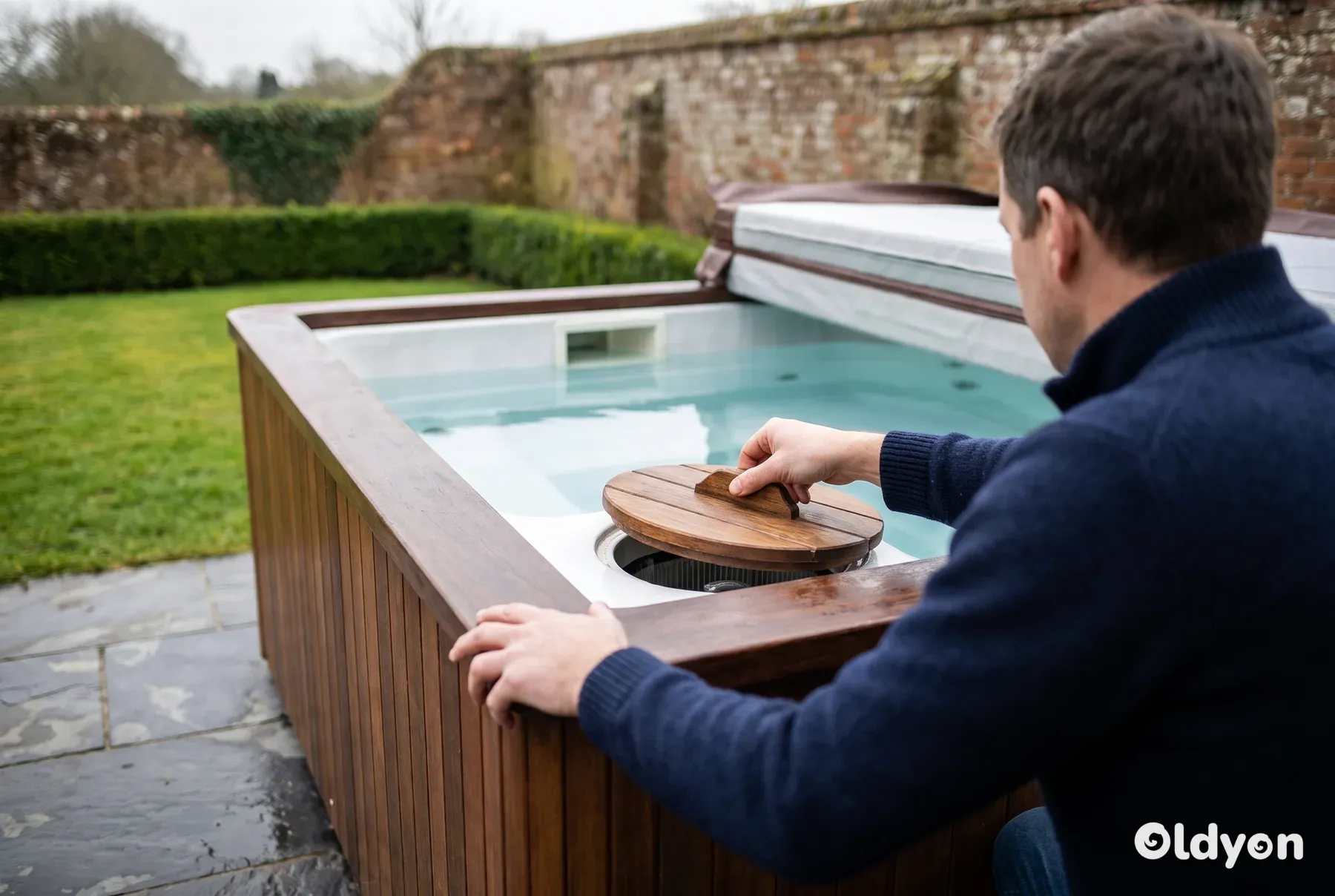
The filter cartridge usually sits in a round housing near the waterline, either in the footwell or behind a side panel. It comes out by unscrewing its cap or turning its locking ring anticlockwise, then lifting the cartridge straight up.
To judge the filter, hold the cartridge up to a light. A clean one is pale white or cream, with open pleats that stand separately. A clogged one looks grey or brown, with pleats that are matted or squashed together.
- Switch the tub off at the isolator.
- Lift out the filter cartridge and look at the pleats. Check for a greasy film, hard white scale, torn fabric or cracked end caps.
- Rinse it with a gentle spray from a garden hose, working the water between each pleat from top to bottom. Do not use a pressure washer or a high-pressure jet, because high pressure can damage the filter material.
- Aim the spray into each pleat from the inside of the fold outwards, so debris is pushed out rather than driven deeper. Turn the cartridge as you go, so each pass overlaps the last and no section is missed.
- Refit the filter and switch on. If the cycling stops, the filter was the cause.
- As a quick test, you can run the pump for a few minutes with the filter removed. If it then runs normally, the cartridge is too blocked and needs a deep clean or replacing. Do not run the tub like this for long, because debris can reach the pump and heater.
A rinse only removes loose dirt. Grease and scale need a proper soak in a filter cleaning solution, and the full routine is in our guide on how to clean a hot tub filter properly. If the fabric is torn, the end caps are cracked or the pleats stay stiff after cleaning, replace the cartridge.
A heavily soiled filter is best left to soak overnight in the cleaning solution. Rinse it thoroughly afterwards before it goes back in, so that no cleaner is left in the pleats to foam up in the water.
When to replace the filter instead of cleaning it
- The fabric is torn or the pleats are split.
- The end caps are cracked or loose.
- The central core is bent, crushed or deformed.
- The pleats stay stiff, grey or matted after a deep clean.
- The cartridge is 12-18 months old, even if it looks clean.
The age limit matters because the filter material breaks down inside over time. An old cartridge restricts flow even after a thorough rinse, so it can keep the pump cycling when everything else checks out.
Hard water causes scale to build up on both the filter and the heater. Keeping calcium hardness at 150-250 ppm and pH at 7.2-7.6 helps the filter stay clean for longer between deep cleans.
How do you clear an airlock in a hot tub pump?
An airlock is a pocket of air trapped inside the pump housing. The impeller spins in air rather than water, so the pump hums but moves little or no water. The flow switch sees no flow and the controller stops the pump, then tries again. Airlocks most often happen after the tub has been drained and refilled, but they can also appear after a service visit or after the tub has stood unused for a while.
You can often hear an airlock. Listen for gurgling, hissing, whining or sputtering from the pump or the jets, while the motor seems to spin freely and almost no water comes out of the jets.
Timing helps too. A pump that runs for about 10-15 seconds and then cuts out points to an airlock rather than overheating, because a motor's thermal overload usually takes longer than that to trip.
Many control systems start in a priming mode when power is restored, often shown as Pr on the display. This lets you run the pumps for a few minutes to push the air out before the heater is allowed to switch on. Your manual will explain how your system handles priming.
- Make sure the water is at the correct level in the skimmer.
- Switch on and let the tub enter priming mode, or turn on the jet pumps from the topside panel.
- Run each pump on high speed, then low speed, several times with short pauses between. The surge of water often pushes the air bubble through.
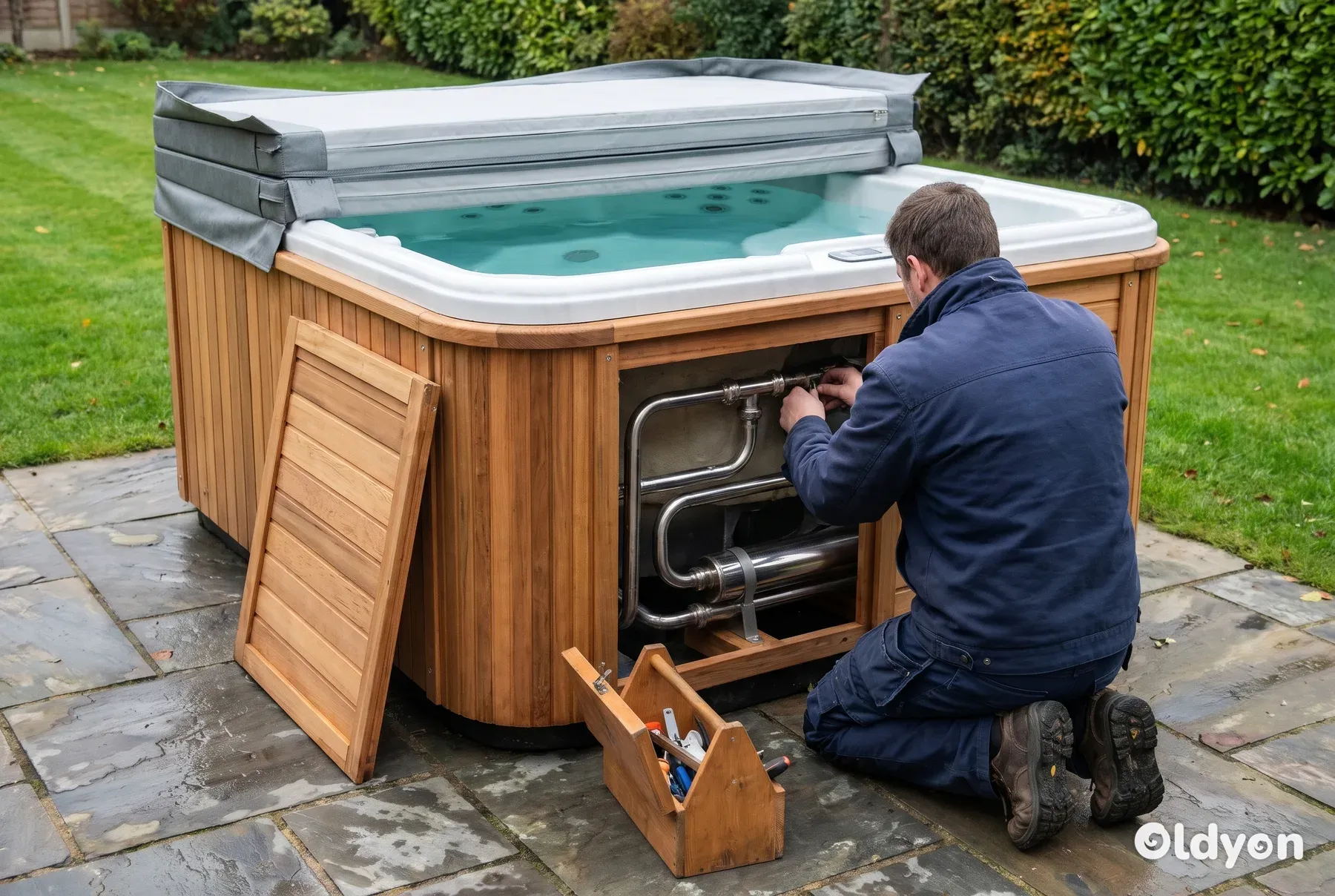
- If the pump still hums without moving water, switch off at the isolator and open the side panel.
- Find the union nut on the pump outlet (the pipe coming out of the top or side of the pump housing). Slowly loosen it by hand, by only about a quarter turn, until you hear air hissing out. Never take the union fully off.
- When water starts to seep out steadily, tighten the union again firmly by hand. Do not overtighten it or use force, because this can crack the fitting. Keep a towel underneath to catch the water.
- Refit the panel, switch back on and test each pump.
Filling the tub through the filter housing, rather than from the open top, pushes water up through the pipework from below. This makes an airlock much less likely the next time you refill.
Why does a flow or pressure switch make the pump cycle?
Your heater has a safety device that confirms water is moving through it before it allows the element to switch on. Depending on the make, this is a flow switch with a small paddle or a pressure switch that senses water pressure in the heater pipe. If it cannot confirm flow, the controller shuts off the heater and may stop the pump as well.
In most cases the switch is reacting correctly to a real problem, such as low water, a blocked filter, an airlock or a closed valve. Fix those first. The switch itself only becomes a suspect once you know the flow through the tub is good.
Signs the switch itself may be faulty
- Flow errors continue even with a clean filter, full water and strong jets.
- The error appears and clears at random, with no change to the water or filter.
- The problem started after the heater was worked on or the tub was moved.
- There is visible scale or debris around the switch fitting.
Pressure switches can drift out of adjustment or stick because of scale, and flow switch paddles can wear or jam. Testing, adjusting or replacing them involves the heater and the control box, so this is a job for a spa technician. If your main symptom is cold water rather than cycling, see what to check when your hot tub is not heating.
Why your hot tub pump keeps turning on and off when it overheats
If the pump runs normally for some minutes, then cuts out with no flow error and restarts some time later, overheating is the most likely cause. Most spa pump motors have a built-in thermal overload that switches the motor off when its windings get too hot, then lets it restart once it has cooled.
Signs the motor is overheating
- The pump runs for longer on cool mornings but cycles faster in hot weather.
- The cycling is worse when the equipment bay is poorly ventilated.
- The motor buzzes or sounds as if it is straining just before it shuts off.
- The motor body is too hot to keep your hand on after it stops.
Why a pump motor overheats
- Poor ventilation in the cabinet, such as vents blocked by leaves, soil or stored items.
- Blocked cooling vents on the motor's end cap, or cabinet walls and panels pressed too close to the motor.
- Insulation, towels or debris packed against the motor.
- Low supply voltage, often from a cable that is too long or too thin for the load.
- Worn motor bearings, which usually make a grinding or screeching noise.
- A failing capacitor on motors that use one, which can make the motor hum and struggle to start.
- Something caught in the impeller, making the motor work harder than it should.
After switching off at the isolator, carefully feel the motor body with the back of your hand. Motors normally run warm, but if it is too hot to keep your hand there and the pump keeps cutting out, it needs attention. Clearing the vents and the space around the motor is something you can do yourself. Bearings, capacitors and voltage checks are for a professional.
With the power still off, shine a torch into the pump inlet and the impeller area and look for leaves, hair or small stones. Even a partial blockage makes the motor work harder and run hot. Remove anything you can reach easily by hand, and leave the pump housing sealed if clearing it would mean taking the pump apart.
Capacitor faults
Many single-phase pump motors use a capacitor to help them start. When it fails, the motor hums but cannot get up to speed, draws excess current and then cuts out on its thermal overload. If the capacitor has already been replaced and the problem continues, a fault in the motor windings or in the control system is more likely.
The start capacitor usually sits under the rear end cap of the motor or inside a raised hump on the side of the motor body. Knowing where it is helps you describe the fault clearly when you speak to a technician, but do not open the cover yourself.
A replacement capacitor must match the original's microfarad (µF) rating, printed on its case, to within about 10%, and have the same or a higher voltage rating. Capacitors can hold a charge after the power is off, so testing or changing one is a job for a qualified person.
Low supply voltage
Low voltage makes the motor draw more current to do the same work, so it heats up until its thermal overload trips. In the UK, the supply should be within the statutory range of 216.2-253 V. An electrician should measure it under load, at the moment the pump starts, because a reading taken with nothing running can look normal. Other countries have their own supply limits.
Common causes of low voltage at the tub are loose connections, corroded terminals and a supply cable that is too small for its length and load. All of these are wiring faults for a registered electrician to put right.
High-limit and temperature sensor faults
Separate from the motor, the control system has a high-limit sensor on the heater and a sensor that reads the water temperature. If the high-limit sensor detects a temperature above its safe point, the system shuts down and shows an overheat code, often OH, HL or similar. Many systems need a reset at the isolator after this.
On some tubs a tripped high limit does not show a text code at all. It appears only as a warning light or a flashing logo light on the topside panel, so check your manual for what each light means on your model.
The high limit does not only trip because the water is too hot. It can also trip because too little water is flowing through the heater, so the water inside it heats up quickly. Check the water level and clean the filter before you reset, or it is likely to trip again straight away.
Once the water level and filter are sorted, reset a high-limit trip like this:
- Switch the tub off at the isolator and keep the power off for at least 30 seconds. A full 60 seconds is better, because it also lets any charge in the control pack drain away.
- Switch back on and watch the display through the start-up sequence.
- If the high limit or overheat error is still showing, press the red reset button on the control box once.
- If the error comes back, stop and call a spa technician.
If the high-limit error clears and the pump runs normally after you have topped up the water, cleaned the filter and reset, the overheat was a false alarm caused by restricted flow. No part has failed, so there is nothing to replace. Keep the water level and filter routine up to date to stop it happening again.
If the high limit trips again within minutes of a reset, stop resetting it. Repeated resets will not help, and the underlying cause needs fixing, whether that is restricted flow, a faulty sensor or a control fault.
A faulty temperature sensor can give false readings, which makes the controller switch the heater and pump on and off at the wrong times. Testing a sensor usually means measuring its resistance and comparing it with the manufacturer's chart, which is a technician's job inside the control box.
Water temperature sensors are not interchangeable between brands, because their resistance values differ. A replacement must match the manufacturer's specification for your control system, or the controller will read the wrong temperature and the cycling can carry on.
You can spot a likely sensor fault yourself. Compare the temperature on the display with a separate floating thermometer left in the water for a few minutes. A large difference, or a pump that shuts off for overheating while the water feels cool, suggests the sensor is at fault.
Hot weather and overheating
In summer, the pumps themselves can push the water above your set temperature, because a running motor adds heat to the water. The controller may then shorten filter cycles or stop the pump to stop the water getting any hotter. Keep the set temperature at or below 40°C (104°F), shorten filter cycles in hot spells, and open the cover in the evening to let heat escape.
If you want to know whether the motor is the problem, our guide on how to test a hot tub pump with a multimeter explains the checks a qualified person will carry out.
When should you reset the tub, and when should you call a professional?
A full reset clears temporary errors and gives the controller a fresh start. It will not fix a physical fault, but it can clear a code that stays on after you have solved the cause.
The control system can also glitch after a power cut, a voltage spike or a lightning strike, and then send false on and off signals to a pump that is perfectly healthy. A full reset is worth trying before you blame the pump or replace any parts.
How to do a full reset
- Switch the tub off at the isolator, not just at the topside panel.
- Leave the power off for a full 60 seconds. Capacitors in the control pack can hold a charge for around 30-45 seconds, so flicking the isolator off and straight back on may not clear the fault. Some manufacturers recommend a longer wait, so check your manual.
- Switch back on and wait about 60 seconds before pressing any buttons on the topside panel, so the controller can finish its start-up sequence undisturbed. Then let it run through priming.
- Watch the display for any error code and write it down exactly as shown.
- Run each pump and check that the jets have strong, steady flow.
Straight after a reset, it is normal for the circulation or low-speed pump to run briefly while the controller checks the system. If rapid on-off cycling starts again at once, the reset has not fixed the fault, so move on to the other checks in this guide.
Some control systems also have a deeper diagnostic reset, done with a button combination on the topside panel, such as holding two buttons together for a few seconds. On many systems this means holding the Jets and Temperature buttons together for about 5 seconds. The sequence differs between systems, so follow the exact steps in your owner's manual.
Where to find reset buttons
Many tubs have a small red reset button on the outside of the control box in the equipment bay, and some pump motors have one on the end cap. Press it only with the cause dealt with, and only once.
Many of these buttons have no label, or are simply marked Reset. They look like a small push button, similar to the reset button on a kitchen waste disposal unit, so they are easy to overlook.
Plug-and-play and inflatable tubs often have a recessed reset button on the pump unit itself. You press it with the tip of a pencil. Check your manual for its position on your model.
Could the topside panel be causing it?
A faulty topside keypad can send false signals that make the pump cycle at random, irregular intervals rather than in a steady pattern. Common causes are corroded buttons, water inside the panel or a damaged cable. A technician can confirm this by disconnecting the panel and watching whether the cycling stops.
If the cycling stops completely once the topside panel is disconnected, the panel is faulty and needs replacing. On most tubs the topside panel is a plug-in part that connects to the control box by a single cable or connector, so changing it is usually a straightforward job for a technician.
If the pump keeps cycling after the topside panel has been disconnected, the panel is not to blame. The fault then lies in the circuit board inside the control box or in its pump relay, which a spa technician will need to test.
Two further signs confirm a relay or board fault: clicking from the relay even when the pump has been disconnected, and burn marks, discolouration or melted plastic around the relay on the circuit board. Checking for these means opening the control box, so leave it to the technician.
If the RCD trips, rather than the pump simply cycling, you have a different fault. It usually means current is leaking to earth, often because water has reached an electrical component. Do not keep resetting the RCD. Leave the tub switched off and call a registered electrician or a spa technician.
Press the test button on the RCD regularly to check that it trips. A weak or failing RCD that trips repeatedly can be mistaken for pump cycling, so if the whole tub goes off rather than just the pump, look at the RCD first.
When you press the test button, the RCD should trip at once and then reset normally. If it will not reset, or it resets but trips again within seconds of the pump starting, the RCD or the circuit has a fault. Leave the tub off and call a registered electrician.
Signs you need a spa technician
- Flow errors continue after you have checked the water level, filter, valves and airlock.
- The pump hums but will not start, or the motor keeps cutting out from overheating.
- You hear clicking or chattering from the control box, which can point to a worn relay on the circuit board.
- The pump starts as soon as power is restored, with no button pressed and the jets switched off, which points to a control fault such as a stuck relay.
- The topside panel shows sensor errors or behaves erratically.
- The display shows an error code that is not listed in your owner's manual, which often indicates a firmware or control board fault.
- Water is leaking from the pump seal or around the heater.
Signs you need a registered electrician
- The RCD trips repeatedly, or trips when one particular pump starts.
- You see scorch marks, smell burning or notice melted cable insulation.
- The supply cable, isolator or connections feel warm or look damaged.
- You see moisture, rust, water stains or corrosion inside the isolator, the consumer unit or the hot tub supply panel. Call an electrician immediately.
- A breaker feels warm or looks discoloured. Call an electrician immediately.
- The tub was recently moved or rewired and the problems started afterwards.
Why you should not replace parts on a guess
Avoid buying filters, capacitors or a whole new pump just in case. Owners often swap the part that is easiest to reach rather than the one that is faulty, and the cycling carries on afterwards.
A diagnostic call-out from a spa technician often costs less than a part you did not need. Once you have done the simple water, filter, airlock and reset checks, booking a diagnosis is usually the better value next step.
Before anyone visits, write down which checks you have already done and what you found, along with any error codes. Telling the technician what has been ruled out makes the call-out quicker.
If the motor turns out to be worn beyond repair, our guide to hot tub pumps and how to replace one explains how to match the correct pump and what the job involves.
Summary: how to stop a hot tub pump short cycling
Start by deciding whether the pump is simply following its normal pattern of filtration, heating, frost protection and temperature checks. Long, regular runs with no error code are normal. Rapid starts and stops, especially with a flow error, point to a fault.
- Top up the water to the middle of the skimmer opening.
- Clean the filter, or replace it if it is damaged, will not come clean or is 12-18 months old.
- Open all slice valves fully and open the jet controls.
- Bleed any airlock at the pump outlet union.
- Clear the motor vents and the pump inlet, and look for signs of overheating.
- Reset at the isolator, leaving the power off for a full 60 seconds, and note any error code.
- Call a spa technician or registered electrician for switches, sensors, relays, capacitors or wiring.
The first four checks are simple and cover the causes owners meet most often. Everything beyond them involves mains electricity, so leave it to a qualified person.
Frequently asked questions
Should I keep using my hot tub while the pump is short cycling?
It is best not to. If the heater cannot run, the water cools, and poor flow means the water is not filtered or sanitised evenly. A pump that keeps overheating can also wear out faster. Fix the cause, or switch off at the isolator with the cover on until a technician visits. Once it runs normally, test the water and bring free chlorine back to 3-5 ppm before anyone gets in.
Why does my pump only turn on and off after I refill the tub?
That pattern almost always means an airlock. When the tub is empty, air fills the pump and pipework, and filling from the open top can trap it inside the pump housing. Run the priming mode, switch the jets between high and low speed a few times, then bleed the pump outlet union if needed. Filling through the filter housing next time helps prevent it.
Can a new filter cause flow errors?
It can. A cartridge of the wrong size or with too little pleat area can restrict flow on some models, and one that is not pushed fully into its housing can stop the lid or weir sitting correctly. Compare the length, diameter and end cap style with the old cartridge, seat it firmly, and check that nothing is pinched when you close the filter lid.
Why does my hot tub pump run more in winter?
Cold weather makes the heater run more often to hold your set temperature, and the circulation pump runs with it. Frost protection may also start the pumps at night when the cabinet gets cold. A well-fitting cover and good cabinet insulation reduce how often this happens. Long runs with no error code are normal in winter and are not a sign of short cycling.
Why does my pump run constantly instead of cycling?
First check the filtration settings. Cycles are sometimes set to 8-12 hours a day, when 2-4 hours is usually enough for home use; your manual gives the figure for your model. If the pump still runs outside the programmed times, a stuck relay on the control board is the likely cause. While you wait for a technician, cut filtration to about 2 hours a day or use a rest or economy mode to cut run time.
Is it safe to adjust the pressure switch myself?
It is not recommended. The pressure switch is a safety device that stops the heater running without water, and setting it wrongly can let the heater operate with too little flow, which can damage it. On many tubs it also sits close to mains wiring. If you suspect the switch after checking water, filter, valves and airlocks, ask a spa technician to test and adjust it.
Does short cycling increase running costs?
The stopping and starting itself uses little extra power, but the faults behind it often do. A blocked filter or failing motor makes the pump work harder, and a heater that keeps dropping out means the tub spends longer reheating. Fixing the cause, keeping the cover in good condition and setting filter cycles to your manufacturer's recommendation all help keep running costs down.
Filed under