Why does my hot tub keep tripping the RCD?
Hot tub keeps tripping RCD protection? Learn the safe checks, what each trip pattern means and when a damp heater or worn element needs an electrician.
If your hot tub keeps tripping RCD protection, the device is almost always doing its job: it has detected electricity leaking to earth. The usual causes are moisture in the heater, pump or connections, or a heater element that is starting to break down. Less often, the RCD itself is worn or is shared with too many other appliances.
Some of the checks are safe for any owner to do, and they can narrow the fault down quickly. Others involve live parts and test equipment that belong with a qualified electrician. This guide shows you where that line sits, so you can be useful without putting yourself at risk.
What does an RCD actually do on a hot tub circuit?
An RCD (residual current device) compares the current flowing out along the live conductor with the current returning along the neutral. If the two differ by more than a set amount, some electricity must be escaping somewhere else, possibly through water or a person. The RCD then cuts the power in a fraction of a second.
In the UK, the wiring regulations (BS 7671) require hot tub supplies to have RCD protection with a rated sensitivity of 30 mA. That is low enough to greatly reduce the risk of a fatal shock. The UK equivalent of the American GFCI breaker is an RCD or an RCBO, which is a combined RCD and circuit breaker protecting a single circuit.
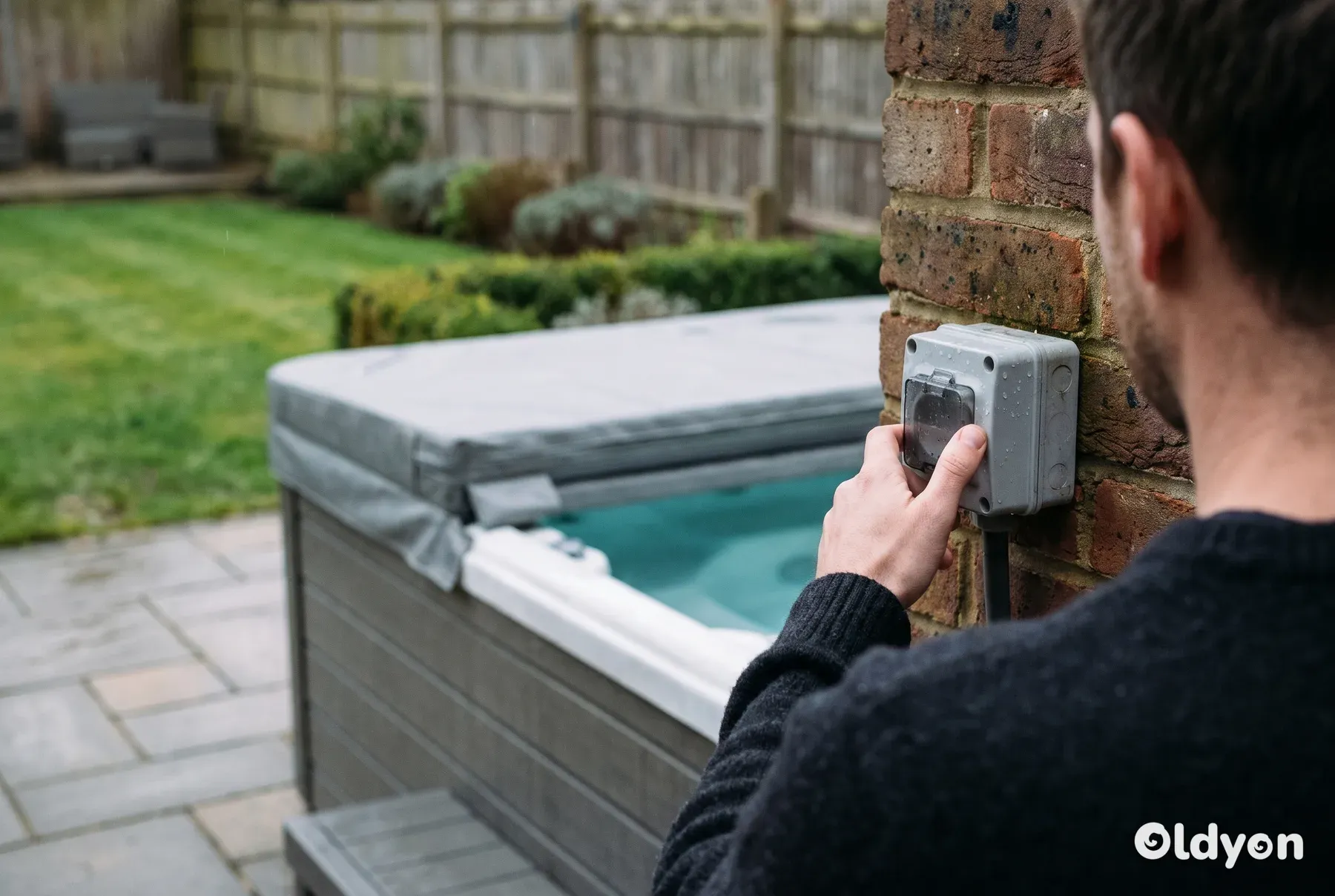
It helps to know which device you have. A hard-wired hot tub normally has its own RCD or RCBO in the consumer unit, a separate outdoor isolator switch, and sometimes a second RCD in an outdoor enclosure near the tub. A 13 amp plug-in tub, including most inflatables, usually has a portable RCD built into the plug or cable. For a fuller explanation of the types and ratings, see our guide to hot tub RCD protection.
One point matters before anything else. An RCD that trips is protecting you. The goal is to find out why it is tripping, never to stop it from tripping.
What should you do first when the RCD trips?
Start with a calm, simple routine. These steps are safe for any owner because you are only using the switches and buttons designed for you to operate.
- Dry your hands and the area around the switches completely, and make sure you are not standing on wet ground, before you touch the isolator, the RCD or any electrical item.
- Make sure nobody is in or touching the hot tub, then switch the tub off at its outdoor isolator.
- Go to the device that tripped (the consumer unit, the outdoor enclosure or the plug-in RCD) and check which switch has moved to the off position. Many devices show a trip with a small indicator window, or with a handle resting in a middle position rather than fully off, which helps you tell which one has tripped.
- Look at the hot tub and its cable route for anything obvious: water pooling around the cabinet, a damaged cable, a socket cover left open in the rain, or a burning smell. If you see or smell any of these, stop and call an electrician.
- If everything looks normal, reset the RCD. First push the handle fully to the off position until it clicks, wait about 10 seconds, then push it firmly back up to the on position. A tripped handle can sit part-way and look reset without having re-engaged.
- Switch the hot tub back on at the isolator and watch for a few minutes.
- If the RCD trips again straight away, switch off at the isolator and leave it off. Do not keep resetting it.
Never reset an RCD more than once or twice for the same fault. Each reset sends power back into whatever is leaking. If it trips again, leave the hot tub switched off at the isolator and arrange an electrician.
Using the RCD test button
Every RCD has a button marked T or Test. Pressing it creates a small, deliberate imbalance, and a healthy RCD should trip immediately. If you press it with the power on and nothing happens, the RCD is not protecting the circuit and the hot tub should not be used until an electrician has checked it.
The test button only proves that the trip mechanism moves. It does not measure how fast the RCD trips or how sensitive it is. An electrician uses a dedicated RCD tester for that. Electrical Safety First advises owners to test their RCDs regularly, and many manufacturers suggest every three months, so check the instructions printed on or supplied with your device.
If the RCD will not reset at all
Switch the hot tub off at the isolator and try to reset the RCD again. If it still will not stay on with the hot tub isolated, the fault is not in the tub. It is in the RCD itself, the wiring between the consumer unit and the isolator, or another circuit sharing the same RCD. That needs an electrician.
Why does a hot tub keep tripping the RCD?
Hot tubs combine water, heat and electricity in a box that sits outdoors all year. That makes earth leakage more likely than with most household appliances. Most causes fall into one of the groups below.
Moisture in the cabinet or connections
Water is the most common cause. A slow leak from a pump seal, a union fitting or a heater housing can drip onto electrical parts. Condensation can form inside the control box during cold, damp weather. Rainwater can also get into outdoor sockets, junction boxes, cable glands or a plug left lying on wet ground.
Typical signs are tripping after heavy rain, on cold mornings, or after the tub has been topped up or drained. Damp-related trips often clear up when the weather is dry, then return.
A failing heater element
The heater element sits in the water flow inside a metal tube. Over time, scale, corrosion or poor water balance can crack the outer sheath of the element. Water then reaches the insulation inside and current starts leaking to earth. This often begins as an occasional trip and becomes more frequent until it trips every time the heater switches on.
Water chemistry plays a part here. Low pH and low total alkalinity make water more corrosive to metal parts, while very high calcium hardness can build scale on the element. Keeping pH at 7.2-7.6, total alkalinity at 80-120 ppm and calcium hardness around 150-250 ppm helps protect the heater, although manufacturers' recommended ranges vary, so check your manual.
If your tub has also stopped warming up properly, our guide to a hot tub not heating up covers the other heater faults to rule out.
A pump, blower or motor fault
Circulation pumps, jet pumps and air blowers all have motors with windings. If a pump seal fails and water reaches the motor, or the winding insulation breaks down with age, current can leak to the metal body. This tends to show as a trip when you switch on the jets or when a particular pump starts.
Pump motor insulation failures are more likely in older tubs and after freezing weather, when ice can damage seals and let water reach the motor. If the RCD trips as a pump starts up during or just after a cold snap, the pump is the most likely suspect.
Damaged wiring, plugs and terminals
Loose terminals can overheat, scorch and allow leakage. Rodents sometimes chew cables inside the cabinet. Supply cables can be damaged by garden tools, decking screws or being trapped under the tub. Corroded terminals inside the control box or isolator are another possible cause.
Accessories and add-ons
Lights, ozonators, UV units, audio systems and cover lifters with power all add more connections and more places for water to get in. Lighting in particular sits close to the water and can fail when seals age.
Ozonators deserve a special mention. They use high-voltage components, either a UV lamp or a corona discharge unit, and a fault in these parts or their wiring can leak current to earth.
An overload rather than a leak
Not every trip is earth leakage. An RCBO also contains an overcurrent breaker, so it trips if the tub draws more current than the circuit is rated for. This can happen when the heater and several pumps run at once on a supply that is too small, or after extra equipment has been added.
An overload trip often happens after the tub has been running at full demand for a while rather than at the moment something switches on. An electrician should check the tub's total load against the breaker rating and the cable size before anything is changed.
The RCD itself and nuisance tripping
Sometimes the hot tub is not faulty at all. Every appliance leaks a tiny amount of current to earth in normal use, and these small amounts add up if several circuits share one RCD. A hot tub sharing an RCD with an outdoor socket, a garden office or a washing machine can push the total over the trip threshold.
Other causes of nuisance tripping include an ageing RCD that has become oversensitive, power surges during storms, a neutral-to-earth fault elsewhere on the shared circuit, or an RCD type that does not suit the tub's electronics. Some modern tubs with variable-speed pumps need a Type A RCD or better rather than the older Type AC. Your manual or the manufacturer will say which type is required.
What does the timing of the trip tell you?
The moment the RCD trips is your most useful clue. Keep a simple note of the date, the time, the weather and what the tub was doing when it happened. An electrician will find this very helpful.
When it trips | Most likely cause | What to do |
|---|---|---|
Immediately, even with the tub isolated | RCD, supply wiring or another circuit | Leave off, call an electrician |
As soon as the tub is switched on | Water in control box or serious component fault | Leave off, check for leaks with power isolated |
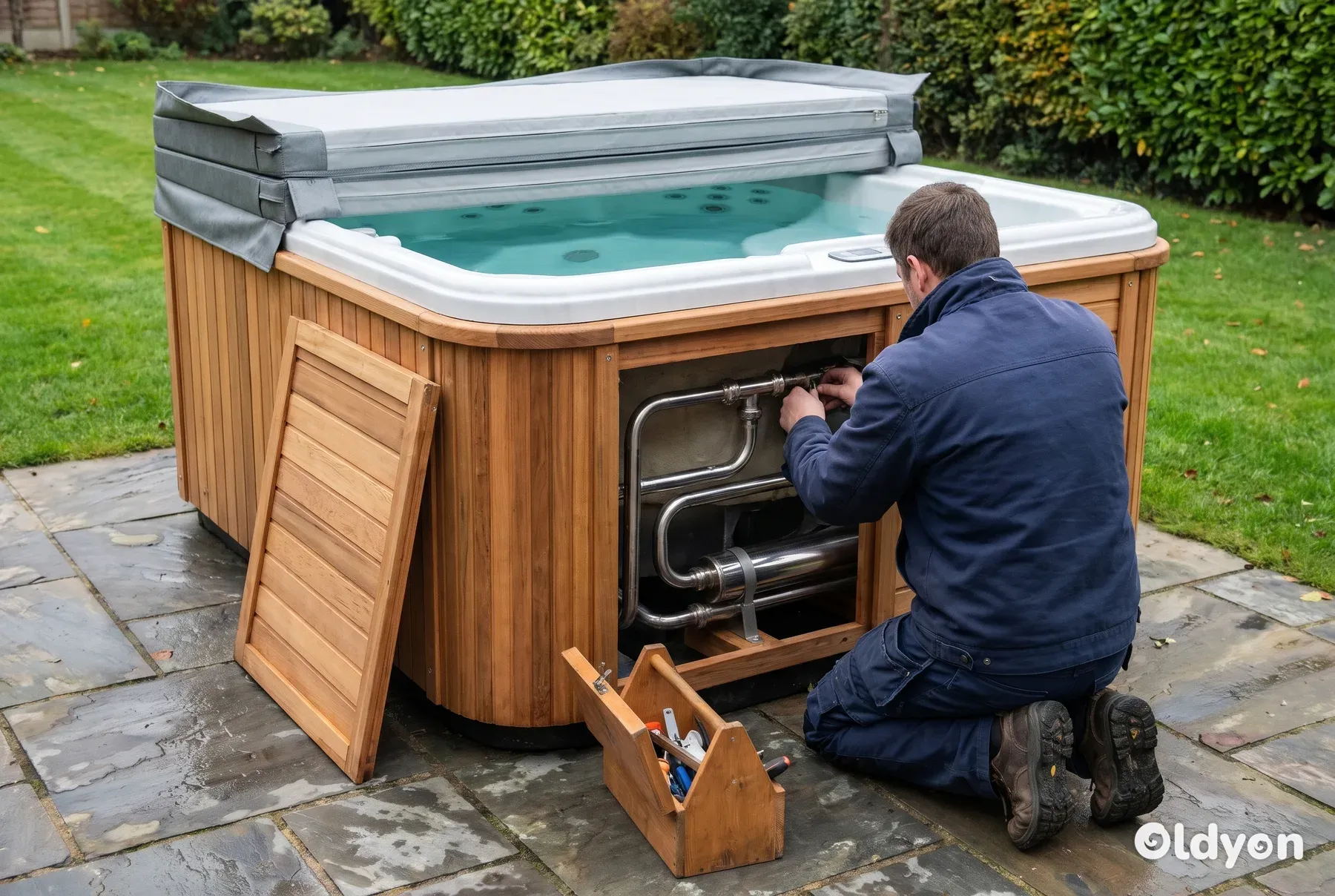
When the heater starts | Failing heater element or heater wiring | Electrician or hot tub technician |
When the jets or blower start | Pump or blower motor, or its wiring | Electrician or hot tub technician |
After running at full demand for a while | Overload on the RCBO or breaker | Electrician to check load against rating |
After rain or on damp mornings | Moisture in sockets, glands or cabinet | Find and stop the water entry |
Randomly, with no clear pattern | Shared RCD, ageing RCD or intermittent fault | Keep a log, arrange an electrician |
How can you narrow down the cause safely?
You can learn a lot without touching any electrical parts. The checks below use only the isolator, the control panel and your eyes. Do them only if the RCD will reset and stay on with the hot tub isolated.
- Switch off at the isolator and wait a few minutes before opening anything.
- Tape over the isolator switch with a note saying 'Do not switch on, work in progress', or lock it off if it has a lock, so nobody in the household restores power while you are looking.
- Remove the cabinet side panels that the manual says are owner-accessible. Do not open the control box, the isolator or any sealed electrical enclosure.
- Look carefully for water: drips from pump unions, wet insulation foam, damp patches under the heater, rust marks or white mineral trails showing where water has run.
- Look for scorch marks, melted plastic, chewed cables or signs of nesting animals. If you find any of these, stop here and call an electrician.
- If you find a leak, leave the power off and the panels open so the area can dry, ideally in dry weather for a day or two, and arrange a repair of the leak before running the tub again.
- If everything is dry and undamaged, refit the panels, remove your note and switch the tub on with the jets off. Set the target temperature a few degrees below the current water temperature so the heater does not call for heat.
- If your tub has an ozonator, switch it off using the control panel setting, if there is one, and see whether the tripping stops. If the ozonator can only be disconnected inside the control box, leave that to a technician.
- If the tub runs for a while without tripping, raise the set temperature so the heater switches on. A trip at this point points strongly to the heater circuit.
- If the heater runs normally, switch on each pump, the blower and the lights one at a time, waiting a minute between each. Note which one causes the trip.
Stop at the first trip. You now have a clear lead to pass to an electrician or hot tub technician, which can shorten their visit. Some control systems run pumps automatically during filter cycles, so check your manual if the tub starts a pump you did not select.
Should you test a hot tub with a multimeter?
Guides written for other countries often suggest measuring voltages at the breaker terminals with the power on. Please do not do this. Testing live terminals in a consumer unit or hot tub control box carries a real risk of electric shock and arc flash burns, and it is work for someone trained and equipped for it.
An ordinary multimeter is also the wrong tool for most RCD faults. Earth leakage is found with an insulation resistance tester, which applies a higher test voltage (usually 500 V on domestic circuits) to each component after it has been disconnected. Electricians use this to identify exactly which heater, pump or cable is leaking.
There are limited dead tests a confident owner can do on a component that has been fully isolated and disconnected, such as checking a pump motor for continuity. Our guide on how to test a hot tub pump with a multimeter explains what those tests can and cannot tell you. They will not prove a component is free from earth leakage.
Some owners are tempted to disconnect the heater or a pump inside the control box to see whether the tripping stops. This means working inside a box fed by a high-current supply, often with several circuits and capacitors. Unless you are qualified, leave that step to an electrician.
When do you need an electrician?
Your safe checks end at the isolator, the control panel and the owner-accessible cabinet panels. Call a registered electrician, or a hot tub technician who is qualified for electrical work, in any of these situations:
- The RCD will not reset even with the hot tub isolated.
- The RCD trips again after one or two resets.
- The test button does not trip the RCD.
- The RCD or breaker feels loose, will not stay in the on position or shows burn marks. It is faulty and should be replaced, whatever tests it passes.
- The hot tub, its lights or its control panel stay on when the RCD or breaker is in the off position, or a dead test shows continuity (near-zero resistance) across the device when it is switched off. Its contacts have welded closed, which is a fire hazard, and it should be replaced straight away.
- The RCD stays on and the isolator is switched on, but the hot tub has no power at all.
- You find water in or near the control box, or any scorching, melting or burning smell.
- The trip happens when the heater, a pump or the blower starts.
- The breaker trips after the tub has been running at full demand, which may mean an overload.
- The tripping is random and you cannot find a pattern.
- The tub is more than about 10 years old, has never had an electrical service and shows several faults at once.
- You have recently added a new circuit, outdoor socket or garden building on the same supply.
How an electrician finds the leaking component
To pin down which part is leaking, an electrician disconnects the components inside the control box one at a time and resets the RCD after each one. If the RCD holds after a particular part has been disconnected, that part is the one leaking to earth. If it still trips, they reconnect that part and move on to the next.
- Isolate the supply and disconnect the heater, the most common source of earth leakage, then restore power and reset the RCD.
- If it still trips, reconnect the heater and disconnect the pumps, one at a time, resetting after each.
- Then work through the smaller loads in turn: the ozonator, the blower and the lights.
- Once the RCD holds, confirm the suspect part with an insulation resistance test before replacing it.
This is the same process as your control panel checks, carried one step further inside the control box. Each disconnection means working on terminals fed by a high-current supply, which is why it belongs with a qualified electrician.
If the RCD stays on but the tub has no power
A hot tub that is completely dead while its RCD stays on is a different problem from tripping. The cause is either in the supply upstream of the tub, such as the consumer unit or the incoming supply to the house, or an RCD or breaker that has failed internally and no longer passes power. Both need an electrician to diagnose, so do not open the consumer unit or the isolator to look.
If the breaker has welded closed
The opposite failure is more dangerous. Heavy current, a short circuit or repeated tripping under load can weld the contacts inside an RCD or breaker together. The handle may move to off, but the device still passes power, so it can no longer disconnect the circuit when a fault happens. That is a fire hazard as well as a shock risk.
An electrician confirms this with a dead test: with the supply isolated and the device switched off, they check for continuity across it, from the supply side to the hot tub side. Near-zero resistance means the contacts are welded. The device must be replaced straight away and never reset or reused.
The sign you may notice yourself is the hot tub, its lights or its control panel staying on after you switch off its RCD or breaker. If that happens, do not touch the tub or the water. Switch off at the outdoor isolator and at the main switch on the consumer unit if you can do so safely, keep everyone away from the tub and call an electrician.
Older tubs with several faults at once
A hot tub that is more than about 10 years old and has never had an electrical service may have ageing wiring insulation, corroded terminals and worn components. These can produce several faults at the same time that do not fit any single pattern in the table above. In that case, a full electrical inspection of the tub and its supply by an electrician is a better use of money than chasing one cause at a time.
An electrician will usually test the RCD's trip time, carry out insulation resistance tests on the hot tub circuit and each component, and check the earthing and bonding. If parts are faulty, they or a hot tub technician can replace them. They may also recommend giving the tub its own RCBO so that it is not affected by other circuits.
A replacement RCD, RCBO or heater element must match the original specification exactly, including its current rating, sensitivity and type. Give your electrician or parts supplier the tub's model and electrical rating, which are usually on a label inside the cabinet or in the manual.
UK rules for hot tub electrical work
In the UK, electrical installations should follow BS 7671. Installing a new circuit for a hot tub in England or Wales is notifiable building work under Part P of the Building Regulations. The simplest way to comply is to use an electrician registered with a competent person scheme, who can self-certify the work. GOV.UK explains building regulations approval and the role of these schemes.
Unnotified or uncertified electrical work on the tub's circuit can cause problems with your home insurance, and it can create liability for you if a fire or injury follows. Keep the electrician's certificate with your hot tub paperwork, as you may need it when you make a claim or sell your home.
Scotland and Northern Ireland have their own building regulations, and other European countries have their own wiring standards and approval systems. If you are outside England and Wales, check your local rules. Our guide to hot tub electrical requirements in the UK covers supply sizes, isolators and cable runs in more detail.
Employers and landlords providing hot tubs for others to use have additional duties. The HSE's electrical safety pages set out what is expected of them.
How can you stop the RCD tripping again?
Once the fault has been repaired, a few habits reduce the chance of it returning. Most of them are about keeping water where it belongs.
- Look inside the owner-accessible cabinet panels every few months for drips or damp, with the power off at the isolator.
- Keep the cover on when the tub is not in use so rain does not run over the cabinet edges.
- Make sure the ground around the tub drains away and water does not pool under the cabinet.
- Keep outdoor socket covers closed and plugs off the ground, and check cable glands are tight.
- Never use an extension lead for a plug-in tub unless the manufacturer specifically allows it.
- Keep pH, total alkalinity and calcium hardness within range to protect the heater element.
- Protect the tub against freezing in winter, as your manual describes, to reduce the risk of seal and pump damage.
- Press the RCD test button at the interval your RCD maker recommends, and reset it afterwards.
- Have the hot tub circuit inspected periodically by a registered electrician, especially on older installations.
Summary: what to remember about a tripping RCD
A hot tub that keeps tripping the RCD is usually telling you that current is escaping where it should not. The most common causes are moisture in the cabinet or connections, a failing heater element, a pump or blower fault, or an RCD that is shared, worn or the wrong type. If you have an RCBO, an overload can also trip it.
You can safely reset the RCD once or twice, press the test button, look for water with the power isolated and note when the trip happens. Anything involving live parts, the control box or test equipment belongs with a registered electrician. Never bypass or replace the RCD to stop it tripping.
Frequently asked questions
Can I fit a less sensitive RCD so it stops tripping?
No. Hot tub supplies in the UK need 30 mA RCD protection under BS 7671, because that sensitivity is what protects people from a dangerous shock. A less sensitive device, or bypassing the RCD, would leave the fault in place and remove your protection. The right answer is to find and repair the leak, or give the tub its own correctly rated RCBO.
Is it safe to use the hot tub after the RCD has been reset?
If it tripped once during a storm or after heavy rain and has run normally since, it is usually fine, but keep an eye on it. If it trips repeatedly, do not use the tub until an electrician has tested it. A leak to earth means part of the system is not as well insulated as it should be. Our guide on whether you can get electrocuted in a hot tub explains the risks.
Why does my hot tub only trip the RCD when it rains?
Rain-related tripping usually means water is reaching a connection outside the tub's sealed parts. Common places are outdoor sockets with open covers, loose cable glands on the isolator or control box, junction boxes and plugs lying on the ground. Water running down the cabinet sides when the cover is off can also reach electrics. An electrician can find and seal the entry point.
Can a faulty circuit board make the RCD trip?
A failed control board more often causes error codes, a blank panel, or a heater or pump that will not switch on. It is less likely to cause earth leakage by itself. However, water or condensation inside the control box can affect the board and the connections around it, and that can trip the RCD. Any work inside the control box is a job for a qualified technician.
Could another appliance be tripping the hot tub's RCD?
Yes. If the hot tub shares an RCD with other circuits, the small normal leakage from each appliance adds up, and a fault on any of those circuits trips the RCD too. If tripping happens when the tub is idle, or when something else in the house switches on, mention this to your electrician. Giving the hot tub its own RCBO often solves it.
Does a new heater element sometimes trip the RCD?
It can happen, usually because of a fitting fault such as a loose terminal, a damaged seal letting water into the housing, or the wrong element for the heater. If the RCD starts tripping soon after a heater repair, switch off at the isolator and ask whoever fitted it to come back and check their work, including an insulation resistance test.
Filed under