Why is my hot tub water yellow?
Learn the hot tub water yellow causes, from pollen and iron to bromine, tannins and early algae, with a simple test and fix for each and when to drain.
The most common hot tub water yellow causes are pollen on the surface, iron in your fill water, too much bromine, tannins leaching from wood, and the first stage of algae. Each one has a simple test that tells them apart, and once you know which you are dealing with, the fix is usually quick and cheap.
Below, each cause is matched with the test that confirms it and the steps that clear it. There is also a quick reference table, a step-by-step recovery routine, and clear advice on when to stop soaking and when to drain.
What are the main hot tub water yellow causes?
Yellow water is a symptom, not a diagnosis. The same colour can come from something harmless floating on top, something dissolved in the water, or something growing in it. That is why testing comes before treating.
Start by looking closely. Is the colour a film on the surface, or is the whole body of water tinted? Is the water clear but coloured like weak tea, or hazy as well? Did the colour appear after a refill, after shocking, or slowly over a week? Those three answers point you towards one of the causes below.
Pollen and garden debris
Pollen is the most common cause of yellow water in British gardens, especially in spring and early summer. It is a fine yellow or yellow-green powder that settles on the water and on the cover, then gets stirred in when the jets run. Trees, grasses and some hedging plants all produce it, and a tub near flowering trees can collect a lot in a single afternoon.
The test: wipe a white kitchen towel across the water surface and along the waterline. If it comes away with yellow dust or a powdery film, pollen is your main suspect. Pollen also tends to gather in corners and around the skimmer, and the problem is seasonal, so it often eases after midsummer.
A useful clue is that pH, alkalinity and sanitiser all test normal, yet the water still looks yellow. The finest pollen grains can pass through the filter and hang in the water as a pale yellow or greenish haze. This often appears suddenly after a windy day or after the tub was left uncovered.
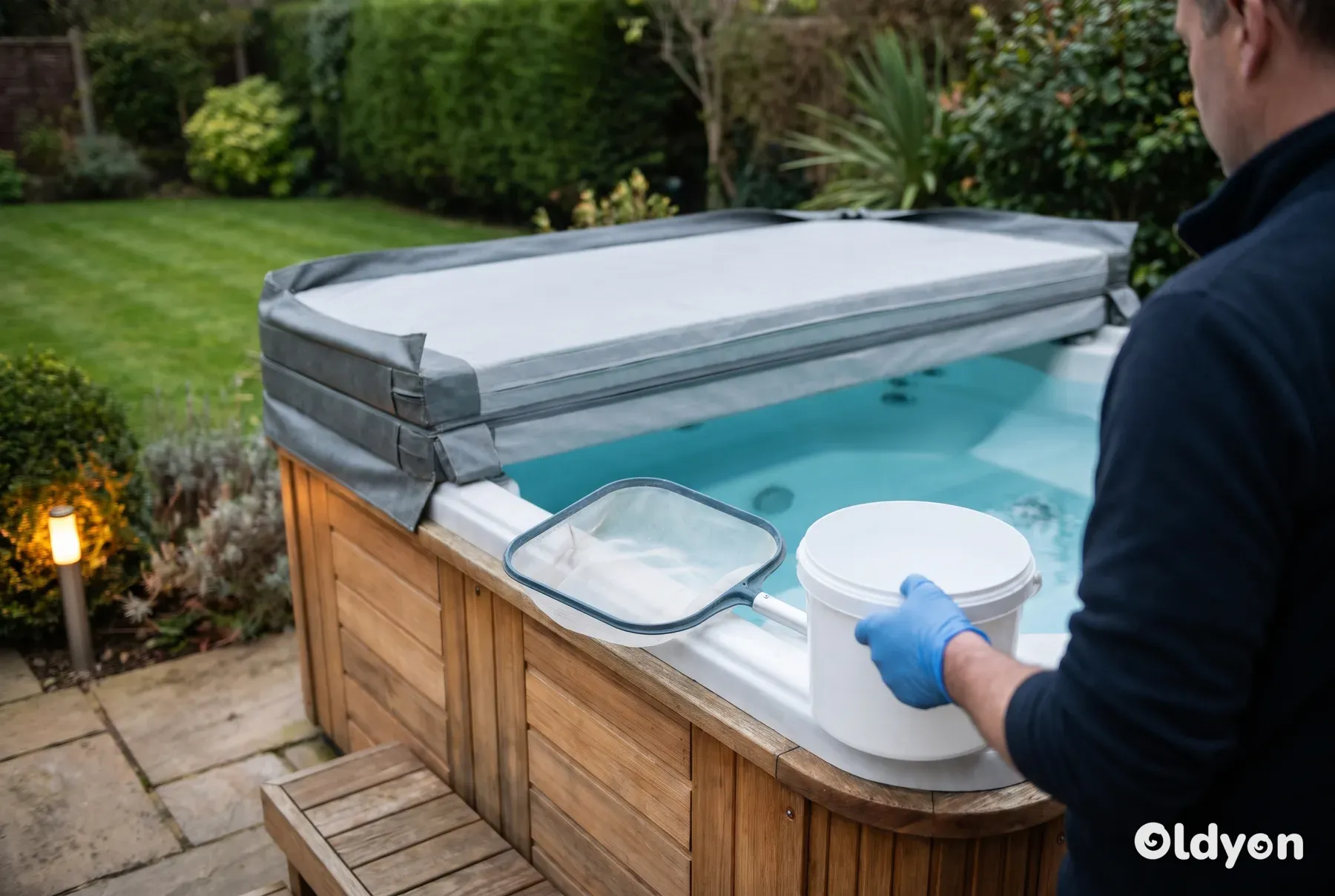
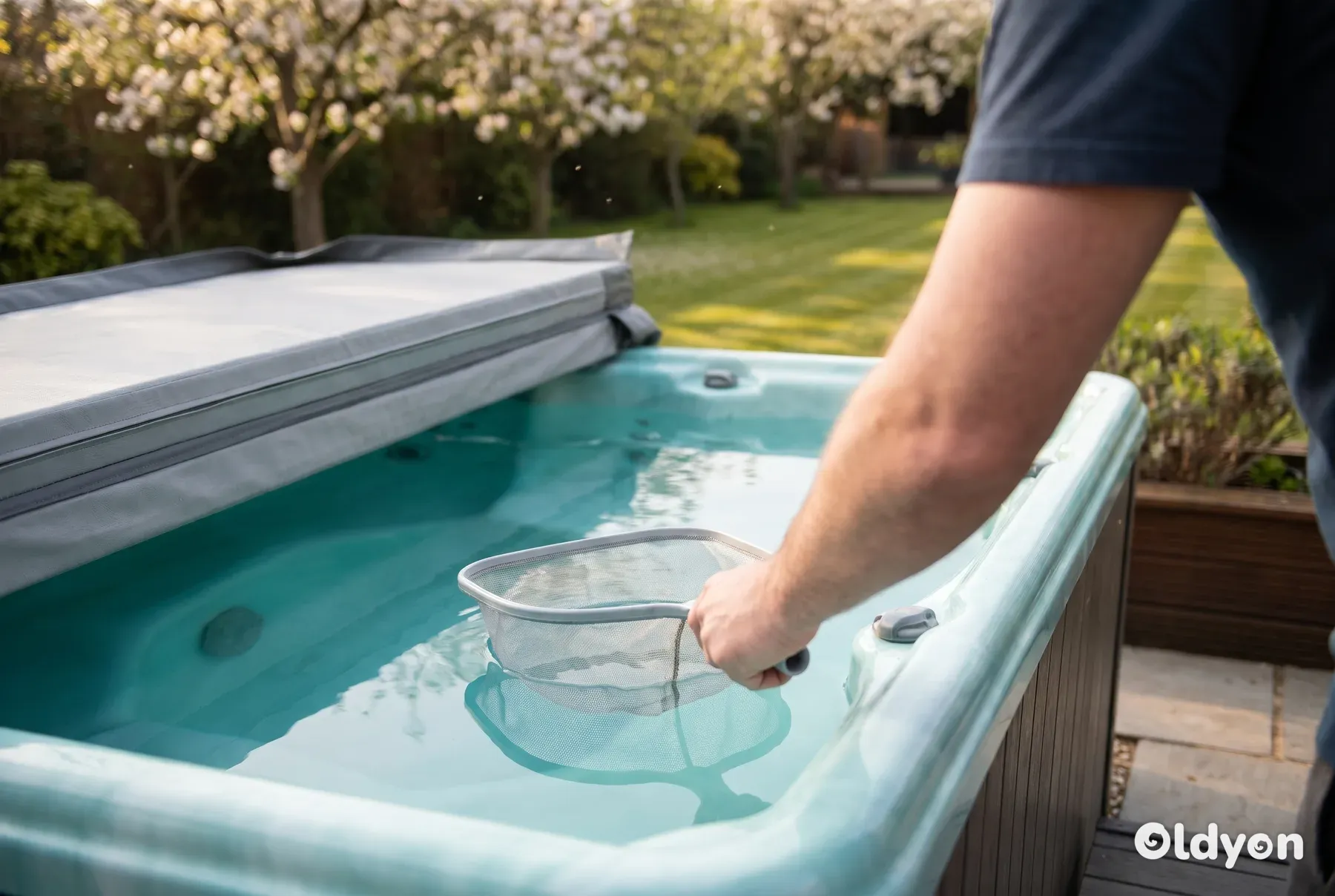
The fix: skim the surface with a fine mesh net, wipe the waterline, then rinse or clean the filter, because pollen grains clog it quickly. Keep the cover on whenever the tub is not in use, and wipe the cover before opening it so the pollen on top does not slide into the water. An enzyme product or a clarifier can help the filter catch the finest particles.
Leaves, soil and dust blown in from the garden can tint the water in a similar way. These are physical causes, so they need no chemical adjustment. Clean the filter, add a clarifier and keep the cover on until the water clears.
Iron and other metals in the fill water
Dissolved iron is invisible until something oxidises it. When you add shock or sanitiser, the iron turns into tiny solid particles that colour the water yellow, orange or light brown. That is why metal problems so often appear straight after a refill and a first dose of shock.
It takes very little metal to cause this. Iron at only about 0.3 mg/L (0.3 ppm) is enough to visibly discolour water, so a small amount of dissolved metal can tint the whole tub within hours of adding sanitiser or a pH adjuster.
Mains water in the UK is treated and usually low in iron, but it can carry more after work on the water mains or through older pipes. Water from a private well or borehole is far more likely to contain iron and manganese. Copper is the other common metal, but it usually tints water green or blue rather than yellow, and it can come from mineral systems or from corrosion when pH stays low for a long time.
Metal does not always arrive with the fill water. It can also come from inside the tub through corroding parts, or from cheap metal hose fittings. Hair clips, coins, jewellery and other metal items left in the water can add to it, so check the footwell and the filter area.
The test: use metal test strips or a liquid test kit that reads iron and copper. A useful home check is to run a little fill water into a clean white bucket, add a small amount of shock, and watch. If it turns yellow or rusty within minutes, the metal is coming in with the water.
If you cannot test for metals at home, fill a clean bottle with about 500 ml (about 1 pint) of tub water and take it to a local pool and spa shop. Many shops test it for free. Any iron or copper reading above zero makes metals the likely cause.
The fix: add a metal sequestrant (often sold as a stain and scale or metal remover) at the dose on the label. It binds the metal so it stays dissolved and does not stain the shell. Run the filtration, clean or replace the filter, and use a hose pre-filter for every future top-up and refill. Shock after the sequestrant has had time to work, not before.
Too much bromine
Bromine itself has an amber colour, so a high reading can give the water a pale yellow tint. This is more noticeable when pH is low, and it often happens when a floating dispenser is set too open or when tablets are added on top of an already healthy level.
The test: check bromine with a test strip or a DPD kit. The usual target is 3-5 ppm, and some manufacturers allow a little higher, so check your manual. If your reading is well above the range, or the strip turns the darkest colour instantly, high bromine is the likely cause. Check pH at the same time.
The fix: stop adding bromine and close the dispenser down or take it out. Leave the cover off for a few hours with the jets running, because bromine is broken down by sunlight and lost to the air. Raise pH to 7.2-7.6 if it is low. If the level is very high, a partial drain and refill with fresh water is the fastest way to bring it down.
High bromine combined with low pH
High bromine together with low pH is a separate and more harmful problem. When bromine sits well above the normal range, around 6-8 ppm or more, and pH falls below 7.2, the water becomes corrosive and takes on a yellow tint. This is common in new owners who add extra bromine to be safe.
Corrosive water attacks copper fittings and heater elements, which adds metal to the water and can shorten the life of the heater. The test is a high bromine reading and a low pH reading at the same time. Never add more bromine until pH is corrected, then let the bromine fall back as described above.
Tannins in wood fired tubs
Wood fired tubs made from cedar, spruce, larch or thermowood release natural tannins into the water, especially when they are new. Tannins give water a clear amber or tea-like colour. Leaves left sitting in any tub can do the same thing on a smaller scale. Our guide to owning a wood fired hot tub covers the wider routine for these tubs.
Tannins can come from more than the tub itself. A wooden surround or wooden steps, nearby trees dropping leaves, or the fill water can all add them. Some supplies come from surface reservoirs surrounded by vegetation, and these can carry tannins, particularly after heavy rain washes plant matter in.
The test: the water is clear and sparkling but tinted, with no surface film and no slimy feel. The colour does not change much after shocking, sanitiser readings are normal, and the tub is wooden or has had leaves in it. A glass of the water held up to the light looks like weak tea.
The fix: in a new wooden tub, tannin colour is normal and fades over the first weeks and months. Many makers recommend filling, soaking and draining the tub a few times before regular use. Most wood fired tubs without filtration are designed to be drained and refilled after a short period of use, so follow your manufacturer's guidance on how often. For tubs with plastic or fibreglass liners, tannins usually mean leaves or bark have been in the water, so remove them and change the water.
Tannins do not respond to metal sequestrants. They are removed with activated carbon filtration or a product made for tannin removal. If the water keeps a tea tint while sanitiser, pH and metals all test normal, this is the approach to try.
Organic waste and low sanitiser
Every soak adds sweat, body oils, cosmetics, sunscreen and traces of urine to the water. Sanitiser breaks this waste down, but when sanitiser runs low it builds up. The chloramines or bromamines that form can tint the water yellow or yellow-brown and give it a musty, chemical smell.
Below about 1 ppm sanitiser, the water has almost no protection against this waste. Skipping even one or two weekly shocks can be enough for yellowing to appear. This happens most in the first months of ownership, while you learn how fast your tub uses sanitiser.
The test: a low sanitiser reading, a stale smell and water that looks dull rather than sparkling. The fix: clean the filter, balance the water and shock, then keep sanitiser at 3-5 ppm from then on.
Early algae and low sanitiser
Algae does not always start bright green. In its early stage, or in shaded corners, it can look yellow-green or mustard coloured. It grows when sanitiser runs low, filtration is short, or the water is warm and left uncovered in daylight.
The test: check sanitiser first. If free chlorine is below 3 ppm or bromine below 3 ppm, low sanitiser is part of the problem. Run your hand along the waterline, seats and footwell. A slippery or slimy feel, or yellow-green patches that cloud the water when brushed, point to algae. Biofilm in the plumbing can show the same signs as small flakes coming from the jets.
The fix: brush all surfaces, clean the filter, balance the water and shock to the level on your product label. Leave the cover open while the shock works. If the colour comes back within days, or flakes keep appearing from the jets, use a plumbing line cleaner before draining, then refill. If the water has gone fully green, follow our guide on how to fix green hot tub water.
Biofilm in the plumbing
Biofilm is a slimy layer of bacteria that grows inside pipes and jets. It shields the bacteria from normal sanitiser levels, so it does not respond to ordinary shocking. It is most common in tubs left unused for long periods or never given a plumbing purge.
Biofilm tends to break loose from the pipe walls when the jets start up or the water temperature changes. The pieces release bacteria and organic compounds into the tub, which can turn the water yellow or murky and give it an unpleasant smell.
- A slippery feel on the shell or around the jets.
- A musty or swampy smell.
- White or grey flakes coming from the jets, especially when they first start.
- Yellow colour that returns soon after shocking.
The fix: add a plumbing line cleaner (purge product) at the dose on the label and run the jets as directed. Then drain, clean the shell and filter, and refill. Shocking alone will not remove biofilm.
How can you tell which cause it is?
Use this table as a quick first check, then confirm with a proper test before treating. More than one cause can happen at once, for example pollen settling on water that also has low sanitiser.
Cause | What you see | Quick test | Main fix |
|---|---|---|---|
Pollen | Yellow film on surface, worse in spring | White towel wipe picks up yellow dust | Skim, clean filter, keep covered |
Iron | Yellow or rusty tint after refill or shock | Metal test strip, bucket and shock test | Sequestrant, hose pre-filter |
Copper | Yellow-green tint | Metal test shows copper | Copper sequestrant |
High bromine | Pale amber tint, strong smell | Bromine above 5 ppm | Stop dosing, leave uncovered, raise pH |
High bromine, low pH | Bright, vivid yellow | Bromine 6-8 ppm or more, pH below 7.2 | Raise pH first, add no bromine |
Tannins | Clear tea colour, no film | Wooden tub or leaves, normal sanitiser | Rinse new tub, change water |
Organic build-up | Yellow-brown, murky, musty smell | Low sanitiser reading | Clean filter, shock |
Early algae | Yellow-green, slimy surfaces | Low sanitiser, slime on brushing | Brush, shock, clean filter |
The exact shade gives another clue. Look at the water in daylight, ideally in a clear glass held against something white.
- Pale yellow and hazy, with normal chemistry: pollen or tannins.
- Bright, vivid yellow with acidic pH: high bromine with low pH.
- Yellow-orange or rust coloured: iron.
- Yellow-green: copper or early algae.
- Yellow-brown, murky and smelly: organic build-up from low sanitiser, or early biofilm.
- Yellow with grey flakes and slippery jets: biofilm.
Copper gives a greener yellow than iron. If the tint is yellow-green, test for metals and add a copper sequestrant first if copper shows up. If metals test at zero, early algae is the alternative, so test sanitiser and shock promptly.
If the water is yellow and also hazy or milky, the cloudiness may have its own cause. Our guide to what causes cloudy hot tub water explains how to separate the two problems.
Is yellow hot tub water safe to soak in?
It depends on the cause, and the sanitiser reading is the deciding factor. If sanitiser and pH are in range and the colour is from pollen, a small amount of iron or tannins, the water is not usually a health concern, though it may stain or look unpleasant.
- Pollen with good sanitiser: generally fine once skimmed, but people with hay fever may notice itchy eyes or sneezing. The NHS hay fever page explains symptoms and treatment options.
- Iron: not a health worry at the levels found in fill water, but it can stain the shell, cover and swimwear.
- High bromine: can irritate skin and eyes. Wait until the level is back within your manufacturer's range.
- Tannins: harmless in themselves, provided the water is fresh and changed as your manufacturer advises.
- Algae or low sanitiser: do not soak. Algae means sanitiser has failed, so bacteria may also be growing.
Do not use the tub if sanitiser is below range, the water feels slimy, or it smells musty. Poorly maintained hot tubs can spread infections, including Legionnaires' disease. The HSE guidance on Legionella and Legionnaires' disease explains why warm, poorly sanitised water carries a risk.
Badly sanitised water carries other risks too. Hot tub folliculitis is a skin infection caused by Pseudomonas bacteria, which thrive in biofilm and in water with low sanitiser. It shows as itchy red bumps that appear hours to days after soaking. Poorly sanitised water has also been linked to ear and respiratory infections.
Do not soak in under-sanitised water if you have open cuts or grazes, because they raise the risk of infection considerably. Long soaks in chemically unbalanced water can also aggravate eczema and sensitive skin.
If you have used a tub with poor water and develop a red, itchy rash, a pharmacist can advise you. Speak to your GP or call NHS 111 if you develop a high temperature, a cough, shortness of breath or flu-like symptoms in the days after using a hot tub. The NHS Legionnaires' disease page lists the symptoms to watch for.
Take extra care if anyone using the tub is pregnant, very young, older, or has a weakened immune system. For these groups, wait until the water is fully clear and tests in range before anyone soaks. Pregnant users should also speak to their midwife or GP about hot tub use in general.
People who are immunocompromised, for example those having chemotherapy, taking immunosuppressant drugs or living with HIV, face a higher risk from any waterborne germ in under-sanitised water. They should not soak until the water is fully clear and every reading is back in range, and can ask their GP or specialist team about hot tub use in general.
- Heart conditions or atrial fibrillation (AFib): hot water raises body temperature, widens blood vessels and lowers blood pressure, which can trigger irregular heart rhythms. The risk is higher for people with an existing heart condition, people over 65 and anyone soaking in water above 40°C, so check with your cardiologist or GP before regular hot tub use. Anyone who feels chest tightness, palpitations, dizziness or breathlessness during a soak should get out at once and seek medical help, calling 999 if symptoms are severe.
- Older adults: more prone to heat stress and dehydration, so keep soaks short, around 15 minutes, and the water at or below 40°C (104°F).
- Pregnancy: hot water can cause overheating (hyperthermia), which is why many sources advise avoiding hot tubs altogether during pregnancy unless a midwife or doctor says otherwise.
Even when the tint is only pollen or tannins and the chemistry is normal, run the filter, add a clarifier and keep the tub covered until the colour clears. The water will be more pleasant to sit in, and the particles will not clog the filter.
How do you fix yellow hot tub water step by step?
This routine works for most causes. Switch off at the isolator before opening the filter housing or touching any equipment, wear gloves and eye protection when handling chemicals, and never mix chemicals together or add water to chemicals. Store all chemicals out of reach of children and pets, and keep your manual to hand for the manufacturer's dosing.
Plan for roughly 45 minutes of hands-on work, spread over about 24 hours in total while chemicals circulate and the filter runs. Gather the whole kit before you start so the routine is not interrupted halfway through:
- Multi-parameter test strips or a liquid test kit.
- Gloves and eye protection.
- Alkalinity increaser, plus pH increaser and pH decreaser.
- Metal sequestrant.
- Shock suited to your sanitiser.
- Clarifier.
- Your hot tub manual.
- Test the water fully: sanitiser, pH, total alkalinity, calcium hardness (about 150-250 ppm), and metals if you have a kit. Write the readings down so you can see what changes.
- Skim the surface and wipe the waterline to remove pollen, oils and debris before adding anything.
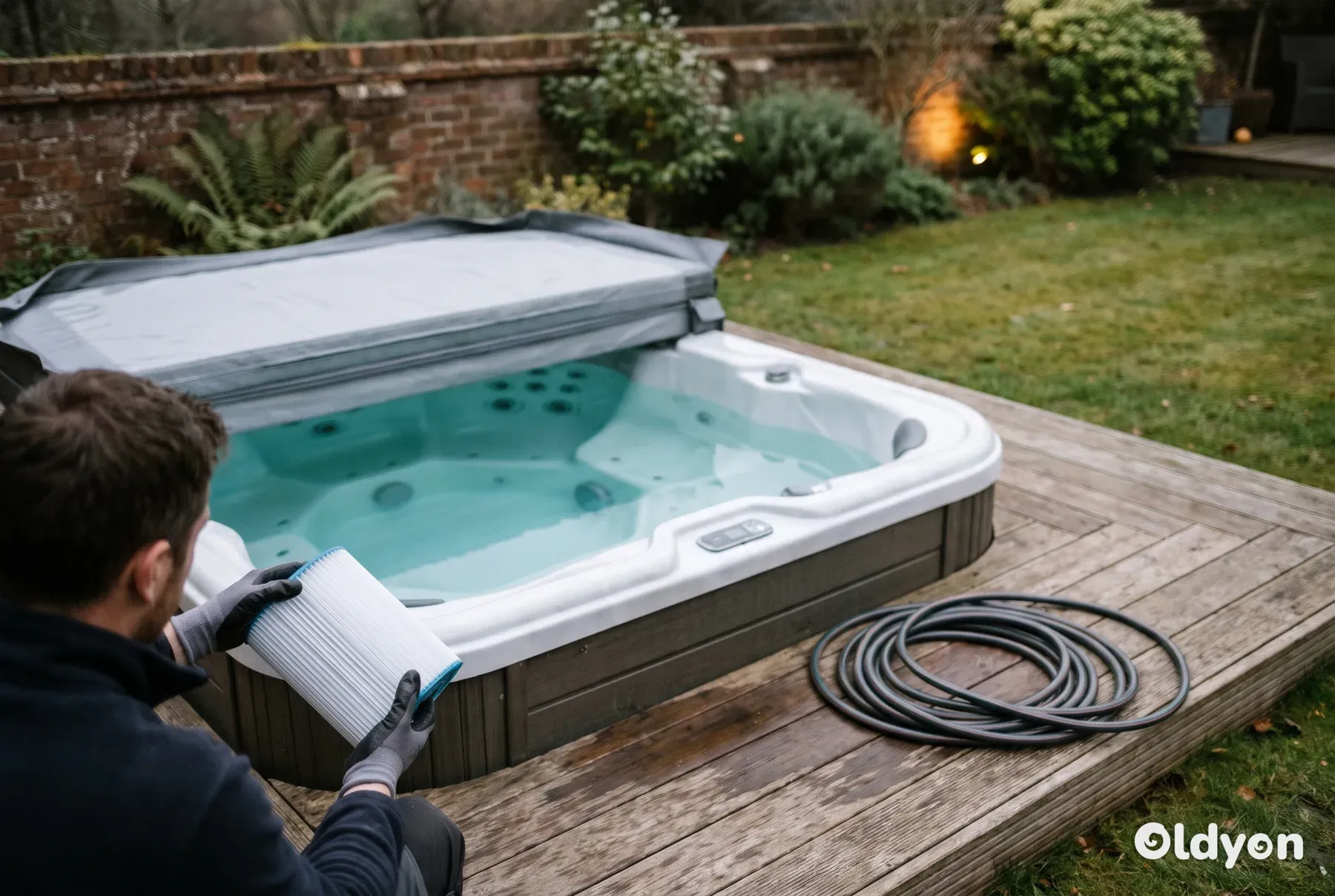
- Remove and clean the filter before you start treatment. Rinse it with a hose from the top down, then soak it in a filter cleaner if it looks discoloured. Replace it if the pleats are torn or flattened.
- Balance total alkalinity to 80-120 ppm first, because it steadies pH. Raise low alkalinity with sodium bicarbonate in small doses with the jets running. If alkalinity is high, a pH decreaser (sodium bisulphate) lowers alkalinity and pH together, so add it carefully.
- Adjust pH to 7.2-7.6. Sanitiser and sequestrant both work best in this range. Use a pH increaser (sodium carbonate) to raise it or a pH decreaser to lower it.
- If metals showed up on the test, add a metal sequestrant now and run the jets for 30-60 minutes, or the time on the label, to spread it through the plumbing. Then run the filter for around 24 hours before shocking.
- Shock the water at the dose on the product label for your tub's volume, with the cover open and the jets running. Skip this step if the problem is high bromine. Retest after about 4 hours.
- Clean the filter again about 12 hours into treatment, because it will have trapped oxidised metal, dead organic matter and biofilm fragments. Keep the filtration running for 24-48 hours in total, then retest. Add a clarifier if the water is still slightly hazy; it typically clears mild haze within 12-24 hours.
Dose in small steps
Add every chemical in small amounts rather than the full calculated dose at once. Let the jets circulate for 30-60 minutes before retesting, then add more only if needed. This avoids overshooting, which is how many owners end up chasing pH up and down.
pH matters for two reasons. Low pH leaches copper and iron from fittings and heater elements, adding metal to the water. pH above about 7.8 can cut the efficiency of chlorine by up to half, so the sanitiser you add does far less work. Bromine is less affected by high pH, but the same target range still applies.
Keeping pH in range also protects comfort. Chlorine is very effective at around pH 7.0, but water that acidic irritates skin and eyes. The 7.2-7.6 band is gentler on bathers and still keeps sanitiser working efficiently.
Choosing the right shock
- Non-chlorine shock (potassium monopersulphate): suits bromine tubs and people with sensitive skin. Soaking is usually allowed after roughly 15-30 minutes, but follow the label.
- Chlorine shock (usually calcium hypochlorite or sodium dichloro): stronger, and better for severe contamination such as organic build-up or early algae. It is also the better choice when you suspect bacterial contamination. Wait until free chlorine falls back to 3-5 ppm before soaking, which typically takes 4-8 hours.
Add shock with the jets running, preferably in the evening when there is no strong sunlight, and with the cover off so gases can escape. Use the label dose for your tub's volume. Some labels allow a double dose for severe cases, but never go beyond what the label states.
As a rough guide, many standard maintenance shocks call for about 40-60 g per 1,500 litres (about 400 US gallons). A double dose is sometimes suitable for severe yellowing. Products differ in strength, so always check the label before you measure.
If the water is no better after two rounds of this routine, the problem is either in the plumbing or the water is too loaded to recover. At that point, a line clean followed by a drain and refill is usually quicker and cheaper than more chemicals.
When should you drain and refill instead?
Draining is the right answer more often than people expect. Fresh water resets everything at once, and a refill uses far less effort than chasing a problem for weeks.
- The water is more than three to four months old. Many manufacturers suggest a change every three to four months for an acrylic tub, depending on use, so check your manual.
- Bromine is very high and has not dropped after a day uncovered.
- The colour returns within a few days of treatment.
- Two complete rounds of treatment have failed to clear the colour.
- Flakes or slime keep coming from the jets, which points to biofilm in the pipes.
- Total dissolved solids (TDS) are high, roughly 1,500 ppm above your fill water's own reading, the water feels heavy, or chemicals no longer seem to work. Test your fill water once so you have a baseline.
- You have inherited or bought a used tub, or cannot remember when the water was last changed. Drain it rather than trying to treat water with an unknown chemical history.
How often to change the water
The usual three to four month interval assumes average household use, roughly 2-4 people soaking 3-4 times a week. The main reason water needs replacing is rising total dissolved solids. Every dose of chemicals, every bather and every top-up leaves something behind, and as TDS climbs the water becomes harder to balance.
Heavy use shortens the interval. Frequent soaks, several bathers or regular guests can mean changing the water every 6-8 weeks.
A commonly used guide is to take the tub volume in US gallons (litres divided by 3.8), divide by 3, then divide by the average number of bathers per day. The result is the rough number of days between changes. For example, a 1,500 litre tub holds about 400 US gallons, so 400 divided by 3 is about 133, and with two bathers a day that gives roughly 66 days. Treat this as a starting point and follow your manual.
Before draining, add a plumbing line cleaner and run the jets for the time on the label. This lifts biofilm from inside the pipes so it leaves with the old water instead of colouring the new fill. Clean the shell and the filter while the tub is empty, then refill through a hose pre-filter.
Call a hot tub technician if the water turns yellow again immediately after a clean refill, if you see rust on metal parts inside the cabinet, or if the heater or pump behave strangely. Low pH over a long period can corrode heater elements, which adds metal to the water.
Also call a technician if pH will not stay stable despite repeated adjustment, which can point to a failing heater element or a problem with the water source. Unusual staining on the shell, jets or equipment that standard cleaning does not remove is another reason to have the tub checked.
How do you stop hot tub water turning yellow again?
Prevention comes down to steady water balance, a clean filter and keeping the outside world out of the tub. A short weekly routine saves most of the work.
A weekly routine
- Test sanitiser and pH two or three times a week, and alkalinity once a week.
- Keep sanitiser at 3-5 ppm for chlorine or bromine and pH at 7.2-7.6.
- Shock once a week, and after heavy use or parties.
- Rinse the filter weekly and deep clean it monthly. Many people keep a spare so one can dry while the other is in use.
- Wipe the waterline and the underside of the cover.
- Keep the water at or below 40°C (104°F), which is the widely accepted maximum.
Filter and plumbing care
The filter is your main defence against pollen, metal particles and organic debris. Watch for these signs that it needs attention:
- Water clarity getting worse even though the chemistry tests correctly.
- Weaker flow from the jets.
- A cartridge that looks discoloured or compressed, or has damaged pleats.
Replace cartridges roughly every 12-24 months, depending on how much the tub is used. Run a plumbing purge before every drain, so biofilm is flushed out and does not re-establish in the pipes.
Keeping metals out
Use a hose pre-filter for every fill and top-up, and add a dose of sequestrant after each refill if your water carries metals. Keep pH from dropping below 7.2 so the water does not attack metal parts. If you use a copper or silver system, read our guide to mineral sanitisers and what they really do, because these systems need careful pH control to avoid staining.
On well or borehole water, add a maintenance dose of sequestrant about once a month. This keeps any remaining metal bound so it does not show as colour or stains, and lets the filter remove it over time.
Saltwater tubs
Saltwater tubs make their own chlorine, so the same chlorine and pH ranges apply. Yellow water in a salt tub most often comes from metals or pollen rather than the salt itself. Check that the salt level matches your manufacturer's range and clean the cell as your manual describes, because scale on the cell reduces output and lets sanitiser fall.
Salt tubs have one extra risk. When pH is low, the electrolysis in a salt system can speed up copper leaching from heater elements. If a salt tub turns yellow, check pH first.
Seasonal habits
In spring and early summer, keep the tub covered whenever possible and clean the filter more often. Trim back overhanging branches if you can, and wipe pollen off the cover before you lift it. In autumn, take leaves out promptly before they release tannins.
Which mistakes make yellow water worse?
- Shocking water that contains metals before adding a sequestrant, which turns invisible iron into visible colour and can stain the shell.
- Adding more bromine to yellow water without testing first, when high bromine may be the cause.
- Ignoring the filter. A clogged filter cannot catch pollen, metal particles or algae.
- Adjusting pH before alkalinity, which leads to pH swinging back.
- Using several clarifiers or products at once, which can cloud the water further.
- Soaking before the water tests in range again.
The single most useful habit is to test before you treat. Pollen, iron, bromine, tannins and algae all need different fixes, and the wrong product can make the colour worse.
Summary: clear water with the right test
Yellow hot tub water usually has one of five main causes. A towel wipe finds pollen, a metal test finds iron, a sanitiser reading finds high bromine or the low levels that let algae grow, and a clear tea colour in a wooden tub points to tannins. A musty smell or flakes from the jets point to organic build-up or biofilm.
Match the fix to the cause, keep the filter clean and the water balanced, and drain when treatment stops working. If the water ever turns fully green, our guide on why hot tub water turns green picks up from there.
Frequently asked questions
Will shocking get rid of yellow hot tub water?
Shocking helps when the cause is pollen, early algae or low sanitiser. It does not help with high bromine, which needs time uncovered or fresh water, and it can make iron worse by turning dissolved metal into visible colour. Test for metals first, add a sequestrant if needed, then shock. Retest after 24 hours of filtration.
Why did my water turn yellow straight after refilling?
Colour that appears within hours of a refill and first dose of chemicals almost always points to metals, usually iron, in the fill water. The sanitiser oxidises the iron and makes it visible. Use a hose pre-filter next time, add a metal sequestrant after filling and before shocking, and run a metal test on your tap water to confirm.
Do tennis balls help keep hot tub water clear?
A tennis ball floating in the tub can soak up a little surface oil from skin and lotions, which is why the tip is popular. It will not remove pollen, metals or algae, and the fuzz can shed into the filter. A purpose-made oil-absorbing sponge does the same job more effectively, and showering before soaking does more than either.
Is yellow water normal in a new wood fired hot tub?
Yes. New wood releases tannins that give the water a clear amber or tea colour, and this is expected rather than a fault. The colour usually fades over the first weeks and months of use. Rinsing and draining the tub a few times before regular use helps, and your manufacturer may give a specific break-in routine.
Can yellow water stain my hot tub shell?
It can if the cause is metal. Iron and copper can leave yellow, brown or green marks on acrylic, especially around the waterline and on the floor. Treat with a sequestrant as soon as you spot metal colour, keep pH in range, and use a stain remover suitable for acrylic if marks appear. Pollen and bromine rarely stain.
How long does it take to clear yellow hot tub water?
Pollen and early algae often clear within a day of skimming, cleaning the filter and shocking. High bromine can take a day or two uncovered, or a few hours with a partial drain. Metals may need two or three days of sequestrant and filtration. If nothing has improved after two treatment rounds, drain and refill.
Filed under