Poo in a hot tub? How to clean it safely
Poo in a hot tub? Learn how to tell a formed stool from diarrhoea, when to shock or drain, how to clean the filter and how to prevent it with young children.
If you find poo in a hot tub, get everyone out, switch off the jets and look at what you are dealing with. A formed stool can usually be scooped out and the water superchlorinated. Diarrhoea is different: it can carry Cryptosporidium, a parasite that normal chlorine levels do not kill quickly, so drain the tub.
This guide follows the approach used in UK pool and spa water guidance and adapts it for a domestic tub. It covers how to remove the stool safely, how much chlorine to use, what to do with the filter, when a full drain is the only safe option and how to stop it happening again with young children.
What should you do first if there is poo in a hot tub?
Act calmly but quickly. The aim of the first few minutes is to stop anyone else being exposed and to stop the circulation system spreading the material around the pipework and filter.
- Ask everyone to get out of the water straight away, and keep children and pets away from the tub.
- Turn off the jets, blowers and any air controls so the water is as still as possible. If you can, switch the circulation pump off too, or switch the tub off at the isolator.
- Once everyone is out and the jets are off, close the cover. This stops anyone touching or climbing into the water, and keeps leaves, insects and birds out until you are ready to start the clean-up.
- Anyone who was in the water should shower with soap and wash their hands thoroughly before eating or touching their face.
- Put on disposable gloves before you go near the water. Choose waterproof gloves made of nitrile or rubber, because thin or porous gloves do not protect your skin from contaminated water. Safety glasses are sensible too, because you will be handling chlorine later.
- Keep a spare pair of disposable gloves to hand, and wear old clothes or an apron that you can put straight in the wash or throw away afterwards.
- When you are ready, open the cover, look carefully at the water and decide whether you are dealing with a formed stool or diarrhoea. Everything that follows depends on this.
Do not let anyone get back in until the tub has been treated and the water has been tested and is back in the normal range. This applies even if the incident looks small.
Plan for the whole job to take one to two days, from removing the stool to having the water tested and safe again. Much of that time is waiting for the chlorine to work and the levels to settle, so you do not need to be at the tub the whole time.
Is it a formed stool or diarrhoea?
A formed stool holds together in the water and can be lifted out in one or a few pieces. The water around it usually stays clear. This is the more manageable case, because most of the germs stay inside the stool and a well-chlorinated tub can deal with what escapes.
Diarrhoea is loose or watery. It breaks up, clouds the water and spreads quickly, especially if the jets were running. It is far more likely to contain large numbers of germs, including Cryptosporidium, which is the main reason it needs a much stronger response.
If you are not sure which it is, treat it as diarrhoea. Vomit can be handled like a formed stool, unless the person who was sick also has diarrhoea or a stomach bug is going around the household.
Question | Formed stool | Diarrhoea |
|---|---|---|
How it looks | Solid, holds together | Loose, clouds the water |
Main concern | Bacteria such as E. coli | Cryptosporidium and other parasites |
Can chlorine handle it? | Yes, with a shock dose | Not reliably in a domestic tub |
Recommended response | Remove, superchlorinate, clean filter | Remove, drain, clean, refill |
Filter | Clean and soak | Replace, or soak thoroughly if unsure |
How do you remove the poo safely?
Whatever the type, remove as much of the material as you can before you add any chemicals. Chlorine works much better on clean water, and leaving solid matter in place uses up the chlorine you add.
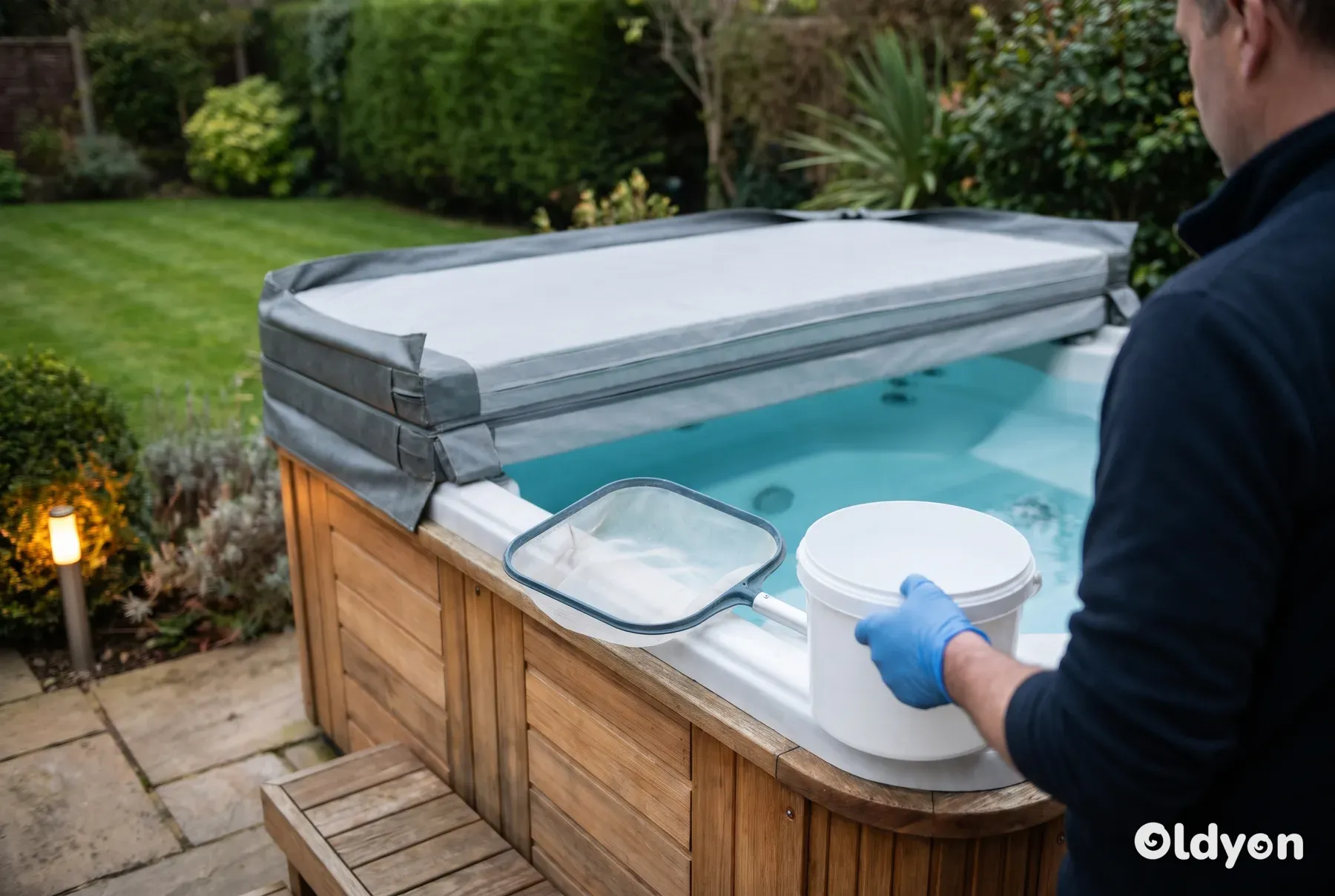
You will need disposable gloves, a fine-mesh skimmer net or a small plastic container, a bucket, a bin bag and household bleach for cleaning your equipment afterwards. Avoid using a vacuum, because it can break the stool apart and push it into the plumbing.
Use a net or scoop that you keep only for faecal incidents. If you have to use your everyday skimmer net, do not put it back with your normal hot tub kit afterwards, because it can carry germs back into the tub the next time you skim. Bin it, or disinfect it and keep it separately for this job from then on.
Put your test kit or test strips beside the tub before you start removing the stool. That way you can test pH and chlorine as soon as the material is out, without taking off your gloves and going back into the house.
Make up a surface-cleaning solution before you start, so it is ready for the shell. Use unscented household bleach at roughly 15 ml of bleach per litre of water (about 1 tablespoon per US quart), and keep it in a labelled spray bottle. Scented bleach can leave residues that cause foaming in the fresh water.
- Keep the jets and pump off so the stool does not break up.
- Lower the net or container gently under the stool and lift it out in one smooth movement. Work slowly to avoid breaking it apart, and avoid splashing, because splashes spread contaminated droplets onto the shell, the surrounding area and you.
- Tip the stool into the bucket, carry it indoors and flush it down the toilet. Do not empty it into a drain, flower bed or the garden.
- If you used a net, either bag it and put it in the general waste, or soak it in a bleach solution made up as the bleach label directs, then rinse it well.
- Wipe any splashes on the shell, headrests or steps with a disposable cloth and bin the cloth.
- Spray the affected part of the shell with the diluted bleach solution from your spray bottle and leave it for a minute or two. Wipe it off with a fresh disposable cloth, then rinse the area with clean water.
- Remove your gloves by turning them inside out, put them in the bin bag and wash your hands well with soap and water, scrubbing for at least 20 seconds. Wash them the same way again after you handle the filter.
Once the material is out, the next step depends on what you found. Follow the formed stool route or the diarrhoea route below, not both.
How do you superchlorinate a hot tub after a formed stool?
For a formed stool in a domestic tub, a shock dose of chlorine is usually enough. Public pool guidance in the UK and the US treats formed stools as a lower risk, because the germs they carry are killed quickly by chlorine at the right level and pH.
Before you start, test the water. Chlorine works best at a pH of 7.2-7.6. If the pH is higher than that, correct it first, because chlorine becomes much weaker as pH rises. Our guide on how to shock a hot tub step by step covers dosing in more detail.
- Test the pH and adjust it into the 7.2-7.6 range. Let the pump run for about 15 minutes after adjusting, then retest.
- Work out your water volume from the manual. A typical four to six seater holds roughly 1,000 to 1,500 litres (about 260 to 400 US gallons).
- Add a chlorine shock dose following the product label for your volume. Many manufacturers suggest a dose that raises free chlorine to around 10 ppm, but products differ, so check your manual and the label.
- Dissolve granules in a bucket of tub water first if the label says so, then pour the solution slowly into the tub with the pump running.
- Once the shock is in, run the jets for a few minutes as well as the circulation pump. This sends the treated water through every jet line, not only the filter loop.
- Retest free chlorine a short while after shocking, for example after half an hour. If it has dropped quickly because the organic matter has used it up, add more shock so the level stays high for the whole treatment.
- Leave the cover open and let the circulation pump run for several hours so the treated water passes through the pipework and filter many times.
- Remove and clean the filter while the shock is working (see the filter section below).
- Wait until free chlorine has fallen back to 3-5 ppm and pH is 7.2-7.6 before anyone uses the tub again. This usually takes a day or so, sometimes longer.
Liquid chlorine (sodium hypochlorite) is a good choice for this job, because it mixes into hot water faster than granules. As a rule of thumb, about 10 ml of 10% liquid chlorine per 1,000 litres raises free chlorine by roughly 1 ppm. So about 150 ml takes a 1,500-litre tub from near zero to 10 ppm. Strengths vary between products, so check the label.
Any dose you work out from the water volume assumes the starting chlorine is close to zero. Always retest after adding it, and top up if the reading falls short of your target.
If you want complete certainty, you can also drain and refill the tub once the shock treatment is finished. A hot tub holds a small volume of warm water, so a fresh start is the safest option even after a formed stool, and it costs little compared with a pool.
If your tub runs on bromine, use a chlorine-based shock for this job. Chlorine shock is widely used in bromine tubs, but check your manual first, as some sanitising systems are not compatible with it.
If your tub has a UV or ozone system, keep it running, but do not rely on it here. These systems help with day-to-day water quality, but they do not replace a chlorine shock after a faecal incident.
Never mix chlorine with any other chemical, including pH products and bromine, in the same bucket or container. Add each product to the tub water separately, with the pump running, and wear gloves and eye protection.
Why does diarrhoea mean you should drain the tub?
The concern with diarrhoea is Cryptosporidium. This parasite has a tough outer shell that protects it from chlorine. The CDC notes that it can survive for days in water that is chlorinated to normal pool levels, which is why it is a leading cause of outbreaks linked to swimming.
Volume matters too. A hot tub holds about 1,100 to 1,900 litres (about 290 to 500 US gallons), compared with tens of thousands of litres in a garden pool. Any germs released into a hot tub are far more concentrated in the water, so you need to act faster.
Commercial pools sometimes deal with diarrhoea by holding very high chlorine levels for many hours under carefully controlled conditions. That is hard to do reliably at home. Most domestic tubs use stabilised chlorine granules, which add cyanuric acid to the water, and cyanuric acid slows down chlorine and makes this kind of treatment much less effective.
For context, US public pool guidance treats diarrhoea by holding free chlorine at about 20 ppm for roughly 13 hours, with the pH at 7.5 or below. That figure applies only to water with no cyanuric acid (stabiliser) in it. Once stabiliser is present, the same treatment takes much longer or may not work, so the figure does not translate reliably to a domestic tub.
Hot tubs also have a small volume of warm water, a lot of pipework and a cartridge filter that cannot reliably trap the parasite. For commercial spa pools, the HSE guidance HSG282 on spa-pool systems expects the pool to be drained, cleaned and disinfected after faecal contamination. For a domestic tub after diarrhoea, draining is the safe choice.
- Remove as much of the material as you can, following the removal steps above.
- Add a chlorine shock dose and run the pump for an hour or two. This disinfects the pipework before the water goes, and reduces the risk to you while you drain it.
- Switch the tub off at the isolator, then drain it fully. Our guide on how to drain a hot tub explains how to do this without damaging the heater or pump. The drain valve is usually low down on the side of the cabinet, and most tubs take about one to two hours to empty through it.
- Wear gloves while draining, and run the hose to a foul drain or toilet connection rather than onto the lawn, a pond or a surface water drain. Local rules vary, so check with your water company if you are unsure.
- If the drain valve leaves a few centimetres of water in the footwell, remove it with a submersible pump or a wet-and-dry vacuum so no contaminated water is left behind. A vacuum is fine at this stage, because the solid material has already gone.
- Remove the filter. Replacing it is the safest option after diarrhoea.
- Clean and disinfect the shell, seats, steps, headrests and the inside of the cover with a hot tub cleaner or a diluted bleach solution, then rinse thoroughly so no cleaner goes into the fresh water. Include the waterline and the jet nozzles, and leave the bleach solution on for about five minutes before rinsing.
- Use a soft cloth or soft brush on the shell, not an abrasive pad. Abrasive pads scratch acrylic and leave grooves where bacteria can hide.
- Leave the cover off for a short while so the empty shell can air out before you refill.
- If your water is hard, fit a pre-filter to the hose when you refill to reduce scale.
- Refill, fit the new or disinfected filter, balance the water, shock it and check that free chlorine and pH are in range before anyone uses the tub.
There is a second reason to keep the hose off the garden. Water from a tub that has just been shocked is heavily chlorinated, and it can scorch lawns and harm plants, as well as fish and other wildlife in a pond. Sending it to a foul drain avoids this.
If you use a commercial hot tub surface cleaner instead of bleach, choose one labelled as sanitising or disinfecting. A product that only says it cleans may lift grime without killing the germs left behind.
Balance the fresh water in a set order, because each step affects the next. Adjust total alkalinity to 80-120 ppm first, then pH to 7.2-7.6, then calcium hardness to about 150-250 ppm. Only then set the sanitiser to its normal level.
Once the water is balanced, run the jets for about 30 minutes to push the balanced water through the cleaned lines. Then test again before anyone gets in.
Do not rush the rebalancing after a refill. Unbalanced water irritates skin and eyes, and the wrong pH weakens the chlorine that is meant to protect the fresh water.
Purging the pipes matters more after diarrhoea than at a routine water change. Bacteria can survive in biofilm, a slimy layer on the inside of the plumbing, even after the tub has been drained. If you refill without purging, those germs can be released into the fresh water, even though the shell looks perfectly clean.
A pipe purge product before draining is also worth using if you have one, as it lifts biofilm from inside the plumbing. Our guide on how to deep clean a hot tub at water change covers the shell, cover and pipework step by step.
When you use a pipe purge, run the jets on high for the time given on the label. Expect brown or grey foam to rise to the surface. This is biofilm coming out of the pipes, and it shows the purge is working.
If you would rather not purge in the old water, you can purge in a small amount of fresh water once the tub is empty:
- Partly refill the empty tub with about 15-20 cm (6-8 inches) of fresh water, enough to cover the jets.
- Add the line purge product as the label directs.
- Run the jets on high for 30-60 minutes.
- Drain this purge water completely.
- Rinse the shell again before the final refill.
What should you do with the filter?
The filter traps whatever the water carries, so it needs attention in both cases. Take it out while the pump is off, wearing gloves, and handle it as if it is contaminated.
After a formed stool
Rinse the cartridge thoroughly with a garden hose, working between each pleat from top to bottom. Then soak it in a filter cleaner, or a chlorine solution made up as your filter or chemical label directs, rinse well and let it dry before refitting. A spare filter lets you keep the tub running while the dirty one soaks.
A filter-cleaning wand on the hose is worth using if you have one. It gets between the pleats far better than an open hose.
For a disinfecting soak, a solution of 1 part household bleach to 10 parts water is a common choice. Follow it with a very thorough rinse, and check the filter maker's advice first, as some recommend a specific cleaner instead.
Leave the filter in the cleaning or chlorine solution for at least an hour, or overnight for a thorough clean. Then rinse it until no solution is left, because leftover cleaner upsets the water chemistry once the filter goes back in.
After diarrhoea
Replace the cartridge if you can. Cryptosporidium is very small and resistant to chlorine, so a soak cannot be relied on to remove it from the fibres. If you cannot get a replacement straight away, give the old filter a long chlorine soak, rinse it well and replace it as soon as a new one arrives.
Replace the filter in either case if it is old, cracked, has flattened pleats or the end caps are damaged. A worn filter traps less and is harder to clean properly. Replace it rather than cleaning it if it is more than about 12 months old and has had regular use, or if the water stays cloudy after you have cleaned it and refitted it.
What are the health risks of faecal contamination?
Faeces can carry bacteria such as E. coli, Shigella and Salmonella, viruses such as norovirus and hepatitis A, and parasites such as Giardia and Cryptosporidium. Swallowing even a small amount of contaminated water can be enough to make someone ill, which is why nobody should go back in until the water has been treated.
Hot tub water is usually kept at 38-40°C (100-104°F), which helps bacteria multiply faster than they would in cooler pool water. This is another reason to start removing the material and treating the water straight away, rather than leaving it until later.
How long do the germs survive in water?
These germs do not all respond to chlorine in the same way. Giardia is less resistant to chlorine than Cryptosporidium, but it can still survive for days to weeks in water. Cryptosporidium can stay infectious for weeks to months, and the warm water in a hot tub does not kill it.
In water held at normal chlorine levels, Giardia is mostly killed within a few hours. Cryptosporidium is different: normal chlorine levels do not reliably kill it, which is why diarrhoea needs a drain rather than a standard treatment.
E. coli can survive for hours to days in untreated water, but it dies within minutes at normal chlorine levels. Hepatitis A can survive for days to weeks in water and is more resistant than E. coli, which is another reason to use a proper superchlorination dose rather than relying on everyday levels.
Symptoms to watch for
Symptoms of a stomach infection usually start within a few days of exposure. Watch anyone who was in the water for:
- Diarrhoea, which may be watery
- Stomach cramps or pain
- Feeling sick or being sick
- A mild fever
- Loss of appetite or tiredness
Young children, older people and anyone with a weakened immune system are the most likely to become seriously ill after swallowing contaminated water. Keep a closer eye on them in the days after an incident, and act early if they start to show symptoms.
Most cases clear up on their own with rest and plenty of fluids. The NHS guidance on diarrhoea and vomiting explains how to look after yourself at home and when to get help. A pharmacist can advise on rehydration products.
Illness caused by Cryptosporidium can last for several weeks, not just a few days. If stomach symptoms keep going after a hot tub incident, speak to a GP rather than waiting for them to pass.
Contact a GP or NHS 111 if symptoms last more than a week, if there is blood in the diarrhoea, or if a baby, young child, older person or someone with a weakened immune system shows signs of dehydration, such as passing little urine or being unusually drowsy.
What about hot tub folliculitis?
Hot tub folliculitis, an itchy, bumpy rash, is a different problem. It is usually caused by Pseudomonas bacteria that grow in warm water with too little sanitiser, not by faeces. Keeping chlorine or bromine at 3-5 ppm prevents both.
There is still a link to faecal incidents. Faecal matter uses up chlorine quickly, and the low sanitiser level that follows creates the conditions in which the bacteria behind folliculitis can multiply. Testing and correcting the water after an incident protects against both problems.
The rash shows up as red, itchy bumps or small pus-filled spots, mainly where a swimsuit covered the skin. It usually appears 12 to 48 hours after using the tub.
Hot tub folliculitis does not spread from person to person, and in healthy people it usually clears up on its own within 7 to 10 days. Stay out of the tub while you have it. See a GP if it lasts more than two weeks, spreads widely or comes with a fever.
In people with a weakened immune system, the rash can spread across the body and last longer. If that applies to you or someone in your household, see a GP sooner rather than waiting for it to clear.
How can you stop it happening with young children?
Most incidents involve young children, so prevention is mostly about how and when they use the tub. Many manufacturers advise against hot tubs for children under five, and the right age and temperature for older children varies, so check your manual and our hot tub safety rules.
- Take children to the toilet just before they get in, and again every 30 to 60 minutes.
- Keep sessions short and the water cooler for children, well below the 40°C (104°F) maximum for adults.
- Limit children's continuous soaks to around 10-15 minutes, and let them cool down outside the tub before going back in. Hot water raises body temperature and can cause dizziness and dehydration.
- Do not rely on swim nappies. They hold in a formed stool for a short time but do not stop diarrhoea leaking into the water.
- Keep anyone who has had diarrhoea out of the tub until 2 weeks after their symptoms have stopped, which matches NHS advice for swimming.
- Everyone showers with soap before getting in, children included.
- Watch children closely the whole time they are in the water, and get them out at the first sign they need the toilet.
The limit of about 15 minutes per soak, with cool-down breaks, also applies to pregnant people and older adults. Hot water raises body temperature and can strain the heart, as well as causing dizziness and dehydration. Anyone who is pregnant should check with their midwife or GP before using a hot tub.
The same habits protect adults and guests too. Our hot tub hygiene rules for owners and guests cover showering, swimwear and what to do when someone is unwell.
When should you call a professional?
Most owners can deal with an incident themselves. It is worth calling a hot tub service technician if you cannot drain the tub safely, if the pump or heater shows an error after refilling, or if the water stays cloudy or smells despite correct chemical levels.
It is also worth calling a professional in any of these situations:
- Several people had diarrhoea in the tub, or there was a large amount of contamination.
- Anyone becomes ill with stomach symptoms after using the tub.
- You do not have the right chemicals, or a test kit that can confirm your chlorine level.
- Your plumbing is complex, for example with multiple jet zones or an in-ground installation.
- The water is still discoloured after the full clean-up, which can point to remaining contamination or a failing filtration system.
If you run a holiday let, a gym or any tub used by paying guests, follow the HSE guidance for commercial spa pools and your own written procedures. Those rules are stricter than anything in this guide, and record keeping is expected.
Summary: the key points
- Get everyone out, turn off the jets, close the cover and put gloves on.
- Decide whether it is a formed stool or diarrhoea. If you are unsure, treat it as diarrhoea.
- Formed stool: remove it, correct pH to 7.2-7.6, shock with chlorine, clean the filter and wait for free chlorine to return to 3-5 ppm.
- Diarrhoea: remove what you can, shock, then drain, clean, replace the filter and refill.
- Watch for stomach symptoms over the next few days and contact a GP or NHS 111 if they are severe or last more than a week.
- Toilet breaks, short sessions and no tub for 2 weeks after diarrhoea prevent most incidents.
Frequently asked questions
Can I just use more chlorine instead of draining after diarrhoea?
It is not recommended for a domestic tub. Cryptosporidium needs very high chlorine for many hours to be killed, and the cyanuric acid in stabilised chlorine granules slows this down a great deal. You also cannot easily confirm it has worked. Draining, cleaning and refilling a hot tub takes less time and chemical than trying to hold extreme chlorine levels, and it is far more reliable.
How long after shocking can we use the hot tub again?
Wait until free chlorine has dropped back to 3-5 ppm and pH is between 7.2 and 7.6. After a strong shock dose this often takes around a day, but it depends on the dose, temperature and whether the cover is off. Test the water with strips or a test kit rather than going by time alone, and never get in while chlorine is above the normal range.
Do I need to clean the hot tub cover after a poo incident?
After a formed stool with no splashing, wiping the underside of the cover with a hot tub cleaner is usually enough. After diarrhoea, clean and disinfect the whole underside, including the seams, because the cover sits in contact with steam and splashes. Rinse it well afterwards so cleaner residue does not end up in the fresh water and cause foaming.
Is it safe if a dog or other pet had an accident in the hot tub?
Treat it the same way as a human incident. Remove the material, then shock the water for a formed stool or drain for loose stools. Animal faeces can carry their own bacteria and parasites. It is also best to keep pets out of the tub altogether, because hair and claws can damage the shell and clog the filter.
Should someone who swallowed the water see a doctor?
Not usually, unless they become unwell. Watch for diarrhoea, stomach cramps or sickness over the following days. Speak to a pharmacist for advice on fluids, and contact a GP or NHS 111 if symptoms are severe, last more than a week, include blood, or affect a baby, older person or someone with a weakened immune system.
Can I use household bleach in my hot tub?
Use diluted household bleach only for cleaning the empty shell, nets and equipment, and rinse thoroughly afterwards. Do not use it to sanitise the water. Household bleach is not made for hot tubs, its strength varies, and some products contain fragrances or additives that can cause foaming or damage. Use a chlorine product sold for hot tub water treatment instead.
Filed under