How to fix green hot tub water
Learn how to fix green hot tub water: brush, shock hard, clean or replace the filter, purge the pipes and know when draining is the better choice.
To fix green hot tub water caused by algae, lower the pH into range, brush every surface, shock hard with chlorine, then clean or replace the filter. If the green returns, purge the pipes with a line flush product, drain, clean the shell and refill. Most tubs clear within one to three days.
This guide covers the full algae fix, from the first brush to the moment the water is safe again. If you are not yet sure the green is algae, read why hot tub water turns green first, because metals in the water need a different treatment.
Is it algae or metals in the water?
Two things turn hot tub water green: algae, and dissolved metals such as copper. The treatments are almost opposite. Shocking kills algae, but a heavy shock can make metal staining worse.
This is why the diagnosis must come before any chemical goes in. A metal sequestrant added to an algae problem achieves nothing, because it does not kill algae. Shock or algaecide added to a copper problem makes it worse, because shock can turn dissolved copper into stains and copper-based algaecides add even more metal.
Take two minutes to check before you start. Run your hand along the waterline and under a seat, and look at the water against the white of the shell.
Sign | Algae | Dissolved metals |
|---|---|---|
Colour | Yellow-green to dark green | Teal or blue-green tint |
Smell | Musty or earthy | Metallic, or no smell |
Water clarity | Cloudy or murky green | Often clear, with a green or blue tint |
Surfaces | Slimy film that wipes off | Smooth, stains that do not wipe off |
Sanitiser reading | Low or zero | Often normal |
When it appears | After low sanitiser or a missed week | After a fresh fill, a shock or a pH drop |
Response to shock | Clears over one to three days | No change, or gets darker |
Algae needs three things: warm water, light and low sanitiser. Even indirect daylight is enough. If free chlorine falls below about 1 ppm, a warm tub can turn visibly green within 24 to 48 hours.
Copper usually comes from corroded heater elements, copper pipework or copper-based algaecides. When the pH falls below 7.2, the water becomes acidic enough to dissolve these parts faster, which releases more copper into the water.
If your results point to algae, carry on with the steps below. If they point to metals, stop here and treat with a metal sequestrant instead of shocking.
How to test for copper
- Take the water sample from about elbow depth, not from the surface. Surface water can give a misleading reading.
- Test for copper with a metals test strip, following the timing on the pack.
- Test free chlorine and pH from the same sample.
- Read the results together. Copper above about 0.2 ppm with clear, teal water points to metals. Normal copper with free chlorine below 1 ppm and murky green water points to algae.
How to get accurate test strip readings
Test strips are easy to use, but small mistakes can give a false reading and lead you to the wrong treatment. Follow these habits every time you test.
- Keep wet fingers off the test pads, as water or residue from your skin can change the colour
- Dip the strip for the time on the pack, then hold it level and do not shake off the water
- Read the strip against the colour chart in natural daylight, not under a warm indoor bulb
- Read it within the time the pack gives, as the colours keep changing after that
- Do not use strips past their expiry date
- Replace strips from a container that has been open for a long time, as moisture and air slowly spoil them, and check the pack for how long they last once opened
- Keep the lid tightly closed and store the strips somewhere cool and dry
What to do if copper is the cause
A metal sequestrant is a product that binds dissolved metals, so they cannot stain the shell and the filter can catch them. It does not kill algae, so use it only when your tests point to metals.
- Add a metal sequestrant at the dose on the label before any shock. Shocking first can make the copper plate onto the shell as a stain that is much harder to remove.
- Do not use a copper-based algaecide. It adds more copper and makes the discolouration worse.
- Bring the pH back to 7.2-7.6 so the water stops dissolving metal parts.
- Run the jets and let the water circulate for about 24 to 48 hours. Metal tints clear more slowly than algae.
- Clean the filter after treatment. The filter collects the bound metals, so expect it to need a thorough clean once the water has cleared.
- Retest copper afterwards. Aim for under 0.2 ppm, and add more sequestrant if the reading is still high.
What do you need before you start?
Gather everything first so you can work through the fix without stopping. Once algae is weakened by the shock, you want to finish the job the same day.
Plan for roughly 2 to 4 hours of active work, plus 12 to 24 hours of circulation while the treatment does its job. A weekend morning is a good time to start.
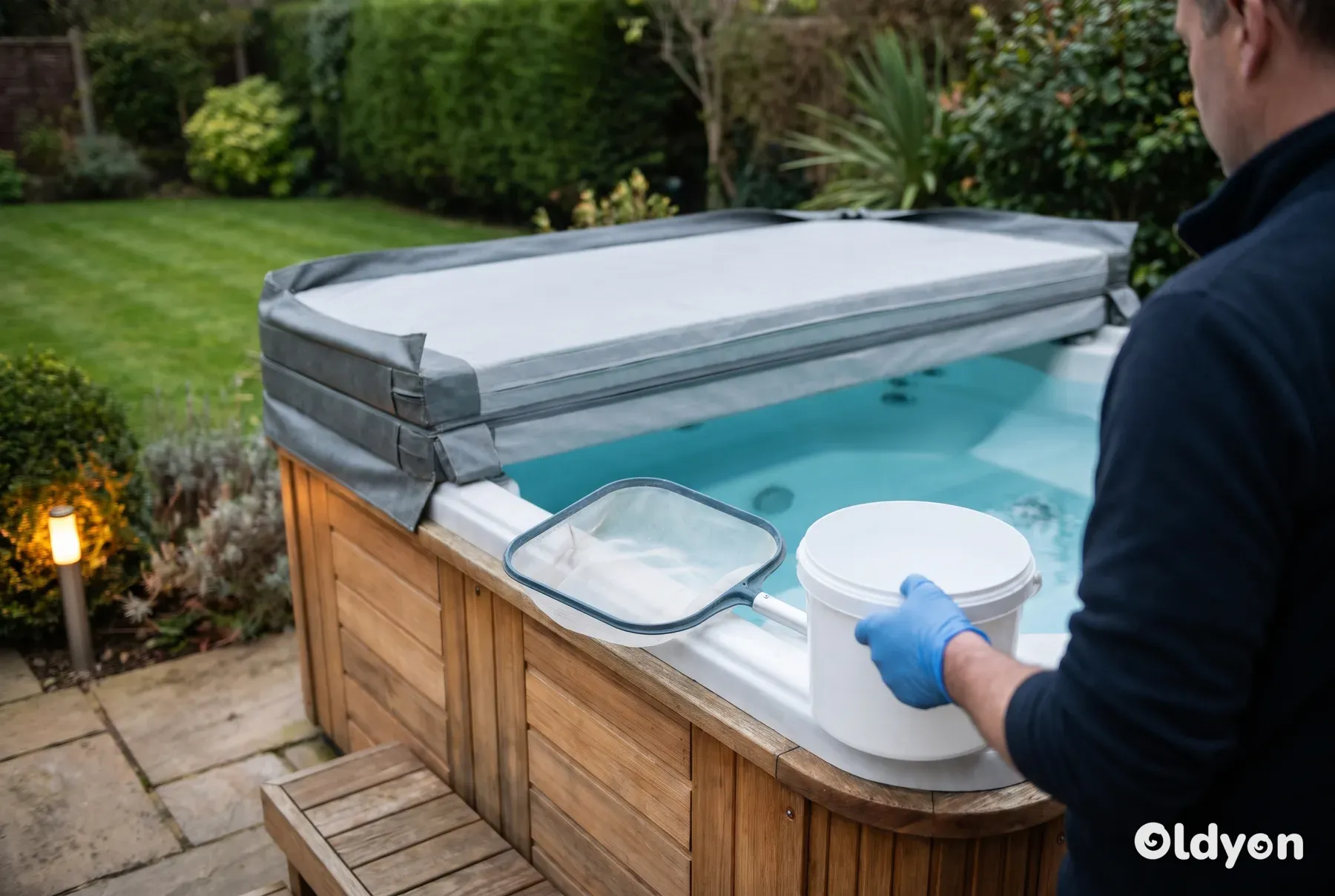
- A reliable test kit: test strips work, but a liquid or tablet kit gives more accurate chlorine readings at high levels
- A digital water tester, as an alternative to a liquid kit: it gives more precise readings than test strips, which helps when you are deciding between algae and metals
- Metals test strips, to rule out copper
- pH increaser, pH decreaser and alkalinity increaser, depending on your readings
- Chlorine shock granules (usually dichlor) made for hot tubs
- A soft brush or non-scratch sponge that is safe for acrylic
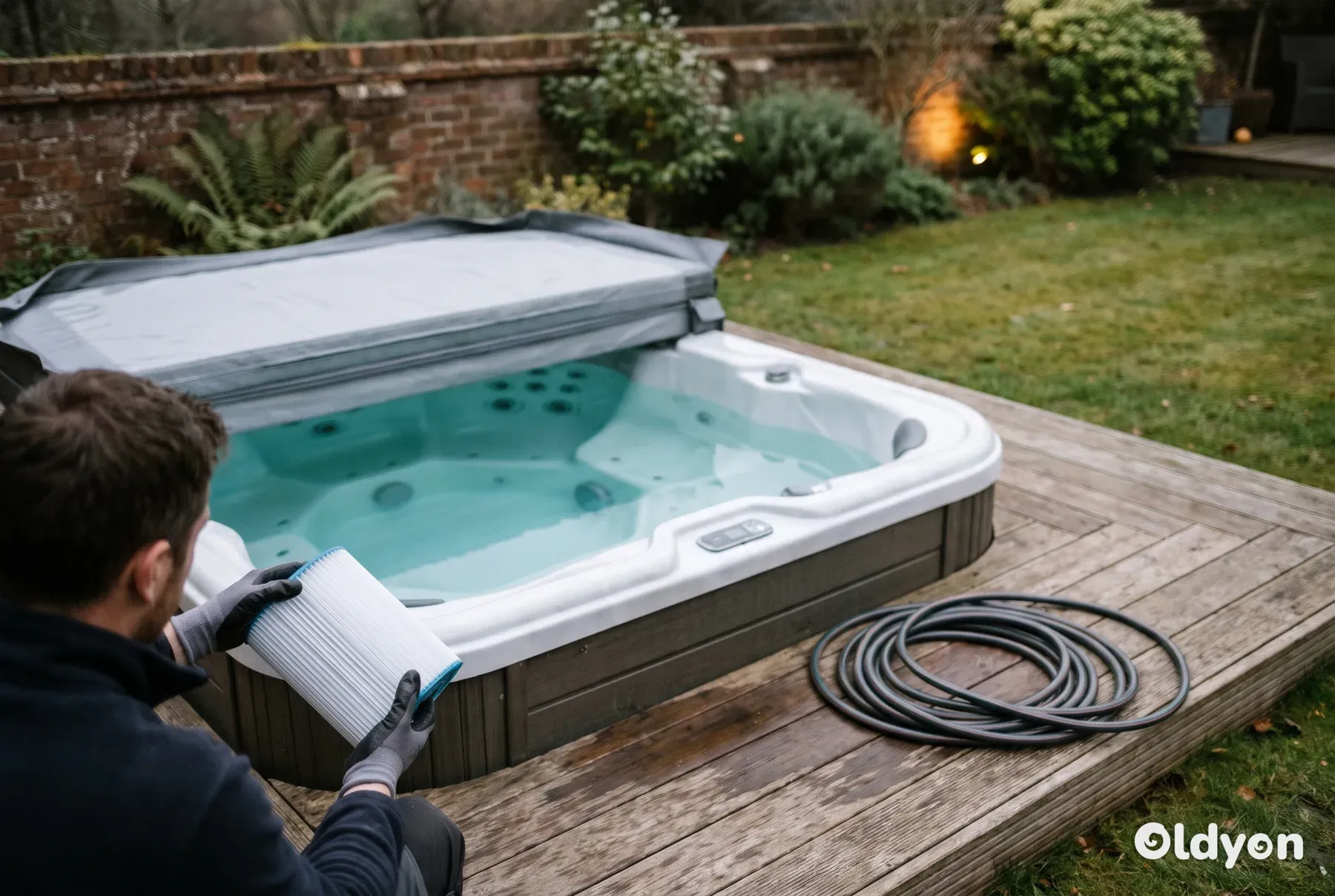
- A garden hose with a filter cleaning nozzle, or a filter cleaning wand
- Filter cleaner, either a soak or a spray
- A spare filter cartridge, or a new one if your current filter is old
- A hot tub line flush or pipe purge product, if you plan to drain
- Rubber gloves and eye protection
If you use a digital tester, check which readings it covers before you rely on it. Many measure pH and chlorine but not copper, so you may still need metals strips. Follow the maker's instructions for calibration and keep the sample cell or probe clean, as a dirty one gives false readings.
Balancing products are sold under many different names, so check the active ingredient on the label to be sure you have the right one. Alkalinity increaser is usually sodium bicarbonate. pH increaser is usually sodium carbonate, sometimes called soda ash. pH decreaser is usually sodium bisulphate, sometimes called dry acid. Some products use other ingredients, so always follow the dose on the pack you are using.
Safety first: switch the hot tub off at the isolator before removing the filter. Always add chemicals to the water, never water to chemicals, and never mix different chemicals together, even in a bucket. Wear gloves and eye protection and keep children and pets away while you work.
How to fix green hot tub water step by step
This is the full fix for an algae bloom when you plan to keep the water. It works for light to moderate green in water that is less than a few months old.
- Test the water. Note the free chlorine (or bromine), pH and total alkalinity before you add anything.
- Balance the alkalinity and pH. Bring total alkalinity to 80-120 ppm first, then pH to 7.2-7.6. Chlorine works much better in this pH range, so this step makes the shock far more effective. After adding alkalinity increaser, run the jets for about 20 minutes and retest before you adjust the pH. If the pH is below about 7.2, add pH increaser. If it is above 7.6, add pH decreaser. Then retest the pH after about 30 minutes of circulation.
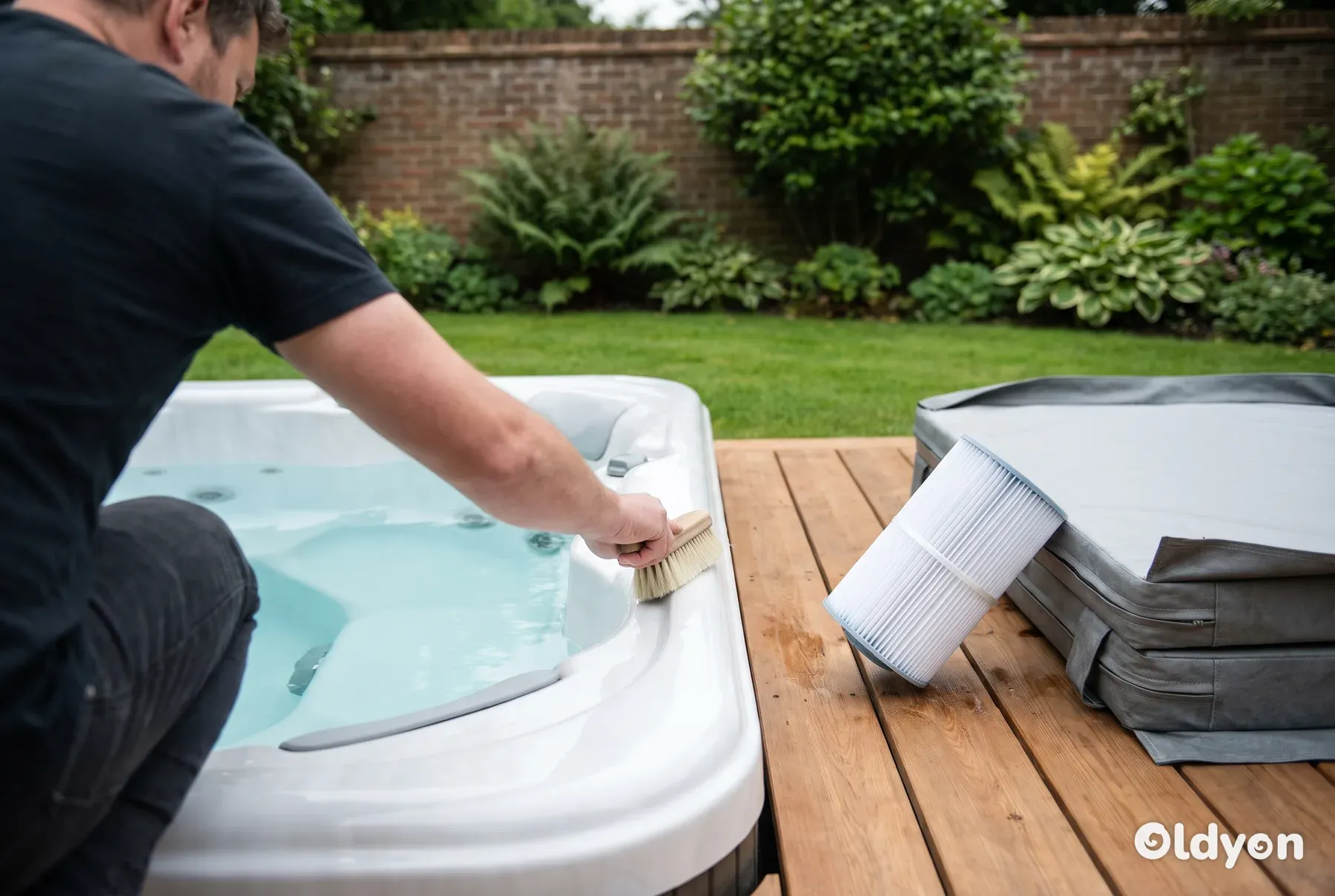
- Brush every surface. Scrub the walls, seats, footwell, the waterline, under the headrests and around each jet. Algae shelters in these spots, and brushing breaks up the protective film so the chlorine can reach it.
- Remove the filter and wipe the inside of the filter housing. Algae often collects in the housing, where shocked water does not reach well.
- Shock hard with chlorine. Use a chlorine shock at the dose the label gives for algae or superchlorination, based on your tub's volume. For green water this is typically around double the normal maintenance dose, but check the label. Scatter the granules across the surface while the jets run, walking around the tub as you go. Run the jets on high for at least 30 minutes, and leave the cover off or cracked open for 1 to 2 hours so the gases can escape.
- Clean the filter while the shock works. Rinse it thoroughly, then soak or spray it with filter cleaner and rinse again. Leave a soak on for about 15 minutes, or overnight if the filter is heavily soiled. If you have a clean spare, fit that instead.
- Circulate the water. Once the filter is back in, keep the jets on high for at least two hours of continuous running. A tub turns over its full volume every 15 to 30 minutes, so this passes the water through the filter many times. If chlorine is still very high, keep the cover on but slightly cracked, as this holds in the heat that helps the chemicals work.
- Check the water by eye every few hours. If the diagnosis and treatment are right, cloudy green water should begin to lighten within 4 to 8 hours.
- Retest after a few hours. If free chlorine has dropped sharply, the algae is still using it up. Shock again and keep the jets running.
- Brush again the next day and rinse the filter again. Dead algae settles on surfaces and in the filter, and it will feed new growth if you leave it.
- Reassess at 24 hours. If the water is still green after 24 hours of treatment, suspect a misdiagnosis. Retest for copper before you assume the algae is simply stubborn.
- Wait for the water to clear and the chlorine to settle. Once the water is clear and free chlorine has fallen back to 3-5 ppm on its own, rebalance the pH and return to normal care.
For more detail on dosing and timing, see our guide on how to shock a hot tub step by step.
Why correct alkalinity before pH?
Total alkalinity acts as a buffer that holds the pH steady. When alkalinity is too low, the pH swings up and down with every chemical you add. When it is too high, the pH is hard to move at all.
Fixing alkalinity first gives the pH a stable base. Your pH adjustment then takes less product and stays where you set it, which keeps the chlorine working at full strength during the shock.
Final retest: what to check
Run a final retest 12 to 24 hours after treatment. Check every target together, because one reading out of range can undo the others.
- pH: 7.2-7.6
- Total alkalinity: 80-120 ppm
- Free chlorine or bromine: 3-5 ppm
- Copper: under 0.2 ppm
- Water: fully clear, with no green tint
If the water is still green, shock again and keep the jets running. If copper is high, add more metal sequestrant. If the pH or alkalinity is off, adjust alkalinity first, then pH, and retest after circulation.
How hard should you shock for algae?
A routine weekly shock is not enough for an algae bloom. You need to raise free chlorine well above the normal 3-5 ppm and keep it high until the algae is dead. Many technicians aim for around 10 ppm, but product strengths differ, so follow the dose on your shock label for your volume of water.
The key is holding the level, not hitting it once. If the reading falls back within a few hours, the algae is still active, so dose again. When the chlorine holds steady overnight, the bloom is beaten.
What if your tub uses bromine?
Most hot tub specialists recommend a chlorine shock to clear algae, even in a bromine tub, because it acts quickly and strongly. Adding chlorine to bromine water also reactivates spent bromide in the water.
Non-chlorine shock (usually MPS) is good for routine oxidising, but it is not a sanitiser and will not reliably kill an algae bloom. Some manufacturers have specific advice for their systems, so check your manual first.
Should you clean or replace the filter?
The filter holds a large amount of algae once the shock starts working. A rinse alone will not remove it from deep inside the pleats, so use a proper filter cleaner and rinse from the top of each pleat downwards. Our guide to cleaning a hot tub filter properly covers the method in full.
A clogged filter feels stiff when you press the pleats and looks discoloured. Cleaning usually restores it, but not always.
Replace the filter rather than cleaning it if any of these apply:
- The pleats are frayed, flattened or torn
- The end caps are cracked or loose
- The filter stays green or slimy after a chemical clean
- The filter stays permanently discoloured after a full soak
- The filter is more than about a year old, or past the age your manufacturer recommends
- The algae came back after a previous clean
Keeping a second filter is useful here. You can fit the clean spare straight away and give the dirty one a long soak without leaving the tub unfiltered.
Why purge the pipes?
Hot tub pipework is full of narrow, warm, dark spaces. Algae and bacteria can hide there inside a slimy layer called biofilm, which protects them from normal chlorine levels. This is the most common reason green water returns a week after it seemed to clear.
A line flush product loosens this layer so it can be pumped out. Add it to the old water before you drain, run the jets for the time on the label, then drain. Expect foam and floating debris; that shows it is working. Read more in our guide on how to get rid of biofilm in a hot tub.
When should you drain instead of treating?
Treating green water saves water and chemicals, but it does not always work. Old water is full of dissolved solids, and these make every chemical you add less effective.
Drain and refill if any of these apply:
- The water has been in the tub for three months or more, or past the interval in your manual
- The tub is dark green or you cannot see the footwell
- The water stays green after two full shock treatments
- The water has stayed green for more than 72 hours despite treatment
- The algae returned within a week or two of clearing
- The water smells musty or stale even with chlorine in it
- There is a strong sulphur or sewage smell, which points to bacterial growth beyond what normal treatment can handle
- You can see slime or biofilm inside the shell or on the jets, which needs a drain and deep clean rather than just a shock
- You cannot get the pH or alkalinity to hold steady
Do not simply pull the plug on green water. If you drain without killing the algae and purging the pipes, the algae left in the plumbing will grow into your fresh water. Follow the full drain procedure below.
How to drain and refill after algae
- Shock the green water with chlorine and run the jets, so the algae is weakened before you drain.
- Add a line flush product and run the jets for the time on the label.
- Switch off at the isolator, then drain the tub fully using the drain valve or a submersible pump.
- Brush and wipe the empty shell with a hot tub surface cleaner, paying attention to jets, seats and the filter housing. Rinse well.
- Clean the underside of the cover with a cleaner made for hot tub covers, then rinse and let it dry.
- Fit a clean or new filter.
- Refill through the filter housing if your manual allows, as this pushes air out of the pipes and helps prevent airlocks.
- Switch on, balance alkalinity and pH, then shock and bring sanitiser to the normal range before anyone uses the tub.
A typical tub of 1,500 litres (about 400 US gallons) can take a few hours to fill and heat. Plan the work for a day when you do not need the tub straight away.
If you fill from a well or another source with a high mineral content, test the fill water for metals before you start. Add a metal sequestrant at every refill, so copper in the supply does not discolour your fresh water.
Is it safe to use a green hot tub?
No. Do not use a hot tub while the water is green, cloudy or being shocked. Algae itself is not usually the main concern. The problem is that algae only grows when sanitiser has run low, which means bacteria can grow too.
Warm, poorly sanitised water can carry Pseudomonas aeruginosa, which can cause an itchy, bumpy rash known as hot tub folliculitis. The NHS has guidance on folliculitis and when to get help. Hot tubs can also spread Legionella through the fine spray above the water, which is why the Health and Safety Executive gives guidance on Legionnaires' disease for spa pools.
Hot tub folliculitis typically shows as red, itchy bumps, often on skin that was covered by swimwear. The rash usually appears 12 to 48 hours after using the tub.
Pseudomonas lives in biofilm on the shell and inside the pipes. It is also harder for chlorine to kill when the pH is out of range. This is why keeping the pH at 7.2-7.6 and removing biofilm matter for safety, not only for clear water.
If you or anyone in your household develops a rash, ear pain, sore eyes, or flu-like symptoms after using a tub with poor water, stop using it. Speak to a pharmacist or your GP, and mention the hot tub. If someone has a high temperature with breathing problems, contact NHS 111 or your GP promptly.
Why you should not get in too soon after a shock
After a green-water shock, free chlorine can reach 10 ppm or higher. Getting in at this level can cause skin irritation and red, sore eyes. In more serious cases it can cause chemical burns, such as hair loss on the legs.
Do not judge the water by smell. Chlorine at 8 to 10 ppm can smell faint and still be harsh on skin. Always take a fresh test reading before anyone gets in.
When is it safe to get back in?
Wait until all of these are true before anyone uses the tub again:
- The water is fully clear and you can see the floor of the footwell
- Free chlorine is back to 3-5 ppm (or bromine 3-5 ppm)
- The pH is 7.2-7.6
- There is no strong chemical smell above the water
- The temperature is no higher than 40°C (104°F)
After a heavy shock this usually takes from several hours to a day or more. If the water clears but looks hazy, our guide on how to clear cloudy hot tub water explains the next step.
Hot tubs and heart conditions
Hot water raises your heart rate and puts extra strain on your circulation. If you have a heart condition or an irregular heart rhythm, such as atrial fibrillation, speak to your GP or specialist before using a hot tub, even when the water is perfectly balanced.
Why does the algae keep coming back?
If the green returns within days or weeks, something in the fix was missed. These are the most common causes.
- The shock was not strong enough, or chlorine was not held at a high level until the algae died
- The shock itself was old or degraded, so it did not deliver an effective dose: replace chlorine shock that has been stored for over a year or has clumped
- The pH was too high during the shock, so the chlorine was weak
- The filter was rinsed but not chemically cleaned, so it reseeded the water
- The filter housing, headrests or cover underside were not cleaned
- Algae and biofilm remained in the pipes because the lines were not purged
- The water was too old for the chemicals to work properly
- Sanitiser was allowed to run low again after the tub cleared
Work through the list honestly. In most cases a single missed step explains a repeat bloom, and doing that step properly ends the problem.
If the water turns green again after a full drain and refill, look beyond the chemicals. A biofilm colony in the pipes may need another line flush. A failing heater element can leach copper into the water, and a cracked filter housing can let dirty water bypass the filter.
When to call a hot tub technician
Ask a professional to look at the tub if the water turns green again after a full drain, purge and refill. This can point to a circulation problem, a failing pump, or a fault with an ozone or UV system that is no longer doing its job.
Also get help if you see leaks, error codes, or the heater or pump stops working during the fix. Do not open the equipment bay or touch electrical parts yourself.
How do you stop the water turning green again?
Algae is almost always a sign that sanitiser dropped too low for too long. A short, regular routine prevents it far more easily than any fix.
- Test the water two or three times a week, and before each use if the tub is busy
- Keep free chlorine or bromine at 3-5 ppm at all times
- Keep pH at 7.2-7.6 and total alkalinity at 80-120 ppm
- Shock once a week, and after heavy use or a party
- Rinse the filter weekly and give it a chemical clean about once a month
- Wipe the waterline and headrests every week
- Shower before using the tub, to reduce the load on the sanitiser
- Keep the cover closed when the tub is not in use, as daylight helps algae grow
- Check the cover regularly: a cracked or waterlogged cover lets in debris and loses heat, and both unbalance the water
- Drain and refill every three to four months, or as your manual advises
The right drain interval depends on how much the tub is used. Every three to four months suits 2 to 4 people using it three to four times a week. If more people use it, or they use it more often, drain more often.
If you are going away, top up the sanitiser and shock before you leave. Ask someone to check the levels if you will be gone for more than a few days, especially in warm weather.
What other water problems should you watch for?
While you are fixing green water, you may notice foam on the surface or the water level dropping. Both are common, and both are easy to check.
Why is my hot tub water foamy?
Foam usually comes from soap-like residues in the water. Body lotion, shampoo, cosmetics and detergent left in swimwear all build up over time. Low calcium hardness makes the water softer and more likely to foam.
- Add a spa defoamer for a quick fix, but remember it only hides the foam for a short time
- Ask everyone to shower before using the tub, to wash off lotions and products
- Rinse swimwear in plain water without detergent before it goes in the tub
- Test calcium hardness, and raise it to roughly 150-250 ppm if it is low
If the foam keeps coming back despite defoamer, the water usually has too many dissolved solids. At that point no chemical will fix it for long, so drain and refill the tub.
Is the water level dropping from evaporation or a leak?
Normal evaporation is slow and steady, roughly 1 to 2.5 cm (about 0.5 to 1 inch) a week. It is faster in hot, dry or windy weather, or when the cover is left off. There are no wet spots around the tub.
A bigger drop than this suggests a leak. So do damp patches around the cabinet, or water pooling near the jets or the equipment bay.
- Top up the water to its normal level and mark the waterline with a piece of tape.
- Switch the jets off and leave the tub for 24 hours, keeping the cover on to limit evaporation.
- Measure how far the level has dropped.
- Repeat the test for 24 hours with the jets running, and compare the two results.
- If the level drops by the same amount with the jets off as with them on, the leak is probably in the shell or the plumbing fittings rather than the jet seals. Ask a hot tub specialist to inspect it.
Switch off at the isolator before you look near the equipment bay, and do not open it yourself. Water and electrical parts together need a qualified technician.
Green water fix in brief
Confirm the green is algae, not metals. Balance alkalinity and pH, brush every surface, and shock hard with chlorine while running the jets. Clean or replace the filter, retest, and shock again until the chlorine holds.
If the water is old, very green, or the algae keeps returning, purge the pipes, drain, clean the shell and cover, and refill. Stay out of the tub until the water is clear and sanitiser and pH are back in range.
Frequently asked questions
How long does it take to clear green hot tub water?
A light algae bloom often clears within 24 hours of a strong chlorine shock, as long as the pH is in range and the filter is clean. Heavier green can take two or three days and several shocks. If it is not clearing after two full treatments, draining is usually quicker than continuing to add chemicals to tired water.
Can I use household bleach to kill algae in a hot tub?
Household bleach contains chlorine, but its strength varies and some types contain fragrances or additives that are not suitable for hot tubs. Many hot tub manufacturers advise against it and it may affect your warranty. A chlorine shock made for hot tubs gives a known dose and is the safer choice. Check your manual before using anything else.
Why did my water turn green straight after I shocked it?
Water that turns green within minutes or hours of a shock, while staying clear, usually points to dissolved metals rather than algae. The shock oxidises copper or iron and makes the colour visible. This is common after filling with well water or water from copper pipes. Stop shocking and treat with a metal sequestrant instead.
Is slightly green water safe for a quick soak?
No. Even a faint green tint from algae means sanitiser has been too low for some time, so bacteria may also be present. Fix the water first, then use the tub once it is clear and free chlorine and pH are back in range. A short delay is far better than risking a skin, ear or eye infection.
Will a flocculant or clarifier fix green water?
No. Clarifiers and flocculants clump fine particles so the filter can catch them, but they do not kill algae. They can be helpful after the algae is dead, if the water is still hazy. Use them only once the shock has worked, and follow the label closely, as too much clarifier can cause cloudiness.
Does an ozone or UV system stop algae?
Ozone and UV systems help by reducing the load on your sanitiser, but they only treat water as it passes through them. They do not leave a lasting residual in the tub, so you still need chlorine or bromine at 3-5 ppm. If algae appears despite these systems, check that the unit is working and serviced as your manufacturer recommends.
Filed under