How to clear cloudy hot tub water step by step
Learn how to clear cloudy hot tub water step by step: test, balance, clean the filter, shock, clarify, and know when it is time to drain and refill.
To clear cloudy hot tub water, work in a fixed order: test the water, balance alkalinity and pH, clean or replace the filter, shock the water, then add a clarifier if a fine haze remains. If the water is still cloudy after all of that, drain and refill. Most cloudy hot tubs clear within one to two days.
The order matters because each step helps the next one work. Shock works poorly when pH is high, and a clarifier only helps if the filter is clean enough to catch what it gathers. If you are not sure why the water turned cloudy in the first place, read what causes cloudy hot tub water alongside this guide.
What will you need before you start?
Gather everything before you begin so you can work through the steps in one session. Most of it is the same kit you already use for weekly care.
- Test strips or a liquid drop test kit that reads free chlorine or bromine, pH, total alkalinity and calcium hardness
- Alkalinity increaser (usually sodium bicarbonate), plus pH increaser (usually sodium carbonate) and pH decreaser (usually sodium bisulphate)
- Shock: chlorine granules (often sodium dichlor) or a non-chlorine shock (potassium monopersulphate)
- A clarifier made for hot tubs
- Filter cleaner spray or soak, and a garden hose with a normal nozzle
- A spare filter cartridge, if you have one
- Rubber gloves and safety glasses for handling chemicals
- A digital TDS meter, if you want to check whether the water is worn out
- For a full drain: a line flush (pipe cleaner) product, a submersible pump or hose, and a non-foaming hot tub surface cleaner
Add chemicals to water, never water to chemicals. Add one product at a time with the pump running, never mix two products in the same container, and store everything dry, sealed and out of reach of children.
Keep children and pets away from the hot tub while you add chemicals and while they circulate. If you need to step away during treatment, put the cover back on and secure it.
How to clear cloudy hot tub water in six steps
Here is the full routine at a glance. Each step has its own section below with the detail you need.
- Test the water so you know exactly what is out of range.
- Balance total alkalinity first, then pH, then check calcium hardness.
- Clean the filter, or swap in a clean spare.
- Shock the water to break down oils, sweat and other organic waste.
- Add a clarifier if a fine haze remains after shocking.
- Drain, clean and refill if the water stays cloudy despite correct chemistry and a clean filter.
Give each step time. Running the circulation pump for a few hours between steps lets the filter catch particles and lets each chemical mix evenly through the pipework before you add the next one.
Plan for about one to three hours of hands-on work, spread across the steps. After that, allow 12 to 24 hours for the water to clear while the circulation keeps running.
The most common cause of cloudy water is a neglected filter combined with low sanitiser. If you are unsure where to start, check those two things first: look at the filter pleats and test the free chlorine or bromine level.
Quick diagnosis checklist
Before you add any chemicals, use this checklist to decide where to start. It saves product and time, because it points you at the most likely cause first.
- The filter has not been rinsed for four weeks or more: start with the filter.
- Any test reading is out of range: balance the water first.
- The water looks milky with the jets on, or there is foam at the waterline: shock the water.
- There is no improvement 48 hours after full treatment: drain and refill.
Work through the checklist from top to bottom and stop at the first item that applies to your tub. That first match is usually the main cause, so fix it before you move on to the next item.
If the water shows no improvement at all after 24 hours of treatment, come back to this checklist rather than repeating the same treatment. You may have treated the wrong cause, or the total dissolved solids (TDS) may be too high for any chemical to work well.
How do you test cloudy hot tub water properly?
A good test tells you which problem you are fixing, so you do not waste chemicals guessing. Strips are quick and fine for most owners. Liquid drop kits are usually more precise, which helps when readings sit near the edge of a range.
- Run the jets for a few minutes so the water is mixed, then switch them off and let the surface settle.
- Take the sample from about elbow depth, away from the jets and any floating dispenser.
- Follow the timing on the test kit instructions exactly, because reading too early or too late gives wrong results.
- Compare the colours in daylight, not under a warm indoor bulb.
- Write the readings down so you can see whether each later step is working.
Look after your test strips, because damp or old strips give false readings. Keep them in a sealed container in a cool, dry place, keep wet fingers off the test pads, and throw away any strips that are past their expiry date.
Water can turn cloudy even when every reading is in range. In that case the chemistry is probably not the problem. The usual cause is a dirty filter, a build-up of organic waste from bathers, or high total dissolved solids in old water, so move on to the filter, shock and drain steps below.
How do you balance the water in the right order?
Balance alkalinity before pH, because alkalinity holds pH steady. If you adjust pH first, it will often drift again within hours. Our guide to hot tub water balance in the right order explains the chemistry in more depth.
These are the widely used target ranges. Some manufacturers give slightly different figures, so check your manual and follow it where it differs.
- Total alkalinity: 80-120 ppm
- pH: 7.2-7.6
- Calcium hardness: 150-250 ppm
- Free chlorine: 3-5 ppm, or bromine: 3-5 ppm
- Adjust total alkalinity first. Add alkalinity increaser if it is low, or use pH decreaser in small doses if it is high, following the label.
- Run the jets for at least 20 to 30 minutes, then retest.
- Adjust pH once alkalinity is in range. Add small doses and retest between each one.
- Check calcium hardness. If it is low, add calcium increaser. If it is very high, a scale control product will help for now, but a partial or full refill is the real fix.
- Leave sanitiser until the next steps, because shocking will raise it.
High pH and high calcium together are a common cause of a milky white haze. The calcium comes out of the water as tiny particles, especially at hot tub temperatures. Many parts of England have hard tap water, so owners in those areas often see this soon after a refill.
Calcium hardness above about 400 ppm is the level at which white, chalky cloudiness and white scale on the shell and jets become likely. Above about 500 ppm, a partial drain and refill is the most effective fix, as long as your fresh tap water is softer than the water in the tub.
Low sanitiser is another common reason for cloudy water. Free chlorine or bromine below about 1 ppm lets bacteria and organic waste build up faster than they can be broken down. Never let sanitiser fall that low. If your reading is under 1 ppm, the shock step below will bring it back up.
Bromine has a wider working window than chlorine. Below about 2 ppm, bromine is too low to keep the water clear, and above about 8 ppm it is too high for bathing. Treat both readings as out of range and correct them before anyone gets in.
A test can show sanitiser present while the water is still under-sanitised. Once pH rises above about 7.8, chlorine loses most of its strength, so a normal chlorine reading alone does not mean the water is protected. Bring pH back into range before you trust the sanitiser result.
As a rough guide, about 2 teaspoons (roughly 10 g) of chlorine granules (sodium dichlor) in a tub of about 1,100 litres (about 290 US gallons) raises free chlorine by about 5 ppm. Product strengths vary, so always check the label for the dose that matches your tub's volume.
How should you clean the filter when the water is cloudy?
A dirty or clogged filter is one of the most common reasons for cloudy water. If the pleats are packed with debris and oil, fine particles pass straight back into the tub. Our full guide on how to clean a hot tub filter properly covers deep cleaning and replacement.
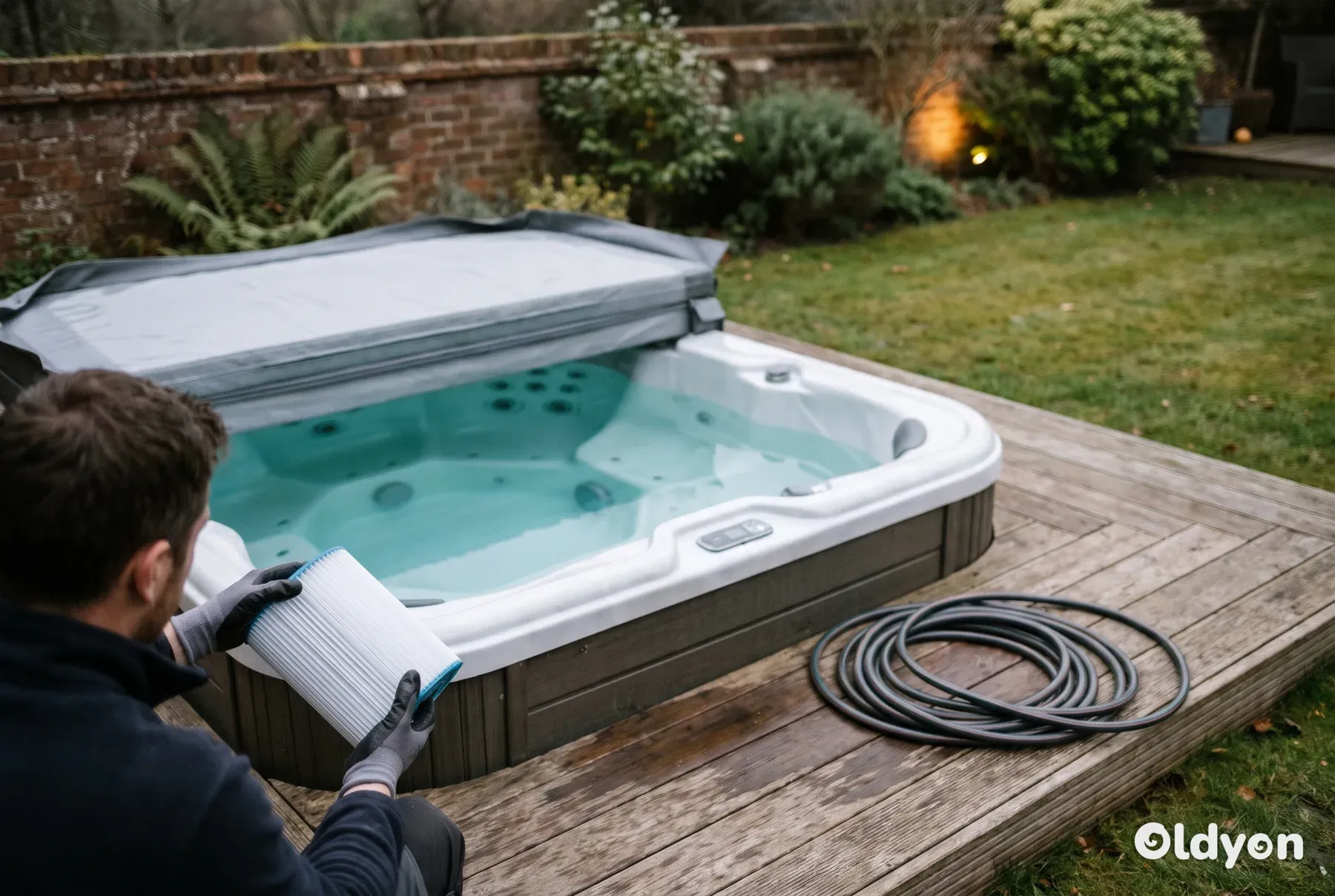
To check whether the filter is the cause, take the cartridge out and hold it up to the light. If the pleats look grey, brown or matted flat, a dirty filter is almost certainly behind the cloudiness.
- Switch the hot tub off at the isolator before you open the filter housing.
- Remove every cartridge and tip out any loose debris. Many hot tubs have more than one cartridge, often between one and four, so clean them all, not just the first one you find.
- Clean the filter housing and any skimmer basket while the cartridges are out, because debris trapped there passes back into the water.
- Rinse each cartridge with a garden hose from the top down, aiming the water between each pleat at an angle. Rotate the cartridge as you work round the pleats, and keep going until the water running off it is clear. A quick hose rinse takes about 10 minutes per cartridge. Do not use a pressure washer, as it can tear the fabric.
- If the pleats feel greasy or look grey, soak the cartridge in a filter cleaner for the time on the label. Overnight is common. Always hose-rinse the cartridge before the soak, so loose debris does not use up the cleaning solution. Unless the label says otherwise, soak for at least 8 hours with the cartridge fully submerged.
- Rinse very thoroughly so no cleaner goes back into the tub, because leftover cleaner can cause foam. After a chemical soak, keep rinsing until no foam comes off the cartridge, because foam shows that cleaner is still in the pleats.
- Refit the clean cartridge, or fit a clean spare and let the first one dry fully.
- Switch the power back on and let the circulation pump run. After you refit a freshly rinsed filter, run the jets for about 15 minutes to flush any loose debris through the system.
As routine care, rinse each cartridge every one to two weeks and give it a chemical soak about once a month, or at least every one to three months depending on how much you use the tub. Your manual may give its own schedule.
Many manufacturers suggest replacing cartridges every 12 to 24 months, depending on how much you use the tub. Replace sooner if the pleats are torn, flattened or frayed, or if the end caps are cracked. Check your manual for the interval it recommends.
Also replace a cartridge if its pleats stay discoloured after a full clean and soak. A worn filter cannot clear the water, however well you clean it.
Inflatable hot tubs use smaller cartridges that clog much faster, so they often need rinsing every day or two. See why inflatable hot tub water goes cloudy for advice specific to those models.
How do you shock a cloudy hot tub?
Shocking means adding a larger dose of oxidiser to break down body oils, sweat, cosmetics and other organic waste that your normal sanitiser level cannot keep up with. It also breaks down chloramines, which cause the sharp chemical smell people often blame on too much chlorine.
Signs that the water needs shocking
Water that looks milkier when the jets run and clearer when they are off usually holds body oils and other organic waste. You may also see foam or an oily ring at the waterline and notice a faint smell. These signs point to shock rather than another chemical.
Chlorine shock or non-chlorine shock?
Chlorine shock both oxidises waste and kills bacteria, so it is usually the better choice when water is cloudy. Non-chlorine shock oxidises waste without raising chlorine much, so you can often use the tub again sooner. Bromine tubs usually use non-chlorine shock to reactivate the bromine, but some manufacturers allow chlorine shock too, so check your manual.
- Make sure alkalinity and pH are in range and the filter is clean.
- Ask everyone to get out, and take the cover off.
- Measure the dose for your tub's volume from the product label. For example, a tub holding 1,000 litres (about 260 US gallons) needs a different dose to one holding 1,500 litres (about 400 US gallons), so find the volume in your manual.
- Turn all the jets up to full power, then add the shock, either sprinkled or pre-dissolved in a bucket of tub water, as the label says. Full power spreads the shock quickly through the water and the pipework.
- Leave the jets running with the cover off for at least the time on the label, often around 20 minutes, so gases can escape.
- Let the filtration run for several hours, ideally at least 8 to 12 hours. During this time you can leave the cover off or slightly open so gases keep escaping instead of being sealed in. Replace and secure the cover if you have to leave the tub unattended where children or pets could reach it.
- Retest before anyone gets in. Free chlorine should be back to 3-5 ppm, or bromine to 3-5 ppm.
After shocking, run the circulation continuously for at least 8 to 12 hours so the filter can catch the broken-down particles. A tub with a dedicated circulation pump can run it nonstop. A tub with jet pumps only should run them on low speed for at least 8 hours.
For stubborn cloudiness, shock in the evening and let the water circulate overnight for 8 to 12 hours. In the morning, retest the water and clean the filter, because it will be holding much of the waste the shock broke down.
How long to wait before using the tub after shocking
After a non-chlorine shock, the tub is often usable after about 15 to 30 minutes. After a chlorine shock, the wait is often 8 to 24 hours, until free chlorine has fallen back to 3-5 ppm. Always follow the product label and test before getting in.
Do not let anyone use the hot tub while free chlorine is above 10 ppm. At that level it can irritate the eyes, skin and airways.
A slight haze straight after shocking is normal while the filter catches the broken-down waste. If it lasts more than a day, read why a hot tub can stay cloudy after shocking.
Should you use a clarifier or a flocculant?
Use a clarifier for the fine haze that remains after balancing, cleaning the filter and shocking. A clarifier makes tiny particles clump together into larger ones that the filter can catch. It works with your filter, not instead of it.
Confirm that pH and sanitiser are in range before you add clarifier. It works poorly in unbalanced water, and owners often wrongly conclude the product does not work when the real problem is the chemistry.
A flocculant makes particles clump into heavy lumps that sink to the floor, so you have to vacuum them out. That suits swimming pools with a sand filter and a pool vacuum. Most hot tub manufacturers advise against flocculant, because the residue can clog cartridge filters and is hard to remove from a small shell. Only use one if the product is clearly labelled for hot tubs and your manual allows it.
Most hot tubs have no vacuum system. Removing flocculant residue from the floor therefore often means draining part of the water, which is another reason a clarifier is usually the better choice.
Product | What it does | When to use it | Afterwards |
|---|---|---|---|
Shock | Breaks down oils and organic waste | After balancing and filter cleaning | Retest before use |
Clarifier | Clumps fine particles for the filter | Haze remains after shocking | Rinse filter in 24-48 hours |
Flocculant | Sinks particles to the floor | Rarely, only if labelled for spas | Vacuum floor, clean filter |
Anti-foam | Breaks surface foam | Short-term foam control | Find and fix the cause |
- Add the clarifier dose on the label, with the jets running.
- Run the jets on low for about 30 to 60 minutes to spread the clarifier evenly through the water.
- Leave the filtration running for the time the label states, often several hours. About 8 to 12 hours is typical, so the filter has time to catch the clumped particles.
- Rinse the filter within 24 to 48 hours, because it will now hold the particles the clarifier gathered.
- Retest and repeat once if needed, but do not exceed the label dose.
The filter rinse after a clarifier is not optional. A loaded cartridge left in place can release the clumped particles back into the water, and the haze then returns even though the clarifier did its job.
Too much clarifier can make water cloudier, not clearer. If one or two correct doses do not help, the problem is somewhere else, such as worn-out water or a damaged filter.
When should you drain and refill your hot tub?
Every chemical you add, and everything that comes off bathers, leaves dissolved material behind. This is measured as total dissolved solids (TDS). Over time, TDS builds up until chemicals stop working properly, and no amount of balancing will clear the water. At that point, fresh water is the fix.
Hot tubs build up TDS much faster than swimming pools. A typical tub holds only about 1,100 to 1,900 litres (about 290 to 500 US gallons), so the same chemicals and bather waste go into far less water.
Evaporation makes this worse. It removes water but leaves the dissolved solids behind, so each top-up with fresh water concentrates the TDS a little further.
Many manufacturers suggest a full drain every three to four months, sooner with heavy use. Some give a TDS limit instead. Figures vary between brands, so follow your manual.
You can measure TDS with an inexpensive digital TDS meter. Test your fresh tap water first and record the reading as a baseline. A common guide is to drain when the tub's TDS is more than about 1,500 ppm above that baseline.
- The water stays cloudy after several days of correct chemistry and a clean filter
- Chemicals seem to stop working, or readings jump around after each dose
- You need unusually large amounts of chemicals to hold the water in balance
- Foam keeps returning even after shocking
- Foam comes back straight after a dose of anti-foam
- The water smells stale or musty even with sanitiser in range
- It has been three to four months since the last refill, or longer
Keep treating rather than draining if the water is less than about three months old, if TDS is acceptable, or if the cloudiness appeared suddenly after a specific heavy-use event such as a party. In those cases, the six steps above usually clear it.
Also keep treating if you have not yet worked through every step of the routine: test, balance, filter, shock and clarify. Draining before you have tried them all may throw away water that could still be saved.
Draining about 1,500 litres with a submersible pump typically takes 30 to 60 minutes. The whole drain, clean and refill usually takes roughly two to four hours, plus time for the water to heat.
- Add a line flush product the day before or a few hours before draining, as the label says, and run the jets to clean biofilm from the pipework.
- Switch the hot tub off at the isolator.
- Drain the water using the drain valve, a submersible pump or a hose. On most hot tubs the drain valve or spigot sits behind a side panel near the base of the cabinet, and you can connect a garden hose to it. Let the water cool first, and check your local water company's guidance before draining chlorinated water near drains, streams or plants.
- Remove the filter and clean or replace it.
- Check the O-rings and gaskets on the filter housing for cracks or flattening, and lubricate them with the lubricant your manufacturer recommends.
- Wipe the shell with a non-foaming cleaner made for hot tubs, then rinse well. Pay particular attention to the waterline ring and the jet faces, where oil and residue collect. Avoid household cleaners, which can cause foam and damage the surface.
- Refill through the filter housing where possible, which helps prevent air locks in the pipes. Fit a hose pre-filter if you have one, because it lowers the starting TDS of the fresh water so it lasts longer before the next drain.
- Switch the power back on and test calcium hardness as well as alkalinity and pH. Balance alkalinity and pH, and adjust calcium hardness to 150-250 ppm, before you shock and heat. Then shock and bring sanitiser into range. A fresh fill usually needs a higher startup dose of sanitiser than routine dosing, so follow the product's fresh-fill instructions.
- Heat the water to your normal temperature, no higher than 40°C (104°F).
- Allow about 24 hours for the water to heat up and the chemistry to settle, then retest before the first soak.
Always switch off at the isolator before the water level drops. Running the heater or pumps without water can damage them, and you should never work near electrics with wet hands.
What mistakes keep hot tub water cloudy?
If you follow the steps and the haze keeps coming back, one of these is often the reason.
- Adding chemicals without testing first, for example adding more chlorine to water where chlorine is already high
- Testing only when the water looks wrong: test at least once a week, ideally on the same day each week
- Not testing calcium hardness once a month, so it climbs to the level where it clouds the water before you correct it
- Shocking before fixing high pH, so the shock does far less than it should
- Adding several chemicals at once, which can react and cause haze
- Giving up too soon: severely cloudy water can take 24 to 48 hours to clear after correct treatment, so retest about every 12 hours before deciding treatment has failed
- Running the circulation pump for too few hours each day
- Forgetting to rinse the filter after using a clarifier
- Using more clarifier than the label allows
- Getting in without a quick shower, which brings lotions, deodorant and hair products into the water. Make it a plain water rinse without soap, so no soap residue goes into the tub.
- Wearing swimwear washed in detergent, which can cause foam and haze
- Using swimming pool chemicals that are not dosed or formulated for hot tubs
- Topping up with fresh water and not retesting afterwards
- Skipping a monthly check of the jets, cover and seals: a damaged cover lets in debris and lets sanitiser break down faster
Habits that stop cloudiness coming back
- Add a dose of non-chlorine shock after every heavy-use session, so body waste is oxidised before it builds up into cloudiness.
- Wipe the waterline regularly with a spa sponge to remove the oil and residue that collect there.
- Keep the cover on whenever the tub is not in use. Sunlight breaks down chlorine quickly, and the cover keeps leaves and dust out.
- Ask bathers to remove makeup and sunscreen, and not to get in straight after applying moisturiser or body oil.
- Limit how many people use the tub at once relative to its water volume, because each bather adds organic waste.
- Keep the water topped up to the correct level, because low water strains the pump and reduces filtration.
- As part of your monthly routine, add a small maintenance dose of clarifier if the water starts to look slightly hazy, before it turns properly cloudy. Follow the maintenance dose on the label.
Once the water is clear, a simple weekly routine stops the problem returning. Our guide on how to keep hot tub water clear all year sets out weekly, monthly and seasonal tasks.
Is it safe to use a cloudy hot tub?
Stay out until the water is clear and your sanitiser reading is back in range. Cloudy water often means the sanitiser is not keeping up, and you cannot see the floor or steps clearly, which is a safety risk for children in particular.
Warm water suits bacteria. Pseudomonas aeruginosa can cause an itchy, bumpy rash sometimes called hot tub rash or folliculitis. Legionella bacteria can grow in poorly maintained hot tubs and be breathed in through the fine spray from the jets. The HSE guidance on legionella and the CDC healthy swimming pages explain why good sanitiser levels and clean filters matter.
Hot tub rash usually appears 12 to 48 hours after exposure, often as small pus-filled spots in areas covered by swimwear. Mild cases often clear on their own within 7 to 10 days. Severe cases, especially in people with weakened immune systems, may need antibiotics prescribed by a doctor.
Poorly sanitised water can also cause outer ear infections from Pseudomonas. Chloramines, the by-products of chlorine reacting with body waste, can irritate the eyes and airways, especially when you first lift the cover and the trapped air escapes.
pH outside the target range can sting the eyes on its own, separately from any irritation caused by chloramines. If your eyes sting, test the pH before assuming the sanitiser level is the cause.
Anyone who already has folliculitis should stay out of hot tubs until it has fully cleared. This avoids making the rash worse and spreading bacteria into the water.
Speak to a pharmacist or GP if a rash spreads, is painful or does not settle within a few days. Contact a GP or call NHS 111 if you develop flu-like symptoms, a cough, a high temperature or breathlessness in the days after using a hot tub, and mention that you used one. The NHS page on Legionnaires' disease describes the symptoms.
What if the water is discoloured rather than cloudy?
Coloured water usually has a different cause from cloudy water, and shock alone will not fix it. Shocking water that holds dissolved metals can even make staining worse, so test before you treat.
- Brown or rust-coloured water usually means iron or manganese from the fill water. Treat it with a metal sequestrant made for hot tubs, not shock.
- Blue-green water usually means copper from corroding fittings, often linked to low pH. Correct the pH and add a metal sequestrant.
- Green-tinged water can mean algae or metals, and it can also be caused by very high pH. Algae is rare in hot tubs, so check pH as well as metals before you treat green water. Test for metals as well as standard chemistry. If metals are not the cause, shock the water and balance the pH.
Standard test strips do not always read metals, so you may need a separate metals test kit. If discoloured water keeps returning after a refill, a hose pre-filter can help reduce metals in the fill water.
Clear water in the right order
Cloudy hot tub water nearly always clears if you work in sequence: test, balance alkalinity then pH, clean the filter, shock, and clarify only if needed. Give each step time with the pump running, and retest as you go.
If the water stays cloudy after several days of correct chemistry and a clean filter, it has reached the end of its useful life. Drain, clean and refill, then keep to a weekly routine so you do not have to repeat the whole process.
Frequently asked questions
How long does it take to clear cloudy hot tub water?
Mild haze often clears within 24 hours of cleaning the filter and shocking, as long as the circulation pump keeps running. Heavier cloudiness usually takes one to two days, with a clarifier dose and a second filter rinse. If the water is still cloudy after three or four days of correct chemistry and a clean filter, a drain and refill is usually the quicker fix.
How long does each fix take to clear the water?
It depends on the cause. After cleaning a dirty filter, water often clears in about 4 to 8 hours. After correcting the chemistry, allow about 8 to 12 hours. After shocking to break down organic waste, expect about 12 to 24 hours. Keep the circulation running throughout, and retest about every 12 hours before deciding that the treatment has not worked.
How long does fresh water take to clear after a drain and refill?
Allow about 24 to 48 hours after a refill for the new water to settle chemically and clear fully. A slight haze in the first day is common while the heater warms the water, the sanitiser startup dose works and the filter catches any loose particles. Keep the circulation running, retest after the first day, and correct any reading that is out of range before you use the tub.
How can I clear cloudy hot tub water as fast as possible?
The quickest reliable route is to fit a clean spare filter, check alkalinity and pH, then shock to the label dose and run the jets with the cover off for the time stated. Keep the circulation pump running for the next few hours. Adding more chemicals than the label says does not speed things up and can make the water cloudier.
Can I just add more chlorine to clear the water?
Not on its own. When pH is high, chlorine works much more slowly, so extra doses mostly raise costs and can irritate skin and eyes. A blocked filter will also leave the haze in place however much chlorine you add. Balance alkalinity and pH first, clean the filter, then shock to the dose on the label.
Why do people put tennis balls in a hot tub?
A clean tennis ball floating in the water or in the skimmer basket can soak up a little surface oil from skin and cosmetics. Use two or three, rinse them in plain water without soap between uses, and replace them every four to six weeks or when they feel slimy. They help slightly but never replace sanitiser, shock or filter care. Some technicians prefer purpose-made oil-absorbing sponges, because ball fibres can shed.
Is foamy water the same problem as cloudy water?
They often share a cause. A little foam while the jets run is normal; only thick foam that does not disappear is a problem. It usually comes from soap, detergent in swimwear, lotions, body oils or high dissolved solids in old water. Never put bubble bath or soap in the tub. Shocking and a clean filter help both problems. Anti-foam only hides the symptom. If foam returns soon after a refill, rinse swimwear in plain water first.
Can cheap hot tub chemicals cause foam?
They can. Some cheap or poor-quality chemicals contain soap-like compounds that make the water foam, and they may also add more dissolved solids than you expect. Use products made specifically for hot tubs and buy them from a reputable supplier. If foam appears soon after you start a new product, stop using it, shock the water and rinse the filter to see whether the foam settles.
Does hard tap water make a hot tub cloudy?
It can. In hard water areas, calcium hardness can be well above 250 ppm straight from the tap. When pH or temperature rises, some of that calcium comes out of the water as a fine white haze and scale. Keep pH at 7.2 to 7.6, use a scale control product made for hot tubs, and consider a hose pre-filter when you refill.
Filed under