What causes cloudy hot tub water
Learn the cloudy hot tub water causes by symptom: dusty, milky, worse after use, after shocking, or linked to high TDS or hardness, before you treat it.
The most common cloudy hot tub water causes are low sanitiser, high pH or alkalinity, a dirty filter, a heavy bather load and old water with high total dissolved solids (TDS) or hardness. The look of the cloudiness, and when it appears, usually points to the cause before you test anything.
This guide is about finding the cause. Once you know it, the step-by-step treatment is in our guide on how to clear cloudy hot tub water. Treating the wrong cause wastes chemicals and can make the water worse, so a few minutes of diagnosis pays off.
Is cloudy hot tub water safe to use?
Cloudy water is a warning sign, not proof that the water is unsafe. Sometimes it is only fine particles or tiny air bubbles. Often, though, it means the sanitiser has been used up, and warm water without enough sanitiser lets bacteria grow quickly.
The safe rule is simple. If you cannot see the seats or the floor of the tub, or if your sanitiser reading is below the recommended range, stay out until the water is clear and tested. Free chlorine should be 3-5 ppm, or bromine 3-5 ppm, with pH at 7.2-7.6.
Keep children, and anyone with a weakened immune system, out of a cloudy hot tub. They are the people most at risk from the bacteria that grow when sanitiser runs low, and even a short soak in poorly treated water is not worth the risk.
The most common hot tub rash is caused by Pseudomonas bacteria, which thrive in warm water with too little sanitiser. It usually shows as itchy red bumps on skin that was covered by swimwear. Ear infections are another typical illness from poorly sanitised water.
More sanitiser is not safer. Free chlorine above 5 ppm can irritate skin and eyes, so aim for the 3-5 ppm range rather than overdosing to make up for cloudy water.
Do not use a cloudy hot tub until the sanitiser reads within range. Poorly maintained hot tubs can spread skin rashes and, rarely, Legionnaires' disease. If you develop a rash, ear pain, a fever or a cough after using a hot tub, speak to your GP or pharmacist and mention the hot tub.
The NHS page on Legionnaires' disease explains the symptoms to watch for, and the HSE guidance on legionella explains why warm, poorly treated water carries that risk.
What should you check first?
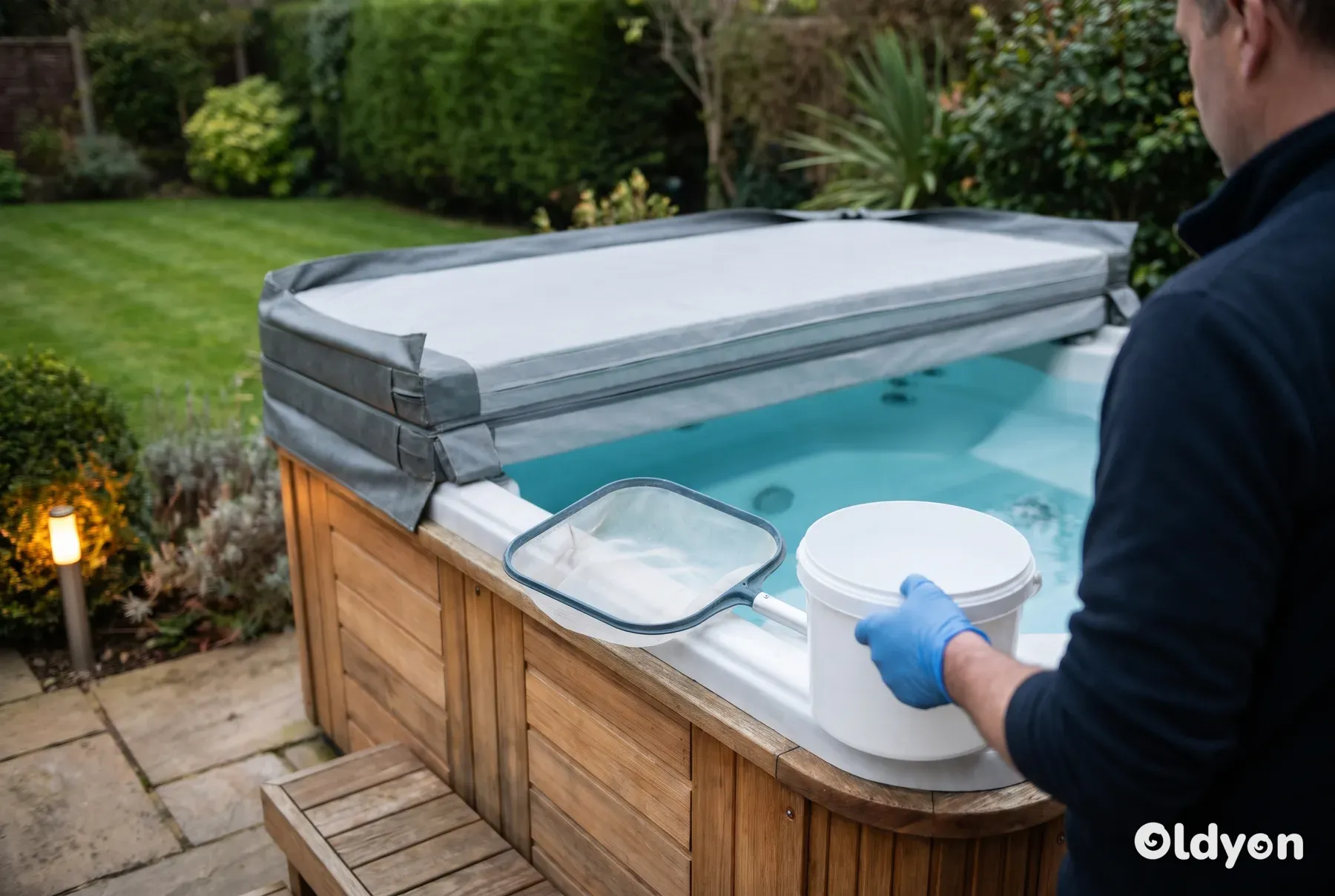
Before you add anything, gather a few simple things: fresh test strips or a liquid test kit, a TDS meter if you have one, and a torch. Then work through these checks in order. Each one rules a cause in or out.
- Switch the jets and air controls off and wait ten minutes. If the water clears, the cloudiness was tiny air bubbles, not a water problem.
- Shine a torch into the water after dark or look at the floor of the tub. Fine floating specks suggest particles. An even milky haze suggests a chemical or bacterial cause.
- Test free chlorine or bromine, pH and total alkalinity. Write the numbers down so you can compare them later.
- If you use chlorine, check combined chlorine (total chlorine minus free chlorine). A result above 0.5 ppm means used-up chlorine is building up.
- Test calcium hardness and, if you can, TDS. Compare TDS with a reading from your tap water.
- Switch off at the isolator, remove the filter and look at it. Grey, greasy or slimy pleats mean the filter is part of the problem.
- Think back over the last few days: heavy use, a recent shock, a refill, rain or garden debris all point to different causes.
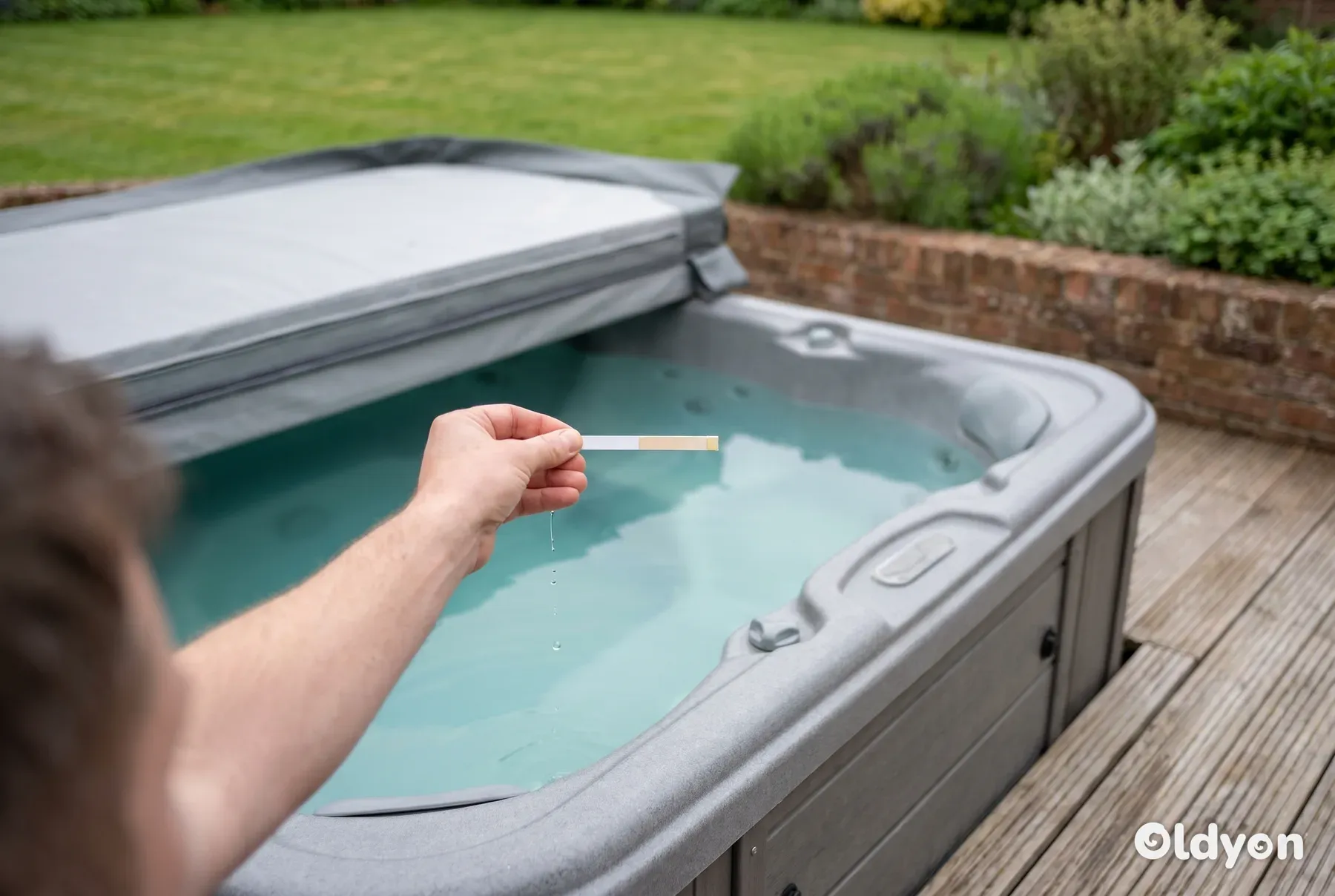
Test strips are only as accurate as the way you handle them. Keep wet fingers off the strips, read the colours in natural daylight rather than under artificial light, and store the pot somewhere cool and dry with the lid closed. Use up an opened pot within its stated life, often about 90 days, because old strips give false readings.
Knowing which product does what helps you read your results. pH is usually raised with sodium carbonate (sold as pH increaser) and lowered with sodium bisulfate (sold as pH reducer). Total alkalinity is raised with sodium bicarbonate.
Sodium bicarbonate, the chemical sold as alkalinity increaser, is the same substance as household baking soda. To lower total alkalinity that is above 120 ppm, add pH reducer (sodium bisulfate), then wait about 30 minutes with the pump running before you retest.
Cloudy hot tub water causes at a glance
Use this table to match what you see with the most likely cause. Many tubs have more than one cause at once, so confirm with a test rather than relying on looks alone.
What you see | Most likely cause | What to check |
|---|---|---|
Fine dusty haze, specks in torchlight | Dirty or worn filter, debris | Filter condition |
Milky white, even haze | Low sanitiser or high pH | Sanitiser, pH, alkalinity |
Clear until people get in | Bather load, lotions, sweat | Sanitiser after use |
Cloudy straight after shock | Normal reaction or calcium | Wait, then test hardness |
Hazy plus white scale on surfaces | High hardness with high pH | Calcium hardness, pH |
Dull, hard to balance, old water | High TDS | TDS against tap water |
Comes back soon after a refill | Biofilm in the pipes | Filter slime, pipe residue |
Cloudy with a green tinge | Algae after low sanitiser | Sanitiser, filter, walls |
A green tinge in cloudy water usually means algae has taken hold after the sanitiser has been low for a while. Expect the water to look worse before it looks better, because dead algae clouds the water further until the filter removes it.
Algae is less common in hot tubs than in swimming pools, because the hot water suppresses most strains. If your water does turn green, the sanitiser has been low for a long time. The usual treatment is:
- Add a double dose of chlorine shock, typically about 115-170 g per 1,900 litres (500 US gallons), staying within the limits on the product label.
- Run the pump continuously for 24 hours.
- Clean the filter twice during those 24 hours, because dead algae clogs it quickly.
- If the water is still green after 48 hours, drain and refill the tub.
Cloudiness from dead algae usually clears within 24-48 hours of this aggressive shocking, as long as you keep the filter clean while it works.
Why does the water look dusty or hazy?
A dusty look, where you can see tiny specks drifting when you shine a torch into the water, usually means fine particles that the filter is not catching. The water often looks fine from a distance but dull up close.
A dirty, worn or badly fitted filter
This is the first suspect for dusty water. A clogged cartridge lets water bypass the pleats, and an old cartridge loses its ability to trap fine particles. A cartridge that is not seated properly lets water flow around it rather than through it.
A filter can look clean on the outside and still be clogged with body oils you cannot see. If the filter housing gives off a stale or unpleasant smell, the cartridge needs a chemical clean, not just a rinse.
Most manufacturers suggest a rinse every week or two and a chemical clean every month or so, with replacement every 12 to 18 months depending on use. Intervals vary by tub and use, so check your manual. Hairline cracks in the end caps or flattened pleats mean it is time for a new cartridge.
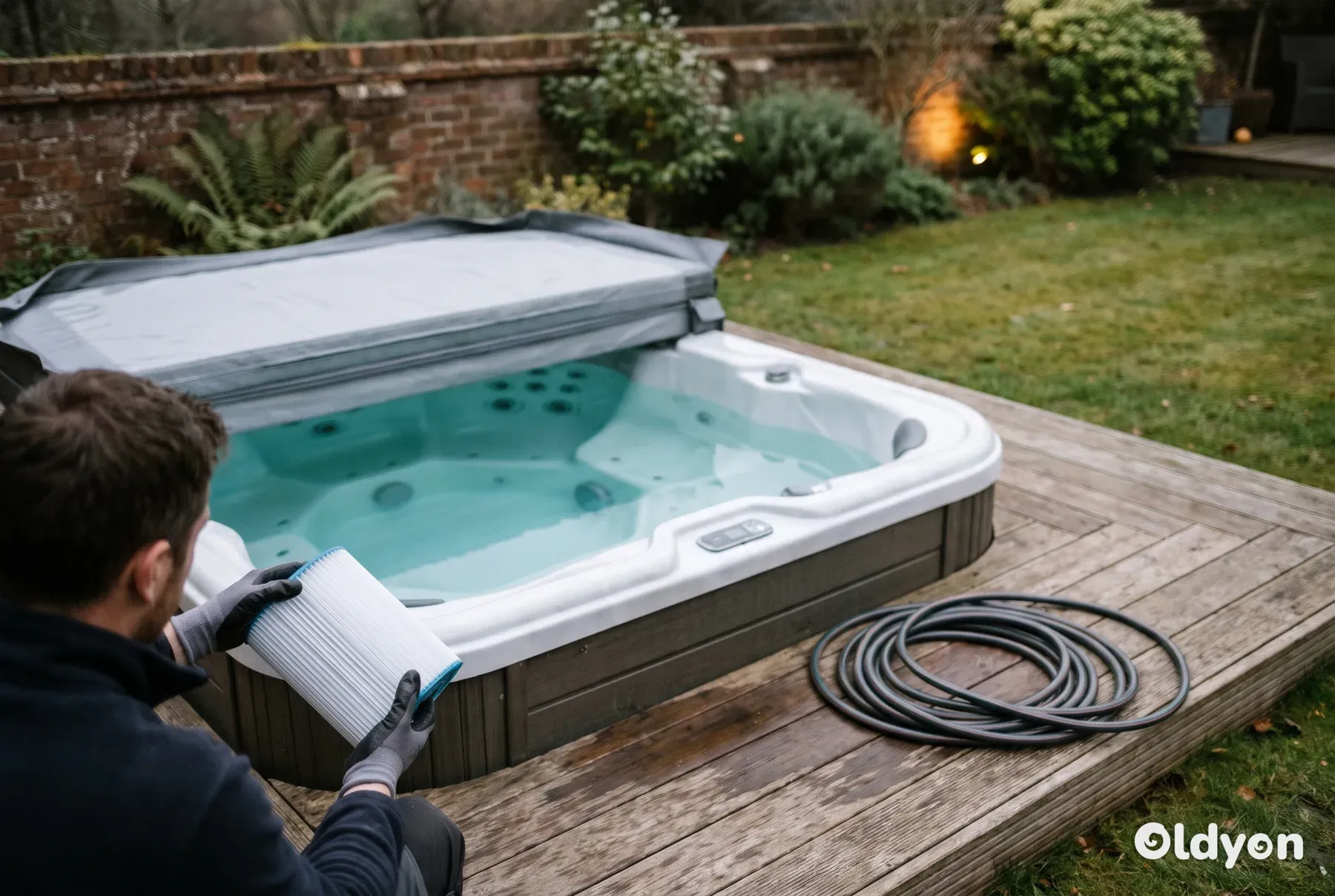
How you rinse matters. Use a garden hose rather than a pressure washer, which can tear the pleats, and spray between each pleat from the top downwards at an angle. For a deeper clean, soak or spray the cartridge with a filter cleaner, leave it for around 15 minutes, then rinse it again.
After using filter cleaner, keep rinsing until the water running off the cartridge is clear. Only then refit it and switch the pump back on, so no cleaner residue goes into the tub.
After a thorough filter clean, circulation usually improves within 1 to 2 hours. Mild cloudiness caused only by the filter often clears within 12 to 24 hours without any chemicals, so give the clean filter that long before you add anything.
Replace a cartridge that is discoloured, has torn pleats or still looks grimy after a proper clean, even if it is less than a year old. A worn cartridge cannot hold fine particles, however often you rinse it.
Not enough filtration time
If the pump does not run long enough each day, particles never reach the filter. Economy settings and short filter cycles can save energy but leave water dull. Check that your filter cycles run for the hours your manual recommends.
Debris, pollen and fresh fill water
Pollen, dust, leaves and grass clippings can blow in when the cover is off. Some fresh tap water also carries fine sediment, especially after mains work in your area. Inflatable tubs with small filters are particularly prone to this, which we cover in why inflatable hot tub water goes cloudy.
Why is the water milky white?
Milky water, where the haze is even and you cannot pick out individual specks, usually has a chemical or biological cause. It is the most common type of cloudiness and the one most likely to mean the water is not safe to use.
Low sanitiser
When free chlorine or bromine falls below range, bacteria and organic waste build up faster than the sanitiser can deal with them. The water turns milky, may smell stale, and can feel slimy. Hot water uses sanitiser quickly, so levels can drop within a day or two of heavy use.
A free chlorine reading below 2 ppm means the sanitiser is effectively used up, and cloudiness can follow within hours. If you see a reading that low, treat it as the likely cause even if the water still looks clear.
A strong chlorine smell, or a haze that persists while chlorine still registers on the test, usually comes from used-up chlorine compounds called chloramines, not from too much chlorine. Shocking breaks chloramines down, so this is a reason to shock rather than to cut back on chlorine.
Some owners keep bromine nearer 6 ppm when the tub is used heavily. If you do this, stay within the limits given on the product label.
High pH or total alkalinity
When pH rises above 7.8 or so, chlorine becomes much less effective, and calcium in the water starts to come out of solution as fine white particles. High total alkalinity (above about 120 ppm) pushes pH upwards and keeps it there. The result is a dull, milky haze even when the sanitiser reading looks acceptable.
The reason is that pH controls how much of your chlorine is in its active, fast-acting form, called hypochlorous acid. At pH 7.2 roughly two-thirds of the free chlorine is in this form. At pH 7.8 it is only around a third, and by pH 8.5 it is close to a tenth.
This is why a normal free chlorine reading can still leave the water poorly protected when pH is high. The test counts all the free chlorine, but most of it is in a slow-acting form, so bacteria and haze can build up while the reading looks fine.
Aim for total alkalinity of 80-120 ppm and pH of 7.2-7.6. Some manufacturers give slightly different ranges, so use the figures in your manual if they differ.
Readings below the range cause problems too, even though they rarely cloud the water on their own. pH below 7.2 makes the water irritating to skin and eyes and corrosive to heaters and fittings. Total alkalinity below 80 ppm lets pH swing up and down with every chemical you add, so the water never stays balanced.
Biofilm in the pipework
Biofilm is a slimy layer of bacteria that grows inside pipes, jets and hoses, where sanitiser struggles to reach. Signs include cloudiness that returns within days of a fresh fill, a slimy feel to the filter, and flakes or gunk appearing when the jets start. If this pattern sounds familiar, a pipe cleaner product used before draining is usually needed.
Other signs of biofilm are cloudiness that returns soon after shocking, a slippery feel on the shell walls and a persistent musty smell. Shock clears the open water, but the biofilm in the pipes keeps releasing bacteria back into it.
Tiny air bubbles
Jets and air controls can whip millions of tiny bubbles into the water, which can look milky. This is harmless. If the water clears within minutes of switching the jets off, there is nothing to treat, though a loose suction fitting or low water level can make it worse.
Why does it go cloudy after people use it?
If the water is clear before a soak and cloudy afterwards, the cause is almost always what people bring in. Sweat, skin cells, body oils, sun cream, moisturiser, make-up, hair products and deodorant all add organic waste that uses up sanitiser.
Several people in a small tub at 38-40°C (100-104°F) can use up most of the sanitiser in one session. Laundry detergent left in swimwear adds to the problem and can also cause foam. Test the sanitiser straight after a busy soak: if it has dropped well below 3 ppm, bather load is your cause.
- Cloudiness appears within an hour of use and fades slowly
- Sanitiser reading drops sharply after each soak
- A greasy line forms at the waterline
- Foam often appears with the haze
- The problem is worse after parties or weekends with guests
A short shower before getting in, rinsing swimwear in plain water, and a dose of sanitiser or shock after heavy use usually stop this pattern.
If foam comes with the haze, a spa defoamer will knock it back within minutes, but this is only a short-term fix. Wash swimwear without detergent, and do a partial drain and refill if the foam keeps coming back.
Weekly shocking also helps prevent foam. It oxidises the soap-like residues from body wash, shampoo and lotions before they build up, so they never reach the level where the jets whip them into foam.
Why is it cloudy after shocking?
A little cloudiness straight after shocking is common and often normal. Shock breaks down organic waste, and the broken-down material can make the water hazy until the filter catches it. With the jets running and the cover off, this usually clears within a few hours to a day.
How you shock affects how quickly the haze clears. Always follow the product label, and use this general method:
- Take the cover off and switch on all the jets.
- Unless the label says to add it directly, dissolve shock granules in a bucket of warm water first rather than tipping dry chemical into the tub, so they dissolve fully before you pour them in. Put the water in the bucket before the granules.
- Pour the shock evenly around the edge of the tub.
- Keep the pump on high for at least 30 minutes.
- Retest after about 2 hours.
Dose by your tub's volume, which is given in the manual. As a general guide, always checking the label first, non-chlorine (MPS) shock is dosed at about 55-60 g per 1,900 litres, and dichlor chlorine shock at about 55-115 g per 1,900 litres.
After heavy contamination, such as a party with several bathers, use a double dose of shock, staying within the label's limits. Then run the pump for 2-4 hours with the cover off.
Help the filter do its job. After shocking, run the pump continuously for four to eight hours. Check the filter after about two hours, and if it already looks dirty, rinse it again before the pump carries on.
Circulation is what makes the shock work. Without the pump running, the shock stays concentrated in one part of the tub, while untreated water elsewhere never reaches it or the filter. Running the jets mixes the dose through all the water and carries the broken-down waste to the cartridge.
Running time matters because of turnover. Most hot tubs are designed to pass their full water volume through the filter 2-4 times an hour on the high pump setting, so a few hours of continuous running filters every litre many times over.
If it does not clear, look at the shock you used. Calcium hypochlorite adds calcium, so in hard water areas it can push hardness high enough to cloud the water. Most hot tub owners use dichlor or a non-chlorine shock, which do not add calcium. Shocking when the pH is already high can also cause a lasting haze.
Cloudiness that gets worse after shocking can also mean the shock was too small for the amount of waste in the water. For more detail on each of these, read why a hot tub goes cloudy after shocking.
Wait before you get back in. After a non-chlorine shock you can usually use the tub after about 15 minutes. After a chlorine shock, wait at least 4 hours and until free chlorine has fallen back to 5 ppm or below. Check the product label, as waiting times vary.
Could high TDS or hardness be the cause?
If your sanitiser, pH and filter all check out and the water is still dull, look at what has built up over time. Every chemical you add, and everything that evaporates, leaves dissolved material behind.
Test calcium hardness and TDS about once a month, not just when the water clouds. A monthly reading shows you the trend, so you can plan a water change before the haze starts.
High total dissolved solids
TDS measures everything dissolved in the water: minerals, salts, chemical residues and organic waste. As it rises, chemicals work less well, the water becomes hard to balance and it can look flat and hazy. A common guide is to change the water when TDS is about 1,500 ppm higher than your tap water, but manufacturers differ, so check your manual.
Many owners change the water every three to four months regardless, more often with heavy use. A small tub of around 1,000 litres (about 260 US gallons) reaches a high TDS faster than a large one used the same way. Our guide to hot tub TDS and when to change the water explains testing and timing.
High calcium hardness
Much of southern and eastern England, and parts of Europe, have hard tap water. When calcium hardness rises well above 150-250 ppm, especially with high pH or high temperature, calcium settles out as fine white particles and as scale on the shell, jets and heater.
Once calcium hardness passes about 400 ppm, the usual result is a chalky, milky haze that shocking will not clear. If shock makes no difference and the hardness reading is this high, calcium is the cause.
- White crust at the waterline or around jets
- Rough, gritty feel on seats and steps
- Haze that returns every time pH creeps up
- Cloudiness that started with a fresh fill of very hard tap water
Very low hardness causes different problems, such as foam and corrosion, so the aim is the middle of the range, not as soft as possible. A stain and scale product helps, and some owners fill through a hose filter.
Cyanuric acid build-up
If you use dichlor granules, cyanuric acid (stabiliser) builds up with every dose. High levels make chlorine slow to act, so the water can turn cloudy even when the chlorine reading looks fine. Regular water changes are the usual remedy.
What makes cloudy water worse?
Some common habits turn a simple fix into a week of trouble. Avoid these while you work out the cause.
The order you work in matters as much as the products you use. Doing the steps out of order is the main reason treatments fail, so treat them as a single sequence. It usually takes 30-60 minutes of hands-on work, followed by 12-48 hours while the water clears on its own:
- Clean the filter, or fit a new cartridge if the old one is worn.
- Balance total alkalinity, then pH. Retest both and confirm they are within range before you move on to shocking.
- Shock the water.
- Run the pump so the broken-down waste reaches the clean filter.
- Use clarifier only if a haze remains after that.
- Adding clarifier first: it can hide the cause for a while, but the haze will return if sanitiser or pH is wrong
- Adding several chemicals at once: products can react with each other, so add one at a time with the jets running
- Adding any chemical without testing first: for example, pH increaser added to water already at 7.8 can push it above 8, where sanitiser becomes nearly useless
- Adjusting pH before alkalinity: alkalinity buffers pH, so correct it first, then wait about 30 minutes with the pump running before retesting after each adjustment
- Shocking with a clogged filter: the broken-down waste stays in the water with nowhere to go, so clean the filter before you shock
- Using swimming pool chemicals: they are dosed for far larger volumes, which makes overdosing easy, so use products labelled for spas and hot tubs
- Overdosing clarifier: too much can make the water cloudier and clog the filter, so follow the label dose exactly
- Raising sanitiser without fixing high pH: the chlorine stays weak and you waste it
- Running the pump less to save energy: particles never reach the filter
- Draining before cleaning the pipes: biofilm then contaminates the fresh water
- Relying on tennis balls: a ball can soak up a little surface oil, but it is no replacement for a clean filter and correct sanitiser. If you use them, put 2 or 3 clean balls in the water and replace them every 2 to 4 weeks as they become saturated
Call a hot tub technician if the water stays cloudy after a fresh fill and a pipe clean, if the pump or heater is making unusual noises, or if you see leaks or error codes. These can point to equipment faults rather than water chemistry.
Weak jet pressure, or a pump that runs but moves little water, points to a circulation fault that a technician should look at. Call one too if the water is still cloudy after five to seven days of correct treatment, or if slime on the shell walls or jets does not respond to a pipe cleaner or purge product.
Summary: find the cause, then treat it
Look at the cloudiness before you reach for chemicals. Dusty specks point to the filter, an even milky haze points to sanitiser or pH, haze after soaks points to bather load, and dull water that never quite clears points to high TDS or hardness.
Test, write down your readings, and fix the single most likely cause first. Once the water is clear, a simple routine of testing, filter care and regular water changes will stop it coming back, as explained in how to keep hot tub water clear all year.
- Test sanitiser, pH and total alkalinity every two to three days, and after each heavy-use session, to catch problems before the water clouds
- Between full tests, run the pump on high for at least 30 minutes every 2 to 3 days to circulate the water through the filter
- Shock once a week under normal use, even when the water looks clear, to stop used-up chlorine and organic waste building up. Non-chlorine shock is the usual choice for this routine weekly dose
- Wipe the waterline weekly with a spa surface cleaner to remove the oily ring that feeds cloudiness
- Clean the filter housing as well as the cartridge once a month
Frequently asked questions
Does a water clarifier fix the cause of cloudy water?
No. A clarifier makes tiny particles clump together so the filter can catch them. It helps when the problem is fine particles, but it does nothing for low sanitiser, high pH or high TDS. If those are the cause, the haze will return. Balance the water and sanitise first, then give the shock and filter 12 to 24 hours of continuous pump running before deciding clarifier is needed. To use it, keep the pump running and dose by the label, typically around 30-60 ml per 950-1,900 litres (about 250-500 US gallons). Run the pump for another 2-4 hours and check the filter at about 4 hours. Expect a dirtier filter, so clean it again before leaving the pump running overnight.
Should I leave the cover off while the water clears?
After adding shock or any other strong chemical, leave the cover off for 30-45 minutes. Gases trapped under a closed cover can damage its lining and foam cores over time, and can cloud the water. After that, a closed cover keeps debris out and holds heat. Never leave an open hot tub unattended if children or pets could reach it.
How long should cloudy water take to clear once treated?
If you have found the right cause, the water usually improves within 24 hours and is clear within one to two days with the jets running. For the first 0-6 hours it may look worse as oxidised particles are suspended. From 6-12 hours the haze begins to lift, and by 12-24 hours most cases clear. Stubborn haze usually clears between 24 and 48 hours after a second filter clean and clarifier. If it has not improved after two days, retest everything and check the filter again. Cloudiness that persists after a correct treatment often points to biofilm or high TDS.
Can rain make my hot tub water cloudy?
Yes. Rain running off a cover or falling into an open tub carries dust, pollen and dirt, and it can shift pH and dilute your sanitiser. After heavy rain with the cover off, test sanitiser and pH before your next soak. Keeping the cover on and clearing standing water from its top both help.
Why does my water go cloudy every time I refill?
Two causes are likely. Very hard or sediment-rich tap water can cloud as soon as it heats up, which a hose pre-filter and a stain and scale product can help with. If the water clears at first and then turns cloudy within days, biofilm in the pipes is the more likely cause. Before your next drain, add a pipe cleaner and run all the jets for about 30 minutes, then drain through the drain valve or with a submersible pump.
Can cloudy hot tub water recover without draining?
Usually, yes. Most cloudiness from low sanitiser, high pH, a dirty filter or heavy use clears with the right treatment and good filtration. Draining is the better choice when TDS or cyanuric acid is very high, when hardness is far above range, or when the water has been cloudy for a long time despite correct treatment. If it is still cloudy after 48 hours of the full correct sequence, including a second filter clean and clarifier, drain and refill rather than adding more chemicals.
How do I know it is time to drain, and what should I do when I refill?
If you are spending more on chemicals to fight the haze than a drain and refill would cost, it is time to change the water. Once the tub is empty, wipe the shell with a spa surface cleaner and rinse it well. After refilling, balance the fresh water's alkalinity, pH and hardness before you heat it, because hard water with high pH is more likely to cloud as it warms.
Filed under