What temperature is too cold for a hot tub?
Learn what temperature is too cold for a hot tub, how freeze protection works, when an inflatable heater falls behind and how to step out safely on ice.
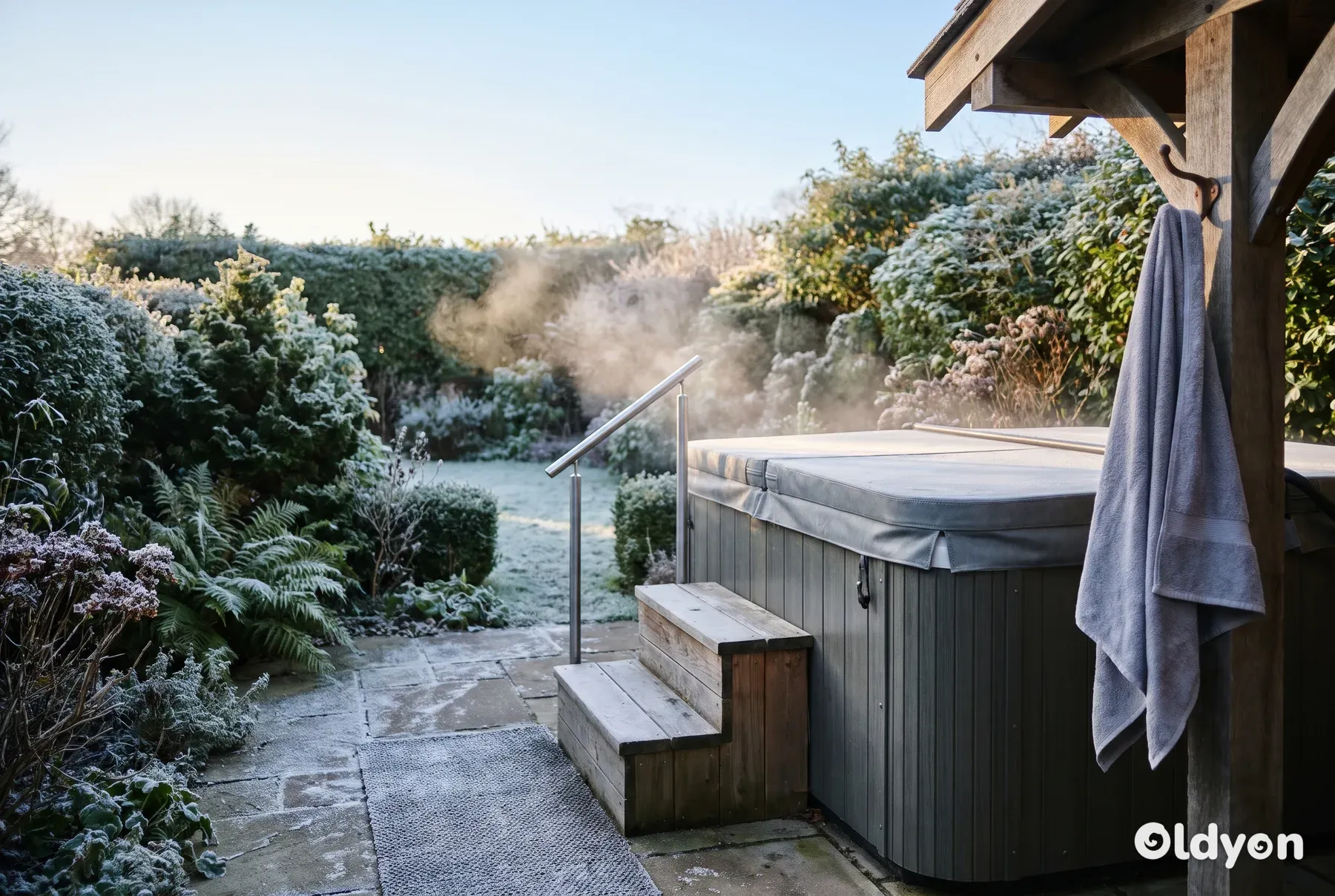
There is no single air temperature that is too cold for a hot tub. A well-insulated acrylic hot tub with working freeze protection, a good cover and a steady power supply can run safely well below 0°C (32°F). In most cases what becomes too cold is you: wind, ice underfoot and the walk back indoors set the real limit.
Inflatable hot tubs are a different case. They lose heat much faster, and many manuals give a minimum air temperature for running them. In winter, the heater, the cover and the ground around the tub matter as much as the number on the thermometer.
Is it safe to soak when the air is below freezing?
Yes, for most healthy adults it is safe to soak in sub-zero air, as long as the water is at a sensible temperature, the session is not too long and you can get in and out without slipping. Many owners say a frosty evening is their favourite time to use the tub. The warm water keeps your body warm while your face and shoulders stay cool.
The risks in cold weather are mostly about the edges of the soak. Getting in means walking across a cold, possibly icy patio. Getting out means standing up with warm, relaxed blood vessels into freezing air while your skin is wet. Plan those two moments and the soak itself is rarely the problem.
How much cold air you can tolerate is personal. Some owners soak happily at -20°C (-4°F), while others find air at around 4°C (39°F) too uncomfortable. The practical limit depends on you, your health and how well you prepare, rather than on one fixed number.
What water temperature works best in winter?
Most people find 37-39°C (98.6-102.2°F) comfortable on a cold night. The widely accepted upper limit for adults is 40°C (104°F), and that limit does not change because the air is cold. Turning the water hotter to make up for a freezing evening raises your core temperature faster and shortens the time you can safely stay in.
If you like a longer soak in winter, a slightly lower water temperature, such as 37°C, is a better choice than a hotter one. For children, keep the water cooler still and the sessions shorter, and always supervise them.
Running the water a few degrees cooler, for example 37-38°C rather than 40°C, also helps the tub in extreme cold. The heater has less work to do, the tub uses less energy, and the sanitiser and pH are easier to keep stable.
Why does wind make such a difference?
Still air at -3°C can feel pleasant from inside a hot tub. The same temperature with a strong breeze feels much colder on your head, neck and wet shoulders, because moving air carries heat away from your skin far faster. The Met Office "feels like" temperature on a forecast is a useful guide to how the air will feel on your exposed skin.
Here is a worked example. Air at -7°C (20°F) with a wind of 20 mph (about 32 km/h) feels like about -16°C (4°F) on exposed skin. That is roughly 9°C colder than the thermometer shows, so the thermometer alone understates how cold the walk back indoors will feel.
Wind also strips heat from the water surface whenever the cover is off. On a windy night the water temperature can fall noticeably during a soak, and the heater then has to work harder to recover. A windbreak and keeping the cover off for the shortest possible time both help.
Wind affects the tub even when the cover is on and nobody is using it. Moving air pulls heat away through the cabinet walls and the cover faster than still air does. The water temperature itself may hardly change, because the heater makes up the loss, but the heater runs longer and more often on windy nights, which raises your running costs.
Check the wind chill as well as the air temperature before every winter soak. As a rough guide, consider postponing the soak if the wind chill falls below about -23°C (-10°F), or at least set up a windbreak on the windward side before you get in.
What temperature is too cold for a hot tub itself?
For a modern acrylic hot tub, cold air is rarely a problem on its own. The cabinet, the foam insulation and the cover keep the water warm, and the control system protects the pipes. The real danger is losing power or leaving the cover off for long periods in a hard frost. If you are choosing a tub for cold weather, our guide to what makes a good hot tub for UK winters covers insulation, covers and heaters in detail.
Modern acrylic hot tubs with working freeze protection are generally designed to run in air temperatures down to about -20°C (-4°F), which is colder than most of the UK ever gets. The weak point is a loss of power, not the cold itself. Design limits vary between manufacturers, so check your manual.
Some parts of Europe, such as northern Scandinavia, can see long spells well below -20°C, sometimes -30°C (-22°F) or lower. If your area has sustained air temperatures below your tub's stated design limit, contact the manufacturer directly before you keep running it, because you would be operating it outside the range it was designed for. Sustained extreme cold of this kind is also a good reason to winterise the tub instead.
Inflatable hot tubs have much less insulation and smaller heaters, so their limit is far higher. The table below gives a general picture. It is not a set of official limits: always follow the minimum operating temperature in your own manual, because manufacturers differ.
Air temperature | Acrylic hot tub | Inflatable hot tub | For the bather |
|---|---|---|---|
Above 5°C (41°F) | Normal running | Normal running | Comfortable with a robe |
0 to 5°C (32 to 41°F) | Normal with cover on | Heater may fall behind | Hat and footwear help |
-5 to 0°C (23 to 32°F) | Fine if powered and covered | Check the manual minimum | Expect ice on steps |
-10 to -5°C (14 to 23°F) | Watch power and cover seal | Often not recommended | Keep soaks short |
Below -10°C (14°F) | Fine if powered, check daily | Usually drain and store | Soaks of 10-12 minutes |
About -20°C (-4°F) | Typical design limit | Do not run | Postpone the soak |
Sustained below -20°C | Ask the manufacturer or winterise | Do not run | Postpone the soak |
Strong wind | Fast heat loss, cover off | Very fast heat loss | Feels much colder |
How does built-in freeze protection work?
Most acrylic hot tubs have temperature sensors in the water and sometimes in the equipment bay. When a sensor detects that the temperature is getting close to freezing, the control system starts the circulation pump, and on many models the heater as well. Moving, warm water is much harder to freeze than still water sitting in a pipe.
Freeze protection sensors typically monitor the water in the plumbing lines, not only the main body of water. On many tubs the pump starts when that water approaches about 1-4°C (34-40°F). The pipes are watched closely because they hold small amounts of water near the cold cabinet walls.
The exact trigger temperature and the way it works vary between manufacturers, so check your manual. Some tubs run freeze protection even in economy or sleep modes, and some only protect the pipework and not the whole volume of water.
Freeze protection has two simple requirements: the tub must have power and it must be full of water. If you switch the tub off at the isolator to save money, or the power fails, the protection stops working. In a long hard frost, an unpowered tub can start to freeze in the pipes and pumps before the main body of water feels cold.
Freeze protection can also fail silently. A faulty temperature sensor or a tripped RCD can stop it working with no obvious sign from outside the tub. Before each cold snap, check that the display panel is lit, shows the water temperature and has no error messages.
If you are not sure whether your tub has freeze protection, check the manual or ask the dealer before winter arrives. Older tubs, around 15 years or more, without documented freeze protection or modern insulation are often safer winterised for the cold months.
What should you do if the power goes off in a frost?
A well-insulated tub with a good cover holds its heat for a surprisingly long time, so a short power cut is rarely serious. The longer the outage and the colder the night, the more you need to act. Our full guide on how to stop a hot tub freezing in a power cut goes into more detail, but these are the main steps.
When the air is below about -2°C (28°F), standing water in the pipes can begin to freeze within about 2-4 hours without power, depending on how well the cabinet is insulated. Treat the first couple of hours after a power cut as the window to act.
Water expands as it freezes. A freeze can crack plumbing, split pump housings and damage the heater manifold. Repairs commonly cost from several hundred pounds to well over a thousand pounds, so a little preparation is worth the effort.
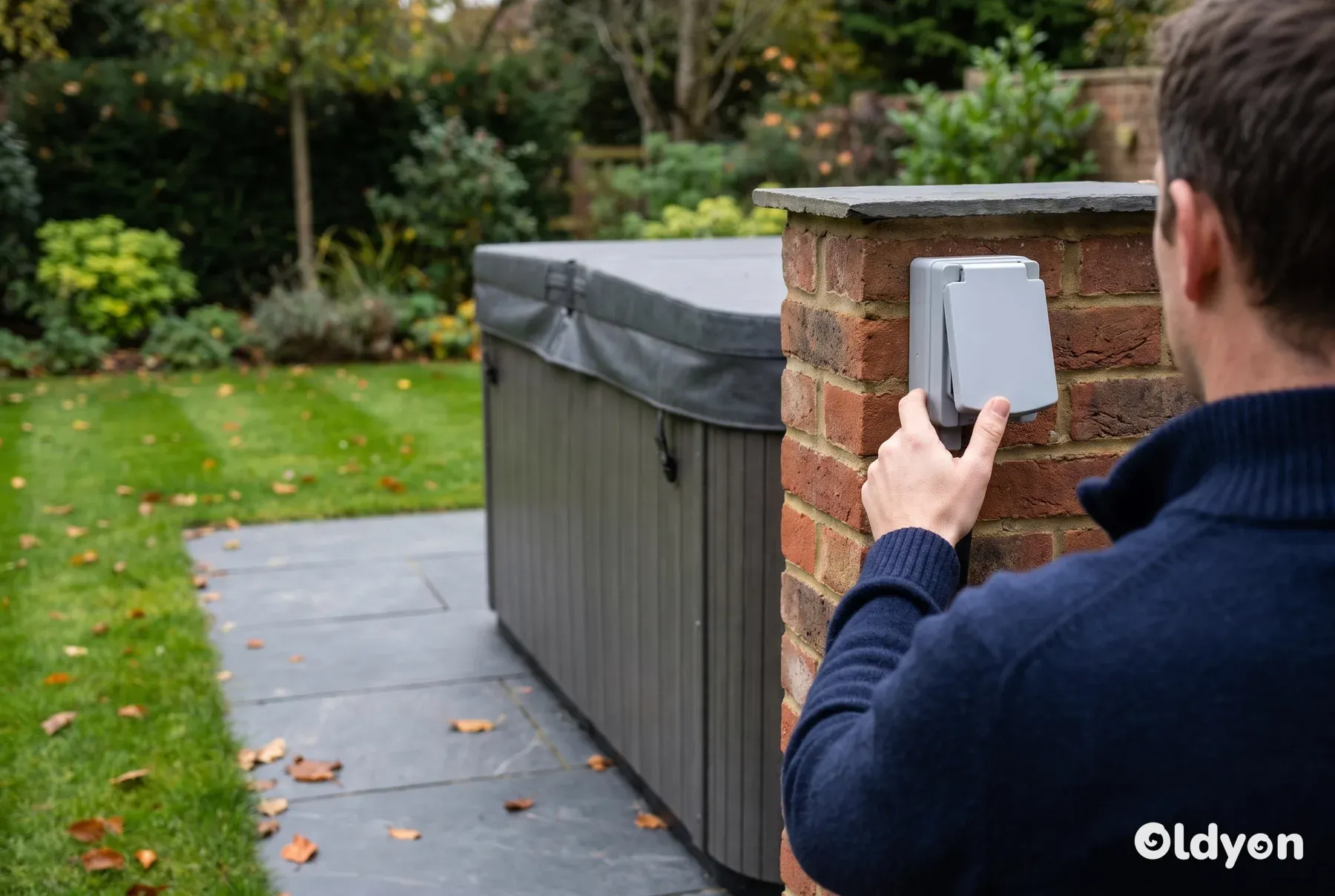
Before winter starts, save two numbers in your phone: the power cut line for your electricity network, which is 105 in the UK, and the emergency contact for your dealer or technician. Other countries have their own outage numbers, so check yours.
- Check the cover is fully closed and the clips are fastened. Do not open it to check the water, because every opening lets heat out.
- Check whether the outage is only your tub. If the tub has tripped its RCD but the house has power, switch off at the isolator and call a qualified technician or a registered electrician rather than resetting it repeatedly.
- Wrap the outside of the cabinet with blankets or old duvets, paying most attention to the side with the pump and heater. Cover them with a waterproof sheet if rain or snow is forecast.
- Never use a gas heater, candle or any open flame near the tub, and never run a domestic electric heater inside the cabinet.
- If the outage looks likely to last many hours in a hard frost, contact your dealer or a hot tub technician for advice before you decide whether to drain.
- If the outage is likely to last more than about 4-6 hours with the air below roughly -2°C, consider emergency draining, because a drained tub cannot freeze. Follow the drain procedure in your manual so the pipes and pumps are emptied too.
- When the power returns, check the control panel for error messages and listen for the pumps running normally before you use the tub.
- Once the power is back and you have found no sign of ice damage, such as leaks, cracked fittings or ice in the filter area, run all the jets for at least 15 minutes. Listen for grinding, rattling or loud humming from the pumps, because unusual noises can be a sign of ice damage. If you hear them, switch off at the isolator and call a technician.
If you think any pipes, pumps or the heater may have frozen, do not run the jets or force the pumps to start. Running a pump against ice can damage it. Let the tub thaw slowly with the cover on, then ask a technician to check it.
When can an inflatable hot tub heater not keep up?
Inflatable hot tubs usually have a small heater that runs from a standard plug socket. The heat-up rate commonly quoted is about 1-2°C per hour in mild conditions, and it falls as the air gets colder. In freezing weather a small heater can reach a point where it only just replaces the heat being lost, so the water stops rising or slowly cools.
On many inflatables the heater and the air bubbles cannot run at the same time, or the heater runs at reduced power when the bubbles are on. The bubble blower also pushes cold outside air through the water. On a frosty night, a long bubble session can drop the water temperature quickly.
Signs that your inflatable is losing the battle with the weather include:
- The water temperature keeps falling even with the heater on and the lid closed
- Frost or ice forming on the lid or around the base
- The pump showing a low temperature or flow error
- Heat-up from cold taking far longer than the times in the manual
- Air temperature falling below the minimum stated in the manual
An insulated ground mat, a fitted thermal cover and a sheltered spot out of the wind all help. If your model is not rated for freezing weather, the safest option is often to drain, dry and store it until spring. Our article on using an inflatable hot tub in winter explains how to decide.
How do you get in and out safely on icy surfaces?
Water drips from your body and the cover every time you use the tub. In sub-zero air those drips freeze on steps, decking and paving within minutes. Combine that with warm legs and slightly lower blood pressure after a soak, and a slip on frozen steps is one of the easiest ways for a winter soak to go wrong.
Before you get in
- Clear snow from the path and the area around the tub, then spread grit or rock salt. Keep grit and salt out of the water and off the cover.
- Check the steps are stable and have a non-slip surface. A sturdy handrail fixed beside the steps makes a big difference.
- Put on footwear with rubber soles for the walk out, such as clogs or sliders, and leave them right beside the steps.
- Hang your robe and towel within arm's reach of the steps, ideally under a small canopy or in a dry bag so they stay dry.
- Turn on outdoor lighting so you can see the path and steps clearly when you come back.
- Use plastic cups, not glass, and leave alcohol for later.
When you get out
- Move to the step or seat nearest the exit and sit for a minute so your body can adjust.
- Stand up slowly while holding the handrail or the edge of the tub. If you feel dizzy, sit back down until it passes.
- Put your robe on and dry your hair or cover it with a towel before you step down.
- Step straight into your footwear rather than onto bare paving or decking.
- Walk back with short, flat steps and one hand free for balance.
- Close and clip the cover, or ask someone already dressed to do it for you.
In very cold air, wet hair can freeze while you soak. A woolly hat kept for hot tub use keeps your head warm and dry. If the path or steps are icy and you cannot make them safe, skip the soak that night.
How long should you soak when it is cold outside?
Cold air can trick you into staying in longer, because your face feels cool while your body is heating up. Many manufacturers suggest limiting sessions at 40°C to around 15-20 minutes, and less for children. This is often called the 15-minute rule. The limit exists because hot water raises your core temperature and widens your blood vessels, which can leave you dizzy or faint.
Hot water also makes your heart beat faster. While you soak, your blood vessels widen, your blood pressure falls and your heart rate rises. When you step out into cold air, your blood vessels narrow again quickly. This fast change is the stress that can trigger an irregular heart rhythm in people who are prone to one.
In very hard frost, below roughly -10°C (14°F), limit soaks to about 10-12 minutes and get out slowly. The bigger the gap between the water and the air, the bigger the change your body has to cope with when you stand up.
After a soak, rest for at least 10-15 minutes before you get back in. Your core temperature keeps rising for a while after you get out, even though your face and shoulders feel cool. Going straight back in can push it higher than you expect.
Get out, sit somewhere warm and drink some water if you notice any of these:
- Dizziness or light-headedness
- Headache or nausea
- A racing or irregular heartbeat
- Feeling unusually tired or confused
- Shivering that does not stop once you are dry and dressed
The bigger cold-weather risk is after the soak. Standing wet in freezing air cools you quickly. Get dried and dressed promptly, and learn the warning signs of hypothermia on the NHS hypothermia page, such as intense shivering, pale cold skin and slurred speech.
Who should take extra care?
Moving between hot water and freezing air puts extra demand on the heart and circulation. If you have a heart condition, including atrial fibrillation, or high or low blood pressure, speak to your GP before using a hot tub in cold weather. The NHS guidance on atrial fibrillation explains when to seek urgent help for symptoms such as palpitations or chest pain.
Hot water widens blood vessels and lowers blood pressure, and cold air reverses this within seconds when you stand up. This sudden cold exposure after heat has been linked to a higher risk of an irregular heart rhythm (arrhythmia) in people who are susceptible. Below roughly -6°C (20°F), anyone with a heart condition should take extra care.
Atrial fibrillation does not automatically rule out a hot tub. Some people with stable atrial fibrillation are cleared by their doctor for time-limited soaks at a moderate temperature. Ask your GP or heart specialist for advice that fits your own situation, rather than assuming you must avoid hot tubs.
- If you are pregnant, speak to your midwife first. NHS advice in pregnancy is to avoid getting too hot. If you are cleared to soak, keep the water below about 38°C and limit it to around 10 minutes. Overheating, especially in the first trimester, is linked to neural tube defects, and cold air on your face can hide how hot the water really is.
- If you take medicines that affect blood pressure or make you drowsy, ask your pharmacist whether hot tub use is suitable. Blood pressure medicines, anticoagulants (blood thinners) and sedatives in particular can interact badly with hot water immersion.
- Older people may feel dizzy more easily on standing, so take extra time getting out. Adults over about 50 regulate core temperature less efficiently and may not notice overheating as quickly, so aim for 10-12 minutes at 37-38°C.
- Children should use cooler water, shorter sessions and always have an adult watching. Children under 5 should not use hot tubs. For older children, keep the water at about 37°C or below and limit sessions to around 5 minutes.
- Do not use a hot tub after drinking alcohol, as it increases the risk of fainting and makes slips more likely.
If you feel chest pain, severe breathlessness or faint while using the tub, get out carefully, stay warm and call 999 or your local emergency number.
How do you keep the heat in during winter?
In winter the cover does most of the work. A thick, well-fitting cover with intact seals keeps heat in and stops wind and snow reaching the water. Check it for cracks, sagging or waterlogging before the cold arrives, because a heavy, wet cover insulates far less well than a dry one.
Industry estimates suggest that up to about 75% of a hot tub's heat loss happens through the water surface when the cover is off or in poor condition. A dense, well-fitting cover can cut heating costs by roughly 30-40% compared with a worn one. Figures vary between tubs, so treat these as a guide.
When you compare covers, look for a tapered shape so rain and snow run off, a thickness of around 10 cm (4 in) at the centre, and foam with a density of at least about 24 kg/m³ (1.5 lb per cubic foot).
Signs that your cover needs replacing include:
- It feels much heavier than when it was new, a sign of waterlogged foam
- Cracks or tears in the vinyl
- A pronounced sag in the centre
- The heater running noticeably more often than it used to
Other ways to hold on to heat in winter:
- Use a floating thermal blanket under the cover for an extra layer against heat loss. It can cut heat loss by a further 15-20% on top of the cover.
- Brush heavy snow off the cover so the weight does not bend it or stretch the seals.
- Place a windbreak, fence panel or hedge on the side where the wind usually comes from. Even a modest windbreak, such as a lattice panel or evergreen planting, can reduce the heater's workload by about 10-15% on windy nights.
- Keep the cover off only while people are in the tub, and close it as soon as you get out.
- Keep testing the water. Cold weather does not change the targets: free chlorine 3-5 ppm or bromine 3-5 ppm, and pH 7.2-7.6.
Used together, a dense, well-fitting cover and a floating thermal blanket can cut total heat loss by as much as 40-55%, according to industry estimates. A thermal blanket costs far less than a new cover, which makes it one of the most cost-effective upgrades you can make before winter.
Cold slows chemical reactions, so water can look clear while it is out of balance. Test at least twice a week in winter, and keep total alkalinity at 80-120 ppm and calcium hardness at 150-250 ppm. Unbalanced water corrodes heaters and pumps and irritates skin.
Should you keep the heat on or turn it off between uses?
For an acrylic tub you use regularly, it is usually better to keep the water at a steady temperature, or a few degrees lower in economy mode, than to let it cool completely and reheat it. Reheating from cold takes many hours in winter, as our guide on how long a hot tub takes to heat up explains. The best setting depends on how often you use the tub and your electricity tariff.
Do not set the tub very low between uses, such as 29°C, to save energy. Reheating from that low takes far more energy, and it leaves less stored heat to protect the pipes if the power goes off.
If your electricity tariff has cheaper off-peak hours, schedule heating and soaks for those times. Economy mode can help if you can set it to follow your tariff's off-peak hours.
Economy or sleep mode typically lowers the target water temperature by roughly 5-11°C (10-20°F) and heats mainly during off-peak hours. It only saves money if your tariff has cheaper off-peak periods. How each mode works varies between manufacturers, so check your manual.
Never switch the tub off completely in a frost to save money. Without power, the freeze protection cannot work, and the cost of a repair after frozen pipes is far higher than the cost of keeping the heater running.
When should you drain the tub or call a technician?
Keeping a hot tub running all winter is often the simplest way to protect it. Draining becomes the better choice if you will be away for weeks with nobody to check the tub, if your power supply is unreliable, or if you have no plans to use the tub until spring. A drained tub must be fully emptied, including the pipes and pumps. Our step-by-step guide on how to winterise a hot tub covers the process.
As a guide, winterising is generally the right choice if you will not use the tub for about four weeks or more in freezing weather. Winterising properly involves these main steps:
- Drain all the water from the shell, following the drain procedure in your manual.
- Blow out the plumbing lines with a wet/dry vacuum or an air compressor so no water is left in the pipes, jets or pumps.
- Add non-toxic, spa-safe antifreeze to any water traps that cannot be emptied, if your manufacturer approves it. Never use antifreeze made for cars.
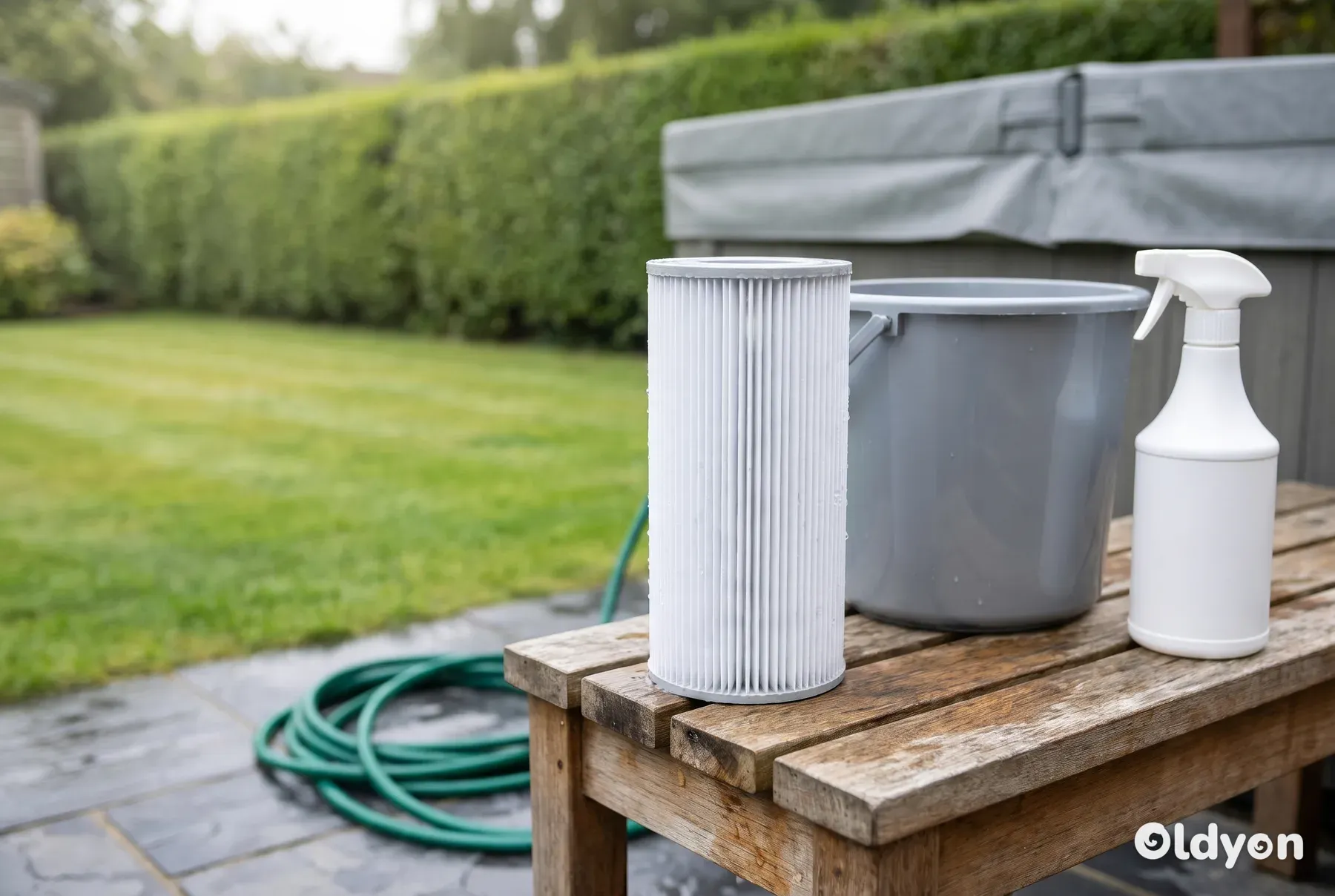
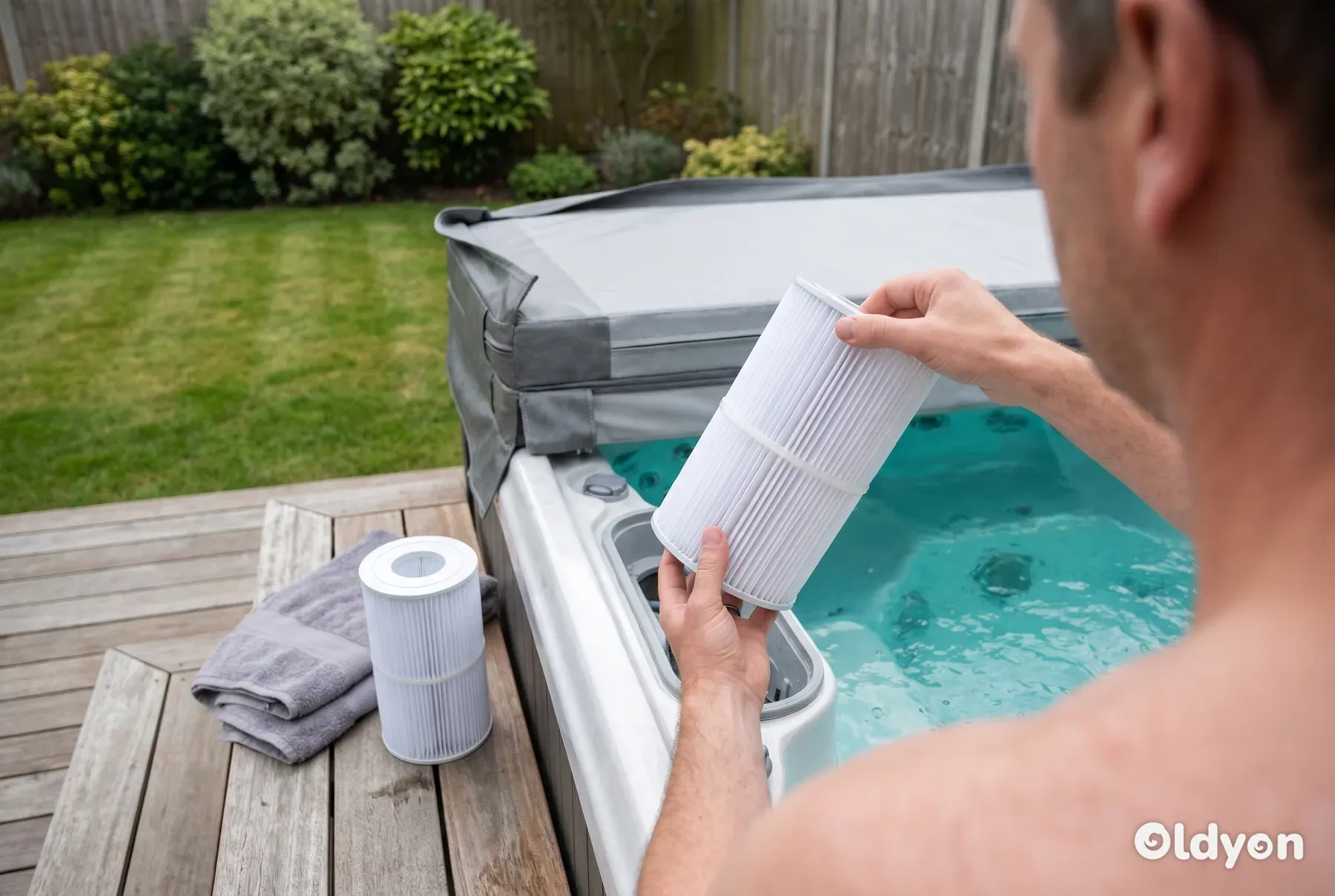
- Remove the filter cartridges, clean them and store them somewhere dry and frost-free.
Common winter mistakes to avoid include:
- Leaving the cover off or unclipped on a windy night
- Topping up with a hosepipe in hard frost and leaving water in the hose
- Draining the main tub but leaving water in the pipework
- Running the jets with the cover open for long periods in sub-zero air
- Ignoring a flow or frost error message on the control panel
Call a qualified hot tub technician if the tub will not heat, shows repeated frost or flow errors, leaks after a cold spell, or the cabinet feels cold and damp inside. If the RCD keeps tripping, switch off at the isolator and leave it off until an electrician has checked it.
Also call a technician if:
- The freeze protection indicator does not come on during a cold snap
- You hear unusual noises from the pump after a cold night
- The water drops by more than about 3°C overnight with the cover on
- The power has been off for more than about 2 hours in a frost
It is also fine to choose not to soak. During a storm, an ice warning, very strong wind or when you feel unwell, keep the tub covered and running, and wait for a calmer night.
Summary: two limits to remember
There are two separate limits in winter. The first is the water: keep it at no more than 40°C (104°F), with 37-39°C a comfortable range for most people, and keep sessions short. The second is the ground around you: if you cannot get in and out without slipping, it is too cold for a soak that night.
For the tub itself, power, a good cover and working freeze protection allow an acrylic tub to cope with sub-zero weather. Inflatable tubs are more limited, so follow the minimum temperature in the manual and be ready to drain and store them when the weather turns hard.
Frequently asked questions
Can you use a hot tub when it is snowing?
Yes, as long as the path and steps are safe. Light snow falling onto the water is harmless and many people enjoy it. Brush snow off the cover before opening it so it does not fall into the water in clumps, keep sessions short, and wear a hat. Avoid using the tub in a blizzard or strong wind, when visibility and footing become poor.
Is a hot tub ruined if it freezes?
Not always. Freezing can crack pipes, fittings, pumps and the heater, but damage depends on how long and how hard the freeze was. Do not run the pumps while ice may be present. Let the tub thaw slowly with the cover on, then have a technician check for leaks and test the equipment before you use it. Some repairs are simple, while others are costly.
What temperature should I keep my hot tub at between uses in winter?
Many owners keep an acrylic tub a few degrees below their soaking temperature, for example 34-36°C, and raise it a few hours before use. This saves some energy without a long reheat from cold. Check your manual for economy or sleep modes, and never let the tub drop so low that freeze protection has to work constantly.
Why do some people put tennis balls in a hot tub?
The idea is that the fuzzy surface soaks up some oils from skin and lotions. Put two or three new, clean balls in while the jets run, then remove them before anyone gets in. They may reduce foam and stretch the time between water changes, but any effect is small. They do not replace showering before you soak, a clean filter or the right sanitiser level.
Do hot tubs help lymphatic flow?
They may. The gentle pressure of the water and the way heat widens blood vessels could support lymphatic circulation, but the evidence is preliminary. If you have lymphoedema or another lymphatic condition, discuss hydrotherapy with your GP or specialist before you use a hot tub, because heat can make swelling worse for some people.
Is it safe to roll in the snow or take a cold plunge after a hot tub?
For healthy adults, a brief cold shock is usually tolerated, but the sudden change puts a strain on the heart and can cause gasping and a jump in blood pressure. If you have a heart condition, high blood pressure or are pregnant, avoid it and speak to your GP or midwife. Never do it alone or after drinking alcohol.
Filed under