How to make hot tub maintenance easier
Learn how to make hot tub maintenance easier with a shower rule, spare filters, enzymes, an ozonator and a ten-minute weekly routine that keeps water clear.
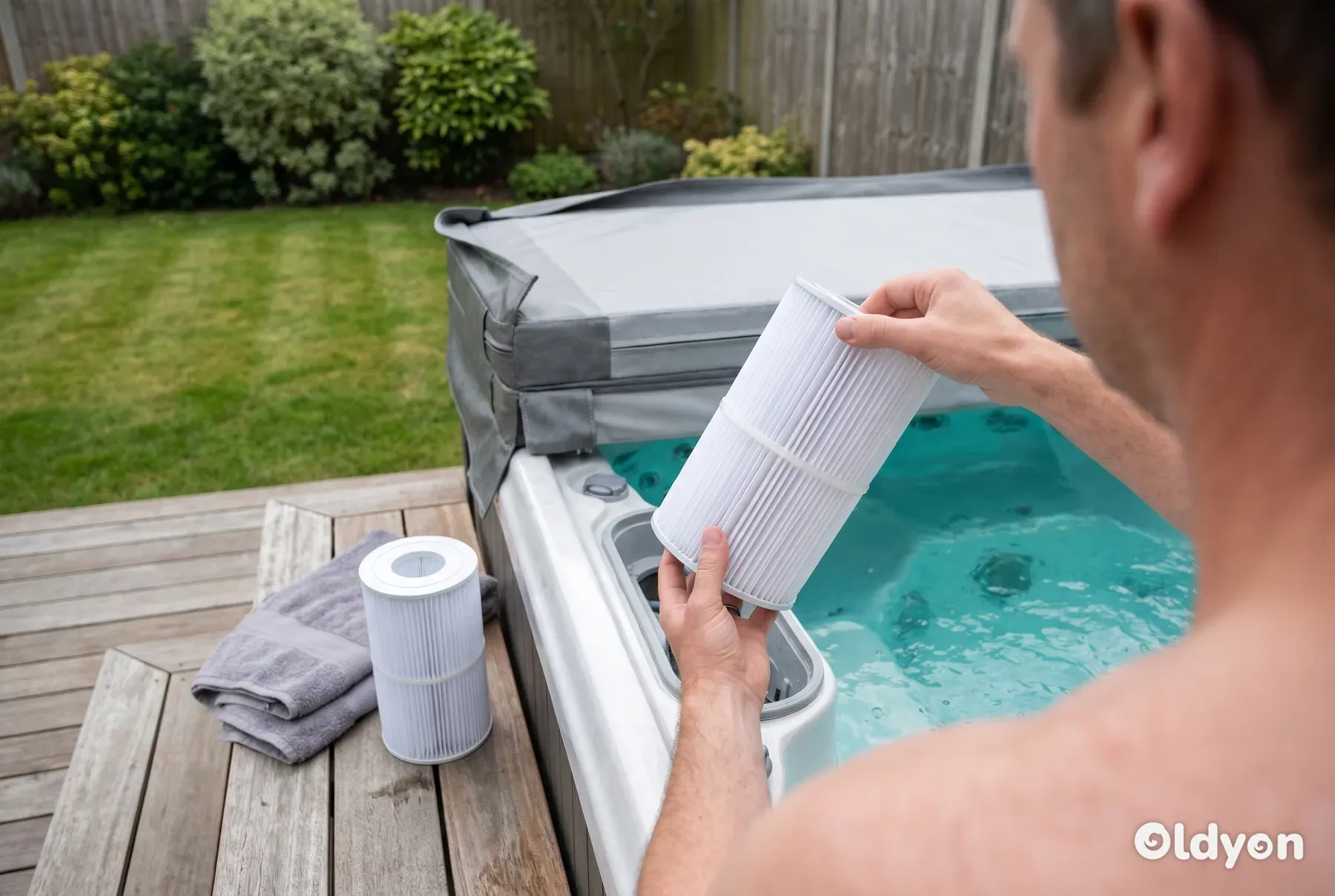
The quickest way to make hot tub maintenance easier is to stop dirt reaching the water and let simple habits do the work. Shower before every soak, keep a spare filter ready to swap, add enzymes, run an ozonator if your tub has one, and follow the same ten-minute routine each week.
Most of the hard work in hot tub care comes from catching up after things have slipped. When the water is tested little and often, problems stay small and quick to fix. The habits below are the ones that save owners the most time over a year.
Why does hot tub maintenance feel like so much work?
A hot tub holds a small amount of very warm water that several people sit in at once. Warm water helps bacteria grow, and every bather adds sweat, skin oils, cosmetics and hair products. Sanitiser is used up quickly fighting all of this, so the water chemistry can change from one day to the next.
Maintenance simply means keeping the water clean, balanced and safe, and keeping the equipment working. Neglect it and you get cloudy water, foam, a scum line, skin irritation and, in the worst cases, harmful bacteria such as Legionella. The HSE guidance on Legionnaires' disease lists hot tubs as one of the water systems that need proper control.
Legionella is caught by breathing in the fine spray and mist thrown up by the jets, not by swallowing water. That is why sanitiser levels matter even for people who always keep their heads above the water.
Legionella grows in biofilm, the slimy layer that builds up inside the pipework where you cannot see or scrub it. Keeping sanitiser in range stops biofilm forming, and draining on schedule with a line flush the day before strips out any that has built up. Together, these remove the places where Legionella can take hold.
The most common skin problem linked to hot tubs is folliculitis, often called hot tub rash. It is mainly caused by a bacterium called Pseudomonas aeruginosa, which thrives in warm water that has too little sanitiser. Keeping sanitiser in its target range is the main way to prevent it.
Water balance matters for the tub as well as for bathers. If pH or total alkalinity is too low, the water becomes acidic enough to corrode the heater, the pump seals and the shell. If they are too high, scale forms that clogs jets and damages the heating element. Unbalanced water is one of the leading causes of early equipment failure.
The good news is that most of that work is preventable. If less dirt gets in, and the filter and sanitiser are kept in good shape, the weekly job becomes short and predictable. For the full background, see our complete guide to hot tub maintenance.
Does an inflatable hot tub need different care from an acrylic one?
The water chemistry targets are the same for both. The differences are in the hardware. Inflatable tubs usually have small paper filters, weaker circulation and often no ozonator, so the water can turn quicker and the filter clogs sooner.
- Inflatable tubs: rinse the filter every few days, replace it far more often, and expect to drain more frequently because the water volume is small.
- Acrylic tubs: larger pleated cartridges that last longer, stronger pumps, and often a built-in ozonator or UV unit.
- Both: test the water at least two or three times a week and keep the cover on whenever the tub is not in use.
- Inflatable liners: clean only with a soft or microfibre cloth. Abrasive pads and scourers scratch and weaken the vinyl.
- Inflatable dosing: the small water volume means chemicals concentrate quickly, so dose at the lower end of each product's range and measure carefully. An overdose is harder to dilute.
- Inflatable pump unit: the pump and heater sit in an external unit, so check its hose connections regularly for leaks or looseness.
- Inflatable liner checks: look over the liner for small tears or punctures, ideally after each use, so you can repair them early.
Always follow the filter and draining advice in your own manual, because it varies a lot between makes and models.
How to make hot tub maintenance easier with a ten-minute weekly routine
A fixed routine is the single biggest time saver. When you do the same steps on the same day each week, nothing gets forgotten and you spot small changes before they become problems. Pick a day that suits you, such as Sunday morning, and keep your kit in one box beside the tub.
- Remove the cover and skim out any leaves, insects or debris with a hand net.
- Test the water with strips or a liquid test kit, checking sanitiser, pH and total alkalinity.
- Adjust total alkalinity first if needed, then pH, waiting for the pump to circulate between doses as your product label directs.
- Top up the sanitiser so it sits in the target range.
- Add your weekly enzyme dose and, if your routine includes it, a non-chlorine or chlorine shock.
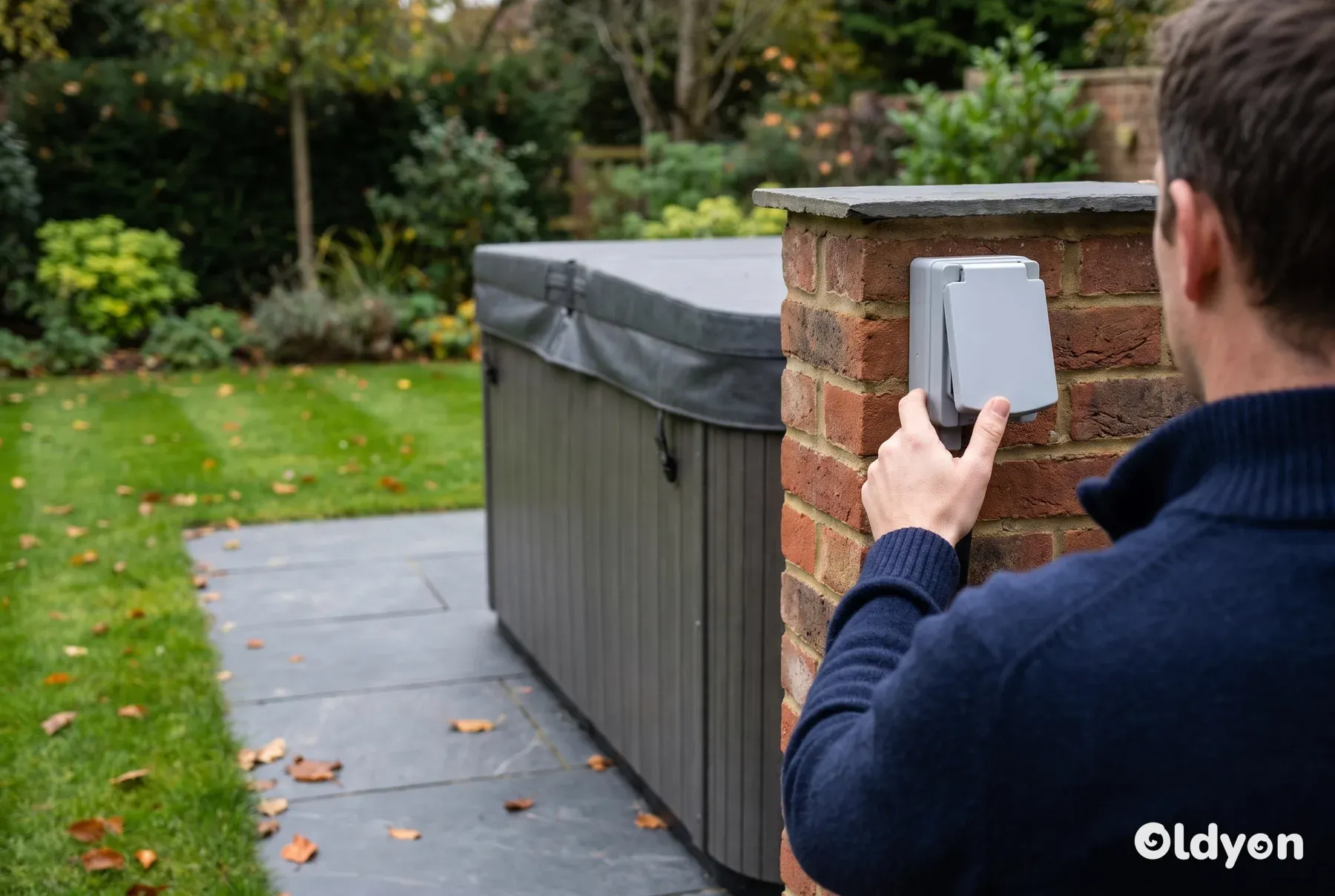
- Switch off at the isolator, swap the filter for your clean spare, and set the dirty one aside to rinse.
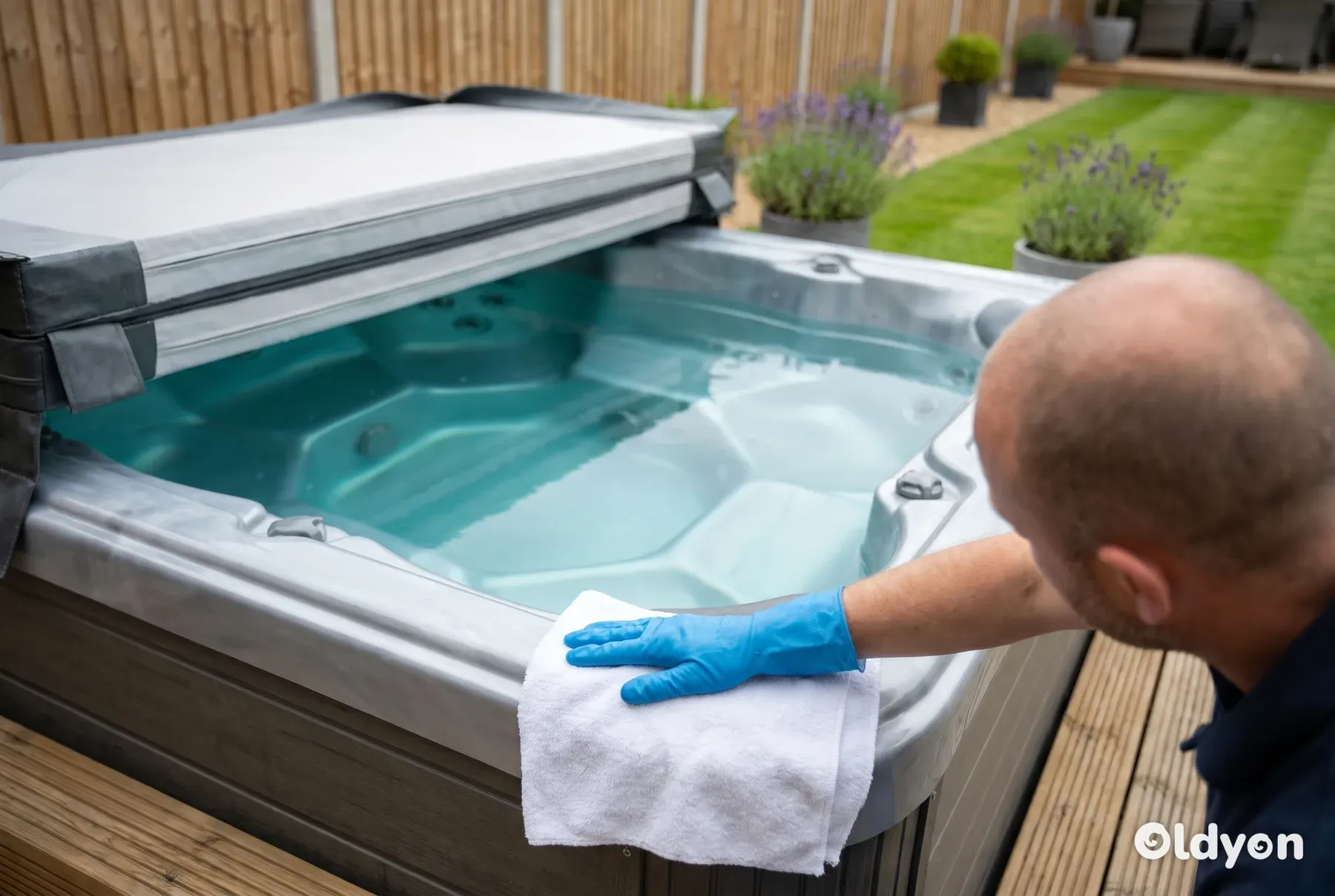
- Wipe the waterline with a soft cloth or sponge, then wipe the underside of the cover.
- Switch the power back on, check the tub is running normally and replace the cover.
Once you know where everything is, most owners find these steps take around ten minutes. Between weekly sessions, a quick test strip after heavy use is usually enough. If you prefer a printable list, our hot tub maintenance checklist covers daily, weekly and monthly tasks.
As a rule of thumb, shock about once a week or after every three to four soaks, whichever comes first. Busy weeks may need it sooner.
Wear chemical-resistant gloves, such as nitrile, every time you handle shock or any other hot tub chemical. Keeping a pair in the kit only helps if you put them on.
These are the widely accepted water targets most manufacturers recommend. Some makers use slightly different ranges, so check your manual if it says otherwise.
- Free chlorine: 3-5 ppm
- Bromine: 3-5 ppm
- pH: 7.2-7.6
- Total alkalinity: 80-120 ppm
- Calcium hardness: 150-250 ppm
- Water temperature: no higher than 40°C (104°F)
If you use chlorine, aim for the low end of the pH range. At pH 7.2, roughly 80% of the chlorine is in its active form, compared with only about 20% at pH 8.0. Holding pH near 7.2 makes the same chlorine dose work about four times harder, so you add less and top up less often.
Never mix hot tub chemicals together, and always add chemicals to the water, never water to the chemicals. Add one product at a time with the pump running and the cover open, store chemicals in a cool, dry place out of reach of children, and keep chlorine and bromine products well apart.
How do you read the test and adjust the water?
Dip the strip, then read it within the time stated on the pack, usually about 15 seconds. If you wait longer, the colours keep changing and give a false reading.
Correct total alkalinity before anything else. When alkalinity is low, pH swings from day to day and is hard to keep balanced, so fixing alkalinity first makes the pH much easier to hold.
- Add pH or alkalinity products in small amounts rather than one large dose.
- Run the jets for about 30 minutes so the product mixes through the water.
- Retest before adding any more.
- If total alkalinity is above 120 ppm, lower it by adding pH decreaser slowly, then retest after a few hours.
- Add sanitiser granules directly to the water with the jets running, never into the skimmer, because concentrated chemicals can damage the filter.
Why do pH, alkalinity and calcium hardness matter?
pH is measured on a scale of 0 to 14, where 7 is neutral. The target of 7.2 to 7.6 means the water should be very slightly alkaline.
- pH above about 7.8: chlorine works much less well. At pH 8, only around a fifth of the chlorine is in its active form, so sanitiser can read in range while giving poor protection.
- pH below 7.2: the water irritates bathers' eyes and skin and starts to attack the equipment.
- Calcium hardness below 150 ppm: the water becomes aggressive enough to attack the shell and equipment.
- Calcium hardness above 250 ppm: white scale forms on the jets and along the waterline.
How do you shock a hot tub safely?
Shocking breaks down chloramines, also called combined chlorine. These are poor at killing bacteria and are the real cause of a strong 'chlorine' smell. A tub that smells strongly of chlorine usually needs shocking, not less sanitiser.
As a rough guide, a typical non-chlorine shock dose is about 30-60 g per 1,000 litres (about 1 to 2 oz per 260 US gallons) of water. Doses vary between products, so always follow the dose on your product label.
- Test the water and confirm the pH is in range first.
- Remove the cover and turn the jets up to their highest setting, so the shock mixes through the water quickly.
- Sprinkle the dose across the surface rather than pouring it in one spot, and never add it to the skimmer.
- Run the jets for about 20 minutes with the cover off so gases can escape.
- Wait 30 to 60 minutes, then retest.
- Replace the cover only once sanitiser is back in its target range.
Why does a shower before soaking cut the work?
Everything on your skin ends up in the water. Body lotion, sun cream, deodorant, make-up, hair products and sweat all use up sanitiser, feed foam and leave a greasy ring at the waterline. A quick rinse removes much of this before it ever reaches the tub.
The effect can be fast. In a small tub, one bather who has not showered can use up a noticeable share of the free chlorine within minutes of getting in. A figure of around 1 to 2 ppm is often quoted, although the real amount depends on the person and the volume of water.
Make it a house rule: a short shower with plain water or a little soap, rinsed off well, before anyone gets in. Ask guests to do the same. You will need less sanitiser, see less foam and clean the waterline less often.
- Tie long hair up so it does not shed into the water and clog the filter.
- Wear swimwear that has been rinsed in clean water, because detergent left in fabric causes foam.
- Rinse your swimwear in fresh water after each soak as well, because bacteria can survive in wet fabric and return to the tub next time.
- Keep a towel and sandals by the tub so grass and soil stay out.
- Put a small mat or tray at the steps for wet feet.
The shower rule also helps with comfort. Poorly sanitised water can lead to an itchy, spotty rash known as hot tub folliculitis. If you or anyone else develops a rash that spreads, is painful, or comes with a high temperature, stop using the tub and speak to a pharmacist or GP.
Hot tub rash usually appears as red, itchy bumps 12 to 48 hours after a soak. It is most often found on the torso and on areas covered by swimwear, where wet fabric holds water against the skin.
Chest symptoms need a different response. If anyone develops a cough, fever or other chest or flu-like symptoms after using a hot tub, they should see a GP and mention the hot tub, as this can be a sign of Legionella infection. Test the water straight away and stop using the tub until it has been checked. The NHS page on Legionnaires' disease describes the symptoms.
How does a spare filter rotation save time?
The filter catches the fine debris your sanitiser cannot remove. A clogged filter slows circulation, makes the water cloudy and makes the heater and pump work harder. Cleaning it properly takes time, because a pleated cartridge needs rinsing and should be fully dry before it goes back in.
A clogged filter also creates poorly circulated dead zones where sanitiser does not reach and bacteria can grow. That is why cleaning or swapping the filter is often the fastest fix for cloudy water.
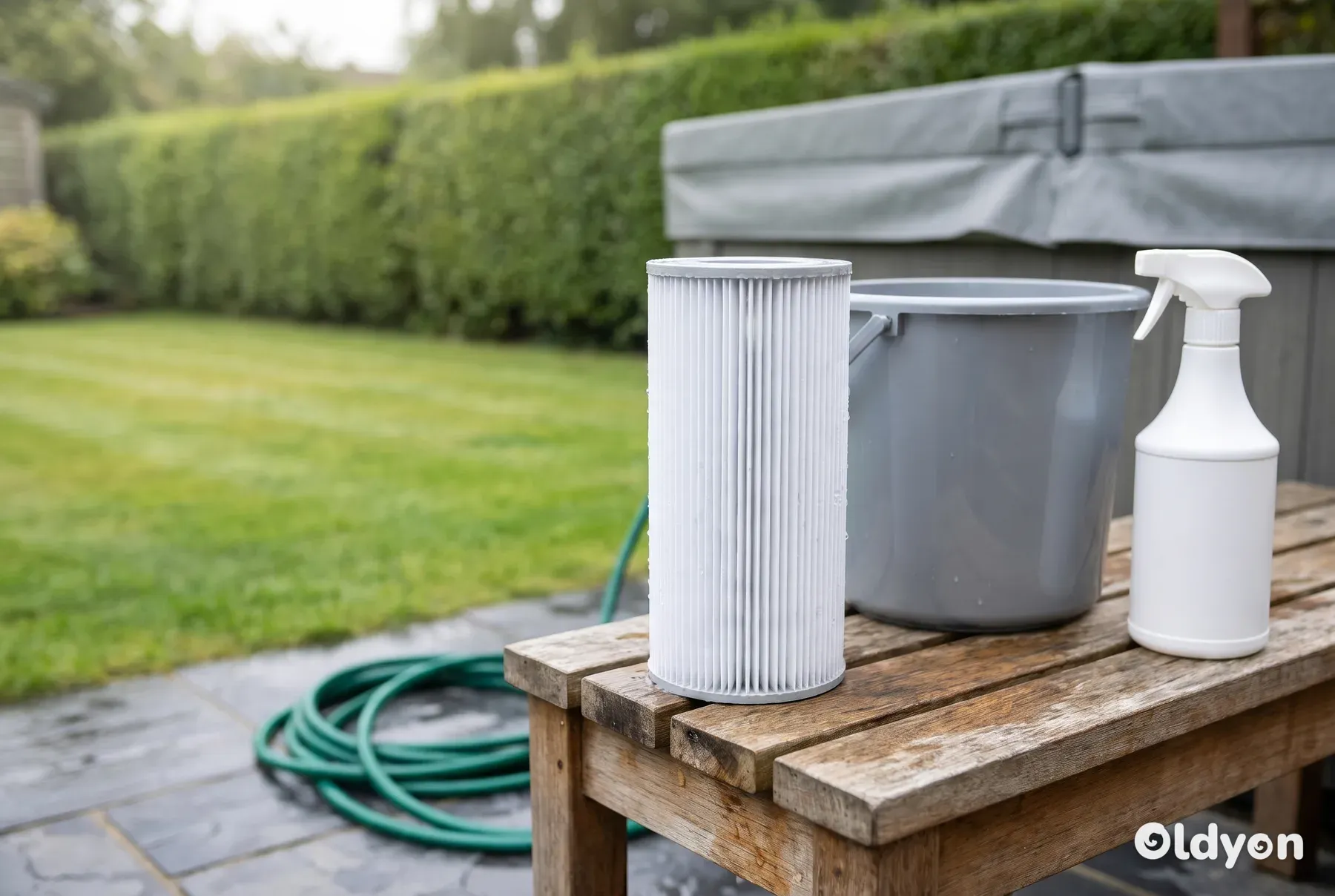
The fix is simple: buy a second filter of exactly the same type. Each week, you swap the dirty one for the clean spare in under a minute. The used filter is then rinsed with a hose and left to dry somewhere shaded while the tub keeps running.
- Switch off at the isolator before opening the filter housing.
- Lift out the dirty filter (most cartridges twist out anticlockwise) and fit the clean, dry spare.
- Restore power and check the pump runs normally.
- Rinse the dirty filter from top to bottom with a garden hose, working between the pleats. Hold it at an angle of about 45 degrees so the water flushes debris out from between the pleats.
- Let it dry completely in a shaded spot, then store it ready for next week.
- About once a month, soak one filter in a filter cleaning solution as the product label directs, then rinse well before use. Remove every trace of cleaner, because leftover cleaner causes foam in the water.
Instead of a soak, you can spray the whole cartridge with a dedicated spa filter cleaner and leave it for about 15 minutes. This breaks down oils and mineral deposits. Rinse it thoroughly afterwards so no cleaner reaches the water.
Drying fully between uses helps the pleats last longer and lets trapped grime loosen before the next rinse. Two filters used in rotation also share the wear, so each one tends to last longer than a single filter used constantly.
Inflatable tub owners should keep two spare cartridges rather than one, because the small filters clog quickly. With three in rotation, there is always a clean, dry filter ready to fit.
Most acrylic tub cartridges need replacing every one to two years depending on use, while inflatable filters are replaced much sooner. Our guide on how often to clean a hot tub filter explains the signs that a filter is worn out.
Do hot tub enzymes really help?
Enzyme products contain natural proteins that break down oils, lotions and other organic waste in the water. That waste is what causes scum lines, greasy feeling water and much of the foam owners complain about. Breaking it down means less scrubbing and a cleaner filter.
Enzymes are a helper, not a sanitiser. They do not kill bacteria, so you still need chlorine or bromine in the correct range. Most enzyme products are designed to work alongside chlorine and bromine, but check the label for compatibility with your system.
- Add enzymes weekly, or as directed, after you have balanced the water.
- Expect the biggest difference in tubs used often or by several people.
- Pair them with the shower rule, because enzymes work best when the organic load is kept low.
- Do not expect them to fix water that is already cloudy or out of balance; correct the chemistry first.
You may have heard of putting a tennis ball in the skimmer or floating it in the water to soak up oils. It can absorb a small amount of surface oil, but the effect is limited and the ball needs replacing often. Enzymes, a good filter and a pre-soak shower do far more.
Which other simple tricks are worth trying?
- Tennis ball: if you use one to soak up oil, replace it about once a month or when it feels heavy. Use it alongside filter cleaning, not instead of it.
- Tennis ball choice: use one or two clean, new balls rather than used ones, which carry dirt into the water.
- Walker glides: tennis balls can shed felt fibres that clog small inflatable filters, so some owners prefer smooth plastic walker glides, which shed no fibres.
- Nylon stocking: stretch one over the skimmer basket to catch fine hair and debris before it reaches the filter.
- White vinegar: a cloth dampened with white vinegar diluted 1:1 with water removes light limescale from the waterline and jet faces. Rinse the area with fresh water afterwards.
Is an ozonator worth having?
An ozonator injects ozone gas into the water as it circulates. Ozone is a strong oxidiser that breaks down many contaminants, which takes some of the load off your sanitiser. Many owners find they use less chlorine or bromine and see clearer water as a result.
An ozonator does not replace sanitiser. Ozone does not stay in the water for long, so you still need a measurable level of chlorine or bromine to protect bathers between cycles. Some manufacturers allow a lower sanitiser level with ozone fitted, so follow the figure in your manual.
With an ozonator fitted, a typical reduced residual is about 1-3 ppm of chlorine or bromine. If your manual gives a different figure, follow the manual.
Most ozonators run automatically during the filtration cycles, so the ozone only works while the tub is filtering. If your filtration cycles are short, the ozonator has less time to help.
Ozonators also need some care. Many units have a limited working life and need servicing or replacement after a few years, depending on the make. Our article on what a hot tub ozonator does explains how to check yours is working.
What about salt water, UV and mineral systems?
Several systems promise less chemical work, and each saves time in a different way. None of them removes the need to test and balance the water. The table below gives a simple comparison.
System | What it does | Still need |
|---|---|---|
Ozonator | Oxidises contaminants as water circulates | Chlorine or bromine residual |
UV-C unit | Light inactivates bacteria passing through it | Chlorine or bromine residual |
Salt water system | Makes chlorine from dissolved salt | Testing, pH control, cell cleaning |
Mineral cartridge | Releases minerals that support sanitiser | Low chlorine or bromine level |
Enzymes | Break down oils and organic waste | Full sanitiser level |
Salt water systems typically run at around 2,000 to 3,000 ppm salt, which is far less salty than the sea. You still need to shock the water periodically, as with any chlorine system.
Salt water gives softer-feeling water and usually lower ongoing chemical costs. You still need to test pH and total alkalinity every week, because salt systems tend to push pH upwards.
Mineral systems use silver and copper ions to support the sanitiser. They usually come as a cartridge that sits inside the filter housing. Where the tub maker approves it, they can allow chlorine as low as about 0.5 ppm. The cartridges usually last about four to six months before they need replacing.
Be wary of any system sold as 'chemical-free'. That is a marketing claim: these systems reduce chemical demand, but every one of them still needs some sanitiser in the water.
Before adding any system, check it is approved by your tub's manufacturer. Fitting an unsuitable device can damage equipment or affect your warranty.
What should be in your maintenance kit?
A tidy, complete kit is a real time saver, because you never have to stop halfway through to find something. Keep everything in one lidded box in a cool, dry place close to the tub.
- Test strips or a liquid test kit that reads sanitiser, pH, total alkalinity and, ideally, calcium hardness
- Your chosen sanitiser, either chlorine or bromine, never both
- pH increaser, pH decreaser and alkalinity increaser
- Shock treatment suitable for your sanitiser
- Enzyme product
- Filter cleaning solution and a spare filter
- A hand skimmer net, a soft sponge and a non-abrasive surface cleaner made for hot tubs
- A measuring scoop, chemical-resistant gloves such as nitrile, and safety glasses
- A pre-filter hose attachment, so it is to hand whenever you refill
- A vinyl repair kit for small punctures, if you own an inflatable tub
Test strips are quicker to use, but liquid test kits give more accurate readings. Many owners use strips for everyday checks and a liquid kit when a reading looks wrong. Choose strips that also measure calcium hardness, not only sanitiser, pH and alkalinity.
If you use stabilised chlorine granules, choose test strips that also read cyanuric acid, also called stabiliser. It builds up in the water over time, and too much of it makes chlorine less effective.
How much should you buy at first?
Sensible first-purchase quantities are roughly 0.5 to 1 kg (about 1 to 2 lb) of chlorine granules, or a bromine floater with tablets. Add about 0.5 kg each of pH increaser, pH decreaser, alkalinity increaser and non-chlorine shock.
For filter care, one bottle of filter cleaner spray typically lasts for about six to eight monthly filter cleans. That means one bottle covers roughly half a year of monthly deep cleans, so you rarely need more than one at a time.
Inflatable tubs typically hold roughly 600 to 1,100 litres (about 160 to 290 US gallons), while many acrylic tubs hold about 1,500 to 1,900 litres (about 400 to 500 US gallons). If you own an inflatable, buy smaller packs and scale every dose to your own volume.
Which optional extras are useful?
- A water clarifier for slight cloudiness.
- A calcium hardness increaser if your tap water is soft.
- A floating thermometer to check that the display reading is accurate. A digital floating thermometer gives a more reliable reading than a basic analogue one.
What is in pH and alkalinity products?
pH increaser is usually sodium carbonate, pH decreaser is usually sodium bisulfate, and alkalinity increaser is sodium bicarbonate. Sodium bicarbonate is plain baking soda, so it can be used as a cheaper alkalinity increaser. Add it in small amounts and retest, just as you would with a branded product.
Starter kits for inflatable tubs usually include smaller quantities suited to lower water volumes, while acrylic tub kits are sized for larger tubs. As a broad guide, basic starter kits tend to fall somewhere in the tens of pounds, with more complete kits costing more. Check the dosing instructions match the volume of your tub in litres.
Check that any ready-made starter kit matches the sanitiser you have chosen before buying. Inflatable tub makers often sell kits with dosing designed for their own tub volumes.
Chlorine or bromine: which is easier?
Choosing between chlorine and bromine is a personal decision. Chlorine works quickly and is easy to adjust. Bromine is more stable at high temperatures and has less smell, but it is slower to raise. Pick one and stick with it, because switching or mixing them causes problems.
- Chlorine: cheaper, and the granules dissolve quickly. It breaks down faster in heat and sunlight, so outdoor tubs may need dosing more often.
- Bromine: costs more and is generally gentler on skin and eyes. Tablets are usually dispensed from a floater, and you need to build up a bromine 'bank' in fresh water before it works fully.
- Inflatable tubs: chlorine granules are usually the easier choice, because small doses are simpler to measure precisely.
If someone reacts to chlorine that is correctly dosed, switching to bromine can help. A system that lowers chlorine use, such as ozone or minerals, is another option to consider.
What does a full hot tub maintenance schedule look like?
The weekly routine covers most of the work, but a few jobs come round less often. Spreading them out on a calendar means none of them becomes a big job.
Healthy, well-balanced water should look clear with a slight blue tint. That makes a quick daily look a useful first check: if the water looks dull, cloudy or a different colour, test it before anyone gets in.
- Daily: check the cover is properly closed and secured, the water looks clear and the temperature reads as expected.
- Before each soak: test the water. This is the safest habit, especially for tubs used often.
- After each use: replace the cover and check the water looks clear.
- After any session with four or more bathers, or a party: shock the water, because heavy use strips sanitiser quickly. A non-chlorine shock with the jets running for about 20 minutes and the cover off is enough.
- Two or three times a week: test sanitiser and pH, and top up as needed.
- Weekly: run the ten-minute routine, swap the filter and add enzymes.
- Whenever needed: shock after a water problem such as cloudiness, foam or an unusual smell, and after use by guests who did not shower.
- Monthly: deep clean one filter with a chemical soak, check the cover for damage and clean the outer cabinet.
- Monthly: unscrew any removable jet faces and rinse them, because blocked jets reduce circulation.
- Monthly: wipe the shell with a non-abrasive spa cleaner, paying attention to the seats and footwell where body oils collect.
- About every three months, for example just before each planned drain: test total dissolved solids so you know whether the water is near the 1,500 ppm limit.
- Every three to four months, or as your manual advises: drain, clean the shell and refill.
- Once a year: arrange a service with a qualified technician to check the pump, heater and electrics.
Cloudiness, foam or a green tint in the water are early warning signs. Test that same day rather than waiting for the weekly routine. An unexpected drop in water temperature can mean a heater fault or a cover that is not sealing properly.
Drain intervals depend on how much the tub is used and on its size. A tub used daily by a family needs fresh water sooner than one used at weekends by two people. Before draining, run a pipe cleaner through the system if your manufacturer recommends it, to remove build-up from inside the plumbing.
You can also test total dissolved solids (TDS). Once TDS rises above about 1,500 ppm, chemicals stop working properly, so drain whenever it reaches that level as well as on your usual schedule.
How do you drain and refill a hot tub?
Set aside about two to three hours for a full drain, clean and refill. Plan it as an afternoon job rather than squeezing it into a weekly session.
- Add a line flush product about 24 hours before draining, as most products direct, to clean biofilm from the plumbing.
- Switch off the power at the isolator so the heater and pump cannot run dry.
- Drain the water. A submersible pump empties most tubs in about 30 to 45 minutes, while a drain valve can take one to two hours.
- Clean the empty shell with a non-abrasive spa cleaner, scrubbing the seats, footwell and waterline ring in particular, because that is where body oils and scale collect most. Then rinse it with fresh water so no cleaner residue is left to cause foam.
- While the tub is empty, inspect the jets, seals and fittings for cracks or wear.
- Refill through a pre-filter hose attachment to remove metals and sediment from the tap water that can cause staining.
- Restore power and give the fresh water a full balancing session (alkalinity, then pH, then sanitiser) before anyone uses the tub.
A small submersible pump is especially useful for inflatable tubs, because their drain valves are often slow.
How do you look after a hot tub in winter?
Inflatable tubs are usually drained, fully dried, deflated and stored indoors for winter. Acrylic tubs are either kept running through the cold months or properly winterised and drained as the manual directs. Do not leave water standing in an acrylic tub that is switched off in freezing weather.
Which shortcuts cause more work later?
Some shortcuts feel like time savers but create bigger jobs down the line. The habits that cost the most are usually small ones repeated for weeks.
- Adding chemicals without testing first, which often throws the pH out of balance.
- Skipping a test because the water looks perfectly clear. By the time water turns visibly cloudy, the sanitiser has often been too low for days and bacteria may already have multiplied, so test on your normal schedule regardless.
- Overdosing to fix a problem faster, which usually creates a new imbalance. Chlorine above about 10 ppm irritates skin and eyes and can damage the shell and equipment.
- Adding more and more chemicals to water that will not clear. If problems persist after about three days of correct treatment, draining and refilling is usually quicker and cheaper.
- Skipping the filter until the water turns cloudy.
- Leaving the cover off, which lets in leaves and lets heat and sanitiser escape.
- Using household cleaners on the shell or filter, which can cause foam and damage surfaces.
- Topping up with fresh water for months instead of draining, which allows dissolved solids to build up.
- Ignoring a small leak or odd noise from the pump.
- Patching an inflatable that is past repair. Repair kits fix minor punctures, but visible cracking or seams coming apart mean the tub should be replaced.
For more examples, see our guide to hot tub maintenance mistakes that cost you money. Professional water care organisations such as PWTAG also publish guidance on pool and spa water treatment.
When should you call a technician?
Some problems are not a DIY job. Call a qualified hot tub technician if the water will not heat, the breaker or RCD keeps tripping, there is a burning smell, you find a leak you cannot trace, or the water stays cloudy after you have corrected the chemistry and cleaned the filter.
If the tub stops heating, clean or swap the filter first. A clogged filter restricts flow, and low flow can stop the heater from working. Call a technician only if a clean filter does not fix it.
- Green or brown staining that does not respond to shock, which may point to metals in your water supply.
- A pump that loses prime or makes unusual noises.
- Bathers who keep getting rashes despite correct water readings, which can mean biofilm in the pipes that needs a professional flush.
Check your warranty terms before attempting any repair yourself, because some DIY fixes can void the warranty.
If your tub trips its RCD or you notice any sign of an electrical fault, switch off at the isolator and do not use the tub until a qualified technician or registered electrician has checked it.
Summary: small habits, less work
Making hot tub care easier comes down to keeping dirt out and doing a little often. Shower before soaking, rotate two filters, add enzymes weekly, use an ozonator if your tub has one, and follow the same ten-minute routine every week.
Test the water regularly, keep your kit in one place, and plan the less frequent jobs on a calendar. With those habits in place, most weeks need only a short session to keep the water clear and comfortable.
Frequently asked questions
How long can you safely stay in a hot tub?
Many manufacturers suggest limiting a soak to around 15 to 20 minutes at higher temperatures, then getting out to cool down for at least five minutes before going back in. Long sessions in very warm water can make you dizzy, dehydrated or overheated. Keep the water at no more than 40°C (104°F), drink water, and get out if you feel unwell. Pregnant women should speak to their midwife or GP first.
Can you use a hot tub twice a day?
Yes, most healthy adults can use a hot tub twice a day if each session is kept reasonably short and you cool down fully for at least 20 to 30 minutes and drink water between soaks. More use does mean more sanitiser is used up, so test the water before the second session and top up if needed. Anyone with a heart condition, low or high blood pressure, who takes medication that affects blood pressure or circulation, or who is pregnant should check with a GP first.
Why shouldn't you put your head under the water in a hot tub?
Keeping your head above water reduces the chance of water getting into your eyes, ears, nose and mouth, where any bacteria present are more likely to cause infection. Warm, sanitised water can also irritate these areas more than pool water. Hot water over your head can make you overheat faster. Long hair can get caught in suction fittings, so tie it up, keep heads and hair away from these openings, and check all suction and drain covers are fitted and undamaged.
Do I still need to shock the hot tub if I use an ozonator?
Most owners still shock regularly, often weekly or after heavy use, even with an ozonator. Shocking breaks down waste that builds up and helps restore free sanitiser. An ozonator may mean you need to shock less often or use a non-chlorine shock instead. Your manufacturer's guidance is the best guide to how often your particular tub needs it.
Why is my hot tub water foamy even though the chemistry looks fine?
Foam usually comes from soaps, detergents, lotions and hair products rather than from the chemistry itself. Rinsing swimwear in clean water, showering before soaking and adding enzymes all help. If foam keeps returning, the dissolved solids in the water may be high, which means it is time to drain and refill with fresh water.
Can I use a spare filter from a different brand?
You can use a filter from another maker as long as it matches the size, fitting and filter area your tub needs. A poor fit lets water bypass the filter, which leaves debris in the water and can strain the pump. Compare the dimensions and specifications in your manual before buying, and if in doubt, ask your tub's supplier which filters are compatible.
What happens if you stay in a hot tub too long or drink alcohol?
Overheating from a long soak can cause nausea, a racing heartbeat and loss of consciousness. Children and older people are at higher risk, so keep their sessions shorter and cooler. Avoid alcohol before or during a soak, because it impairs the body's ability to control its temperature and greatly increases the risk of overheating, fainting and drowning. Get out straight away and cool down if you feel unwell.
Filed under