Why is my hot tub overflowing?
Hot tub overflowing? Learn the main causes, from rain and overfilling to bather displacement, the correct fill level, and how to stop overflow quickly.
A hot tub overflowing is almost always a water level problem, not a fault. The usual causes are filling too high, the water that bathers push up when they get in, jets and air raising the surface, and rain getting in or pooling on the cover. Lower the level and the overflow stops.
Below you will find the correct fill level for hard-shell and inflatable tubs, how much the water rises when people get in, what to do when rain or foam is the cause, and a step-by-step way to bring the level down safely. If water is reaching the cabinet or the electrics, switch off at the isolator first.
What makes a hot tub overflow?
Water only spills over the lip when the surface rises higher than the shell can hold. That happens because there is too much water to start with, because something adds volume while the tub is in use, or because extra water arrives from outside. Most overflows are a mix of two of these.
The common causes are:
- Overfilling, often from topping up by eye or leaving a hose running
- Bathers displacing water as they climb in and sink down
- Jets and the air blower adding air bubbles and making the surface surge
- Rain falling into an open tub or running off a cover, gazebo roof or gutter
- Water pooling on a sagging cover and sliding in when you lift it
- Foam building up and spilling over even though the water level is fine
A quick check tells you which kind of problem you have. If water is spilling over the rim of the shell, the cause is almost always the water level or the way the tub is being used. If a steady stream is running from a small tube or port on the cabinet, and it carries on with the jets off and nobody in the tub, the cause is more likely mechanical. The section on leaks below explains what to do in that case.
The table below helps you match what you see to the likely cause and the first thing to try.
Cause | What you notice | Quick fix |
|---|---|---|
Overfilled | Water at or over the lip with nobody in | Remove water until it sits mid-skimmer |
Bather displacement | Spills only once people get in | Fill lower and mark the correct level |
Jets and blower | Surface rises and splashes when jets start | Close air controls, lower level slightly |
Rain on open tub | Level creeps up after a storm | Remove excess water, retest chemistry |
Water on the cover | A flood of water when the cover opens | Brush it off first, check the cover shape |
Foam | Suds spill over, water level looks normal | Jets off, spa antifoam, then find the cause |
Siphoning tube | Steady flow from a cabinet tube, jets off | Clear pooled water, secure the tube end high |
Leak, not overflow | Wet ground but the level keeps falling | Look for a leak instead |
What is the correct water level for a hot tub?
The right level depends on the type of tub, and your manufacturer's manual always has the final say. The general rule is the same for every design: high enough to cover every jet and feed the pump properly, low enough to leave room for people and air.
Hard-shell hot tubs
On an acrylic hard-shell tub, the most common target is the middle of the skimmer opening, the rectangular intake on the side wall with a floating flap. Some manufacturers allow up to about two-thirds of the way up the opening. The water must also sit a few centimetres above the highest jet or pillow fitting.
On many tubs, the middle of the skimmer opening sits roughly 2.5 to 5 cm (1 to 2 inches) below the top of the shell rim. If the water is noticeably closer to the rim than that, the tub is overfilled and you should remove some water.
Always check the level with the tub empty of people, the jets off and the surface still. A reading taken while the water is moving can be out by several centimetres.
Inflatable hot tubs
Inflatable tubs have MIN and MAX lines printed on the inside of the liner. Fill to somewhere between the two, and nearer the lower line if you usually have a full tub of people. Never fill above MAX, because the soft walls give very little spare height before water spills.
Why too low is also a problem
Draining too much water to stop an overflow causes its own trouble. If the level drops below the skimmer, the pump can draw in air, which leads to noisy running, weak jets, flow errors and possibly an airlock in the plumbing. Aim for the middle of the range, not the bottom.
How to clear an airlock
Air trapped in the plumbing, called an airlock, usually forms after a drain and refill or after a power cut. You will notice weak, gurgling jets while the pump is running but very little water is moving. Do not leave the pump running like this for long, because pumps rely on water flowing through them to stay cool.
- Switch off at the isolator.
- Open the equipment cabinet and find the union on the pump, the large threaded collar where a pipe joins the pump body.
- Loosen the union about a quarter turn by hand. You should hear air hiss out of the joint.
- As soon as water starts to seep out, tighten the union again by hand. Keep a towel ready to catch the drips.
- Restore power, run the jets and check that they work at full pressure. If they are still weak, repeat the steps. Some tubs have a bleed valve or a priming mode instead, so check your manual.
Once the airlock has cleared, the jets should be back to full pressure within about 30 to 60 seconds of restoring power. That tells you the fix has worked. If they are still weak after a minute or two, switch off again and repeat the steps.
A worn or perished O-ring on a pump union is a common reason for an airlock or a slow drip at the pump, because it lets air in and water out. With the power off and any shut-off valves either side of the pump closed, unscrew the union and look at the rubber ring inside. If it is cracked or flattened, replace it with one of the same size before you tighten the union again.
The single most useful habit: fill your tub with nobody in it, stop when the water reaches the middle of the skimmer opening, and make a small mark or take a photo of that level. Use it as your reference every time you top up.
Why does the water rise when people get in or the jets start?
How much water bathers displace
The human body has a density close to that of water, so a fully submerged person pushes aside roughly one litre of water for each kilogram they weigh. Sitting with head and shoulders above the surface, it is a little less. As a rough guide, allow around 50 to 70 litres (about 13 to 18 US gallons) for each adult.
That adds up quickly. Four adults could push up 200 to 280 litres. Spread across the waterline of a typical tub about 2 metres (6.5 feet) square, that is a rise of roughly 5 to 8 cm (2 to 3 inches). If the tub was already filled to the top of the skimmer, that extra height goes straight over the lip.
This is why a tub that looks perfect when empty can overflow on a busy evening. If you want to work out your own tub's volume and how much each centimetre of water holds, see our guide to how many litres are in a hot tub and how to work it out.
Why the jets make it worse
Most jets draw air into the water stream through the air controls on the top of the shell. Those bubbles take up space, so the surface rises while the jets run. An air blower adds even more air through the floor or seat outlets.
Powerful jets also push water towards the walls, so the surface surges and splashes rather than staying flat. Combine a full tub of people, all jets on and every air control open, and a level that was fine at rest can spill over at the edges.
As a rough guide, running the jets and blower typically lifts the waterline by about 2.5 to 5 cm (1 to 2 inches) above its resting level through surge and turbulence. Your resting level therefore needs at least that much headroom below the lip, before you allow anything extra for bathers.
If your tub only overflows with the jets running, close the air controls part of the way and lower the water by a centimetre or two. Splashing out from lively use is normal in small amounts, but regular spills mean the starting level is too high.
Hot tub safety while bathing
Keep soaks to about 10 to 15 minutes, with the water no hotter than 40°C (104°F). Longer sessions risk overheating, dehydration, nausea and fainting. Advice on session length varies between manufacturers, so check your manual as well.
Drink water before and after a soak, and leave the tub straight away if you feel dizzy, sick or unwell. If you are pregnant, ask your midwife before using a hot tub.
People with heart rhythm problems such as atrial fibrillation, or other heart conditions, should check with their GP before using a hot tub. The heat widens blood vessels and raises heart rate, which puts extra demand on the heart. Anyone who feels palpitations or dizziness should get out immediately. The NHS guide to atrial fibrillation explains the condition and its symptoms.
Can rain make a hot tub overflow?
Yes, though usually not in the way people expect. Rain falling straight into an open tub raises the level by about the same depth as the rainfall, so 10 mm of rain adds around 10 mm of water. That only causes an overflow if the tub was already filled to the brim. Our article on whether it is safe to use a hot tub in the rain covers using the tub during wet weather.
Water running in from nearby surfaces
Much more water arrives when rain is collected by something larger and channelled into the tub. A cover folded back over the side, a gazebo or pergola roof with no gutter, or a house gutter that overflows near the tub can all funnel many times more water than falls on the surface itself.
Check where water runs off around your tub during a heavy shower. A short length of gutter on a gazebo, or moving a cover lifter so the folded cover drains away from the shell, often solves the problem completely.
Water pooling on the cover
A good hard cover is tapered so it is thicker in the middle and rain runs off the edges. As covers age, the foam core can absorb water, sag and lose that shape, leaving a dip where rain collects. A cover put on the wrong way round can also pool water along the fold.
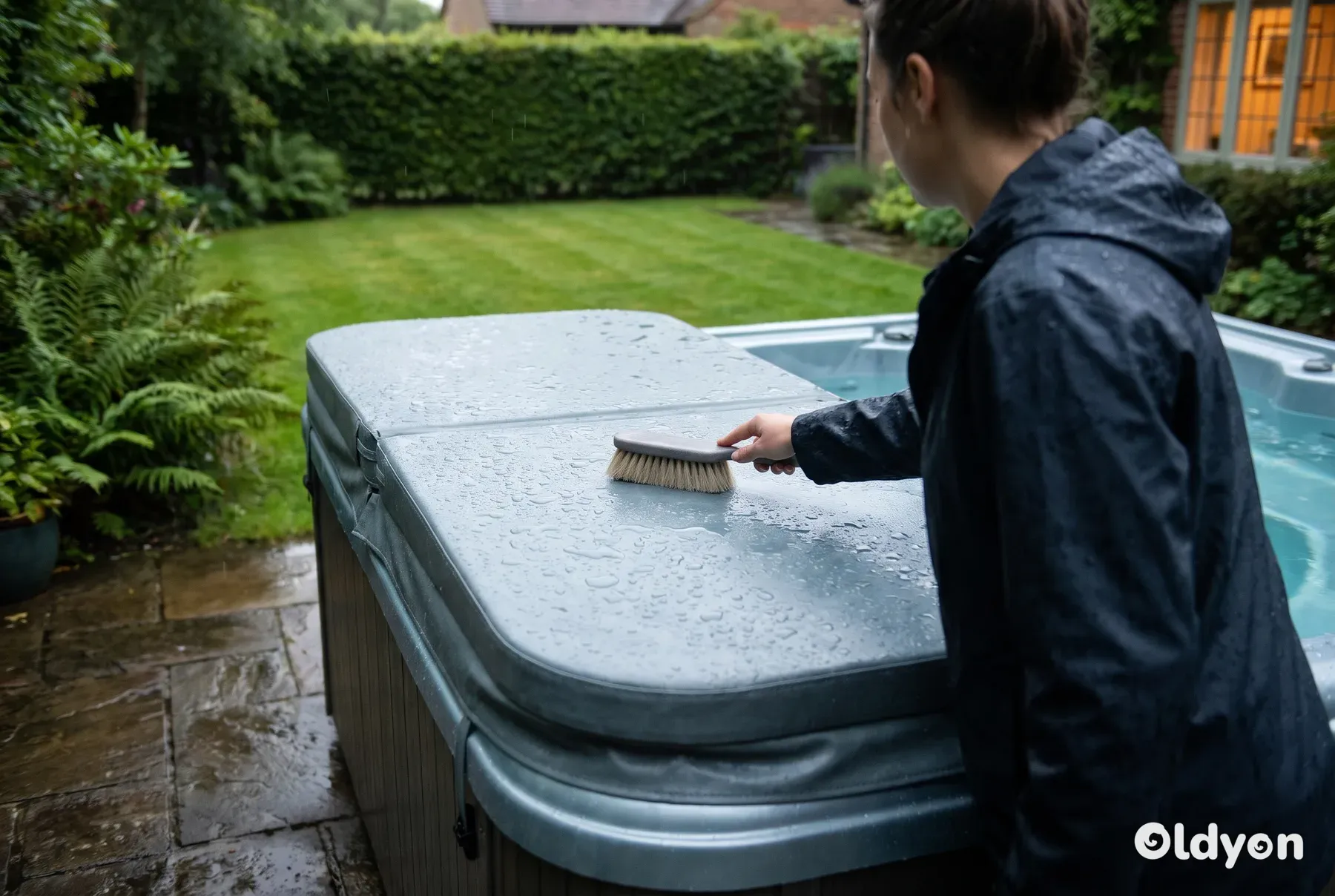
When you lift a cover with a puddle on it, that water slides straight into the tub. A large puddle can hold several buckets of water, along with leaves and dirt. Brush or sweep the water off with a soft brush before you open the cover.
A cover that feels much heavier than it used to, or that sags in the middle, is probably waterlogged. It will also insulate poorly. Our guide on how to choose a hot tub cover explains taper, foam density and what to look for when it is time to replace one.
Check the water chemistry after heavy rain
Rain dilutes your sanitiser and can shift pH and alkalinity. After removing any excess water, test and adjust to the usual ranges: free chlorine 3-5 ppm or bromine 3-5 ppm, pH 7.2-7.6 and total alkalinity 80-120 ppm. Your test kit or sanitiser instructions may give slightly different targets, so follow those where they differ.
Is it foam spilling over, not water?
Sometimes the water level is fine and what spills over the lip is foam. Thick foam can build up quickly once the jets are running and pour over the edge, leaving a wet surround that looks like an overflow.
If foam is spilling over, switch the jets off straight away. While they run, the jets keep whipping air into the water and making more foam, so turning them off lets the surface settle and stops the spill getting worse.
Foam is a sign that something in the water is lowering its surface tension. Common causes include:
- Soap, shampoo or shower gel left on skin or hair
- Washing powder or fabric softener left in swimwear
- Body lotions, sun cream, make-up and hair products
- Low calcium hardness, as very soft water tends to foam more easily
- Old water that has built up a high level of dissolved material
An antifoam product will knock the foam down within minutes, but it only treats the symptom. To stop it coming back, shower without soap before using the tub, rinse swimwear in clean water rather than washing it in detergent, shock the water, and keep calcium hardness at about 150-250 ppm. If foam keeps returning, the water is probably due for a drain and refill.
To use spa antifoam, pour the amount shown on the label directly onto the foam on the surface, rather than into the water elsewhere in the tub. It works on contact with the bubbles, so putting it where the foam is gives the quickest result.
If your test shows calcium hardness below 150 ppm, raise it with a calcium hardness increaser, following the dose on the product label. Low calcium is one of the reasons foam keeps coming back even after you have treated it.
Never use washing-up liquid or a household defoaming product on hot tub foam. These add more surfactants to the water and make the foam worse, and they can upset the water balance. Use only an antifoam made for spas and hot tubs.
How do you stop a hot tub overflowing quickly?
Work through these steps in order. They stop the spill, protect the electrics and bring the water back to the correct level.
- Ask everyone to get out, then turn off the jets and the air blower so the surface settles and you can see the real level.
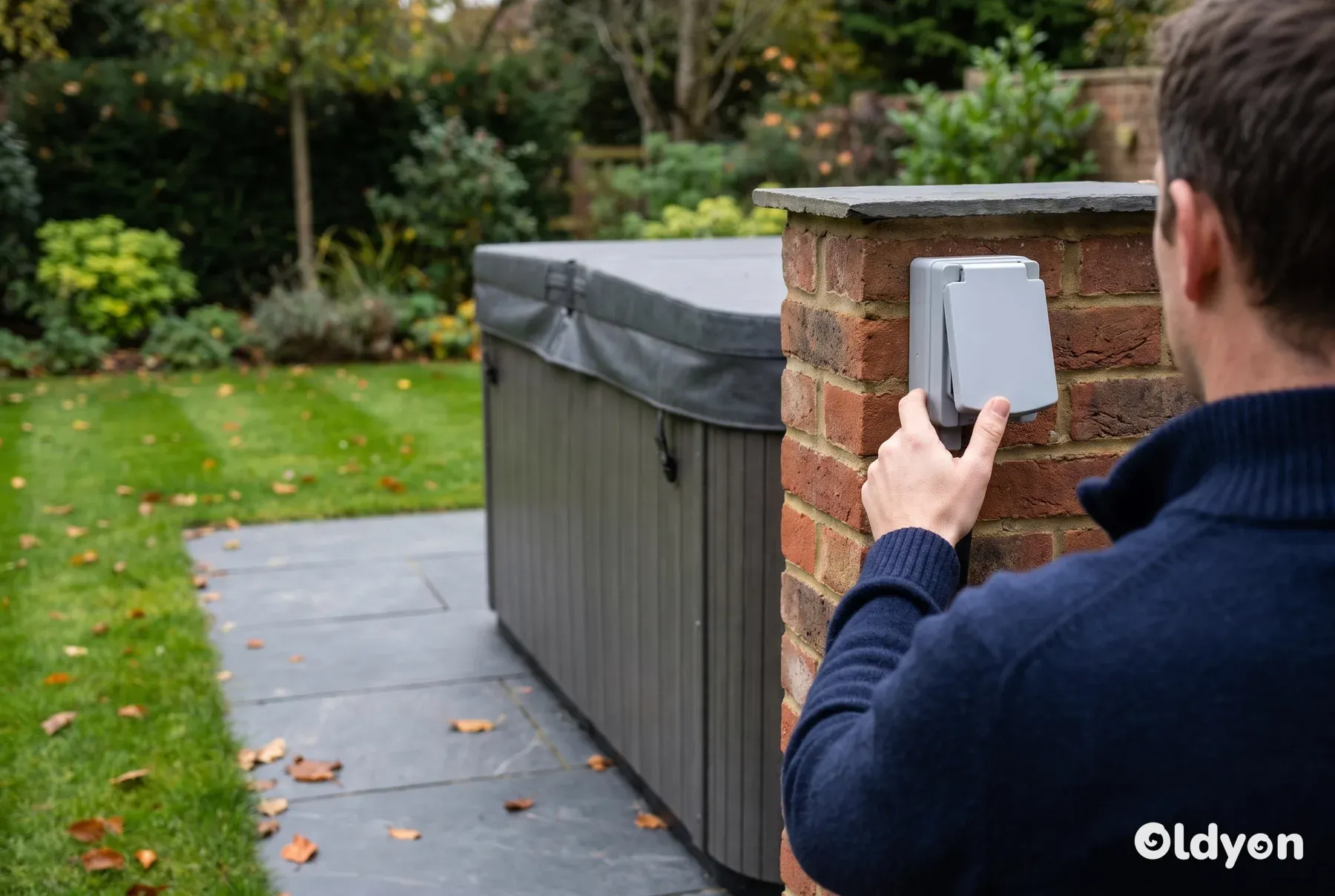
- If water has run towards the cabinet, control panel, plug or isolator, switch off at the isolator (or at the RCD-protected socket for a plug-in tub) before touching anything else.
- Turn off any hose that is still filling the tub, and move it away so it cannot be left running again.
- Remove the extra water. A small submersible pump, a bucket or the tub's drain valve with a garden hose attached will all work. Our step-by-step guide on how to drain a hot tub shows where the drain valve is and how to use it.
- Take the water out a few centimetres at a time, then pause and let the surface settle before you recheck. Removing a large amount in one go makes it easy to overshoot and drop below the skimmer.
- Stop when the water sits around the middle of the skimmer opening with nobody in the tub and the jets off.
- Wipe the lip and dry the surround. If you see water inside the cabinet or around the equipment, leave the power off and read the electrical section below before going further.
- Test the water and rebalance the sanitiser, pH and alkalinity, especially if rain or a hose top-up caused the overflow.
- Switch the power back on, run the jets for a few minutes and check that the level stays below the lip with a normal number of people in the tub.
Removing water from the tub is perfectly normal and does not harm the shell. Just take care not to go below the skimmer, as explained earlier.
If your tub is sunk into the ground or set into a deck pit, do not empty it completely just to fix an overflow. Where the ground water level is high, water pressure under an empty shell can push it upwards and crack it. Only remove the amount you need to reach the correct level.
Can an overflow damage the hot tub electrics?
Hot tub equipment bays are designed to cope with splashes and damp air, not with standing water. A single spill over the lip usually runs down the outside of the cabinet and away. Repeated overflows, or water that pools around the base, can find their way into the equipment area where the pump, heater and control box sit.
Overflow water also affects the ground around the tub. Chemically treated water can damage nearby plants and landscaping, so direct spills and removed water away from flower beds and lawns.
Safety first: if water has got inside the cabinet, the control panel is behaving strangely, you smell burning, the pump makes grinding noises, or the RCD has tripped, keep the power off at the isolator. Do not reset a tripping RCD again and again, and do not open the control box. Call a hot tub technician or a registered electrician.
What to do if water has reached the equipment
- Keep the power off at the isolator for the whole process.
- Remove any water pooled on the cabinet floor with a wet-and-dry vacuum or absorbent towels before anyone inspects the equipment.
- Leave the cabinet open so the wet components can dry for at least 24 to 48 hours. Do not simply mop up and switch back on.
- Have a hot tub technician check the equipment before the power is restored.
Opening the cabinet or carrying out your own electrical or plumbing repairs can void the manufacturer's warranty. Check your warranty terms before you remove any panels, and while the tub is still covered, use a technician the manufacturer approves.
Signs that water has affected the electrics
- Droplets of water on the control board or inside its housing
- Green or white corrosion on terminals
- Burn marks on components or wiring
- Rust or deposits around the heater housing
- Damp or corroded wiring connectors
Corrosion from a single water intrusion can cause intermittent control faults weeks later. A tub that seems to work normally after an overflow into the cabinet should still be inspected, rather than waiting for a fault to appear.
Tub completely dead after an overflow?
If the tub shows no display and nothing runs once the electrics have been checked and dried and the power is back on, a blown fuse could be the reason. Hot tub control boxes usually contain fuses that blow to protect the board when water causes a short circuit.
Have the fuse checked by a hot tub technician or a registered electrician before assuming a bigger fault such as a failed control board or heater. Do not open the control box yourself, as parts inside can stay live even when the display is blank.
UK wiring rules and RCD protection
In the UK, a hot tub's electrical supply must meet the wiring regulations, BS 7671, and needs RCD protection. Installing a new circuit for a hot tub is normally notifiable work under Part P of the Building Regulations in England and Wales, so it should be done by a registered electrician who can certify it. Scotland, Northern Ireland and other European countries have their own rules, so check what applies where you live.
For general advice on staying safe with electricity around the home and garden, the charity Electrical Safety First is a reliable UK source. Pressing the test button on your RCD regularly, as your manufacturer recommends, confirms that it will trip when it should.
If the RCD does not trip when you press its test button, do not use the tub. Leave it switched off until a registered electrician has checked the RCD or replaced it.
Is it really an overflow, or is it a leak?
Wet ground around a hot tub does not always mean it is overflowing. Watch the water level over a day or two without topping up. If the level stays the same or rises, water is coming in. If it keeps dropping, you are more likely to have a leak.
Signs of a leak rather than an overflow include water appearing under the cabinet when nobody has used the tub, a damp patch that never dries, or puddles on one side only. Our guide on why a hot tub loses water explains how to tell evaporation, splash-out and leaks apart, and how to find the source.
You may read that airlocks or a stuck diverter valve cause hot tubs to overflow. These faults cause weak or uneven jets and pump problems, but they do not add water to the tub, so they will not raise the level by themselves.
How to check a faulty diverter valve
The diverter valve is the large knob on the shell that switches water between jet zones. A faulty one shows up as one jet zone running strongly while another is dead, or as knocking or grinding when you turn the knob.
- Switch off at the isolator.
- Unscrew the diverter knob and remove the cap or retaining ring beneath it, following your manual.
- Lift out the stem and check the O-ring on it for cracks or flattening. Replace the O-ring if it is damaged.
- Coat the O-ring lightly with silicone spa lubricant. Avoid petroleum-based greases, which can make rubber seals swell and perish.
- Refit the stem, cap and knob, restore power and check that each jet zone now runs when selected.
- If the valve body itself is cracked or warped, replace the whole valve rather than just the seal.
Overflow outlets and vent tubes
Most hard-shell hot tubs have no overflow drain, so any excess water simply goes over the lip. If your manual does show an overflow outlet, keep it clear of leaves and debris, and check that the pipe from it drains away from the tub and the electrics.
The vent or overflow tube, where fitted, is typically a narrow clear or white plastic tube about 12 mm (half an inch) wide. It runs from the shell down to a low point inside the cabinet.
Some tubs have a small vent or overflow tube running from the shell down into the cabinet. If water keeps running out of it and the tub level drops steadily, the tube has started siphoning. With the power off at the isolator, raise the outlet end of the tube above the tub's water level and secure it there, and the flow will stop. Then check the tube along its length for cracks, and replace it if it is damaged.
A tube usually siphons because its outlet end is sitting in water that has pooled inside the cabinet. Remove that pooled water first with towels or a wet-and-dry vacuum. Then tie the raised end of the tube to a higher point on the cabinet frame, for example with a cable tie, so it cannot drop back into the water.
If the problem keeps coming back after you have corrected the level and dealt with foam, rain and the tube, suspect a deeper plumbing fault. A cracked manifold, a failing check valve or a worn pump seal can all let water escape. These are hard to find by eye, so a hot tub technician will need to pressure-test the system to locate the fault.
How to stop your hot tub overflowing for good
A few simple habits prevent nearly every overflow. None of them need tools or spare parts.
- Fill and top up with nobody in the tub and the jets off, stopping at the middle of the skimmer opening.
- Never leave a hose running unattended. Set a timer on your phone if you need to walk away.
- A garden hose usually takes around 2 to 4 hours to fill a typical tub of 1,100 to 1,500 litres (about 290 to 400 US gallons). Time your own fill once, then set your phone timer to match that duration rather than guessing.
- Check the level before you turn the jets on, particularly after rain or when the tub has sat unused for several days.
- Lower the level slightly before a busy session with several adults.
- Open the air controls gradually rather than all at once when the tub is full of people.
- Brush rain off the cover before lifting it, and keep the cover clipped down between uses.
- Replace a cover that has become heavy, sagging or split.
- Make sure gazebo roofs, gutters and folded covers drain away from the tub, not into it.
- Shower before bathing and rinse swimwear in clean water to keep foam away.
- Test the water about twice a week, not only after rain. Balanced pH, alkalinity and calcium hardness help prevent the foaming that can spill over the lip.
- Check the level once a week, with the jets off, against your reference mark.
- About once a month, switch off at the isolator, open the equipment cabinet and look for pooled water. It is an early warning of a slow leak or a siphoning tube.
Keeping pH, alkalinity and sanitiser balanced does more than prevent foam. It also protects bathers against skin infections such as hot tub folliculitis, an itchy, bumpy rash caused by bacteria that grow in warm water that is not properly sanitised. If a rash appears after using a tub and does not settle within a few days, or you feel unwell, speak to a pharmacist or your GP.
In a typical week, water lost to evaporation and splash-out tends to balance the occasional rain shower, so you should only need small top-ups. If you find yourself removing water regularly, look again at where rainwater is coming from.
Summary
A hot tub overflows when the starting level is too high for the people, air and rain it has to absorb. Fill to the middle of the skimmer with the tub empty and still, allow for each adult adding roughly 50 to 70 litres, and keep rain from running or pooling into the tub.
If it does overflow, turn off the jets, switch off at the isolator if water is near the electrics, remove water back to the correct level and retest the chemistry. If water has reached the equipment or the RCD has tripped, leave the power off and call a professional.
Frequently asked questions
Is it a problem to leave a hot tub slightly overfilled?
A tub that sits just above the skimmer will not be damaged, but it will spill as soon as people get in, which wastes treated water and wets the surround. The skimmer also works less well when the water is too high, because the floating flap cannot draw surface debris in properly. Bringing the level back to mid-skimmer improves filtration as well as stopping spills.
Do inflatable hot tubs overflow more easily than hard-shell tubs?
They can. The soft walls leave little height between the MAX line and the top edge, and the walls flex slightly when people lean back, which pushes water upwards. Filling nearer the MIN line when you expect several bathers helps. Keep the inflatable lid strapped down when not in use, as rain pooling on a soft lid adds water quickly.
Should I drain some water after heavy rain even if it has not overflowed?
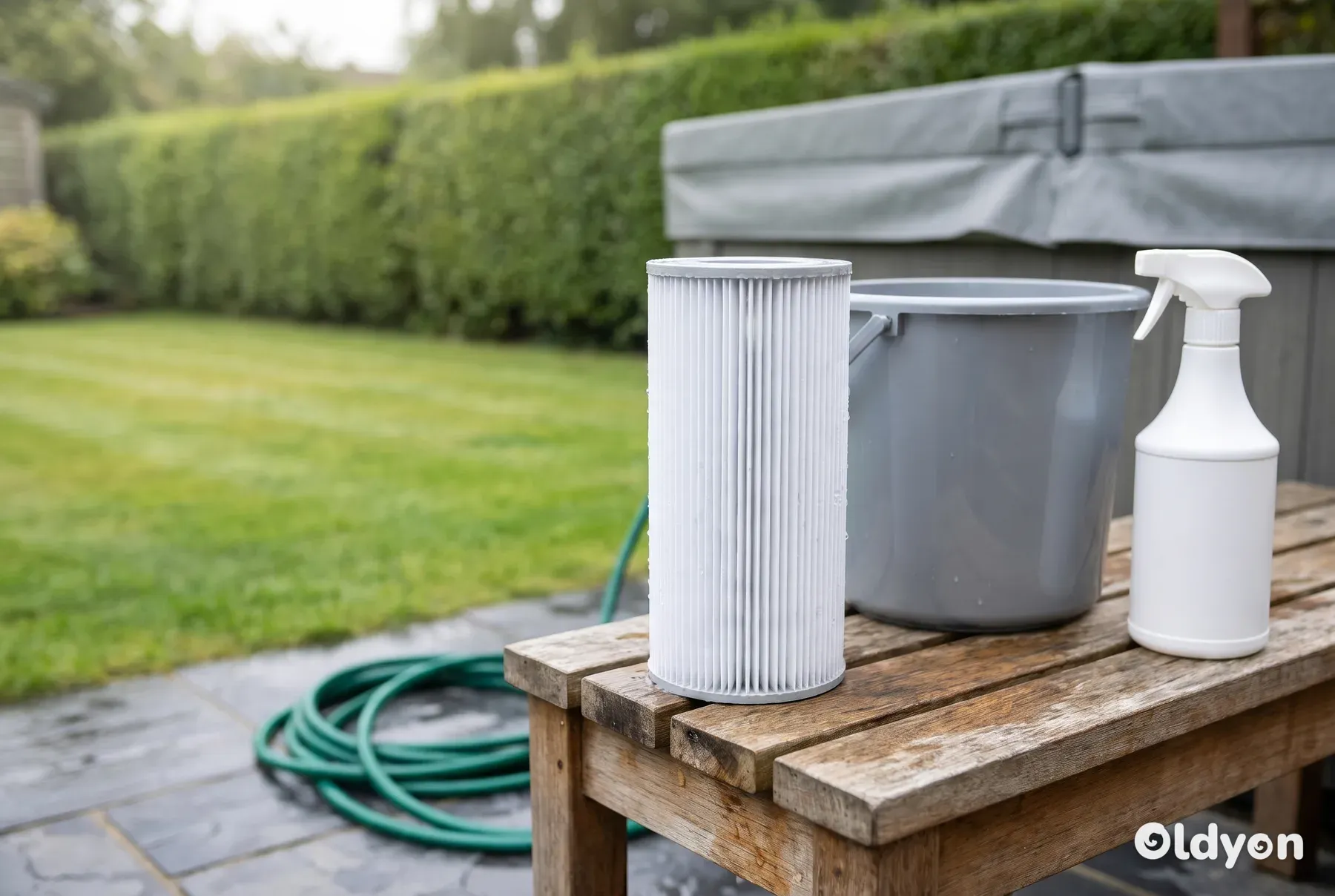
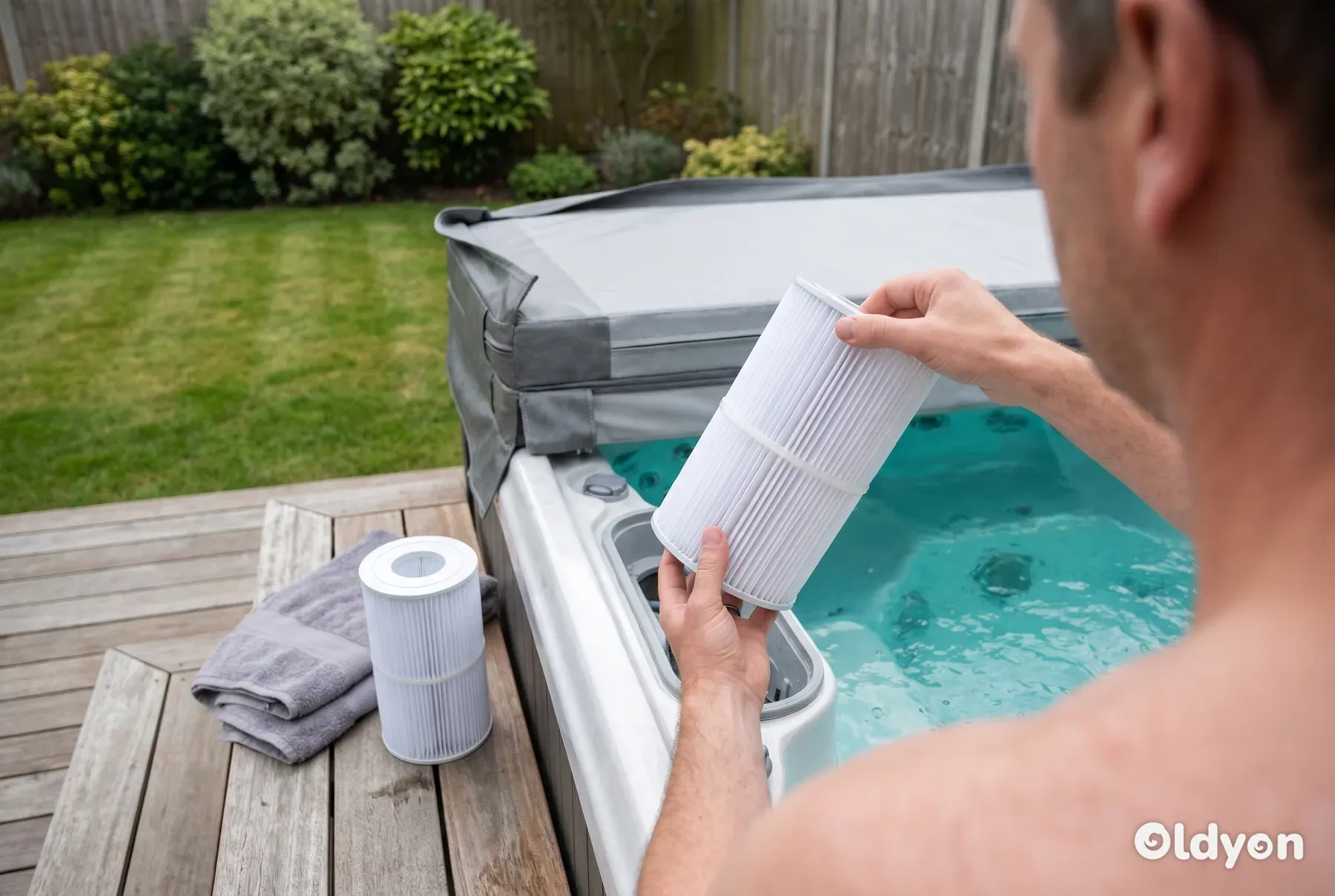
Only if the level is above the middle of the skimmer. What matters more is the water balance, because rain dilutes the sanitiser and can change pH and alkalinity. Test the water after any heavy downpour and adjust it. If a lot of leaves or dirt washed in from the cover, run the filter, then clean the cartridge.
Where should I put the water I remove from the tub?
Water with normal sanitiser levels should not go into a surface water drain, as these often lead straight to streams and rivers. Many owners let the sanitiser fall to a very low level before using the water on a lawn, away from ponds and edible plants. Local rules vary, so check with your water company or council if you are unsure.
How often should I check the water level?
Once a week is enough for most tubs, and after any heavy rain or a busy session with several people. Always check with the jets off and nobody in the tub, so the reading is accurate. A quick look at your reference mark takes seconds and catches both overfilling and a slow leak before either becomes a bigger problem.
Can repeated overflows damage my decking or base?
Yes, over time. Timber decking that stays wet can rot or grow algae, and water running off a concrete pad can wash away gravel or soil around the edges. Paving can stain from treated water. Keep the level correct, make sure the base drains water away from the tub, and dry up any large spills promptly.
Is water around the hot tub a safety risk?
Yes. Overflow water on decking, steps or paving makes them slippery, and wet timber or smooth tiles can be especially slippery when bathers walk on them barefoot. Dry walkways and steps promptly after a spill, rather than leaving them to dry naturally. Non-slip mats or treads on the steps help, and keeping the water at the correct level stops the problem at its source.
Filed under