Choosing a submersible pump to drain a hot tub
How to choose a submersible pump for draining a hot tub: flow rate, head height, hose size, how low it drains and safe RCD protected power for UK gardens.
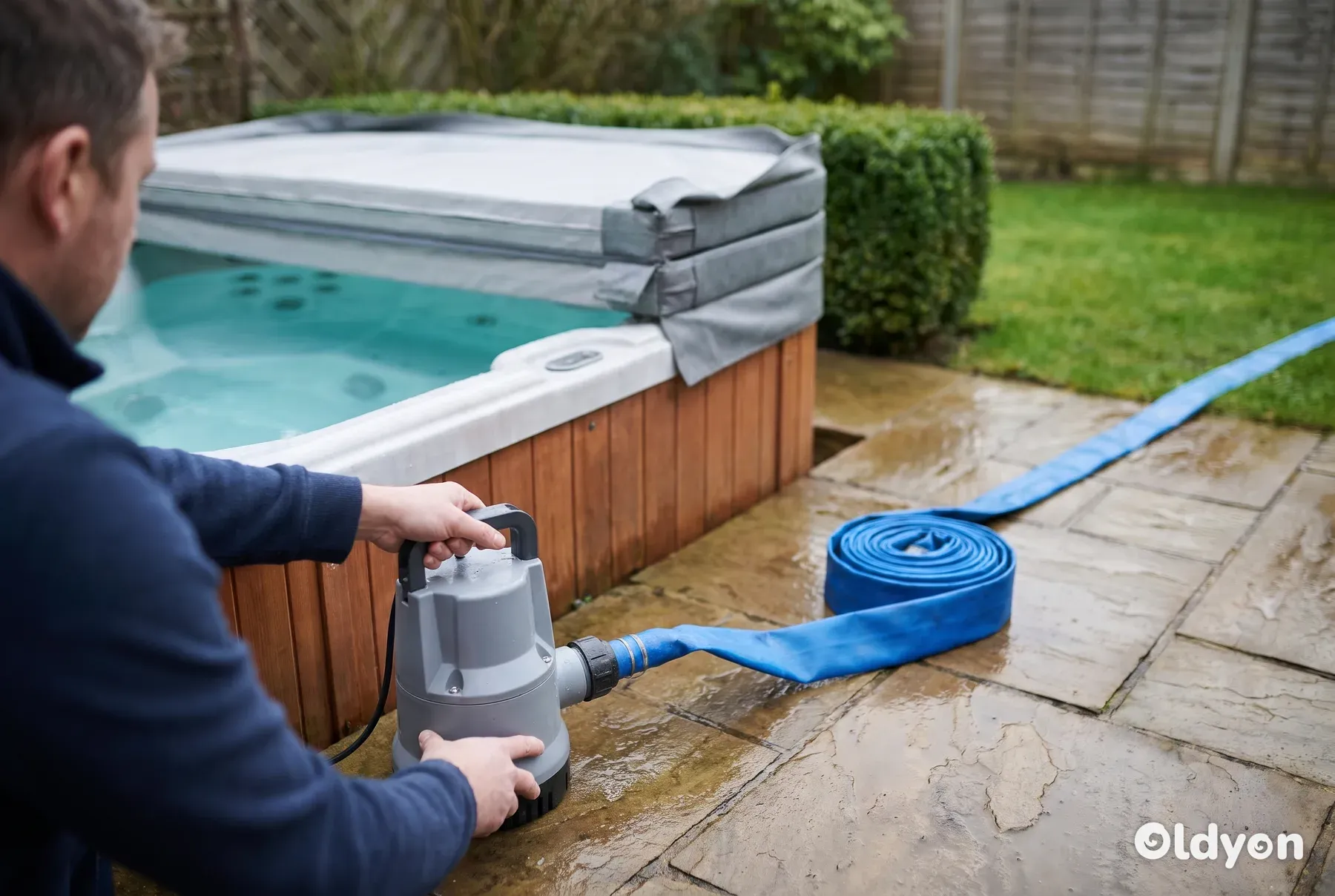
The right submersible pump for draining a hot tub is a clear water drainage pump that still moves several thousand litres per hour at the height you need to lift the water, takes a 25 mm or 32 mm hose, drains to within a few millimetres of the floor and plugs into an RCD protected socket.
American guides call this a sump pump. In the UK the same tool is usually sold as a submersible drainage pump, a clear water pump or a flat suction pump. This guide explains the numbers on the box that decide how fast, how completely and how safely your tub empties.
What to look for in a submersible pump for draining a hot tub
Most hot tubs have a drain valve, and you can attach a garden hose and let gravity do the work. That is slow, often an hour or more, and it only works if there is somewhere lower than the tub for the water to go. A pump empties the tub much faster and can push water up steps or over a wall to a suitable drain.
If you want the full process from switching off to refilling, read our guide on how to drain a hot tub step by step. The checklist below covers the pump itself.
- Flow rate: how many litres per hour the pump moves at your real lift height, not only the maximum on the box.
- Maximum head height: how high the pump can push water. Choose a figure well above your actual lift.
- Outlet size: a connector that fits a 25 mm (1 inch) or 32 mm (1.25 inch) hose.
- Residual water level: how low the pump can drain, usually listed in millimetres.
- Float switch: one that you can set to manual or lock in the raised position, so the pump does not stop early.
- Maximum liquid temperature: listed in the manual. Many household drainage pumps are rated for water up to about 35°C (95°F).
- Cable length: long enough to reach an outdoor socket without an extension lead. Around 10 metres is common.
- Power supply: a 230 volt pump with a UK plug, designed for submersion in water.
Build quality, protection and handling
The headline numbers decide how fast the pump works. The features below decide how long it lasts and how easy it is to use in a hot tub footwell.
- Mechanical shaft seal: a quality mechanical seal on the motor shaft stops water leaking into the motor. This seal largely decides how long a submersible pump lasts, so look for it on the specification sheet.
- Shaft and bearings: a hardened stainless steel motor shaft and good quality bearings help the pump survive repeated use in chemically treated water.
- Impeller and sealing: a high-strength, corrosion-resistant impeller and good sealing throughout the housing help the pump last longer in chlorinated or brominated water. Check the specification for the impeller material and the sealing design.
- Thermal overload protector: a built-in cut-out that stops the motor if it overheats or runs dry. It reduces the damage if you miss the moment the tub empties, but it is not a reason to leave the pump alone.
- Oil-filled motor: some drainage pumps have a motor sealed in oil, which helps it cope with heat and overload and can extend its working life. It is worth looking for on the specification sheet.
- Corrosion-resistant body: reinforced thermoplastic or stainless steel. Chlorinated or brominated water attacks cheaper materials and shortens the pump's life.
- Back-flow prevention: a pump designed to prevent back-flow, often with a built-in non-return valve, stops the water in the hose running back into the tub when you switch off. Check the specification for this feature.
- Quiet running: a capacitor-type motor or a well-built impeller keeps the noise down. This is worth checking if you drain close to the house or near your neighbours.
- Low side inlet with a metal filter: a pump that draws water through low openings in its side, surrounded by a metal filter, is less likely to pull sediment and small stones from the tub floor into the pump. This protects the impeller and other internal parts.
- Maximum solids size: the largest particle the intake strainer lets through, often about 5 mm (0.2 inch) on clear water pumps. A removable strainer base that you can clean stops debris from the tub floor clogging the intake.
- Continuous submersion rating: the manual should confirm the pump is designed to sit fully under water. Its maximum immersion depth should be greater than the depth of water in your tub.
- Bright body colour: a brightly coloured pump is easier to see in murky or foamy water at the bottom of the tub, so it is less likely to be knocked out of position or lost from view.
- Size, weight and handle: check the dimensions and weight before you buy. A compact, lightweight pump with a carrying handle is easier to lower into the footwell, lift out and store.
How much flow rate do you need?
Start with the volume of your tub. A small inflatable often holds about 600 to 1,000 litres, a typical four to six seat hard-shell tub about 1,000 to 1,600 litres (about 260 to 420 US gallons), and larger models more. Your manual or the manufacturer's website will give the exact figure.
UK pumps list flow in litres per hour (l/h) or litres per minute. American pumps use gallons per hour (GPH). One US gallon is about 3.8 litres, so 1,000 GPH is roughly 3,800 l/h.
The figure on the box is the maximum flow, measured with no lift and a short, wide hose. In your garden, with the water lifted over the side of the tub and pushed along several metres of hose, the real flow will be lower and sometimes much lower. Look in the manual for a performance chart that shows flow at 1, 2 and 3 metres of height.
Some listings quote flow at a stated lift instead, for example at about 1.5 metres (about 5 feet). When you compare pumps, compare their flow at the same height. Do not set one pump's figure at a stated lift against another pump's unqualified maximum, because the maximum will always look higher.
Does motor power matter?
Motor power is a secondary figure. A pump of about 1/2 HP (roughly 370 W) with a good real flow at your lift height is enough for most hot tubs. Stepping up to 3/4 HP (roughly 550 W) adds cost and power use without a matching gain in speed at hot tub volumes, so compare flow charts rather than wattage.
A lower-powered pump of about 1/3 HP, giving roughly 1,100 to 1,300 litres per hour of real flow, only suits small tubs of up to about 1,100 litres (about 290 US gallons) that you drain a few times a year. Even then, expect the drain to take close to an hour.
Tubs above about 1,700 litres (about 450 US gallons) benefit from a stronger pump. If you are looking beyond 1/2 HP, the gain from a 3/4 HP pump is often smaller than the gain from going straight to 1 HP, so compare the flow charts of both before you decide.
How to work out drain time
Divide the tub volume by the real flow in litres per hour, then multiply by 60 to get minutes. For example, 1,500 litres at a real flow of 6,000 l/h takes about 15 minutes. The same tub at 3,000 l/h takes about 30 minutes.
Allow extra time for the last few centimetres, because flow drops as the water gets shallow and you may need to move the pump. For most hard-shell tubs, a pump with a maximum flow somewhere between 7,000 and 10,000 l/h, used with a suitable hose, should comfortably empty the tub in well under an hour.
Bigger is not always better. Very powerful pumps often have large outlets that need a wide hose, draw more power and may leave more water behind. A well matched mid-sized pump is usually the better choice.
What does head height mean, and how much do you need?
Head height is the vertical distance a pump can lift water. The maximum head figure on the box is the height at which flow drops to zero, so a pump working near its maximum head barely moves any water at all.
To find your lift, measure from the floor of the tub to the highest point the hose passes over. That might be the top of the tub wall, a raised deck, a garden step or the rim of a drain. Horizontal distance matters less than height, but long hose runs still cost some flow.
A simple rule is to choose a pump with a maximum head of at least twice your actual lift. If your tub wall is 90 cm high and the hose then climbs another 50 cm up a step, your lift is about 1.4 metres (4.6 feet), so look for a maximum head of 3 metres or more.
Most household drainage pumps list a maximum head of several metres, which is plenty for a typical garden. If your tub sits on a deck well below the nearest drain, check the performance chart carefully before you buy.
Which hose size should you use?
The hose matters as much as the pump. A powerful pump connected to a narrow garden hose behaves like a much smaller pump, because the hose limits how much water can pass through it.
- 12.5 mm (0.5 inch) garden hose: suitable only for small pumps. It will slow a larger pump considerably.
- 19 mm (0.75 inch) hose: workable for small pumps and inflatable tubs.
- 25 mm (1 inch) hose: a good match for most household drainage pumps.
- 32 mm (1.25 inch) layflat hose: the best choice for higher flow pumps and longer runs.
Layflat hose is a flexible hose that rolls flat for storage and opens up when water flows through it. It is inexpensive, easy to store and less likely to kink than a narrow hose. Secure it to the pump outlet with a hose clip so it cannot slip off under pressure.
Avoid expandable or retractable garden hoses for draining. Their narrow, stretchy inner tube restricts flow and cuts the pump's real output. Use a standard rigid-walled hose or a layflat hose instead.
Many pumps come with a stepped outlet adaptor that you cut to suit your hose. Cut it at the largest step your hose will fit, because cutting at a smaller step narrows the outlet and reduces flow. Keep the hose as short and as low as practical.
Check the box, the adaptors and the hose length
Check what is included before you buy. Some pumps come with a hose and a set of outlet adaptors, while others come with nothing but the pump. If you do not already own a suitable hose and fittings, a kit saves you a separate trip.
If you plan to use a garden hose, confirm that one of the outlet adaptors fits a standard threaded garden hose connector. If none does, buy the correct adaptor before drain day, so the hose connects securely and does not leak or pop off.
Measure the distance from the tub to your drain point, following the route the hose will actually take. A supplied hose is often short, around 3 metres (about 10 feet), so you may need a longer hose or an extension for longer runs.
How low will the pump drain the tub?
Every submersible pump leaves some water behind, because the intake sits slightly above the floor. Manufacturers list this as the residual water level or as flat suction down to a stated number of millimetres. This number decides how much mopping up you do afterwards.
Most drainage pumps also have a float switch. When the water level falls, the float drops and switches the pump off, often with several centimetres of water still in the footwell. For draining a hot tub, choose a pump that has a manual mode or lets you lock the float in the raised position.
Many pumps sold for hot tub drainage have no automatic start or stop at all. They run as soon as you plug them in and stop only when you unplug them. This suits draining, because there is no float to cut out early, but it means you must watch the pump and unplug it yourself as soon as the tub is empty.
Pump type | Typically drains to | Best for | Watch out for |
|---|---|---|---|
Clear water pump | A few centimetres | Most hard-shell tubs | Float switch stopping it early |
Flat suction pump | A few millimetres | Getting the tub almost dry | Usually slower and costs more |
Dirty water pump | Several centimetres | Flood water with debris | Large outlet, more water left |
Pond or fountain pump | Varies widely | Small inflatables only | Low flow, not built for draining |
At the low end of the scale, some flat suction pumps drain to about 1 mm (0.04 inch) and have a removable stainless steel strainer. For a nearly dry shell, a pump like this can remove the need to mop up afterwards.
Check the specification for your chosen model, as figures vary between makes. With most other pumps, expect to remove the last of the water with a sponge, a towel or a wet and dry vacuum.
Inflatable tubs have a flat floor and soft walls, so the approach is slightly different. Our guide on how to empty an inflatable hot tub covers that in detail.
How do you power the pump safely?
You are putting a mains powered appliance into water, so the socket must be protected by a residual current device (RCD) rated at 30 mA. An RCD cuts the power within a fraction of a second if it detects current leaking to earth, which can prevent a serious electric shock.
The UK wiring regulations, BS 7671, require RCD protection for sockets used outdoors in new installations. Older homes may not have it. If you are unsure whether your socket is protected, use a plug-in RCD adaptor and press its test button before every use. Our guide to hot tub RCD protection explains how RCDs work and how to test them.
Avoid extension leads where you can. If you must use one, choose a lead made for outdoor use, unwind it fully so it cannot overheat, and keep the connection off the ground and well away from the water and the hose outlet.
If you need a new outdoor socket, have it fitted by a registered electrician. In England and Wales, electrical work in homes falls under Part P of the Building Regulations, and a registered electrician can certify that the work complies. Scotland, Northern Ireland and other European countries have their own rules, so check locally.
Switch the hot tub off at its isolator before you start, so the heater and pumps cannot run dry. Plug the drainage pump into an RCD protected socket, never handle the plug or pump with wet hands, and always unplug the pump before you touch it or move it in the water. The charity Electrical Safety First has more advice on using electrical equipment outdoors.
Can the pump handle hot, treated water?
Hot tub water is usually kept between 37°C and 40°C (99°F to 104°F). Many household drainage pumps are rated for water up to about 35°C, so pumping straight from a hot tub at full temperature may exceed the rating and could shorten the pump's life. Check the maximum liquid temperature in your pump's manual.
The simple fix is to switch the tub off at the isolator and leave the cover off for several hours or overnight so the water cools. This also gives chlorine or bromine levels time to fall, which matters for where you drain the water.
Sanitiser levels in normal use are 3-5 ppm for both free chlorine and bromine. Stop adding chemicals a day or two before draining, and test the water before you start. Treated water should go to a foul water drain, not a surface water drain that leads to a stream or river. Our guide on where you can drain hot tub water in the UK explains how to tell the two apart.
Do not pump chlorinated or brominated hot tub water onto your lawn or flower beds. The chemicals can harm plants, and the water can run off into nearby drains, ditches and waterways.
Before you drain a large tub into the foul sewer, ask your water company or local council whether there are any limits on the volume or timing of discharges. Some areas ask you to drain slowly or outside busy periods, and rules vary from place to place.
If you cannot wait for the sanitiser to fade, you can neutralise it before draining with a liquid dechlorinator sold for pools and spas. Follow the dose on the label and test the water again before you start the pump.
Another option is to leave the water uncovered, with the tub switched off, for 24 to 48 hours. Chlorine dissipates naturally in sunlight and open air. Bromine tends to last longer, so test before draining rather than relying on time alone.
After use, run the pump briefly in a bucket of clean water to rinse out any treated water. Let it dry, then store it somewhere frost free, because water left inside can freeze and crack the housing.
How much should you spend, and what mistakes should you avoid?
As a broad guide, basic clear water pumps cost roughly £30 to £60. Stronger pumps from established garden and tool brands sit at roughly £60 to £150. Flat suction pumps and heavier duty models can cost £150 or more. Prices change often, so treat these as bands rather than exact figures.
Compare the warranty as well as the price. Guarantees on household drainage pumps typically range from 12 months to two years, and a longer one gives you some protection if the pump fails early. Keep your receipt with the manual.
Tool hire shops also hire submersible pumps by the day. If you change your water three or four times a year, buying usually makes more sense. Our guide on how often to change hot tub water will help you work out how often you will use it.
These are the mistakes that most often lead to slow drains or damaged pumps:
- Choosing a pump on maximum flow alone, without checking flow at your real lift height.
- Comparing one pump's flow at a stated lift with another pump's unqualified maximum flow.
- Connecting a high flow pump to a narrow garden hose.
- Forgetting about the float switch and finding the pump stops with water still in the footwell.
- Pumping water hotter than the pump's rated maximum temperature.
- Buying an American 120 volt sump pump and running it through a travel plug adaptor.
- Leaving the pump running unattended, so it runs dry or the hose slips out of the drain.
- Draining treated water into a surface water drain, onto the lawn or onto a neighbour's land.
How do you drain a hot tub with a submersible pump?
- Switch the hot tub off at its isolator. Leave the cover off until the water has cooled and the sanitiser level has dropped.
- Remove the filters and set them aside for cleaning.
- Attach the hose to the pump outlet with a hose clip. Lay the hose to a suitable foul water drain and secure the end so it cannot jump out.
- Lower the pump into the footwell by its handle, never by the cable. Stand it flat at the deepest point and do not drag it across the shell.
- As you lower the pump, tilt it to one side and hold it there under water for about 30 seconds so trapped air can escape. Without this step, the pump can airlock and run without moving any water.
- Plug the pump into an RCD protected socket, press the RCD test button, reset it, then switch on.
- Stay with the pump while it runs and check the hose outlet from time to time.
- If the float switch stops the pump early, unplug it, set it to manual or lock the float up, then plug it back in.
- Unplug the pump as soon as you hear it sucking air. Lift it out by the handle.
- Remove the remaining water with a sponge, towel or wet and dry vacuum, then rinse the pump in clean water.
Summary: choosing the right pump
Look past the maximum flow on the box and check the flow at your real lift height, comparing pumps at the same height. Choose a maximum head of at least twice your lift, and pair the pump with a 25 mm or 32 mm hose rather than a narrow or expandable garden hose.
Check how low the pump drains and whether the float switch can be set to manual. Prefer a quality mechanical shaft seal, a stainless steel shaft, a corrosion-resistant impeller and body, a low side inlet with a metal filter, thermal overload protection and a cleanable strainer. Let the water cool below the pump's rated temperature, drain to a foul water drain rather than the garden, and always plug into an RCD protected socket with the hot tub switched off at its isolator.
Frequently asked questions
Can I use an American sump pump in the UK?
No. American pumps are built for 120 volts and have a different plug. A travel adaptor changes the plug shape but not the voltage, so the pump could burn out or become unsafe. Buy a 230 volt pump sold for the UK or European market, with a UK plug and a UKCA or CE mark, and use it with a 30 mA RCD.
Can I use my garden pond pump to drain a hot tub?
Pond and fountain pumps are designed to circulate water, not drain it. Most have low flow, small outlets and a high residual water level, so emptying a hard-shell tub could take a long time. Some are not designed for chlorinated water either. A pond pump might cope with a small inflatable if you are patient, but a drainage pump is the better tool.
Will a submersible pump scratch my hot tub shell?
It should not if you handle it carefully. Lower the pump gently by its handle, stand it flat and avoid dragging it across the acrylic when you reposition it. Do not place a towel underneath, because loose fabric can be drawn into the intake. Check the pump's base for grit or stones before you put it in.
Should I buy a pump or hire one?
Hiring makes sense if you drain once a year or are trying a pump type before you buy. Most owners change their water every few months, and after a few hires the cost usually exceeds buying a decent household pump. A pump of your own also lets you drain when it suits you, rather than when the hire shop is open.
How long should it take to drain a hot tub with a pump?
It depends on the tub's volume and the pump's real flow at your lift height. As a guide, a 1,500 litre tub takes about 15 minutes at a real flow of 6,000 litres per hour, and about 30 minutes at 3,000. Allow extra time for the last few centimetres and for mopping up. A gravity drain through a garden hose is usually much slower.
Can I leave the pump running and come back later?
It is best not to. A pump left alone can run dry once the tub is empty, which may damage the pump's seals and motor. A thermal overload protector limits that damage but does not prevent it. The hose can also slip out of the drain and flood the garden. Stay nearby, check the hose outlet regularly and unplug the pump as soon as it starts sucking air.
Filed under