Do hot tub thermal blankets save energy?
Learn how a hot tub thermal blanket cuts heat loss and evaporation, how to size and trim one, and when a waterlogged cover is the real energy drain.
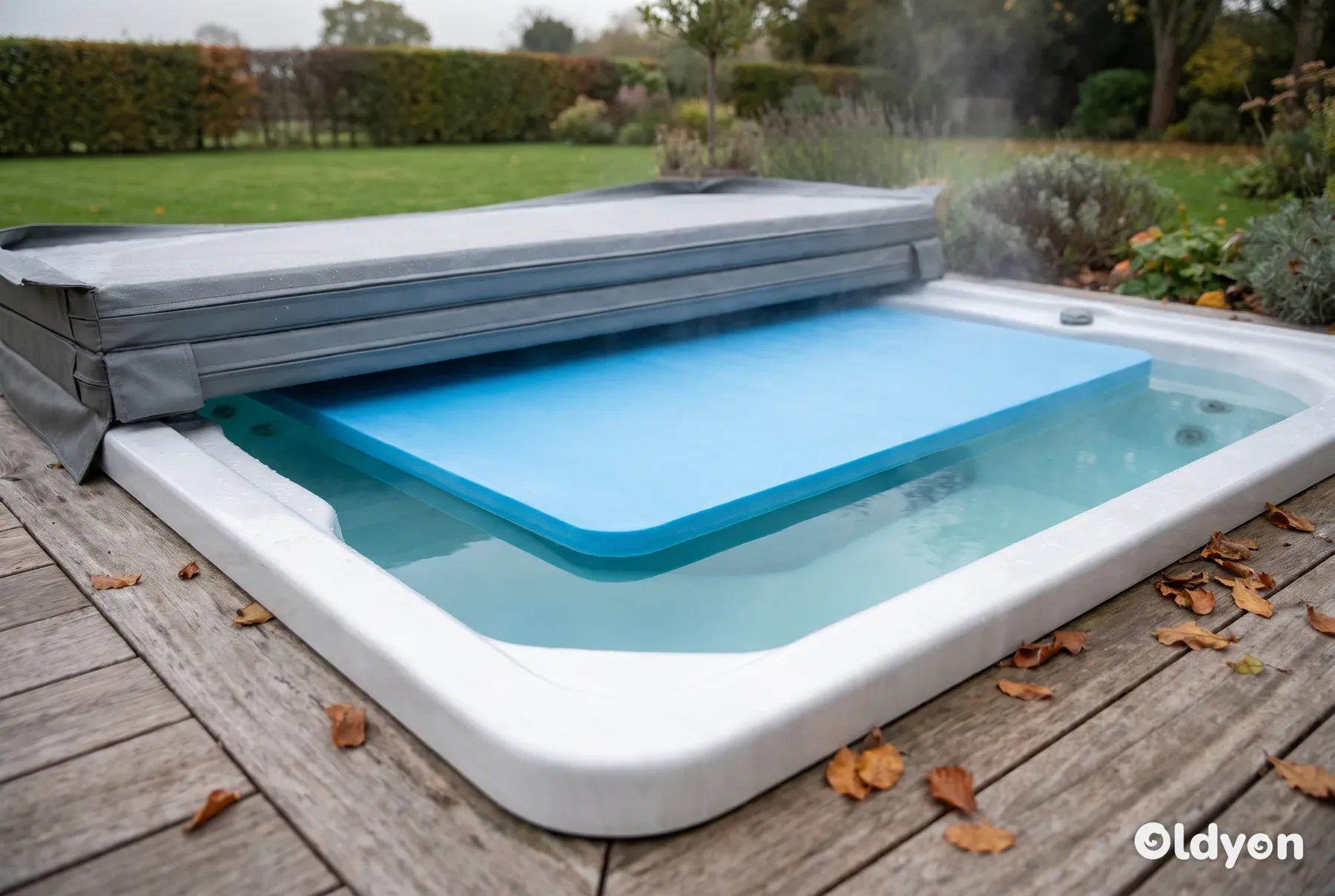
Yes, a hot tub thermal blanket usually saves energy. It floats directly on the water, under your hard cover, and slows the two biggest sources of heat loss when the tub is closed: evaporation and warm air rising into the gap below the lid. Less heat escaping means the heater runs less often.
A blanket is a cheap extra layer, not a replacement for a good cover. Below you will find how it works, which material to choose, how to cut one to fit, how to live with it day to day, and how to tell when your money is better spent on a new cover.
What is a floating thermal blanket?
A floating thermal blanket is a flexible sheet that lies on the surface of the water inside the shell. You put your hard cover on top as normal, so the blanket sits between the water and the underside of the lid.
Most are made from closed cell foam or from bubble film similar to a swimming pool solar cover. Some foam blankets have a reflective foil face on one side. They are sold in standard sizes and shapes, and you trim them with scissors to match your tub.
You will also see them called floating covers, spa blankets, heat retention blankets or energy blankets. They all do the same job. They are used on acrylic hard shell tubs and on inflatable tubs, where they can make a bigger difference because inflatable lids are usually thinner.
How does a hot tub thermal blanket save energy?
Your heater has to replace whatever heat leaves the water. When the tub is closed, heat leaves in a few ways: through the cover, through the shell and cabinet, and through water evaporating from the surface. A blanket works mainly on the last one, and helps with the first.
It stops evaporation at the surface
Hot water evaporates, and evaporation carries a lot of heat away with it. At around 40°C (104°F) the surface of a hot tub is always giving off water vapour, even with the lid closed. That vapour collects under the cover, condenses, and much of its heat is lost.
A blanket lying flat on the water physically blocks most of that surface. Less water evaporates, so less heat leaves with it. You should also notice that you need to top up the water less often.
It adds a layer of insulation under the lid
There is normally an air gap between the water and the underside of the cover. Warm air in that gap moves around and passes heat to the cover, which loses it to the cold air outside. The blanket adds a layer of insulation that slows this transfer.
Foam blankets trap air in sealed cells, and bubble blankets trap it in the bubbles. Either way, the heat has to get through that layer before it reaches the cover.
It eases the load on the heater
Because less heat escapes, the heater switches on less often to hold the set temperature. Fewer heating cycles also mean less wear on the heating element over time, which is a useful benefit on top of the energy saved.
It protects the cover from moisture and fumes
Less vapour under the lid means less moisture trying to get into your cover. Over the years, water vapour slowly works its way into the foam core of a hard cover, which makes it heavy and much less effective. A blanket will not stop this completely, but it can slow it down and help your cover keep its insulating value for longer.
The blanket also shields the underside of the hard cover from chemical fumes rising off the water. Sanitiser vapour slowly attacks the vinyl and the plastic wrap around the foam, so keeping more of it at the water surface helps the cover last longer.
How much difference will a blanket make to your bills?
Nobody can give you an honest figure without knowing your tub. The saving depends on several things, and they vary a lot from one garden to the next.
- The condition of your cover: a blanket helps most when the cover is thin, worn or does not seal well.
- Your climate and exposure: cold, windy and exposed sites lose more heat, so there is more to save.
- How often you use the tub: the blanket only works while the lid is closed.
- The temperature you keep the water at: the hotter the water, the faster it evaporates.
- Your electricity tariff: the same kilowatt hours saved are worth more on a higher unit rate.
- The type of tub: inflatable tubs with thin lids usually gain more than well insulated hard shell tubs.
What do the published figures say?
Blanket makers and spa suppliers commonly claim that a well fitted floating blanket can cut evaporative heat loss by up to about 95%. Treat that as a best-case figure for evaporation only. It does not mean the total energy use of your tub, or your bill, will fall by anything like that amount.
Evaporation is only one way for heat to escape. Heat also passes through the cover, the cabinet, the floor and the pipework, and the heater has to make up for all of it. A blanket does little for those other losses.
For a sense of scale, energy research in the United States found that better cover insulation and sealing saved about 10% of a typical portable electric spa's total energy use, roughly 250 kWh a year. At a UK unit rate of around 25p per kWh, that would be worth about £60 a year.
That research looked at improving the cover rather than adding a floating blanket, but it shows the size of saving that better insulation above the water can make. Your own figure could be higher or lower, depending on your tub, your cover and your climate.
How to check the saving on your own tub
The fairest way to judge it is to check for yourself. Many tubs and smart plugs show energy use, and you can also read your electricity meter at the same time each day. Compare a week without the blanket with a week using it, in similar weather, and you will see what it does for your setup.
A simpler check is to note how far the water temperature drops overnight, first without the blanket and then with it. If your heater holds a fixed temperature all night, compare how long it runs instead. Many owners see a difference within the first week, especially in colder months.
For a wider picture of where the money goes, our guide to hot tub running costs in the UK explains the main factors and how to work out your own figures.
What does a blanket cost?
A blanket is one of the cheapest upgrades you can make. Most cost tens of pounds, while a replacement hard cover usually costs several hundred pounds. Because the outlay is small, even a modest saving tends to pay back over a winter.
Price depends mainly on the material. As a guide, a closed cell foam blanket typically costs around two to three times as much as a good 16 mil bubble blanket of the same size. Foam also lasts much longer, so weigh the higher price against how many bubble blankets you would buy over the same period.
When you work out what a blanket really costs, allow for how often it will need replacing. A cheap bubble blanket bought every year can end up costing more over a few years than one foam blanket that lasts much longer.
Foam or bubble: which material should you choose?
Both types work. The right one depends on how much handling the blanket will get, how you store it, and whether your tub is a standard shape.
Material | Strengths | Watch out for |
|---|---|---|
Closed cell foam | Good insulation, lies flat, easy to handle | Bulkier to fold and store |
Foil faced foam | Reflects some heat back to the water | Foil face can wear or peel over time |
Bubble film | Light, cheap, easy to trim | Bubbles can split, may curl at the edges |
Thick bubble film | Lasts longer than thin bubble film | Stiffer to fold, still less sturdy than foam |
Foam is usually the better choice if you lift the blanket in and out several times a week. It is more robust, easier to grip, and lies flat without curling. Bubble film is cheaper and works well if you use the tub less often or want to try a blanket before spending more.
Which material suits your tub?
R-value is the measure of how well a material resists heat passing through it. A higher number means better insulation. It is the clearest way to understand why foam and bubble film behave differently.
Bubble film has a low R-value, because it relies only on small air pockets held between thin layers of plastic. Closed cell foam has a moderate to high R-value, because it is a dense, continuous layer that heat has to pass all the way through.
Makers do not always publish an R-value for blankets, and different countries use different units for it. Use the idea to compare types of material, rather than to compare one product's figure with another's.
Bubble film works mainly by cutting evaporation. It insulates less than a dense foam sheet, because the thin film and small air pockets slow heat transfer less than a solid layer of foam.
That makes foam the better choice for hard shell tubs and for cold, exposed sites in winter. Bubble film suits buyers on a tight budget and inflatable tubs, where it is light and easy to handle.
How long does each type last?
As a rough guide, bubble film blankets usually last about 6 to 18 months in hot tub use. Closed cell foam blankets commonly last around 3 to 6 years or more. Water chemistry, sunlight and handling all affect how long yours lasts.
Bubble film is made from polyethylene. Daylight and chlorine or bromine slowly break it down, so the bubbles pop and flatten and the sheet cracks, usually starting at the edges. This is normal ageing of the material, not a fault in the blanket.
Foam blankets are usually made from EVA or polyethylene closed cell foam. Because each cell is sealed, the foam does not soak up water or get heavy, and it holds its shape when exposed to chlorine or bromine.
If a bubble blanket has already worn out on you, moving to foam is usually cheaper over time than buying two or three bubble replacements.
What do thickness and mil ratings mean?
Foam blankets are normally sold by thickness in millimetres. Thicker foam insulates a little better and stands up to handling for longer, but it is heavier and harder to fold.
Bubble blankets are often rated in microns or in mil. One mil is one thousandth of an inch, which is about 25 microns. A higher number means thicker film, which usually lasts longer before the bubbles split or the plastic turns brittle.
For bubble film, about 12 mil (around 300 microns) is the lowest worth buying, and 16 mil (around 400 microns) is the usual standard. Film thinner than 12 mil breaks down fastest and insulates least.
For foam, look for a thickness of at least about 6 mm (1/4 inch) for worthwhile insulation. A 6 mm foam sheet insulates better than 16 mil bubble film, even though the bubble film's number looks bigger. 16 mil is only about 0.4 mm thick.
Compare like with like. A thickness figure for foam is not comparable with a micron or mil figure for bubble film, because they measure different things. Within one material, choose the thickest one that you can still handle comfortably.
A thickness or mil figure also does not tell you what the blanket is made of. Read the material description to confirm whether it is bubble film or closed cell foam before you compare prices.
Other features worth comparing
- UV stabilised material, so the blanket does not go brittle in daylight when the lid is open.
- Resistance to hot water and to chlorine or bromine, stated by the maker.
- A shape that matches your tub, such as square, round or a template you can cut to any shape.
- Pre-cut handles or finger holes for lifting.
- A size slightly larger than your tub, so you have room to trim.
How do you measure and trim a thermal blanket?
The aim is a blanket that covers almost all of the water but does not ride up the sides or block the skimmer. A good fit matters more than the exact material, because any open water at the edges keeps evaporating.
You need a tape measure and sharp scissors or a utility knife. Cardboard or brown paper is useful if you want to make a template first. Fitting usually takes about 15 to 20 minutes.
If you own an inflatable tub, you may be able to skip most of the trimming. Blankets are sold in sizes that match common inflatable tubs, such as about 213 x 213 cm (7 x 7 ft) for a square tub. A blanket sized for your tub can often sit in the water with little or no trimming, which saves fitting time. Still measure the water surface first, because inside dimensions vary between models.
- Fill the tub to its normal operating level. The shape of the water surface changes with the water level, so measure at the level you normally keep it.
- Measure the water surface, not the outside of the cabinet or the cover. Take the length and width at the waterline, then the diagonal on a square or rectangular tub, or the diameter on a round one. For an octagonal or other many-sided tub, measure straight across the water surface at its widest point.
- Buy a blanket at least as large as your largest measurement. On an octagonal or other many-sided tub, that means a blanket at least as wide as the widest point of the water surface. It is easy to cut a blanket smaller, but you cannot make it bigger.
- Lay the blanket on the water with the correct side down. For bubble film, the bubbles face the water. For foam, follow the maker's marking. If a foam blanket has no marking, lay it with the smooth face up and any textured or ribbed face down on the water. If there is a foil face, check which way it should go.
- Let it settle and press it gently towards the edges. Mark the outline of the shell, the headrests, the corners and the skimmer opening with a waterproof pen or masking tape.
- Lift the blanket out and lay it flat on a clean surface. Cut slightly inside your marks with sharp scissors, or with a craft knife against a board for thick foam.
- Cut a gap around the skimmer so the blanket cannot be drawn into it when the pumps run.
- Cut the blanket back by about 2.5-5 cm (1-2 inches) around jets, drains and any hardware that sticks out from the shell, so it does not snag when you lift it out.
- Put it back on the water and check the fit. Trim a little more in small steps until it lies flat without folding up the walls.
A small gap of about 1-2 cm (roughly half an inch to three quarters of an inch) around the edges is normal. It lets the blanket move a little as the water level changes without catching on the shell or rubbing against it.
If your tub has an unusual shape, make a template first. Use the old blanket, a sheet of plastic or several sheets of newspaper taped together, cut it to the shape of the water surface, then use it to mark the new blanket.
If you need to remove the filters or reach into the skimmer to check the fit, switch the tub off at the isolator first.
How do you use and look after a thermal blanket?
Always remove the blanket completely before anyone gets in. Never let anyone use the tub with the blanket on the water, and keep children away from an open tub with a floating blanket in it. A person, especially a child, can become trapped under a floating sheet.
Day to day, the routine is simple. Take the blanket out before you get in, and put it back on the water before you close the lid. Most people fold or roll it and leave it on a clean surface beside the tub, or hang it over the open cover while they use the tub.
Keep the water chemistry in range
A blanket does not replace good water care. Keep free chlorine at 3-5 ppm or bromine at 3-5 ppm, pH at 7.2-7.6 and total alkalinity at 80-120 ppm, unless your manual gives different ranges. Test before you use the tub.
When you shock the water, take the blanket off and leave the lid open for the time your product or manual recommends. This lets the gases escape. Trapping them under a blanket and a closed lid can damage the blanket, the underside of the cover and the pillows.
Some manufacturers advise against using a floating blanket with an ozone system, or give specific instructions for it, because the ozone needs somewhere to escape. Other makers are happy with it. Check your manual, and if in doubt, ask your dealer or the manufacturer.
Warm water that is not properly sanitised can allow bacteria such as Legionella to grow. A blanket does not change that risk, but it is a reason not to cut corners on testing. The Health and Safety Executive publishes guidance on Legionnaires' disease and hot tubs that explains the basics.
Cleaning and storage
- Rinse both sides with fresh water when you drain and refill the tub.
- Wipe off any scum line with a soft cloth and plain water, or a cleaner the maker says is safe for the material.
- Avoid household detergents, which can foam in the water and damage some materials.
- Let it dry completely before folding it away for long periods, to prevent mould.
- Store it flat or loosely rolled, out of direct sun, when the tub is not in use.
Replace the blanket when it starts to crumble, split, lose bubbles or shed flakes into the water. Loose pieces can end up in your filters, so a worn blanket is not worth keeping.
When is the real problem a waterlogged cover?
Sometimes a tub that is expensive to heat does not need a blanket at all. It needs a new cover. A hard cover works because its foam core is dry and full of trapped air. Once water gets into that foam, the cover gets heavy and loses most of its insulating value.
Putting a blanket under a waterlogged cover will help a little, but it treats the symptom rather than the cause. Look for these signs first.
- The cover feels much heavier than when it was new, or is hard for one person to lift.
- It sags in the middle, so rain water pools on top.
- Frost or snow melts on the cover faster than on the surrounding deck or garden.
- Steam escapes from the edges or the fold, even with the cover closed and clipped.
- There is a musty smell, or mould on the underside or inside the cover.
- The vinyl skin is split or the seams are torn.
- The heater seems to run much more than it used to in similar weather.
To check the foam itself, follow these steps.
- Lift one corner of the cover and compare its weight with how it felt when it was new. A big change usually means water in the foam.
- Take the cover off the tub and lay it on a clean, dry surface.
- Unzip the vinyl skin on one section, if your cover has zips.
- Look at the plastic wrap around each foam panel. If it is torn, cloudy with condensation inside, or the foam feels wet or heavy, the core is taking on water.
- Close the zip again and decide whether to replace the foam panels, if the maker sells them, or the whole cover.
Our guide on when to replace a hot tub cover goes through these signs in more detail. If you do need a new one, our advice on how to choose a hot tub cover explains foam thickness, taper, seals and fit.
If your cover is heavy, sagging or letting steam out at the edges, fix that first. A floating blanket works best as an extra layer under a cover that is dry and seals well.
What else helps to keep a hot tub warm?
A blanket is one part of the picture. Heat also escapes through gaps around the cover and through the cabinet and floor, and these are worth checking at the same time.
- Close and clip the cover every time, so the seal is even all the way around.
- Check the seals along the hinge fold, where many covers lose heat.
- Shelter the tub from the wind with a fence, hedge or screen, because moving air takes heat away faster.
- Make sure the cabinet panels fit snugly and the insulation behind them is dry and intact.
- Stand the tub on a solid, level base, and on an insulated base pad if the maker recommends one.
- Set the water to the temperature you actually use, and no higher than 40°C (104°F).
- Use the economy or sleep settings in your manual to suit when you use the tub.
In cold weather, an insulating wrap or jacket around the outside of the cabinet, or around the wall of an inflatable tub, can cut wind chill. Add one only after the blanket and a well sealed cover are in place, because those two give the best return first.
If the water takes a long time to warm up after a refill, our guide on how to heat a hot tub faster explains what helps and what to avoid. A blanket helps here too, because it reduces evaporation while the water is coming up to temperature.
If you are still choosing a tub, the cabinet insulation, cover design and heater matter much more than any blanket. Our article on how to choose an energy efficient hot tub explains what to look for before you buy.
Summary: is a thermal blanket worth it?
For most owners, yes. A floating thermal blanket is cheap, easy to fit, and cuts the heat and water lost through evaporation when the tub is closed. It also helps to keep moisture out of your hard cover.
Choose foam if you handle it often, bubble film if you want to spend less. Measure at the waterline, trim in small steps, and leave room around the skimmer. Always remove it before anyone gets in.
If the cover is heavy, sagging or leaking steam, put that right first. A blanket adds to a good cover, but it cannot make up for a waterlogged one.
Frequently asked questions
Can I use a swimming pool solar cover as a hot tub blanket?
You can cut down bubble film sold for pools, and many people do. Check that it is rated for warm water and for chlorine or bromine, because hot tub water is much warmer than pool water and can make thin film brittle faster. Lay it bubble side down and trim it with a gap around the skimmer, just as you would with a purpose made spa blanket.
Does a thermal blanket work on an inflatable hot tub?
Yes, and it often helps more than on a hard shell tub. Inflatable lids are usually thinner and the walls lose more heat, so stopping evaporation at the surface makes a noticeable difference. Buy a round or square blanket to match the shape, and trim it so it does not catch on the inflatable wall or the filter housing.
Should I leave the blanket on when I go away?
Yes, as long as your water chemistry is balanced before you leave and you are not shocking the water. The blanket will keep evaporation down while the tub sits unused. If you have an ozone system, check your manual first. When you return, remove the blanket, test the water and let the tub run with the lid open for a short while before use.
Will a thermal blanket change my chemical use?
It can slightly. With less evaporation, the water level and the concentration of minerals change more slowly, so you may top up less often. It does not replace sanitiser. Keep testing at your normal interval and adjust to the readings, not to an assumption that the blanket is doing the work. Always remove it when you shock the water.
How long does a hot tub thermal blanket last?
It depends on the material, the thickness, your water chemistry and how carefully you handle it. Foam blankets generally last longer than thin bubble film. Replace yours when it starts to crumble, split, lose bubbles or shed flakes into the water, because pieces can clog the filters. Keeping chemicals in range and storing it out of direct sun helps it last.
Can a thermal blanket replace my hard cover?
No. A floating blanket is an extra layer, not a cover. It does not lock, carry weight, keep out leaves and rain, or protect children from the water. You still need a hard cover that fits well and can be secured. Use the blanket underneath it to reduce evaporation and heat loss.
Filed under