Hot tub base pads and when they are enough
Learn when a hot tub base pad is enough for an inflatable, why hard shell tubs need a solid base, and how to prepare level, firm ground beneath it.
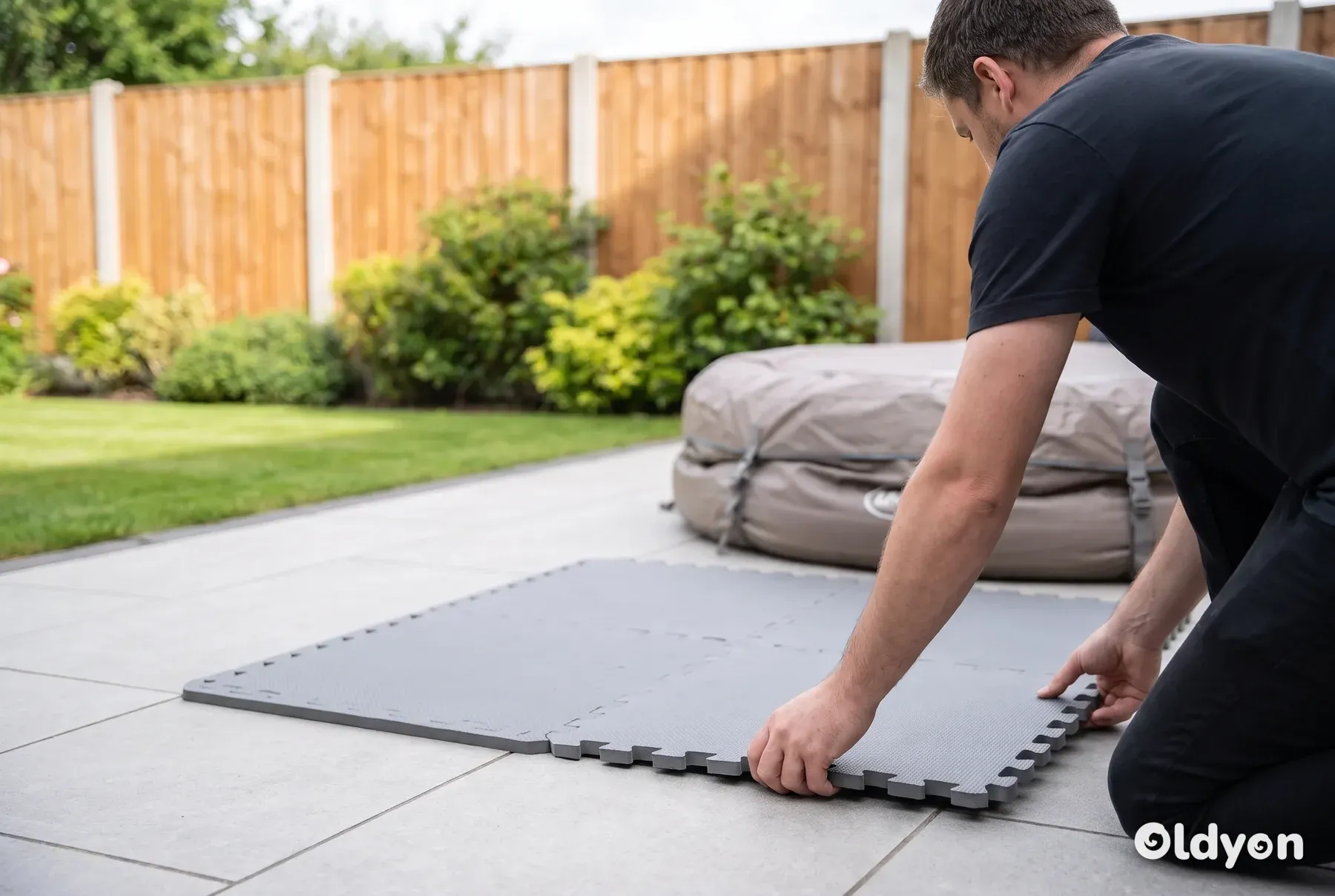
A hot tub base pad is usually enough for an inflatable hot tub, as long as it sits on ground that is already level and firm, such as paving or a concrete patio. A pad adds insulation and puncture protection, but it does not level or support the ground. A hard shell tub needs a solid, engineered base instead.
Below, you will find what a pad really does, how to tell whether your ground is good enough, how to work out the weight your base must carry, and what to choose for each type of tub. The aim is simple: a tub that stays level, keeps its heat and lasts for years.
What does a hot tub base pad actually do?
A hot tub base pad is a layer of foam that sits between the tub and the ground. Most are made from closed-cell foam, often EVA, which does not soak up water. They come either as interlocking tiles that click together like a jigsaw, or as a single mat cut to a square or round shape.
A good pad does five useful jobs. It is worth knowing exactly what they are, because people often expect a pad to do things it cannot.
- Insulation: the ground under a tub is cold for much of the year in the UK and northern Europe, and it draws heat out of the water through the floor of the tub. A foam layer slows that heat loss, which helps the heater work less hard.
- Puncture protection: grit, small stones and sharp edges on paving can wear or pierce the floor of an inflatable over time. A pad gives a smooth, clean layer that protects the vinyl.
- Comfort: the floor of an inflatable is also your seat. A pad softens hard paving underneath, so sitting on the floor of the tub feels better.
- A cleaner footprint: a pad keeps the tub floor off dirt and moss, and gives you a tidy area that is easy to sweep.
- Quieter running: foam damps the vibration and noise from the pump and bubblers, so less of it passes into the ground, a patio or a garage floor.
What a pad does not do matters just as much. It does not make uneven ground level, it does not make soft ground firm, and it does not spread a heavy load the way concrete does. Foam compresses under weight, so it follows whatever shape is underneath it.
When is a pad enough for an inflatable hot tub?
For an inflatable, a pad on a sound, level surface is a common and sensible set-up. Inflatables spread their weight across the whole floor of the tub rather than onto a few points, so a soft layer under them is not a problem as long as the ground below is solid.
A pad is usually enough when all of the following are true:
- The surface is hard and stable, such as a concrete slab, well-laid paving or a solid garage floor.
- The surface is level, with no obvious dips, humps or loose slabs.
- The surface is larger than the tub on every side, so no edge overhangs.
- Rainwater drains away rather than pooling under the tub.
- The surface is free of sharp stones, roots and anything that could wear through the pad.
- Any decking or raised structure has been confirmed as strong enough for the full weight.
If your patio is old, has slabs that rock when you step on them, or has sunk in one corner, fix that first. Our guide to putting a hot tub on paving slabs explains how to check slabs and what to do if they are not up to the job.
Grass is the most common problem. Lawn is soft, often uneven and stays damp, and it compresses unevenly under the weight of a full tub. A pad on grass alone does not solve this. If grass is your only option, prepare the ground properly first, and read how to choose an inflatable hot tub for what to check in the maker's site requirements before you buy.
Why does a hard shell hot tub need more than a pad?
A hard shell tub is a rigid acrylic shell on a frame, with pumps, a heater and plumbing inside the cabinet. It is much heavier than an inflatable, both empty and full. The shell cannot flex to follow the ground, so any movement in the base puts stress on the shell, the cabinet and the pipe joints.
Many hard shell tubs also carry their weight on a frame, a perimeter base or a set of support points, rather than across a soft floor. That concentrates the load. A foam pad under those points can compress unevenly, which lets the tub settle out of level over time.
For these reasons, manufacturers of hard shell tubs typically ask for a level, solid base such as a reinforced concrete slab, a properly built structural deck, or a purpose-made rigid base system. Concrete slab guidance is often around 10 cm (4 inches) thick, but requirements differ between makers, so check your manual and installation guide before you start.
Many hard shell warranties depend on the tub being installed on a base that meets the manufacturer's specification. If the base fails or is not as specified, damage to the shell or cabinet may not be covered. Read the installation section of your manual before you choose or build a base.
Should you put a foam pad under a hard shell tub at all? Usually it is not needed, because the tub already has an insulated base and the slab provides the support. Some owners use a thin pad to protect a decorative surface, but a soft layer under a rigid tub can do more harm than good. Follow your manufacturer's advice here.
How much does a full hot tub weigh?
Knowing the total weight tells you how much your base must carry. Water is the biggest part: 1 litre of water weighs about 1 kg (2.2 lb). A tub that holds 1,000 litres (about 260 US gallons) carries roughly a tonne of water before anyone gets in.
You can work out a reasonable estimate in a few minutes:
- Find the water capacity in litres in your manual or on the product page. Count 1 kg for each litre.
- Find the dry weight of the tub. For an inflatable this is a small part of the total. For a hard shell tub it can be several hundred kilograms.
- Add the weight of the maximum number of bathers the tub is rated for. Use a realistic adult weight for each person.
- Add the three figures together. This is your total load.
- Measure the footprint of the tub in square metres. For a square tub, multiply length by width. For a round tub, multiply the radius by itself and then by 3.14.
- Divide the total load by the footprint area. This gives the load per square metre that the ground must carry.
As a worked example, an inflatable holding 800 litres with four adults of 80 kg each carries over 1,100 kg (about 2,400 lb). On a round footprint about 2 m across, that is roughly 360 kg on every square metre. These figures are only an illustration. Always use the numbers for your own tub.
Hard shell tubs are in a different weight class. Filled and with bathers in, a typical hard shell tub weighs roughly 1,400 to 2,300 kg (about 3,000 to 5,000 lb), far more than an inflatable of a similar size.
Hard shell makers commonly ask for a base that can carry at least about 490 to 590 kg per square metre (100 to 120 lb per square foot). Compare your own calculated load per square metre against that figure and against the figure in your manual, and use whichever is higher.
If you plan to place any tub on decking, a balcony or a roof terrace, ask a structural engineer to check it against your total load. A pad does nothing to strengthen a structure. Our overview of hot tub base options covers what each type of base can safely support.
As a guide, decking for a hot tub generally needs to be built or reinforced to carry at least about 490 kg per square metre (100 lb per square foot), and often more, before a load check will pass it. Standard garden decking is rarely built to that level without extra joists and supports.
Why must the ground under a pad be level and firm?
Foam is soft by design. When you put a tonne of water on it, it compresses until it rests on whatever is underneath. If the ground has a dip, the pad sinks into the dip, and so does the tub floor.
An unlevel inflatable causes several problems. The water line sits higher on one side, which can push water close to the top of the wall. The seams on the low side take more strain. Seats and the floor feel uncomfortable, and the cover may not sit evenly, which lets heat escape.
Soft ground adds another risk. Grass, loose soil or uncompacted sand can sink further over weeks, especially after rain. A tub that was level when you filled it may lean a month later.
How level is level enough?
Use a long spirit level, ideally 1.2 m (4 ft) or more, or a straight timber with a shorter level on top. Check across the whole area in several directions, including corner to corner. Manufacturers give different tolerances, so check your manual for the figure that applies to your tub.
For a hard shell tub on an existing slab, a common tolerance is level to within about 13 mm across 2.4 m (1/2 inch over 8 ft). Some makers ask for less, so treat this as a starting point and confirm it in your installation guide.
A slight fall for drainage is common on patios. Small falls are generally fine for an inflatable, but a hard shell tub may need a flatter surface. Your installation guide is the final word.
Surfaces that are not suitable under a pad
- Bare grass or loose soil without preparation.
- Gravel that has not been compacted and contained with an edging.
- Patio slabs that rock, have sunk or have wide gaps between them.
- Decking that has not been checked for the full load.
- Surfaces with tree roots, stones or sharp edges pushing up from below.
- Areas where rainwater collects after a shower.
Which hot tub base pad should you choose?
Base pads look similar, but a few features make a real difference. Compare these before you buy, and check them against your tub size and your ground.
Check which kind of product you are looking at before you buy. Soft foam mats and rigid, load-bearing panel systems are both sold under the same 'hot tub pad' name, and listings do not always make the difference clear. Look for the material, the thickness and a stated load rating per square metre. A foam mat cannot stand in for a structural base, so if your tub needs a solid base, a foam pad is not a substitute.
Interlocking foam tiles
Tiles are the most common type. They are easy to carry, they fit almost any space and you can trim the edges to shape. If one tile is damaged, you can replace it on its own. The downside is the seams, which can separate a little over time, especially if the ground is not level.
Tiles also suit irregular spaces. You can lay them around steps, posts or awkward corners, cutting individual tiles to fit, in places where a one-piece mat would ruck up or not lie flat.
Tile seams also collect dirt and debris, so a tiled pad takes more cleaning than a single mat. Rinse it with a garden hose or wipe it with a damp cloth, then let it air-dry before the tub goes back on.
Tiles take longer to assemble and take apart than a one-piece mat. If you set up and pack away your tub often, a single mat will save you time each season.
Single-piece mats
One-piece mats, often round or square, have no seams. Some include a foil or heat-reflective layer and a textured top that is less slippery when wet. They are harder to store and transport, and if part of the mat is damaged, you usually replace the whole mat.
A one-piece mat has no locking edges to hold it in place, so it can slide on a smooth indoor floor such as a garage. Choose a mat with a textured underside, or lay an anti-slip layer beneath it.
Rigid base systems
Rigid base systems are a different product. They are interlocking panels made from stiff plastic or composite, designed to sit on compacted gravel or level ground and carry heavier loads. Some hard shell manufacturers accept them as an alternative to concrete, and others do not, so check your manual before you choose one.
For an inflatable, a rigid base system is usually more base than you need. On a patio that is already sound and level, a foam pad does the same job at a fraction of the cost. Rigid panels only make sense for an inflatable when they also replace ground preparation that is missing, for example on a compacted gravel area with no hard surface.
Never lay a rigid modular base straight onto soft or uneven soil. It needs a properly compacted sub-base of crushed stone or sharp sand underneath, laid level and firm. Without one, the panels shift as the ground moves and the tub settles out of level over time.
Each system carries a rated load per square metre, and some are rated at around 1,460 kg/m² (300 lb per square foot). Check that rating against your total load calculation, and against your tub maker's requirement, before you buy.
Panels made from high-density polyethylene do not rot or absorb water, and they resist UV light. They can be rinsed clean with a garden hose.
Many rigid plastic panels have a textured top for grip and an open structure that lets rainwater drain away underneath. This helps stop water pooling under the tub, so the area stays drier between rain showers.
Most rigid systems can be extended by clipping on extra panels. If you later change to a bigger tub, you can often enlarge your existing base instead of replacing it. Prepare the sub-base under the new panels to the same standard as the original.
Size matters with rigid bases. A compact 2 to 3 person hard shell tub may need a base of only about 1.2 x 2.4 m (4 x 8 ft). A typical 4 to 6 person hard shell tub usually needs a base of at least about 1.8 x 1.8 m (6 x 6 ft), and many larger tubs need around 2.4 x 2.4 m (8 x 8 ft). Check the exact footprint in your manual and size the base to it, rather than buying more panels than you need.
On large layouts, the connectors between panels can work loose under load over time. Check them periodically, for example each time you drain the tub, and add extra brackets or fixings if the panels start to shift.
Do not put a plastic rigid base or a foam pad under a gas-fired heater or any other hot equipment. Plastic and foam can deform, melt or catch fire. Check the base maker's guidance on what may sit on it, and keep hot equipment on a non-combustible surface such as concrete or paving.
Gravel under a pad or rigid base
If you build a gravel base, use clean, angular crushed stone of about 20 mm (3/4 inch). Avoid rounded pea gravel. Angular stone locks together when compacted and under load, while pea gravel rolls and shifts, so the tub can settle unevenly.
Compacted crushed stone drains rainwater away well. That makes it a good choice where standing water would otherwise collect under the tub, for example on clay soil or at the low point of a garden. Contain it with a firm edging so it cannot spread.
Getting the size and shape right
Measure the diameter or base dimensions of your own tub before you order. Pads are sold in fixed sizes, commonly about 1.95 m (77 inches) or 2.15 m (85 inches) across, and a 6 person inflatable is often too big for the smaller size.
As a rough sizing guide, compact 4 person inflatables are typically about 1.8 to 1.95 m (70 to 77 inches) across, so they suit the smaller pad size. Six person inflatables are usually about 2.0 to 2.15 m (80 to 85 inches) across, so they need the larger pad. Always confirm with your own tub's measurements.
Match the pad shape to the tub. A square tub on a round mat leaves its corners unsupported, so a square tub needs a square pad. A round tub can sit on either shape, as long as the pad is larger than the tub.
Features to compare
- Size: the pad should be slightly larger than the tub, so no part of the tub floor sits off the edge.
- Thickness: thicker foam gives more insulation and cushioning. Common pads range from a few millimetres to around 2 cm (about 3/4 inch).
- Minimum thickness: about 12 mm (1/2 inch) is widely treated as the sensible minimum for an inflatable. A 9 mm pad gives noticeably less protection, and 6 mm (1/4 inch) foam compresses quickly and adds almost no insulation, so thin pads suit only smooth indoor floors.
- Density: firmer foam compresses less under load and holds its shape for longer. Very soft foam can leave dents.
- Closed-cell foam: this resists water. Open-cell foam soaks up water and can stay damp under the tub. Closed-cell EVA also resists mould and mildew, so a good pad can stay outdoors through the season without rotting or growing mildew underneath, which open-cell foam cannot do.
- Surface texture: a textured top helps stop the tub sliding and gives better grip if you step on it with wet feet.
- UV resistance: if the pad edges stay in the sun, cheaper foam can become brittle.
- Edge pieces: tile sets with matching edge strips give a neater finish and stop corners lifting.
- Indoor and outdoor use: if you move an inflatable between a patio in summer and a garage or conservatory in winter, choose a pad sold for both indoor and outdoor use, so one pad serves both places.
Base type | Inflatable tub | Hard shell tub |
|---|---|---|
Foam pad on concrete or paving | Usually suitable | Not usually enough on its own |
Foam pad on grass | Not recommended | Not suitable |
Compacted, edged gravel | Suitable with a pad | Only if the maker approves |
Rigid base system | Suitable | Only if the maker approves |
Reinforced concrete slab | Suitable with a pad | Usually the preferred base |
Structural decking | Only after a load check | Only after a load check |
How do you lay a hot tub base pad?
Laying a pad takes less than an hour on a prepared surface. Most of the work is in the checks before you start. Our step-by-step guide to installing a hot tub covers the full set-up, including power and filling.
- Choose the spot. Make sure the surface is larger than the tub on every side and that you can reach the control unit and power safely.
- Sweep the area thoroughly. Remove stones, grit, leaves and anything sharp.
- Check the surface with a long spirit level in several directions. Correct any dips or loose slabs before going further.
- Lay the first tile or unroll the mat at one corner or the centre, depending on the shape. Work outwards.
- Press each tile firmly into its neighbour so the joints close fully. Walk over the seams to seat them.
- Add any edge pieces, and trim tiles with a sharp knife if needed. Keep the cut edges away from the tub floor.
- Trim any pad that sticks out well beyond the tub. Loose overhanging foam can bunch up and become a trip hazard around the tub.
- If your kit includes a small separate mat for the pump and control unit, lay it where the unit will sit. It protects the unit and keeps it off wet ground.
- Lay any groundsheet supplied with your tub on top of the pad if the manufacturer recommends it.
- Place the deflated tub in position, inflate it, and check it is centred on the pad before filling.
- Fill a little water, then check the level again. Fix any problem now, because it is much harder once the tub is full.
Never try to drag or slide a full or part-filled tub to adjust it. Drain it, switch off at the isolator, and move it empty. If you need to reposition across a lawn, see how to move a hot tub across grass.
What does a proper base cost, and do you need permission?
A foam pad is the cheapest part of any set-up, usually tens of pounds depending on size and quality. Rigid base systems cost more, often somewhere in the low hundreds of pounds. A new concrete slab laid by a contractor can cost from a few hundred pounds to over a thousand, depending on size, access and the work needed to prepare the ground.
A compacted gravel base sits between a pad and a concrete slab in cost, and it is a realistic DIY job. Preparing one typically takes about half a day to a day. A rigid base system can usually be laid in 2 to 4 hours once the sub-base is prepared.
Think about the total installed cost, not just the pad. Ground preparation, delivery, a possible electrical supply and any lifting equipment for a hard shell tub can all add up. Get a written quote that lists what is included.
Most hard shell tubs, and some larger inflatables, need a hard-wired supply. In the UK, this should be installed by a registered electrician to BS 7671, with RCD protection. In England and Wales, a new outdoor circuit is notifiable work under Part P of the Building Regulations, and a registered electrician can certify it for you. Other countries have their own rules. The charity Electrical Safety First has guidance on finding a registered electrician.
In the UK, a hot tub on its own does not usually need planning permission, but the base and anything around it might. In England, decking or a platform raised more than 30 cm (about 12 inches) above the ground normally needs planning permission, and listed buildings, conservation areas and flats have extra rules. Check the GOV.UK planning permission guidance or ask your local planning authority before you build. Scotland, Northern Ireland and other European countries have their own rules.
Hard shell tubs are heavy to move into place, and lifting them by hand can cause serious injury. Plan the delivery route and use the right number of people or equipment. The HSE guidance on manual handling explains the risks and how to reduce them.
Common mistakes to avoid
- Using a pad to hide uneven ground. The tub will settle into the low spots.
- Putting an inflatable straight onto grass with only a pad underneath.
- Laying a rigid modular base on bare soil without a compacted sub-base.
- Buying a pad smaller than the tub, so the tub edge sits on bare ground.
- Choosing open-cell foam that holds water and stays damp under the tub.
- Placing a hard shell tub on foam instead of the base the manufacturer specifies.
- Assuming decking is strong enough without a load check.
- Filling the tub fully before checking it is level.
- Leaving the pad in place for years without lifting it to check for damp, damage or pests.
The single most important tip: get the ground level and firm before you think about the pad. A good pad on poor ground still gives you a leaning tub. A basic pad on a sound, level slab works well.
Summary
A hot tub base pad is a good finishing layer for an inflatable. It adds insulation, protects the tub floor and makes sitting more comfortable. It only works if the surface underneath is already level, firm and well drained.
A hard shell tub is a different case. It needs the solid, level base that its manufacturer specifies, which is usually a concrete slab, a checked structural deck or an approved rigid base system. Work out your total weight, check your manual, and prepare the ground first.
Frequently asked questions
Can I put two hot tub base pads on top of each other?
You can, and some owners do it for extra insulation in colder months. Make sure the joints in the top layer do not line up with the joints in the bottom layer, so the seams stay closed. Two soft layers compress more than one, so the ground underneath must be truly level. Check the tub level again after filling.
How often should I replace a hot tub base pad?
There is no fixed interval. Lift or inspect the pad whenever the tub is drained, at least once a year. Replace it, or the damaged tiles, if the foam is crushed flat, cracked, crumbling at the edges or permanently damp. Pads in full sun tend to wear faster, because UV light makes cheaper foam brittle over time.
Can I use gym or garage floor mats instead of a hot tub pad?
Interlocking floor mats made from closed-cell EVA foam are often very similar to hot tub tiles, and many owners use them. Check that the foam does not absorb water, that it is firm enough not to dent badly under weight, and that the total area is larger than the tub. Avoid thin rubber mats with holes, which can trap water and grit.
Is an inflatable hot tub safe indoors or in a garage on a pad?
A sound concrete garage floor is often a good surface for an inflatable with a pad on top. Indoors, plan for drainage in case of a leak or spill, and for good ventilation, because warm water creates a lot of humidity and condensation. Check that the floor can take the full weight, especially on an upper floor, which usually needs an engineer's advice.
Will a base pad stop my hot tub floor feeling cold?
A pad helps, because foam slows the heat that the cold ground draws out of the water. It will not make the floor feel warm on its own. Combining a pad with a good insulated cover and an insulated groundsheet, if your tub came with one, gives the best result. Keeping the cover on between uses matters more than the pad.
Do I need to remove the pad when I put the tub away for winter?
If you drain and pack away an inflatable, lift the pad as well. Clean it, let it dry fully, and store it flat in a dry place. Leaving tiles out on a bare patio through winter can trap damp, encourage moss and let ice push the joints apart. Check every tile for damage before you lay it again in spring.