8 person inflatable hot tubs and their real capacity
How many adults an 8 person inflatable hot tub really seats, how long it takes to heat on 13 amps, the ground loading and how to set chemical doses.
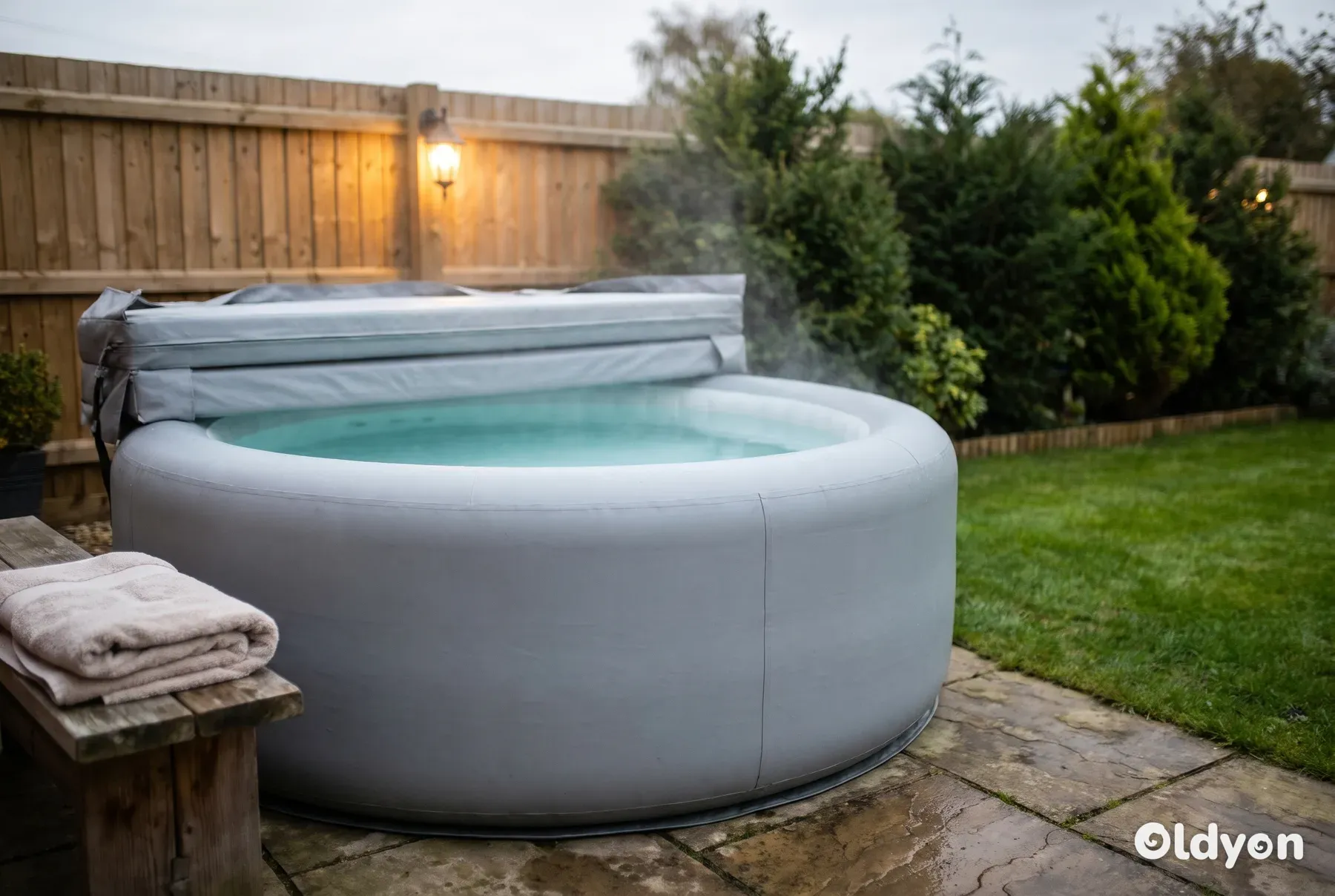
An 8 person inflatable hot tub can hold eight adults on paper, but for many groups five or six is the comfortable number once legs and elbows are counted. Before you buy, check the inner diameter, the water volume, how long the heater needs on a 13 amp plug and whether your ground can take roughly two tonnes.
This guide works through each of those questions with simple maths you can repeat for any model. It does not rank products. Instead, it shows you what to measure, what to ask and which costs appear after the box arrives.
What does '8 person' on the box really mean?
The number on the box is usually the most people who can physically fit inside, sitting close together with knees touching. It is not a promise that eight adults will be comfortable for a relaxed half hour. Manufacturers do not share one agreed method, so two tubs both sold as 8 person can feel very different.
Inflatable tubs have no moulded seats. Everyone sits on the floor with their back against the wall, so the space you get depends on the inside of the tub, the length of everyone's legs and how much each person likes to stretch out.
Inner diameter matters more than outer size
Listings often lead with the outer size, commonly around 2 metres (about 6 ft 7 in) or quoted in inches. The inflated walls take up a fair share of that, so the space you actually sit in is noticeably smaller. Always look for the inner diameter, or the inner length and width for a square tub.
Wall construction changes this gap. Drop-stitch walls are flat panels held rigid by thousands of internal threads, and they can be slimmer for the same stiffness than older ring-style walls. Two tubs with the same outer size can therefore have quite different amounts of room inside.
As a worked example, a tub about 216 cm (85 in) across with drop-stitch walls 10 cm (4 in) thick gives about 196 cm (77 in) of space inside. A ring-wall tub with the same outer size usually has thicker, rounder walls, so it gives noticeably less room inside. Compare the inner figures, not the outer ones.
How to estimate comfortable seating yourself
You can get a realistic figure with a tape measure and a calculator. The idea is to measure the circle where people's hips sit, not the wall itself.
- Find the inner diameter on the specification sheet, or measure across the inside of an inflated tub.
- Subtract about 50 cm (about 20 in). This allows for a seated adult's back and hips, which sit roughly 25 cm (about 10 in) in from the wall on each side.
- Multiply the result by 3.14 to get the length of the seating circle.
- Divide that length by 0.6 m (about 24 in) for relaxed seating, or by 0.5 m (about 20 in) for a close fit.
As a worked example, a tub with an inner diameter of 1.6 m (about 5 ft 3 in) gives a seating circle about 1.1 m across and 3.5 m around. That is roughly six adults with elbow room, or seven at a squeeze. It is only a rough guide, but it shows why the box number and the comfortable number differ.
For a quick cross-check, divide the inner diameter in centimetres by about 33, or the inner diameter in inches by about 13. The answer is a realistic adult count. A tub around 216 cm (85 in) across with about 196 cm (77 in) inside gives a result of about six, so it seats five to six adults comfortably rather than eight.
The quick check is more cautious than the circle method because it allows for legs meeting in the middle, not only shoulder room. If the two methods give different answers, plan around the lower figure.
Legs are the other limit. In a round tub every pair of legs points towards the same small area in the middle, so tall adults will tangle feet long before their shoulders touch. If your group is mostly tall, take one person off your estimate.
A rule of thumb for any size
If you want a quick answer without any maths, take one or two people off the manufacturer's stated capacity. That gives a realistic seated count for most groups, whatever the size of the tub.
For round inflatables, the overall diameter gives a useful guide to comfortable adult seating:
- About 2.35 m (93 in) or more across: six to eight adults
- About 2.15 m (85 in) across: five or six adults
- About 1.9 m (75 in) across: four or five adults
These bands agree with the measuring methods above. Treat them as a starting point, then check the inner diameter on the specification sheet, because wall thickness varies between models.
Round or square?
Square inflatable tubs have four corners, and a corner gives one person a comfortable place to lean back with legs angled out. For the same outer footprint, a square tub usually holds a little more water and can feel roomier with a full group. Round tubs suit curved corners of a garden and are simple to cover. Compare inner measurements rather than shape alone.
For a square tub, judge capacity by the inner side length rather than a diameter. As a guide, inner sides of about 1.8 m (71 in) realistically seat only four or five adults, even if the box gives a higher number.
Staying comfortable and safe with a full tub
Eight people in a tub make it feel warmer and use up sanitiser faster. Keep the water no hotter than 40°C (104°F), keep sessions short, and get out if anyone feels dizzy, sick or overheated. Drinking alcohol in a hot tub raises the risk of fainting and is best avoided.
Children overheat more quickly than adults, so many manufacturers advise lower temperatures and shorter sessions for them, and they should always be supervised. If you are pregnant, have a heart condition or take regular medication, speak to your midwife, GP or pharmacist before using a hot tub.
How much water does an 8 person inflatable hot tub hold?
Tubs in this size class commonly hold somewhere in the region of 1,000 to 1,500 litres (about 260 to 400 US gallons), but figures vary widely between models. Check the exact number on the specification sheet, because it decides your heat-up time, your ground loading and every chemical dose.
Some manufacturers quote the volume when filled to the brim and others quote it at the recommended fill line. When you compare two tubs, make sure both figures are measured the same way.
You can check the figure yourself. For a round tub, multiply half the inner diameter by itself, then by 3.14, then by the water depth, all in metres, and multiply by 1,000 for litres. A 1.6 m inner diameter with 0.7 m (about 28 in) of water works out at about 1,400 litres (about 370 US gallons). Our guide on how many litres are in a hot tub and how to work it out also covers square tubs.
If your group regularly has more than six adults, it is worth looking at larger tubs as well. Our guide to choosing a 10 person hot tub for big groups explains when the step up makes sense.
How long does a large inflatable take to heat on 13 amps?
A UK 13 amp socket can supply a little under 3 kW in total. Inflatable hot tubs typically have a heater rated somewhere around 1.5 to 2.2 kW, and many will not run the heater and the bubble blower at the same time, so the plug is not overloaded.
Physics sets the limit. Raising 1 litre of water by 1°C takes about 4.2 kJ of energy, so a 1,400 litre tub warmed from 15°C (59°F) to 40°C needs about 41 kWh. With a 2 kW heater, that takes more than 20 hours even if no heat escaped at all.
Water volume | Energy for a 25°C rise | Minimum time at 1.5 kW | Minimum time at 2 kW |
|---|---|---|---|
1,000 litres | about 29 kWh | about 19 hours | about 15 hours |
1,200 litres | about 35 kWh | about 23 hours | about 17 hours |
1,400 litres | about 41 kWh | about 27 hours | about 20 hours |
1,600 litres | about 47 kWh | about 31 hours | about 23 hours |
These times assume no heat loss, so real times are longer. Heat escapes through the walls, the floor and the water surface, and it escapes much faster in wind and cold air. For a large volume on a 13 amp heater, the best possible rate is only around 1°C per hour, and on a cold or windy day it can be well below that.
Cold weather also affects the tub once it is hot. As the air gets colder, a 13 amp heater finds it harder to replace the heat being lost, and on very cold days it may not keep up at all. Over several cold days the water can drift below your set point even though the heater is running.
In winter, check the water temperature before each session rather than assuming it matches the setting, and watch the reading over several days when a cold spell arrives. A floating thermometer is a simple cross-check on the control panel. If the water keeps falling, improve the cover, base insulation and wind shelter, and keep everyone's sessions short if the water is cooler than usual.
The same energy appears on your bill. Multiply the kWh figure by the unit rate on your electricity bill to estimate the cost of heating a fresh fill. After that, a well-covered tub only needs to replace the heat it loses each day. For more on what affects timings, see how long a hot tub takes to heat up.
How to shorten heat-up time
- Keep the cover on and strapped down from the moment you start heating.
- Put an insulated ground mat or foam boards under the tub, because cold ground draws heat out through the floor.
- Shelter the tub from wind with a fence, hedge or windbreak.
- Leave the bubbles off while heating, as air bubbles cool the water.
- Start heating a fresh fill on a mild day rather than a frosty one.
- If you use the tub often, holding the water near your usual temperature can be more practical than reheating from cold. Check your manual and your tariff.
Can your garden take the weight?
Water weighs about 1 kg per litre, so a 1,400 litre tub holds about 1.4 tonnes of water. Add eight adults at around 80 kg (about 175 lb) each, plus the tub itself, and the total is roughly 2 tonnes (about 4,400 lb). On a 2 m round footprint of about 3.1 m² (about 33 sq ft), that is around 650 kg per square metre (about 133 lb per square foot).
That load sits on the same spot for months. The base needs to be flat, level, firm and able to drain, with nothing sharp underneath that could puncture the floor of the tub.
- A concrete slab, which is the most reliable choice.
- Paving slabs laid on a compacted sub-base and checked with a spirit level.
- A purpose-made hot tub base or interlocking base tiles, used as the maker describes.
- A garden deck, only if a builder or structural engineer has confirmed it can carry the load.
Grass is a poor base. It sinks unevenly under the weight, stays damp, kills the lawn and can let stones work up into the floor. A tub that is not level holds its water unevenly and puts extra strain on one side of the walls.
Garden decks need particular care. A typical deck is designed to carry people, furniture and plant pots, which is a load far below the roughly 650 kg per square metre of a full large tub. That is why a builder or structural engineer should check any deck before a tub goes on it, even one close to the ground.
For comparison, an ordinary garden deck is often designed for only around 250-300 kg per square metre (about 50-60 lb per square foot). A full large tub at around 650 kg per square metre can therefore exceed that by more than double, so most decks need extra support before they can carry one.
Never put a filled hot tub on a balcony, roof terrace or raised deck without written confirmation from a structural engineer. Around 2 tonnes concentrated in a small area can exceed what these structures are designed to carry.
Think about access too. You need room to walk around the tub, lift the cover off and reach the control unit and drain valve. Place it within reach of a hose for filling, and plan where around 1,400 litres of drained water will go.
Measure the delivery route and the space around the tub
Before you order, measure the route from the road to the spot where the tub will sit. The boxed tub and its pump and heater unit are heavy and bulky, so check the box dimensions and weights on the specification sheet and make sure two people can carry them the whole way.
- The width of every gate and side passage on the route
- Any doorways, if the tub has to go through the house
- Steps, slopes and tight corners where a heavy box is hard to turn
- Low branches, bins or garden furniture that need moving on delivery day
Plan the space around the tub as well as its footprint. Leave a clear path to get in and out safely, room to fold back the cover and space to reach the pump unit, filter and drain valve. Some manuals give a minimum distance from walls or sockets, so check yours before you mark out the base.
What electrical setup does a large inflatable need?
Plug-in inflatable tubs are designed for a standard 13 amp socket, but where that socket is matters. In the UK, an outdoor socket should be protected by an RCD and installed to BS 7671. Most inflatable tubs also have a protective device built into the plug or lead, which you should test as the manual describes.
Adding a new outdoor socket or circuit is a job for a registered electrician. In England and Wales, some electrical work in and around the home is notifiable under Part P of the Building Regulations, and a registered electrician can certify it for you. Other countries have their own rules, so check locally. The charity Electrical Safety First publishes clear guidance on outdoor electrics.
Do not run a hot tub from an extension lead or cable reel. Most manufacturers forbid it, and a lead carrying a heater's load for many hours can overheat. Plug directly into a suitable RCD-protected outdoor socket.
Before cleaning the filter, draining or doing any maintenance, switch off at the socket and unplug the tub.
How do chemical doses change in a bigger tub?
Chemical labels give doses per 1,000 litres or per another set volume, so your water volume is the starting point. A 1,400 litre tub needs about 1.4 times the label dose for 1,000 litres. Guessing the volume is a common reason doses come out too strong or too weak.
Aim for these widely accepted ranges, and test the water before every busy session:
- Free chlorine: 3-5 ppm, or bromine 3-5 ppm if your manual allows bromine
- pH: 7.2-7.6
- Total alkalinity: 80-120 ppm
- Calcium hardness: 150-250 ppm
Some inflatable makers specify which sanitisers suit their liner and heater, and a few advise against products such as floating dispensers. Where the chemical label, your manual and general guidance differ, follow your manual.
Some inflatables accept an optional saltwater chlorinator. This unit makes chlorine from salt dissolved in the water, which reduces how much sanitiser you need to buy. You still need to test the water, keep free chlorine at 3-5 ppm and balance the pH. Only fit a chlorinator your manufacturer lists as compatible, and add salt for your real water volume.
More bathers bring more sweat, skin care products and other residue, so a full tub uses up sanitiser quickly. Poorly sanitised warm water can grow bacteria, and the NHS explains how Legionnaires' disease can spread from hot tubs. Keeping sanitiser in range protects everyone who uses the tub.
Dosing after a busy session
- Ask everyone to shower before getting in, which reduces the load on the sanitiser.
- Once everyone is out and the bubbles are off, test the water.
- Work out each dose from the label using your real water volume.
- Add one chemical at a time with the filter pump running and the cover open, and never mix products together.
- Let the water circulate for the time the label gives, then test again before the next use.
- During weeks of heavy use, rinse the filter cartridge more often than usual.
Water in a heavily used tub needs changing more often. Manufacturers give different intervals, so follow your manual, and change the water sooner if it turns cloudy, smells or will not stay in range.
Which features matter when comparing large inflatables?
Once size, power and base are settled, these features separate one tub from another. Jet or bubble counts printed on the box are rarely useful on their own, because they count holes rather than the strength of the massage.
Walls, setup and massage
- Wall construction: drop-stitch panels feel closer to a solid tub and tend to cost more, while ring-style walls are lighter and usually cheaper.
- Rim strength: drop-stitch walls are rigid enough to sit on the rim while getting in and out, whereas a conventional inflatable wall flexes or folds under a seated adult. Check your manual, as some makers advise against sitting on the walls.
- Wall insulation: drop-stitch walls insulate noticeably better than thin ring-style PVC walls, so for regular winter use they reduce heat loss and running costs.
- Foam-insulated walls: some inflatables use walls with a foam insulating layer instead of drop-stitch. These also slow heat loss noticeably in cold weather compared with standard thin PVC walls.
- Inflation: check whether the tub's own pump inflates it or whether you need a separate hand or electric pump. This affects how long setup takes and what you have to store.
- Bubbles or water jets: most inflatables use air bubble rings, which feel gentle and cool the water while running. A few add pump-driven water jets for a firmer massage, usually at a higher price.
- Headrests: because inflatables have no moulded seats, leaning back against the wall can become uncomfortable in a longer session. An inflatable headrest or pillow that fits on the wall helps, and some tubs include them, so check what comes in the box.
Heating and energy
- Heater rating and lockouts: check the heater power and whether it switches off while the bubbles run.
- Cover: a thick, well-fitting cover with locking straps saves energy and keeps leaves and children out.
- Cover lining: a reflective foil lining on the underside of the cover bounces radiant heat back into the water, which cuts heat loss and how long the heater runs overnight.
- Heating timer: a programmable timer on the control panel lets you have the water hot for a planned session without holding it at full temperature all the time. With a large volume, set it to start well ahead of the session.
- Cold weather use: check the lowest air temperature the manual allows and whether the tub has freeze protection.
- Floor insulation: some tubs include an insulated ground mat, and if yours does not, budget for one.
Water care
- Filtration: larger or additional filter cartridges cope better with eight bathers.
- Hard water: in hard water areas, a tub with built-in hard water treatment, or a separate scale-control product, helps reduce limescale build-up on the heater and liner.
Checks before you pay
- Stated rating: many tubs listed or searched as 'large' are actually rated for four to six or five to seven people. Check that the manufacturer's own stated rating is eight before treating a tub as an 8 person model.
- Spares and warranty: check that filters, covers and pump parts are sold in your country, and compare how long the pump and heater are covered, not only the liner.
- Seller support: many 8 person tubs come from newer brands with less spare-parts support. Read the seller's returns window and warranty terms, and keep the packaging until you have filled and run the tub once.
- Listing details: online listings sometimes contradict themselves on shape, size or jet count. Confirm the details with the seller before you plan the base or layout.
- Same tub, different name: the same tub is often sold under several brand names and finishes. Compare inner size, wall type and heater specifications so you do not pay extra only for a different colour or name.
When a different type of tub may suit you better
An inflatable gives gentle bubbles and moderate insulation. If you want targeted jet massage aimed at specific muscles, or the best insulation for cold weather, a hard-shell spa with pump-driven jets and a foam-insulated cabinet is the alternative.
A hard-shell spa also has moulded seats and lounger positions, which an inflatable's flat floor cannot offer. That suits people who want a reclining seat or a defined place for each bather, rather than everyone sitting on the floor against the wall.
Weight is another big difference. A filled hard-shell spa usually weighs considerably more than a comparable inflatable, often around 1.6 to 2.3 tonnes (about 3,500 to 5,000 lb) with water before anyone gets in. It normally needs a concrete slab or a base checked by a structural engineer, so include the base in your plans and budget.
A hard-shell spa of this kind usually needs a dedicated hard-wired supply rather than a 13 amp plug. In the UK, this should be fitted by a registered electrician to BS 7671 with RCD protection, and in England and Wales a new circuit is notifiable under Part P. Other countries have their own rules.
Budget for that supply as an extra cost on top of the spa itself. A dedicated circuit often costs several hundred pounds or more, depending mainly on how far the tub sits from your consumer unit.
Spare parts are another reason to look beyond the largest inflatables. Most 8 person inflatables come from newer brands. If reliable spares and after-sales support matter more to you than seating eight, a slightly smaller five to seven person model from an established maker, whose filters, pumps and covers are easy to buy, may serve you better.
For a wider checklist that applies to every size, see how to choose the best inflatable hot tub.
What should you budget for?
Prices change often with sales and the seasons, but 8 person inflatables fall into rough bands. Entry-level ring-wall tubs often sit around £400 to £700, mid-range models with better covers and controls around £700 to £1,200, and drop-stitch or premium models from about £1,200 upwards. Treat these as broad guides only.
If this is your first hot tub, a cheaper ring-wall model is a sensible way to find out how often you really use it. If it turns out to be a weekly habit, you can move to drop-stitch walls later, knowing the extra cost is worth it.
The purchase price is only part of the cost. Plan for these as well:
- Electricity for heating a fresh fill and replacing daily heat loss, which rises sharply in winter
- Sanitiser, pH and alkalinity products, test strips and shock treatment
- Replacement filter cartridges, roughly every two to four weeks in regular use
- A level base, a ground mat and, if needed, an outdoor socket fitted by an electrician
- Water for each refill if you have a water meter
- A thicker cover if the supplied one loses heat quickly
- A replacement cover roughly every three to five years, as covers wear and lose their seal
Insulation is the biggest single factor in winter running costs. In cold weather, a poorly insulated inflatable can cost around three times as much a month to keep warm as a well-insulated one. Your own figure depends on your tariff, the weather and how often you use the tub, so a good cover, an insulated base and insulated walls are worth paying for.
For chemicals, budget roughly £15 to £40 a month for sanitiser and balancing products with a chlorine routine. A saltwater chlorinator usually brings this down because it makes chlorine for you, although you still need pH products and test strips.
Mistakes to avoid
- Buying on the box number and finding that six adults is the real limit
- Comparing outer sizes instead of inner diameter and water volume
- Placing the tub on grass or on a deck nobody has checked
- Running the tub from an extension lead
- Dosing chemicals for a guessed volume
- Expecting a large tub filled from cold to be hot the same evening
- Forgetting to plan where the drained water will go
- Ordering before measuring the gates, passages and steps on the delivery route
Summary
An 8 person inflatable hot tub usually seats five or six adults comfortably, so judge it by inner diameter and water volume rather than the number on the box. A large volume on a 13 amp heater can take a day or more to heat from cold.
Plan for around 2 tonnes on a firm, level base, plug into an RCD-protected outdoor socket, and dose chemicals for the real volume. With those in place, a large inflatable is a practical way to share a hot tub with a bigger group.
Frequently asked questions
Will the water overflow with eight adults in the tub?
It can. Every adult pushes water upwards as they sit down, and with eight people the level rises noticeably. Fill only to the line marked inside the tub, never above it, and lower the level slightly before a full session if it reaches the top of the line. Water spilling over the walls also carries chemicals onto your base and lawn, so it is worth avoiding.
How can I see how much electricity my tub is using?
If you have a smart meter, watch the in-home display while the heater runs and again when only the filter pump is on. Comparing a few days in mild and cold weather shows how much heat loss is costing you. Multiply the daily kWh by your unit rate for a cost. A rise after you change the cover or base shows whether the change helped.
Can I use a large inflatable hot tub through a British winter?
Many owners do, but check the lowest air temperature your manual allows first. Heat loss rises sharply in cold, windy weather, so a good cover, an insulated base and shelter from the wind matter more with a large volume. Never let the water freeze inside the pump or pipes. If the tub will sit unused in frost, follow the manual's steps for draining and storage.
Is an 8 person tub too big for two people?
It works, but you pay for space you rarely use. A larger volume takes longer to heat, loses more heat each day and needs bigger chemical doses. If most sessions are for two or three people and a full group only comes a few times a year, a smaller tub may cost less to run. Compare the water volumes of both sizes before deciding.
Do I need planning permission for an inflatable hot tub?
A portable inflatable tub in a private garden does not usually need planning permission. Check with your local council if you live in a listed building or a conservation area, and check your lease or ask your landlord if you rent or own a leasehold flat. Any new electrical circuit or outdoor socket still has to meet the wiring rules in your country.
Can I leave an inflatable hot tub set up all year?
Some models are designed for year-round use and others are meant to be packed away for winter, so check your manual. If you leave it up, keep the cover strapped down, keep the water balanced and protect the liner from strong sun. If you pack it away, clean and dry it fully first, because a damp liner folded in storage can grow mould.
Filed under