Choosing a 2 person hot tub
Choosing a 2 person hot tub? Learn about footprints, seating layouts, plug and play or hardwired, inflatable or hard shell, and fitting one in a small garden.
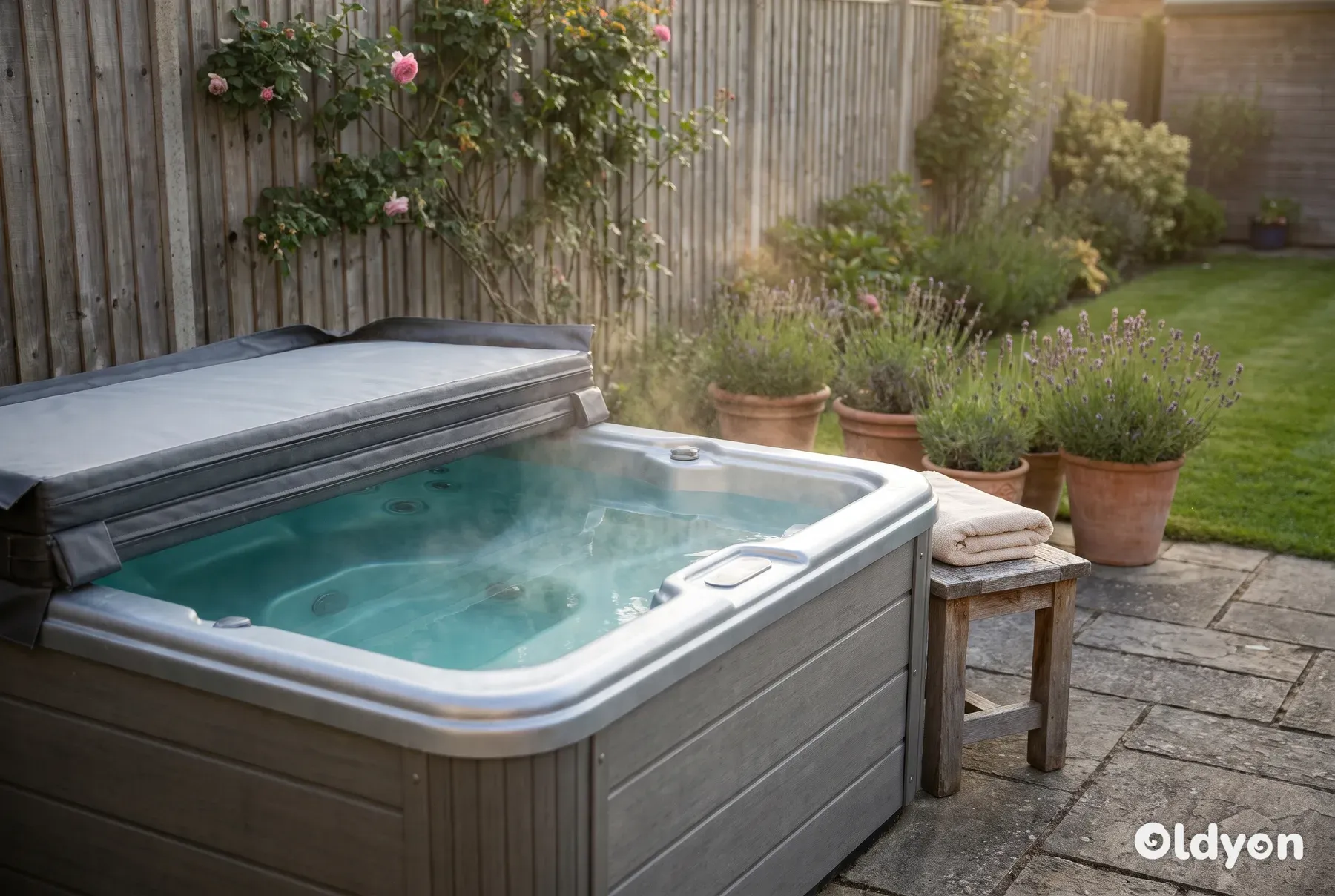
A 2 person hot tub usually takes up about 1.5-2 metres (5-6.5 ft) square and holds roughly 600-1,000 litres (about 160-260 US gallons) of water. The main choice is between a plug and play hard shell, a hardwired hard shell and an inflatable. Choose by footprint, seating layout, power supply and how often you will use it.
This guide follows the order a technician would work in: measure the space, check the power, then choose the type and the layout. If you are still unsure how small to go, it may help to read about whether a 1 person hot tub is worth it.
What size is a 2 person hot tub?
There is no industry standard for a "2 person" hot tub. The label is set by each manufacturer, and some compact models are sold as 2-3 person or even 2-4 person. Always compare the actual seat count and the external dimensions on the specification sheet, not the name.
Compact hard shell tubs are usually square or rectangular, often around 1.5-2 metres along each side, and typically stand about 75-90 cm (30-35 in) tall. Inflatable tubs are usually round or square, with an outside width of around 1.5-1.9 metres. The inside of an inflatable is noticeably smaller than the outside, because the walls are thick.
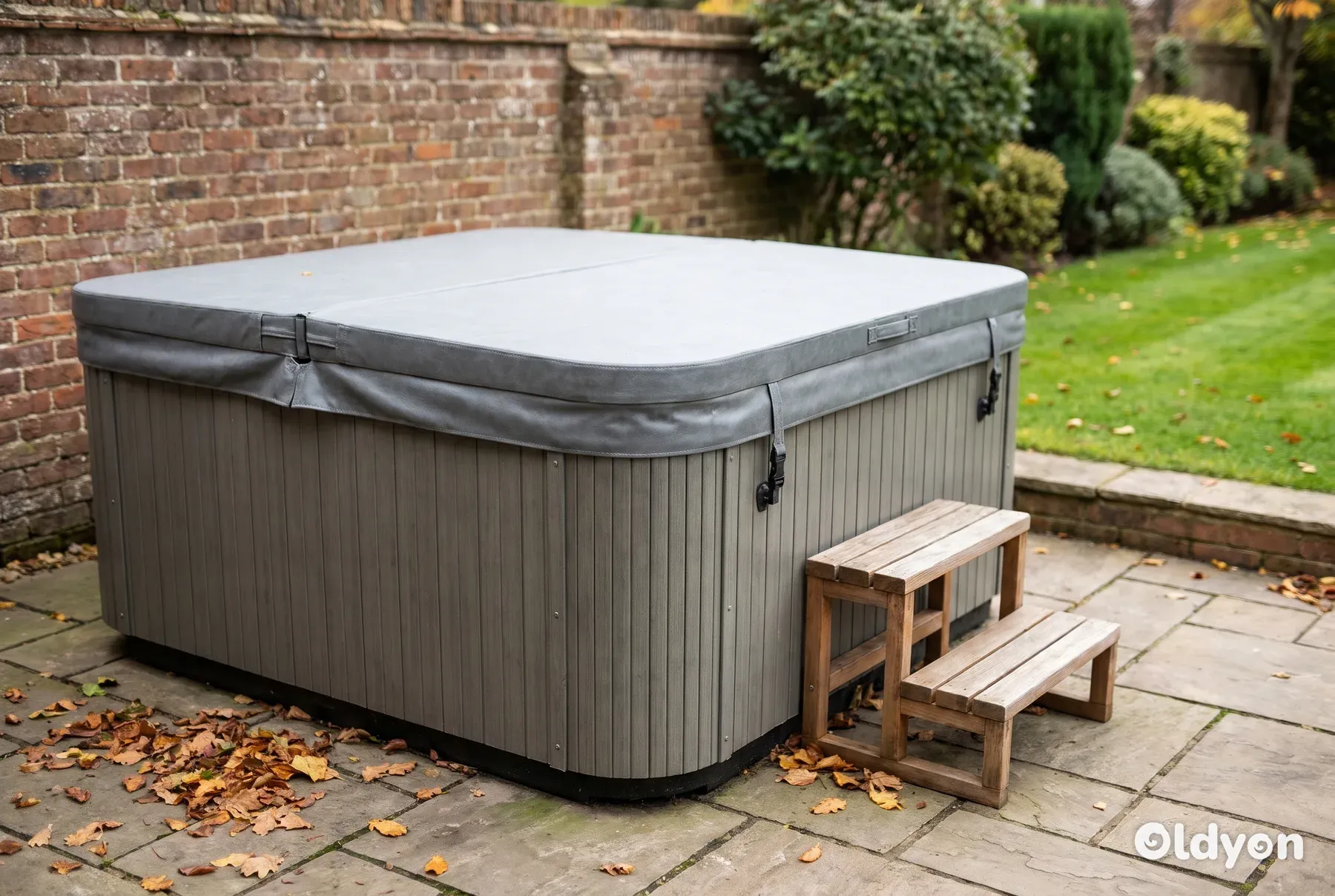
Leave space around the tub as well. You need room for the cover to open or slide off, a clear path to step in and out safely, and access to the equipment panel so a technician can kneel and work on the pump and heater. Your manual will usually give a minimum clearance, so check it before you mark out the space.
As a working rule, allow at least 50 cm (20 in) of clear space on every side of the tub. This gives you safe access for getting in and out, and room to reach the cover, the filter and the equipment panel for maintenance.
How do 1-2, 2-4 and larger tubs compare?
A dedicated 1-2 person oval inflatable has a footprint of roughly 1.6-1.9 metres by 1.2 metres (about 5 ft 3 in to 6 ft 3 in by 4 ft). This suits a small patio well. The narrow oval shape does limit side-by-side seating, so two people usually sit at opposite ends.
A tub labelled 2-4 person is usually about 1.8-2 metres (6-6.5 ft) across. It feels roomier for two adults, but it holds more water, so it takes longer to heat and costs more to run than a dedicated 1-2 person model.
A round 2-4 person inflatable about 1.8 metres across typically holds around 670 litres (about 177 US gallons). Use this as a benchmark when you compare models: a tub holding much more water will take longer to heat and need larger chemical doses, while one holding less will heat faster but change its water balance more quickly.
Larger 4-6 person inflatables need roughly 2.5 metres by 2.5 metres (about 8 ft 2 in square) of clear space. They can take around 6-10 hours to heat from cold tap water, which is noticeably longer than a smaller model with the same type of heater.
If you regularly host family or friends, buying a 4-6 person inflatable at the start can save you an early upgrade. Once it is hot, a well-insulated larger model can cost little more to keep at temperature than a 2-4 person one. Just make sure you have the 2.5 by 2.5 metre space it needs.
How heavy is it when full?
One litre of water weighs about 1 kg. A tub holding 800 litres therefore carries around 800 kg (about 1,760 lb) of water alone. Add the shell and two adults, and the total can easily pass one tonne, all resting on a small area.
This is why the base matters as much as the tub. Lawns, loose gravel and ordinary garden decking are not suitable. If your only outdoor space is raised, read about whether you can put a hot tub on a balcony before you look at any models, because a structural engineer will need to check the load.
Which seating layout works best for two people?
In a small tub, the layout decides how comfortable it feels far more than the number of jets. A full lounger, where you lie back with your legs stretched out, takes up a large share of the space in a compact tub. Upright seats use less room and leave space for a third person when you have a guest.
The most common layouts in compact hard shell tubs are:
- One lounger plus two or three upright seats, which suits a couple where one person prefers to lie back.
- Two upright seats facing each other, which is good for conversation and leaves more legroom.
- Two or more upright seats side by side, which suits watching the garden or the sky together.
- Several upright seats at different depths, including a raised cool-down seat for when you get too warm.
Most inflatable tubs have no moulded seats. You sit on the floor, so the water level depends on your height: it may reach the shoulders of a shorter person and only the chest of a taller one. Some owners use a tub seat or cushion designed for inflatables, so check what the manufacturer allows.
Medium-height benches or collapsible seats made for inflatables can add extra seating or raise a shorter person so the water sits at a more comfortable level. Padded headrests that clip onto the wall also make longer sessions more comfortable.
Shape matters in an inflatable too. A square inflatable usually gives two adults more elbow room than an oval one at a similar price, and the corners let you sit without directly facing each other.
If the two of you are very different heights, sit in the tub before you buy, ideally with water in it. A lounger shaped for a tall adult can leave a shorter person sliding down, and a shallow seat can leave a tall person cold at the shoulders. Our guide to choosing a hot tub for couples covers comfort and layout in more detail.
Plug and play or hardwired: what is the difference?
Plug and play hot tubs
A plug and play hot tub runs from a standard 13 amp socket. This avoids installing a new circuit, which makes it a popular choice for compact tubs. Almost all inflatable hot tubs work this way too.
Put simply, plug and play means the tub runs from the same type of 13 amp household socket as a kettle. The hardwired alternative is a dedicated circuit, commonly 32 amps, wired from your consumer unit.
The limit is power. A 13 amp supply cannot run a full-size heater and a powerful jet pump at the same time, so on many plug and play tubs the heater switches off while the jets run on high. During a long session the water slowly cools, and heating from cold after a refill takes longer.
Most beginners find this an acceptable compromise. You get a tub that heats more slowly and may pause heating while the jets run, but you avoid the cost and disruption of new wiring.
Typical inflatable heaters are rated at around 1,350 W and raise the water temperature by only about 1-1.5°C (roughly 2-3°F) per hour. Allow many hours for the first heat-up, start it the day before you want to use the tub, and keep the cover on while it heats.
Once the water reaches the set temperature, the thermostat holds it there by switching the heater on and off as needed. With a good cover in place, the heater runs only briefly, so keeping an inflatable warm uses far less energy than the first heat-up.
Hardwired hot tubs
A hardwired tub has its own dedicated circuit from your consumer unit, commonly rated at 32 amps, although the requirement varies by model, so check the specification. With more power, the heater and pumps can usually run together, and the water stays at temperature while you use the jets.
The trade-off is installation cost. An electrician has to run a suitable armoured cable from the house to the tub position and fit an outdoor isolator. The length and route of that cable can make a real difference to the price, so get a quote before you choose the tub.
As a rough guide, hardwired installation in the UK often costs around £500-£1,000, depending on the cable run and the state of your consumer unit. Choosing plug and play avoids that cost and leaves you free to move the tub or pack it away for storage.
What the UK electrical rules say
In the UK, any hot tub installation must meet BS 7671, the national wiring regulations, and it must have RCD protection. A hardwired tub should be connected by a registered electrician. In England and Wales, a new outdoor circuit is notifiable building work under Part P of the Building Regulations, and an electrician registered with a competent person scheme can certify it for you.
A plug and play tub still needs a weatherproof, RCD-protected outdoor socket in good condition, and it is sensible to have an electrician check it before the first use. The charity Electrical Safety First publishes clear guidance on outdoor electrics. If you live outside the UK, your country has its own rules, so follow those.
Never run any hot tub, including an inflatable, from an extension lead or a cable reel. Plug it directly into a suitable RCD-protected outdoor socket and test the RCD as often as the manual says. Before any maintenance, switch off at the isolator or unplug the tub.
Should you choose an inflatable or a hard shell 2 person hot tub?
Inflatable tubs cost much less to buy, arrive in a box and can be packed away when you are not using them. Their weaknesses are insulation and durability. They lose heat faster in cold or windy weather, heat up slowly, and the liner and seams wear over time. Some manufacturers advise against running them below a certain air temperature, and that limit varies, so check your manual.
If you are leaning towards the cheaper option, our guide on whether a 2 person inflatable hot tub is right for you goes through the practical details.
What to look for in an inflatable
- Multi-layer, reinforced walls described as puncture resistant, rather than a single thin layer.
- The wall construction. Internal fabric beams or drop-stitch walls hold their air pressure better and keep the tub firmer and more stable than a plain single-chamber wall, so check which construction a model uses.
- A ground cloth or thick insulating mat underneath, to keep heat in and protect the floor from sharp stones.
- A built-in pump that inflates the tub in a reasonable time. Most take about 8-25 minutes to inflate, and deflating and folding for storage takes a similar time.
- Water jets or a combination of jets, if you plan to use it in cold weather.
Many inflatables use air jets only. These bubble cool outside air through the water and can drop the temperature by around 2-4°C during a 30-minute session. For that reason, an air-jet-only inflatable is a poor choice for regular use in deep winter.
Air jets also give a gentle, all-over bubble massage rather than targeted hydrotherapy. If you want firm relief for tired muscles in the back, legs and feet, look at a hard shell tub with water jets, or an indoor whirlpool bath, instead of an air-jet inflatable.
Hard shell tubs
Hard shell tubs have an insulated cabinet, a rigid fitted cover, moulded seats and a proper filtration system. They are designed to stay full and hot all year. They cost more, need a solid base and a clear delivery route, and are not something you move once they are in place.
Wood-fired tubs
Wood-fired tubs are heated by a stove, either inside the water or outside it, so they need no mains electricity for heating. They take time and fuel to bring up to temperature, and many have no filtration, which means the water usually needs changing more often. If you live in a smoke control area, ask your local council what you are allowed to burn.
Running costs are firewood rather than electricity, roughly £1.50-£3 per session or per day depending on local fuel prices. Heating up usually takes about 1.5-3.5 hours, depending on the stove design and the weather.
An internal stove sits inside the tub and heats the water faster, but it takes up part of the seating space. An external stove keeps the whole interior free for sitting, but heats the water more slowly.
An internal stove and its guard can take up roughly 15-20% of the space inside the tub. In a small tub for two, that is a noticeable loss, so choose an external stove if seating room matters more to you than a faster heat-up.
With no pump or electronics, a wood-fired tub is mechanically simple and has little to break. The trade-off is more hands-on care: frequent water changes and manual chemical balancing, because there is usually no filter to help.
When you compare wood-fired models, check the wall thickness. Thicker timber walls hold heat better, so you burn less firewood. Also look for a thick insulated folding cover, a built-in drain tap for easy water changes and matching access steps.
Check what the inside of a wood-fired tub is made of. A contoured fibreglass lining is smoother and more comfortable to lean against than plain timber staves, and it is usually easier to clean.
Wood-fired tubs suit rural gardens with no convenient outdoor socket and easy access to cheap firewood. They also suit people who enjoy the ritual of lighting a fire, rather than wanting hot water at the press of a button.
Check the depth before choosing a compact barrel. A small-diameter barrel can leave taller people with shallow immersion, so their shoulders stay out of the water, and the space can feel restrictive for two adults.
What if you have no garden?
If you live in a flat or have no outdoor space, an indoor two-person whirlpool bath is an alternative. It gives warm-water hydrotherapy in any weather. It needs plumbing and professional installation, so budget roughly £200-£500 extra for fitting, and it cannot be moved once installed.
Some two-person whirlpool baths have adjustable, swivelling jets that you can aim at the back, sides and feet. Look for an inline heater as well: it keeps the water warm while you use the bath and switches off automatically at 40°C.
A whirlpool bath holds only a bath-sized volume of water and is filled fresh from your hot tap each time. That makes it much cheaper to heat and run than an outdoor tub, which has to keep a far larger volume warm.
When you compare whirlpool baths, look at the interior basin size and the soaking depth, not just the outer length of about 1.8 metres (about 6 ft). As an example, one two-person model has a basin of around 112 x 78 cm (44 x 31 in) and a soaking depth of about 40 cm (16 in). Padded headrests and contoured backrests at both ends add comfort for two.
Feature | Inflatable | Hard shell | Wood-fired |
|---|---|---|---|
Broad price band | A few hundred pounds | Several thousand pounds | A few thousand pounds |
Heating | Electric, slow | Electric, faster if hardwired | Wood stove, no mains needed |
Insulation | Low | Good with a fitted cover | Often low |
Filtration | Small cartridge | Full system | Often none |
Seating | Sit on the floor | Moulded seats or lounger | Bench |
Massage | Gentle air bubbles, sometimes water jets | Targeted water jets | Usually none |
Moving it | Easy to pack away | Needs a delivery route | Heavy, needs a delivery route |
Winter use | Limited | Designed for it | Possible, needs fuel and time |
How do you fit a hot tub into a small UK garden?
Most problems with compact tubs come from measuring too late. Check the space, the route and the base before you choose a model. Our guide to fitting a hot tub into a small garden has more layout ideas, but these steps cover the basics.
- Mark the tub's footprint on the ground with string or chalk, then add the clearance for the cover, the steps and the equipment panel.
- Measure the delivery route from the road to the spot: gates, side passages, steps, tight corners and overhanging branches. Hard shell tubs often travel on their side on a trolley, so ask the supplier for the minimum width they need.
- Check the base. A concrete slab or paving laid on a compacted sub-base works well, as does decking built specifically for the load. It must be flat and level.
- Plan the power supply. Find the nearest outdoor socket for a plug and play tub, or ask an electrician to plan a cable route for a hardwired one.
- Decide where you will drain the water. Ask your local water company where treated water should go, and never empty it into a surface water drain that leads to a stream or river.
- Think about shelter, privacy and neighbours. Avoid placing the tub under trees that drop leaves, and remember that pumps can be heard on still nights.
If your garden or patio is very small, under about 4 square metres (43 sq ft), a dedicated 2 person oval inflatable or a compact wood-fired barrel is more practical than a larger model. Make sure you can still keep clear space around it for the cover and for maintenance.
Do you need planning permission?
A freestanding hot tub in a private garden does not usually need planning permission, because it is not treated as a building. Structures around it, such as a gazebo, a pergola or raised decking, may have their own limits. Rules are different for listed buildings, conservation areas, flats and rented homes, so check with your local council or landlord if any of these apply to you.
How much does a 2 person hot tub cost to buy and run?
As broad price bands, inflatable tubs usually cost a few hundred pounds, often under £1,000. Compact hard shell tubs typically start at a few thousand pounds and can reach several thousand for better insulated models. A hardwired tub also needs the electrician's work, and any tub may need a new base.
Running costs depend on the heater's power, the insulation, the cover, the weather, your set temperature and how often you use the tub. No single figure applies to every home, but you can estimate your own cost with simple arithmetic.
- Find the heater rating in kilowatts (kW) on the specification sheet.
- Estimate how many hours a day the heater runs. This is much higher in winter than in summer.
- Multiply the two figures to get kilowatt hours (kWh). For example, a 2 kW heater running for 3 hours uses 6 kWh.
- Multiply the kWh by the unit price on your electricity bill, then add a smaller amount for the circulation and filtration pump.
As a rough guide, a 2 person inflatable costs about £1-£2.50 per day to keep at 40°C, based on an electricity price of around 24p per kWh. The real figure depends on the insulation, the air temperature and your own tariff, so check your bill.
A tub kept heated all the time can cost roughly £45-£60 a month even if you rarely get in. If you are not using it for a while, lower the temperature or use the timer to heat it only before the days you plan to use it.
The biggest savings come from keeping heat in. Use a well-fitting, thick cover and keep it closed whenever the tub is not in use. Shelter the tub from the wind, avoid heating it hotter than you need, and lower the temperature if you are away for a few days.
A fitted insulated cover makes a large difference. Some manufacturers suggest it can cut running costs by up to about 75% compared with leaving the tub uncovered, so put the cover back on after every session.
Your set temperature matters too. Keeping the thermostat at around 36°C (97°F) for regular use, rather than the 40°C maximum, reduces running costs and is comfortable for most people.
Remember the other costs too: sanitiser and balancing chemicals, test strips or a test kit, replacement filters, water for refills and, eventually, a new cover. These are smaller than the energy cost but they add up over a year.
Is the water harder to look after in a small tub?
Yes, in one way. A small tub holds less water, so each person, each drink spilled and each splash of sun cream has a bigger effect on the water balance. Sanitiser levels can drop quickly after a session, so test before each use and dose in small, carefully measured amounts.
These are the widely accepted target ranges for hot tub water:
- Free chlorine: 3-5 ppm, or bromine: 3-5 ppm
- pH: 7.2-7.6
- Total alkalinity: 80-120 ppm
- Calcium hardness: 150-250 ppm
- Water temperature: no hotter than 40°C (104°F)
Warm water that is poorly maintained can support harmful bacteria, including Legionella. The Health and Safety Executive explains the risks on its Legionnaires' disease pages. Change the water as often as your manual recommends, which is usually every few months, and clean or replace the filter on schedule.
Inflatables with air jets often need the water changed more often than a hard shell. Some guidance suggests as often as every 3-4 days under heavy use, while other manufacturers give longer intervals, so follow your own manual.
Plan for about 15-30 minutes a week of routine care: testing the water, balancing the chemicals and rinsing the filter. Underestimating this time is a common reason people end up selling their tubs.
Automation helps here. A tub with freeze protection and timer controls does more of the routine work for you, and starting a simple maintenance routine from the first day makes it far less likely that the tub becomes a chore you want to sell within the first year.
What should you check before you buy?
Use this checklist when you compare compact tubs, whether in a showroom or on a specification sheet:
- The real seat count and the internal dimensions, not only the outside size.
- The power requirement: 13 amp plug and play, or a dedicated circuit and its rating.
- Whether the heater runs at the same time as the jets.
- Cabinet insulation and the thickness and fit of the cover.
- The filter type, and whether replacement filters and parts are easy to get in the UK.
- The warranty: what it covers, for how long, and who carries out repairs in your area.
- Whether delivery, positioning and removal of packaging are included in the price.
- Easy access to the equipment panel once the tub is in position.
- Built-in controls: a digital control panel, a power-saving timer that schedules heating days ahead, an automatic child lock, and a filter-change reminder (often set at about 120 hours of use).
- How far ahead the timer can be set. On some inflatables the power-saving timer can be programmed up to about 40 days in advance, so the water is hot for a planned weekend and the tub is not heated while nobody uses it.
- An adjustable temperature range on the control panel, typically from about 20°C (68°F) up to the 40°C maximum, ideally with a display you can tilt or reach easily from the water.
- For an inflatable, the filter setup. Many heater pumps hold two small replaceable cartridges that catch sand, debris and hair, and show an error code on the control panel when a cartridge stops filtering effectively.
- Freeze protection. A pump damaged by freezing is the most common winter failure in inflatables, so make this a priority if you want a trouble-free tub through the cold months.
- Smartphone app control, if you want to pre-heat from your phone. Some inflatables let you set the temperature, timer, filter and massage functions remotely.
- A built-in hard water treatment system, which helps protect the heater and plumbing from limescale if you live in a hard water area.
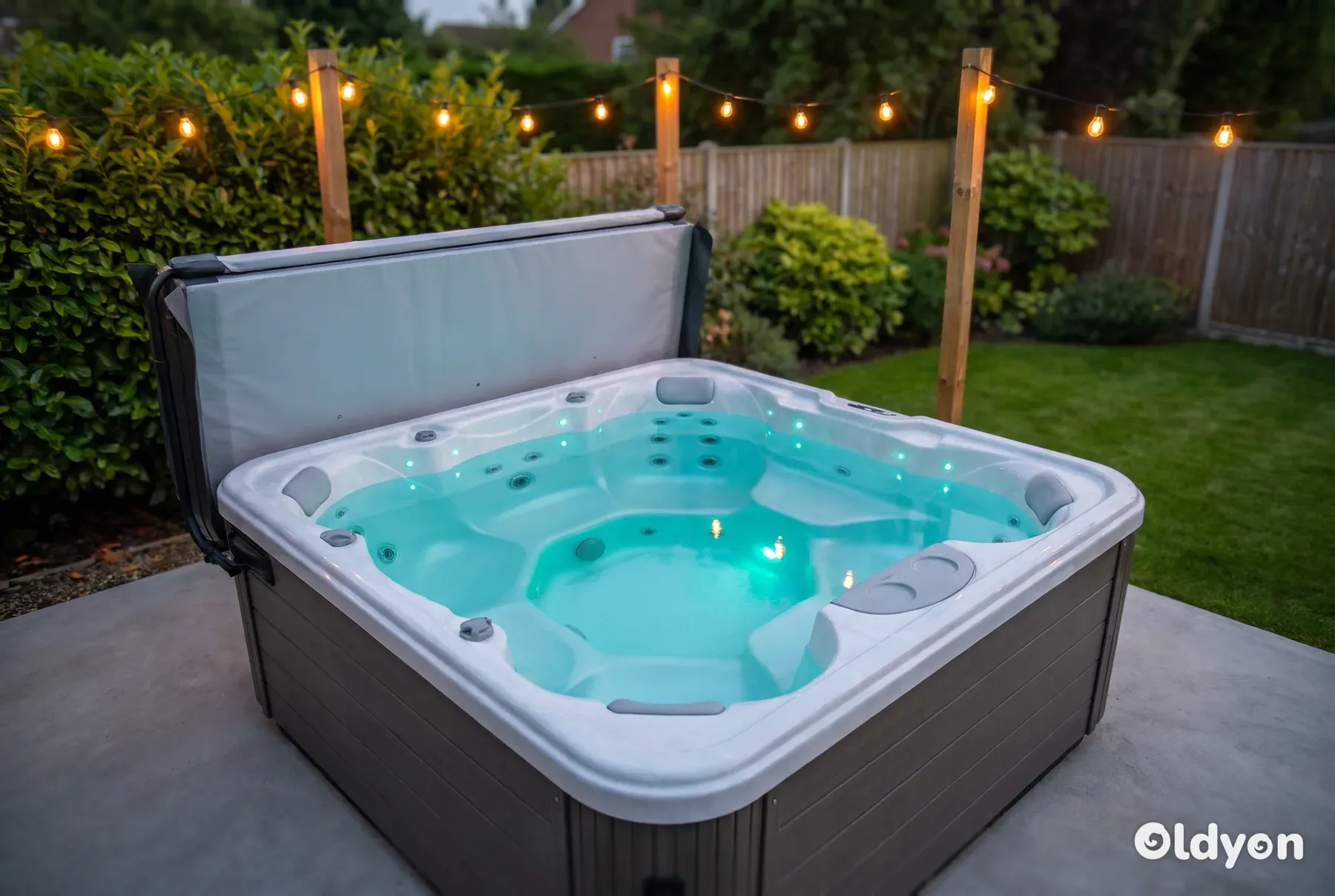
- Underwater LED lighting that changes colour, an optional extra on some inflatables and whirlpool baths that adds atmosphere in the evening. Check whether it is built in and powered by the tub or needs its own batteries.
- What comes in the box: cover, filter cartridges, chemical dispenser, repair patch, headrests and benches. Extras you have to buy separately add to the real cost.
- For an inflatable, UKCA or CE safety marking on the product.
- A UK customer service contact, published warranty terms, a UK returns address and spare parts you can actually order. No UK contact is a warning sign.
Common mistakes are just as useful to know:
- Choosing by the number of jets rather than the comfort of the seats.
- Measuring the garden but not the route from the road.
- Assuming a plug and play tub will always be cheap to run.
- Placing a tub on lawn, gravel or decking that was not built for the weight.
- Buying a tub that has no local service support.
Which brands are the most reliable?
Rather than relying on rankings, look for signs of long-term support. Established manufacturers with a UK dealer network, published specifications, readily available spare parts and a clear written warranty are generally easier to live with. Ask a local dealer how quickly they can supply a replacement pump or heater, and read the warranty terms before you pay.
Reputable inflatable brands often cover the pump unit with a warranty of more than one year, so check the length on the terms. The real test of reliability, though, is whether you can buy a replacement pump and cover from a UK source when you need them.
Unbranded tubs carry a hidden risk. If the pump unit fails and no compatible part is available, you may face buying a replacement unit, typically £60-£120, or replacing the whole tub.
Summary: choosing the right 2 person hot tub
Start with the space: mark out the footprint, measure the delivery route and plan a solid, level base that can carry more than a tonne. Then decide on power, because a hardwired tub keeps the water hot while the jets run, while plug and play is simpler to install.
Choose an inflatable if you want a low-cost tub for occasional use in milder months. Choose a hard shell if you want to use it year round with better insulation and filtration. Sit in the tub before you buy, and keep the water within the target ranges every time you use it.
Frequently asked questions
Can two adults fit comfortably in a 2-4 person inflatable hot tub?
Usually yes, and many couples prefer a tub labelled 2-4 person because the extra space lets two adults stretch their legs. Inflatable capacity ratings assume people sitting close together on the floor. Compare the internal diameter rather than the label, and remember that a bigger tub holds more water, which takes longer to heat and needs more chemicals.
Is a 2 person hot tub cheaper to run than a larger one?
It holds less water, so it often needs less energy to heat. However, insulation matters as much as size. A small, poorly insulated tub in a windy spot can use more energy in winter than a larger, well-insulated hard shell with a good cover. Compare the heater rating and the insulation, then estimate your own cost using your electricity unit price.
Who should check with a GP before using a hot tub?
Heat widens blood vessels and makes the heart work harder. People with heart disease, low blood pressure or a history of stroke should be particularly cautious with water above about 38°C (100°F), because of that extra strain on the heart. Speak to a GP first if you have any of these, high blood pressure, a weakened immune system, a skin infection or open wounds, or take medicine that causes drowsiness or affects your blood pressure or circulation, because the heat adds to those effects. If you are pregnant, speak to your midwife, as the NHS pregnancy guidance advises avoiding overheating, especially early on. Get out straight away if you feel dizzy, sick or too hot.
What is hot tub rash and how do you avoid it?
Hot tub rash (folliculitis) is an itchy, bumpy infection around the hair follicles, mainly caused by Pseudomonas bacteria in warm, under-sanitised water. Test the water at least twice a week, keep free chlorine or bromine at 3-5 ppm and pH at 7.2-7.6, shower before and after use, and wash swimwear. If a rash does not settle within a few days, ask a pharmacist or GP.
Is it worth buying a second-hand 2 person hot tub?
It can be. People often sell because running costs or maintenance were higher than expected, or they stopped using it once the novelty faded, often within the first year. Ask to see the tub full and running, check the shell for cracks, the equipment bay for leaks and the cover. Budget for moving it, a new cover and filters, and set up a maintenance routine from the start.
Can you leave a 2 person hot tub running through the winter?
A hard shell tub is designed to stay full and heated all year, which protects the pipes from frost. For an inflatable, the most useful winter feature is freeze protection, which automatically runs the heater near freezing to protect the pump and liner. Without it, drain the tub before freezing weather. Check your manual, and never leave any tub full and switched off during a frost.
Can a hot tub help with fibromyalgia?
Warm-water immersion may ease pain and poor sleep for some people with fibromyalgia, because warmth relaxes muscle tension and buoyancy takes load off the joints. It is not a treatment, and the evidence varies between studies and between people. Water above about 38°C (100°F) may not suit everyone, so start with short, cooler sessions. The NHS fibromyalgia pages explain recognised treatments. Check with your GP before you start.
Filed under