Can you put a hot tub on a balcony?
Thinking of a hot tub on a balcony? Learn how to work out the weight per square metre, who must sign it off, leaseholder consent, drainage and power.
Yes, you can sometimes put a hot tub on a balcony, but only after a structural engineer confirms the balcony can carry it. A full hot tub on balcony slabs puts far more weight on each square metre than most balconies are built for, and in a flat you will usually need written consent from the freeholder or landlord as well.
Weight is the main question, but it is not the only one. Draining up to a tonne of treated water, getting power to the tub safely, and keeping people away from the railings all need a plan before anything is delivered. The sections below walk through each check in the order you should do them.
Why is a hot tub so heavy?
Water weighs about 1 kg per litre (roughly 2.2 lb). A small two-seat hot tub might hold 600-800 litres, and a family-sized tub often holds 1,000-1,500 litres (about 260-400 US gallons). That means the water alone in a medium tub can weigh well over a tonne.
On top of the water you have the shell, cabinet, pumps and heater. A hard-shell acrylic tub usually weighs a few hundred kilograms when empty. Then add the people: four adults could easily add 300 kg (about 660 lb) or more. Your manufacturer's specification sheet should list the dry weight and the full weight, so start there.
If you are not sure how much your tub holds, our guide on how many litres a hot tub holds and how to work it out shows the method for square and round shapes.
How to work out the load per square metre
Total weight matters less than how that weight is spread. Engineers think in load per square metre, so a rough calculation of your own helps you understand the scale of the problem before you speak to one.
- Find the water volume in litres from the manufacturer's specification. One litre of water weighs about 1 kg.
- Add the empty weight of the tub, including the cover, from the same specification.
- Add the weight of the maximum number of bathers. Using 80 kg per adult is a reasonable rough figure.
- Measure the footprint of the tub in square metres. For a square tub, multiply length by width. For a round tub, multiply the radius by itself and then by 3.14.
- Divide the total weight by the footprint. The answer is the approximate load in kilograms per square metre (kg/m²).
- Write the figure down and give it, with the specification sheet, to your structural engineer. Treat your number as a rough guide only, not a safety check.
As a worked example, a 2 m by 2 m tub (4 m², about 43 sq ft) holding 1,200 litres, weighing 300 kg empty and seating four adults comes to roughly 1,820 kg. Divided by 4 m², that is about 455 kg/m² (around 93 lb per sq ft).
Example set-up | Approx. full weight with bathers | Approx. load per m² |
|---|---|---|
Inflatable, 2 m round, 800 litres, 4 adults | About 1,150 kg | About 370 kg/m² |
Hard-shell, 1.8 m x 1.8 m, 900 litres, 3 adults | About 1,390 kg | About 430 kg/m² |
Hard-shell, 2 m x 2 m, 1,200 litres, 4 adults | About 1,820 kg | About 455 kg/m² |
Hard-shell, 2.2 m x 2.2 m, 1,500 litres, 6 adults | About 2,360 kg | About 490 kg/m² |
These rows are illustrative calculations using the method above, not measurements of real products. Your own tub will differ, so always use the figures from your manufacturer.
Can a balcony take the weight of a hot tub?
Most balconies are not designed for anything close to the loads in the table. In the UK, ordinary domestic floors are commonly designed for an imposed load of about 1.5 kN per square metre, which is roughly 150 kg/m² (about 31 lb per sq ft). Balconies may be designed for somewhat more, but the actual figure depends on the building, its age and the standard it was built to.
That gap is why a full hot tub can be several times heavier per square metre than a balcony was designed to carry. A balcony can also look solid and still have limited capacity, because the structure you can see tells you very little about the steel, fixings or reinforcement inside.
Several features make balconies especially sensitive to heavy loads:
- Cantilevered balconies are supported on one side only, so weight near the outer edge puts much more strain on the fixings at the wall.
- Bolt-on steel or timber balconies depend on a small number of connections to the building.
- Older balconies may have corroded steel, weathered timber or cracked concrete that has never been inspected.
- Waterproof membranes and tiles can be damaged by point loads from feet or frames, which lets water into the structure.
- A hot tub is a long-term load. It stays full for months, unlike a crowd that comes and goes.
Roof terraces and ground-level patios over a basement raise similar questions. Our article on putting a hot tub in a basement or cellar covers the other side of the problem, where the floor is solid but access and ventilation are the challenges.
Are inflatable hot tubs light enough for a balcony?
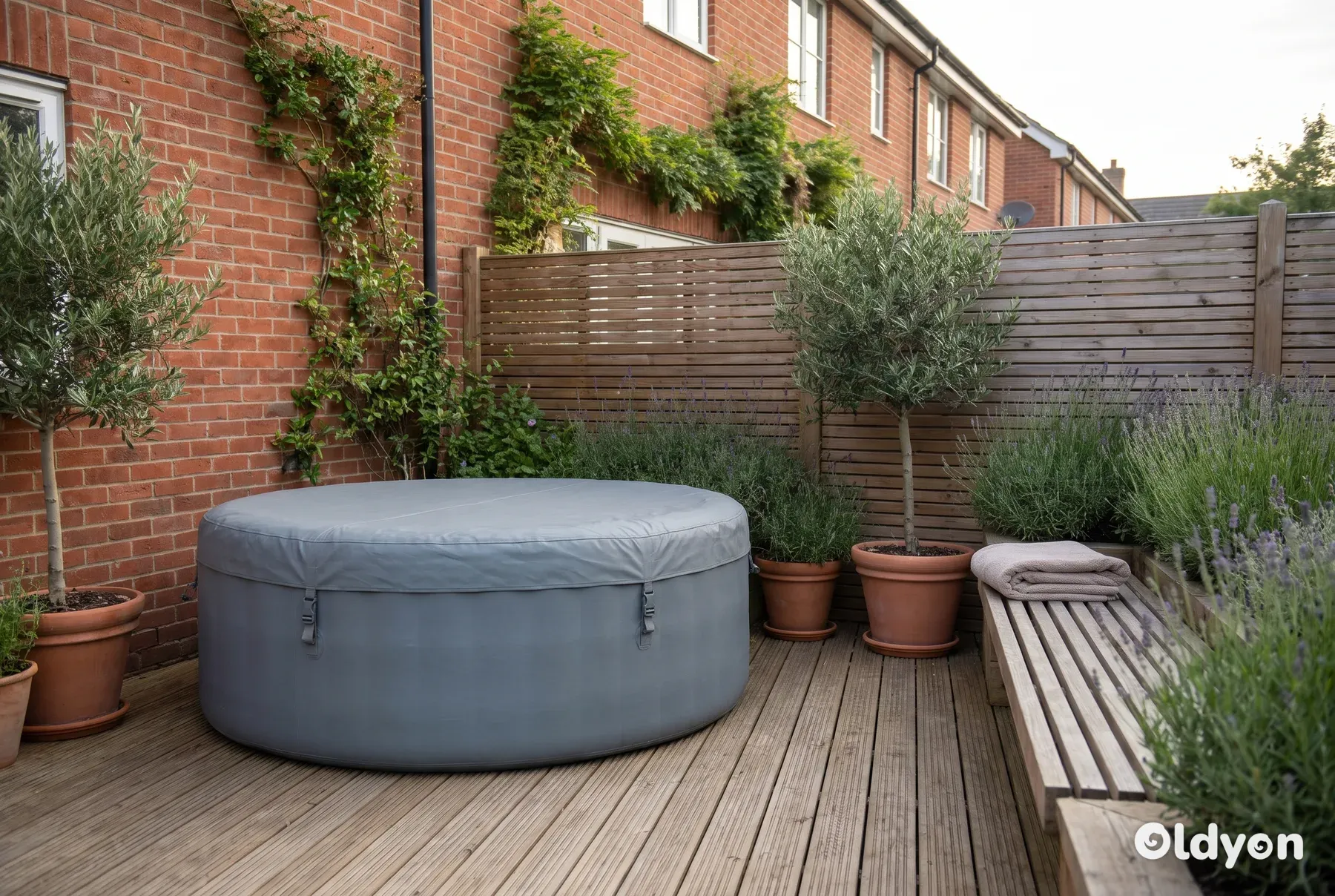
No, not automatically. An inflatable tub is light when empty, often light enough for one or two people to carry, and that gives many owners the wrong impression. Once it is full of water and people, it is a heavy load like any other hot tub.
Inflatables can even be harder on a balcony than some hard-shell tubs. The whole weight sits directly on the floor across the footprint, with no frame or feet that an engineer could position over joists or beams. A round inflatable also has a smaller footprint than you might expect, which pushes the load per square metre up.
The three main types of hot tub shell
Know which type you are choosing, because the shell affects the empty weight, how well the tub holds heat, how long it lasts and what it costs. In every case the water and bathers make up most of the full weight, so all three need the same structural check.
- Inflatable: soft walls that you inflate, the lightest when empty and usually the lowest price band. Insulation is generally limited and the lifespan is the shortest. The base sits flat on the floor.
- Rotomoulded: a one-piece moulded plastic shell. Usually tough and mid-priced, heavier than an inflatable but lighter than most acrylic tubs. Some run from a 13-amp plug. Insulation varies, so check the specification.
- Acrylic hard-shell: an acrylic surface over a reinforced shell inside a cabinet. Usually the heaviest when empty and the highest price band, with the best insulation and the longest expected lifespan.
Lifespan matters here too. Hard-shell tubs from established makers are commonly expected to last about 15-20 years with good care, while inflatables are often quoted at about 3-5 years. The structural survey and any strengthening cost the same whichever tub you choose, so think carefully before paying for that work to support a tub that may need replacing within a few years.
Choosing a smaller tub helps, but it does not remove the need for a check. Our guide to choosing a 2 person hot tub explains how much water and space the smallest models typically need.
Do not fill any hot tub, inflatable or hard-shell, on a balcony until a qualified structural engineer has confirmed in writing that the structure can carry the full weight with water and bathers. A failed balcony can injure people inside the tub, on the floors below and on the ground underneath.
Do you need a structural engineer to check your balcony?
Yes. A structural engineer is the right person to assess whether a balcony can take a hot tub, and in many cases a freeholder, managing agent or insurer will ask for their report before giving approval. Look for a chartered engineer, for example a member of the Institution of Structural Engineers or the Institution of Civil Engineers.
Give the engineer as much information as you can before they visit. This makes the visit faster and the advice more useful.
- The manufacturer's specification sheet, showing dry weight, full weight and water volume.
- The exact footprint and the position you want on the balcony.
- The maximum number of bathers.
- Any drawings or building records for the flat or house, if you have them.
- Details of any base, platform or decking you plan to use.
- How the tub will be lifted into place, since a crane or hoist adds its own considerations.
The engineer may say the balcony is fine as it is, that the tub must sit in a specific position near the wall, that a smaller tub is acceptable, or that strengthening work is needed. They may also say the balcony is not suitable at all. Expect to pay for the survey and report, and treat that cost as part of the project.
Budget for the electrics at the same time. If you choose a 32-amp hardwired tub, the dedicated circuit typically adds roughly £300-£800, depending on the distance from the consumer unit and how the cable is routed. Advertised tub prices rarely include this, so get a written quote from a registered electrician and add it to the survey cost when you set your budget.
If strengthening is needed, that work normally falls under building regulations. GOV.UK explains when you need building regulations approval in England and Wales. Scotland and Northern Ireland have their own systems, and other European countries have their own rules, so check locally.
Do you need permission from a landlord or freeholder?
If you are a leaseholder
Most flats in England and Wales are leasehold. Leases often restrict alterations, heavy items, anything that could cause water damage, and anything that creates noise or nuisance for neighbours. In many buildings the balcony structure is not even part of what you own, and belongs to the freeholder.
Read your lease carefully, then write to the freeholder or managing agent before you buy anything. Include the tub specification and your engineer's report. Get any consent in writing, and keep a copy. Putting a hot tub on a balcony without consent could breach your lease, and you could be asked to remove it at your own cost.
If you rent
Tenants need the landlord's written permission. The landlord may in turn need permission from a freeholder or a mortgage lender, so allow time for that.
If you own a house with a balcony
You still need the structural check. If the house is listed or in a conservation area, check with your local council before making any changes to the balcony or the outside of the building, as extra controls may apply.
Home insurance
Tell your insurer before installing the tub. Escape of water and structural damage are expensive claims, and an insurer may refuse a claim if a known risk was not declared. If you are in a block, the buildings insurance is usually arranged by the freeholder, which is another reason to involve them early.
Where does the water go? Filling, draining and splashes
Drainage is the problem most balcony owners discover too late. A balcony drain or gully is designed for rainwater, not for emptying hundreds of litres at once. Draining a tub straight onto the balcony floor can overwhelm the outlet, flood the balcony, soak the flat below or run down the face of the building.
Treated hot tub water also contains sanitiser. Rainwater drains often lead to local streams and rivers, so treated water should not go into them. In the UK the usual advice is to drain into the foul sewer, which in a flat often means a bath, shower or toilet. Check with your local water company if you are unsure, and check your lease for any restrictions.
A safe draining routine on a balcony usually looks like this:
- Switch off the hot tub at the isolator before you start.
- Let the sanitiser level drop for a few days if your manual recommends it, and test the water before draining.
- Use a submersible pump and a hose long enough to reach an indoor bath, shower or toilet.
- Run the hose along the floor so nobody trips, and secure the end so it cannot jump out of the bath.
- Pump slowly and watch the indoor drain so it does not back up.
- Wipe up any spills on the balcony straight away, so water does not sit on the membrane.
- Refill using a hose from an indoor tap or an outdoor tap with a double check valve, and fill slowly while watching for leaks.
Splashes and overflow matter too. Every bather pushes water up and over the edge, and that water lands on the balcony surface. Ask your engineer or a roofer whether the balcony's waterproofing can cope, and keep the water level at the line shown in your manual.
Keep the water balanced
Test the water regularly and adjust it towards widely used targets. Unbalanced water can turn cloudy, corrode metal parts and leave scale on the heater and shell. Some manufacturers use slightly different ranges, so check your manual.
- pH: 7.2-7.6
- Total alkalinity: 80-120 ppm
- Calcium hardness: 150-250 ppm
- Free chlorine: 3-5 ppm, or bromine: 3-5 ppm
Balance matters even more on a balcony when you drain. Water with a very high or low pH or a high sanitiser level is harsher on hoses, indoor fittings and any balcony surface it splashes onto, and it can mark stone or tiles. Bring the readings back into range and let the sanitiser fall before you pump it out.
Never drain a hot tub over the edge of a balcony or into a rainwater downpipe. The water can damage the building, soak neighbours and passers-by, and treated water should not enter surface water drains.
Safety checklist for a hot tub on a balcony
Once the structure, consent and drainage are settled, a handful of practical checks remain. These apply to every balcony, however strong.
Siting basics for any location
The same basics apply to a balcony, a patio or a garden. Check each one before installation day:
- Floor or ground preparation: the surface must be level, firm and able to shed water.
- Load-bearing capacity: the structure must carry the full weight with water and bathers, confirmed in writing for a balcony.
- A suitable base: if you use a platform or load-spreading base, include its own weight in the engineer's calculation.
- Access routes: the tub, the delivery team and any lifting equipment must be able to reach the spot safely.
Power and electrics
Water and electricity on a raised outdoor platform need care. In the UK, any new circuit for a hot tub must meet BS 7671, the wiring regulations, and be protected by a residual current device (RCD). The work should be done by a registered electrician, and in England and Wales it is notifiable under Part P of the building regulations. Other countries have their own rules, so use a qualified local electrician.
The type of tub you choose affects what power you can realistically get to a balcony. Hot tubs usually come in one of two electrical types:
- 13-amp plug-and-play: runs from a standard RCD-protected socket, so the tub itself needs no electrician. If there is no suitable outdoor socket near the balcony, fitting one is still work for a registered electrician.
- 32-amp hardwired: needs a dedicated circuit from the consumer unit, installed by a qualified electrician. Most hard-shell tubs are this type, and they can usually heat the water while the jets run.
In a flat, a new cable from the consumer unit to the balcony may need to pass through walls or shared areas. That can require the freeholder's consent as well, so raise it when you ask for permission.
Plug-in inflatable tubs still need an RCD-protected outdoor socket. Never use an extension lead or a cable reel to reach a balcony. The charity Electrical Safety First has clear guidance on outdoor electrical safety at home.
Railings and falls
Climbing in and out of a tub raises your standing height. If you step onto the edge of the tub or a step next to the railings, the balustrade may only reach your knees. Place steps on the side away from the railings, and keep the tub itself a sensible distance from the edge, as your engineer advises.
- Keep steps and handrails on the side closest to the building.
- Use a non-slip mat where you get in and out.
- Never let children use the tub unsupervised, and lock the cover when it is not in use.
- Do not use the tub after drinking alcohol, especially at height.
- Keep the water no hotter than 40°C (104°F), and get out if you feel dizzy or unwell.
Session length and health
Keep sessions to about 15-20 minutes with the water at 38-40°C (100-104°F). This is a common recommendation for a relaxing soak without overheating, but manufacturers differ, so check your manual. Get out sooner if you feel too hot, dizzy or unwell, which matters more when you are climbing out at height.
Many people use a hot tub to unwind. Warm water immersion has been linked in some research to lower stress and lower levels of the stress hormone cortisol, thought to involve the parasympathetic nervous system, which helps the body rest. Short soaks within the range above are the usual suggestion. Treat this as a wellness habit, not a medical treatment.
Hot water raises your heart rate and lowers your blood pressure. It widens the blood vessels near the skin (vasodilation), so the heart has to work harder to keep blood pressure up. Moderate use is generally considered safe for healthy adults, but people with an existing heart rhythm problem or a weaker heart are more at risk from this extra demand.
If you have atrial fibrillation, a pacemaker, any other heart condition or a history of heart attack or other cardiac events, get clearance from your GP or cardiologist before using a hot tub. The NHS explains atrial fibrillation and its symptoms. If you are pregnant, speak to your midwife first. Stop and get out straight away if you notice chest pain, a racing or irregular heartbeat or breathlessness, and seek medical help if it does not settle.
Wind, cover and neighbours
Balconies are often windier than gardens, especially higher up. Use cover straps or clips so the cover cannot blow off, and keep loose towels and accessories secured. Think about the people below and beside you as well: pump noise, steam, splashes and light at night can all cause complaints in a shared building.
Getting the tub there
Measure doorways, stairs, lifts and the balcony door before choosing a tub. Hard-shell tubs often need a crane, which may require a road closure or a permit from the council. Our guide to hot tub dimensions and how much space you need includes the access clearances to plan for, including room to service the equipment panel.
Delivery teams usually need a clear route at least 90 cm (about 35 inches) wide. Check that width along every stretch of the path, including corridors, corners, the lift door and the balcony door, before you order.
What does a balcony hot tub cost to run, and how should you buy one?
Running costs depend on insulation, your energy tariff, the weather and how often you use the tub. As a broad guide, a well-insulated four-person hard-shell tub typically costs about £50-£80 a month to run at current UK energy prices, while a poorly insulated tub can cost more than £100 a month.
Check running costs at today's energy prices
Energy prices change, so older running cost figures can be well out of date. In Great Britain the Ofgem energy price cap is reviewed every few months, and your own tariff may differ from the cap. Ask the dealer for the tub's expected energy use in kWh, then work out the cost using the unit rate on your latest bill.
Balconies are often more exposed to wind than gardens, which increases heat loss. Check the insulation quality and ask the dealer for the tub's expected energy use before committing, and use a well-fitting insulated cover every time the tub is not in use.
Comparing models for a balcony
When you compare tubs, look closely at three features, because each one changes the weight, the heat retention or the running cost.
- Number of seats: more seats usually means more water, more bathers and a heavier load per square metre.
- Jet configuration: more jets often means more or larger pumps, which add weight and use more electricity when running.
- Insulation rating: better insulation holds heat for longer and lowers running costs. Makers describe insulation in different ways, so ask for a standby energy figure you can compare.
Budget for the full cost of ownership
The price of the tub is only the start. A realistic budget adds the structural survey, any strengthening, the electrics, delivery and lifting, the monthly running costs and the monthly cost of chemicals. Chemicals include sanitiser, balancing products and test strips or a test kit, so ask your dealer for a typical monthly figure for your tub size.
When to buy
Timing can help your budget. Buying between about October and February usually brings end-of-season discounts of roughly 15-30%. Demand is lower then too, so you are more likely to get faster delivery slots and flexible installation dates, which helps when you need to coordinate an engineer, an electrician and possibly a crane.
Sales events such as Black Friday and the January sales often bring price cuts on both inflatable and hard-shell tubs. Retailers discount over the winter because they want to clear the previous year's stock before new models arrive for spring deliveries. Do not let a sale deadline rush you into buying before the engineer has approved the weight.
Buy from a dealer registered with BISHTA, the British and Irish Spa and Hot Tub Association, for compliant products and honest advice on running costs. Visit a showroom and sit in each model on your shortlist before choosing, because seat depth and legroom are hard to judge from a brochure.
Use one guide for buying and one for upkeep
Choosing a tub and looking after it are separate skills. Keep two resources to hand: a pre-purchase guide that helps you compare weight, insulation and power, and a maintenance guide for water care. Using both helps you avoid buying the wrong tub for your balcony and then neglecting it once it is installed. Your manufacturer's manual should always be part of the second.
Choosing a sanitiser and sticking with it
Chlorine and bromine both keep the water safe, but they behave differently. Chlorine works quickly and is often a good fit for tubs used now and then. Bromine is more stable in hot water and holds its level more steadily, which suits tubs used often. Your local water supply also plays a part, so ask your dealer and check your manual.
Pick one sanitiser and stay with it. Never mix chlorine and bromine products, and never mix any hot tub chemicals together in a container. If you want to switch, drain, clean and refill first, following your manual. On a balcony, store chemicals indoors in a cool, dry, locked place, not next to the tub.
Hard water and limescale
Much of England has hard water, including large parts of the Midlands, the South East and the East of England. In these areas limescale builds up quickly on the heater element, in the pumps and on the shell. Scale makes the heater work harder and can lead to failures.
On a balcony, a failed heater or pump is harder and slower to fix, because getting a technician and parts to the tub is awkward. Keep calcium hardness within 150-250 ppm, use a scale inhibitor if your dealer recommends one, and consider a pre-filter on the hose when you fill. Your water company can tell you how hard your local supply is.
Common problems in the first months
Most new owners meet the same few problems early on. Keep a short quick-reference guide like this near the tub, and always switch off at the isolator before touching any equipment.
- Cloudy water: test and rebalance, rinse or clean the filter, and shock the water as your manual advises.
- Foaming: often caused by soap, lotion or detergent left in swimwear. Ask bathers to shower first and rinse swimwear. An anti-foam product is a short-term fix only.
- Strong chemical smell: often a sign of too little free sanitiser, not too much. Test, then shock the water.
- Filter problems: rinse the filter regularly, deep clean it on the schedule in your manual, and replace it when it is worn.
- Equipment faults or error codes: check the manual for the meaning of the code. If it does not clear, call a qualified technician.
Problems that keep coming back
Some problems are harder to fix than routine chemistry, so do not ignore symptoms that return after you treat them. Each one needs its own treatment.
- Chloramines (combined chlorine): a sharp smell and eye irritation even when chlorine is present. Usually needs a shock treatment to break them down.
- Metal staining: coloured marks on the shell, often from metals in the fill water. A metal sequestrant and a pre-filter can help.
- Biofilm: slimy build-up inside the pipes that can keep making the water cloudy. A pipe cleaning product used before a drain and refill is the usual answer.
If a problem keeps returning after you have followed your manual, ask your dealer or a hot tub technician to look at it.
Keep a maintenance log
Write down each test result, your pH reading, every chemical you add and how much. A simple notebook or spreadsheet is enough. The log helps you spot problems early, shows your technician what has already been tried, and lets you track how much you spend on chemicals against your monthly budget.
What if your balcony is not suitable?
If the engineer says no, or strengthening is not allowed or affordable, there are still options. A ground-floor terrace, a shared courtyard (with permission) or a small garden built on solid ground can usually take a tub with a simple level base.
Small outdoor spaces at ground level bring their own questions about bases, privacy and access. Our article on fitting a hot tub into a small garden explains how to plan them.
Some owners choose a smaller tub after the engineer's visit, as a compact model in the right spot may be approved where a larger one is not. Only make that change if the engineer has checked the new figures.
Summary
A hot tub on a balcony is possible in some buildings, but never assume it. Work out the full weight with water and bathers, divide it by the footprint, and give those figures to a structural engineer before you buy.
If you live in a flat, get written consent from the freeholder or landlord and tell your insurer. Plan how you will drain the water into the foul sewer, have any wiring done by a registered electrician with RCD protection, and keep steps away from the railings. Inflatable tubs need exactly the same checks as hard-shell tubs. Budget for the survey, the electrics, the chemicals and the running costs together, not just the price of the tub.
Frequently asked questions
How much weight can a typical balcony hold?
There is no single answer. Capacity depends on the design, materials, age and condition of the balcony, and the original design standard. UK domestic floors are commonly designed for around 150 kg per square metre, and balconies may allow somewhat more, but a full hot tub often exceeds that several times over. Only a structural engineer who has inspected your balcony can give you a reliable figure.
Can I put a hot tub on a balcony if I spread the load with boards?
Boards or a platform can spread a load across more of the floor, but they cannot increase what the balcony itself can carry, and they add weight of their own. Whether a load-spreading base helps depends on where the supporting beams and fixings are. Ask your structural engineer to design or approve any base, rather than relying on boards you choose yourself.
Is a hot tub on a roof terrace any different from one on a balcony?
The same questions apply: weight per square metre, waterproofing, drainage, access and permission. Some roof terraces sit over strong concrete slabs, while others are lightweight structures over a timber roof. A roof terrace also usually protects a home underneath, so a leak or a damaged membrane can be expensive. Get the same structural check and written consent you would for a balcony.
Does a hot tub on a balcony need planning permission?
A freestanding hot tub usually does not need planning permission on its own, but this depends on your local council and your property. Listed buildings, conservation areas and flats with restrictions in the lease can all change the answer. Any work to strengthen the balcony is likely to need building regulations approval. Check with your council before work starts if you are unsure.
How long should I wait before filling the tub after engineer approval?
Follow your engineer's written report. If strengthening work was needed, wait until it is complete and signed off by building control where required. Before filling, check the tub sits exactly where the engineer specified and that drainage and electrics are ready. Fill slowly and look for leaks, cracks or movement. Stop and contact the engineer if you notice anything unusual.
Can I keep a hot tub on a balcony over winter?
Yes, if the tub is rated for outdoor use in cold weather and the structure has been approved for the full load. Keep it running and heated, as frozen pipes can split and leak onto the balcony. Use a well-fitting insulated cover with straps, since balconies can be windy. If you will be away, check your manual for frost protection or winterising steps.
Filed under