Patio hot tub ideas, from layout to lighting
Patio hot tub ideas for layout, lighting, planters, storage and outdoor kitchens, plus how to check your paving can safely take a full tub's weight.
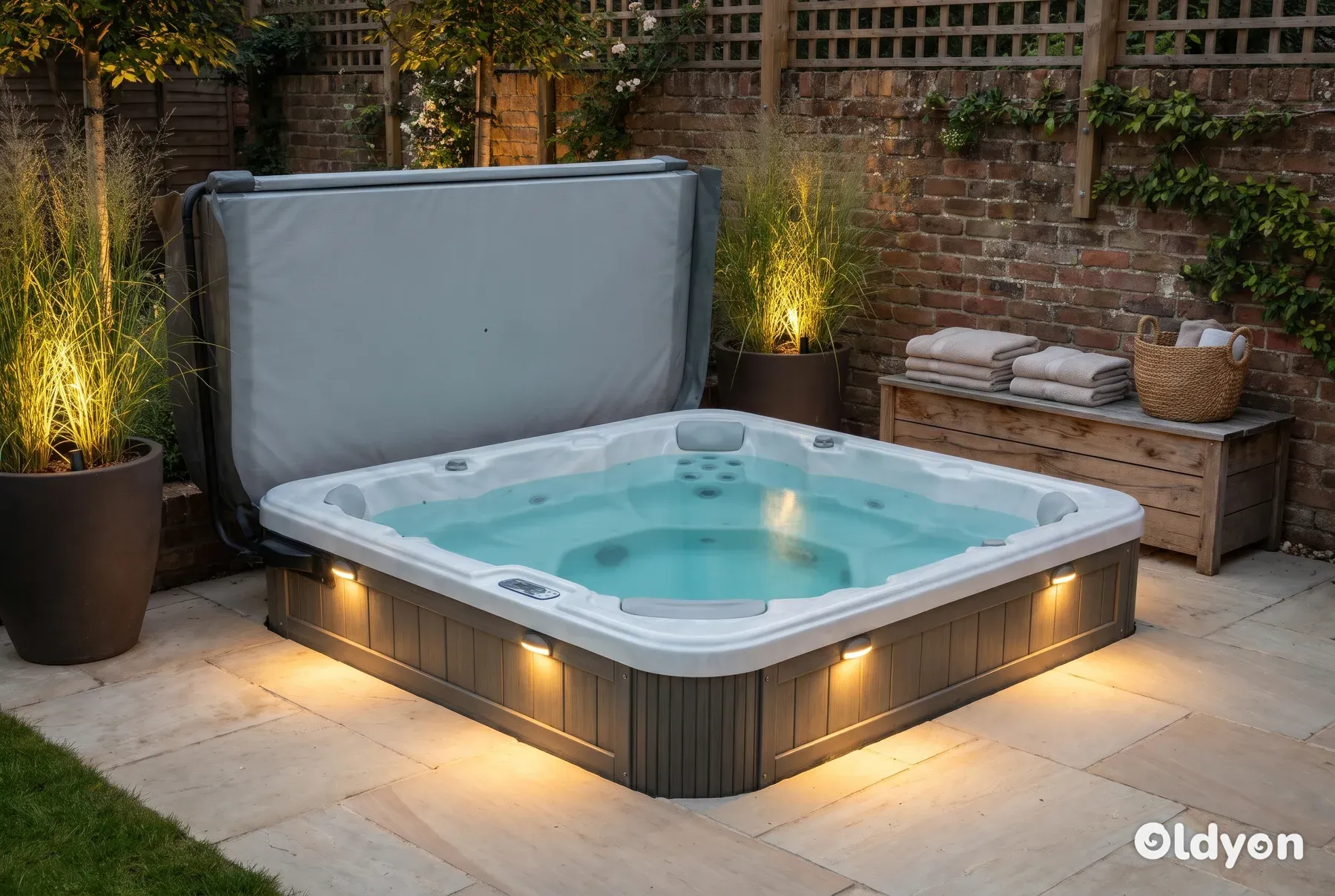
The best patio hot tub ideas start underneath the tub, not around it. First check that your paving and the ground below can carry the full weight of water, shell and bathers. Then plan the layout around cover lifting and service access. Lighting, planters, storage and an outdoor kitchen all come after that.
This guide works through each of those steps in order, from a simple weight check to safe outdoor lighting and sensible chemical storage. Where manufacturers give different advice, it says so. Your tub's manual always has the final word on base, clearances and electrics.
Can your patio take the weight of a hot tub?
Water weighs about 1 kg per litre. A tub holding 1,500 litres (about 400 US gallons) carries roughly 1,500 kg (3,300 lb) of water before you add the shell, the equipment and the people. A full tub of adults can add several hundred kilograms more.
That total often comes to well over two tonnes, sitting on a footprint of perhaps 4 to 5 square metres. It stays there day and night, all year. A patio laid for a table and chairs was not necessarily built for that.
How to estimate the load on your patio
- Find the dry weight and water capacity on your tub's specification sheet or in the manual.
- Add the water capacity in litres to the dry weight, counting each litre as 1 kg.
- Add about 80 kg for each seat to allow for bathers.
- Measure the footprint (length times width) in square metres.
- Divide the total weight by the footprint to get kilograms per square metre.
- Compare the result, and the type of base the manufacturer asks for, with what your patio is actually built on.
As a worked example, a tub with a dry weight of 350 kg, 1,500 litres of water and six seats comes to 350 + 1,500 + 480 = 2,330 kg. On a footprint of 2.2 m by 2.2 m (4.84 m²) that is about 480 kg per square metre. These are example figures only, so use the numbers for your own tub.
What kind of patio is strong enough?
Most manufacturers ask for a flat, level, solid base, and many specify a concrete slab around 100-150 mm (4-6 in) thick. Requirements differ between brands, so check your manual before you decide your existing patio is good enough.
Paving can work when the slabs sit on a full bed of mortar over a well-compacted sub-base. Slabs laid on sand, or on a few dots of mortar, often crack or sink unevenly under a full tub. Our guide on whether you can put a hot tub on paving slabs explains how to tell which you have.
If you already have a sound, level concrete patio, placing the tub on it is the cheapest way to start, because you avoid the cost of preparing a new base. Check its thickness and condition against your manual first.
Heavy-duty composite decking is another possible base, as long as the frame and footings beneath it are designed for the load. Around the tub, slip-resistant porcelain paving is a low-maintenance surface that copes well with splashes and treated water.
Level matters as much as strength. A slope puts the water line off and can stress the shell and cabinet over time. Check the base with a long spirit level in both directions before the tub arrives.
Base | Usually suitable? | Watch out for |
|---|---|---|
Reinforced concrete slab | Yes, the most common choice | Must be level and fully cured |
Paving on full mortar bed and compacted sub-base | Often, if your manual allows it | Hidden voids or a thin sub-base |
Paving on sand or dots of mortar | Rarely | Cracking, sinking, a tilted tub |
Compacted gravel with a plastic grid base | Some tubs, if the maker approves | Needs firm edging and full compaction |
Heavy-duty composite deck | Only on a frame built for the load | Joists, footings and maker approval |
Raised timber deck | Only if designed for the load | Joist spacing and footings |
Decking also needs care with smaller heavy items. Steps, bar furniture and full planters put concentrated loads on a few points, so check the joist spacing and load rating before you add them, and reinforce the joists where needed. If you are unsure, ask a structural engineer.
If you are not sure what your patio is built on, lift one slab where the tub will go and look. Sand directly under the slab, dots of mortar instead of a full bed, or soft soil close to the surface are all warning signs. For a raised deck, balcony or roof terrace, ask a structural engineer before filling a tub.
What layout works best for a patio hot tub?
Start with what the tub needs, then fit the furniture around it. A layout that looks good on paper but blocks the service panels or the cover will be frustrating to live with.
Clearances to plan for
- Space behind the tub for the cover lifter. Many lifters need roughly 45-60 cm (18-24 in), but the figure varies, so check the lifter's instructions.
- Access to the cabinet panels, especially on the equipment side, with room for a technician to kneel and work. Many manufacturers want every panel removable without moving the tub.
- A clear, non-slip path from the back door to the tub steps.
- Distance from overhanging trees, gutters and roof edges that drip or drop leaves into the water.
- Access to the drain valve and a sensible route for the water when you empty the tub.
- An isolator switch within sight of the tub but out of reach of anyone in the water, positioned by your electrician.
Zones that make the patio work
Think of the patio in three zones: a wet zone around the tub, a dry zone for seating and dining, and a clear path between them. Keep towels, robes and slippers at the edge of the wet zone so nobody drips across the dining table.
A tub close to the back door means a shorter, warmer walk in winter. A tub further out gives more privacy and a better view of the garden. Our guide on where to put a hot tub in your garden covers wind, sun, neighbours and access in more detail.
Making the tub part of the patio
Surround the tub with matching decking or paving, consistent furniture and coordinated lighting. The area then reads as one outdoor room rather than an appliance placed on a patio.
A semi-sunken installation, with the tub flush with or just above the surrounding decking, gives a built-in look and reduces the bulk neighbours see. Plan it with care, because you still need full access to the cabinet panels, the drain valve and good drainage around the tub.
Match the colour and finish of bars, steps and furniture to your tub cabinet and patio. Mismatched tones are the commonest look that jars. Grey and black suit modern porcelain or composite, while redwood or natural wood tones suit timber decks and traditional gardens.
Steps and surfaces
Hot tub steps with wide treads and a handrail make getting in and out safer, especially for older or less steady bathers. Choose steps that stand on the paving rather than hooking onto the cabinet, and check that the feet will not slide on wet stone.
Check that the steps suit the height of your tub cabinet and rim. Measure from the paving to the top of the rim before you buy. A step that is too low leaves a long stretch up to the edge, and one that is too high leaves you leaning awkwardly over it, and both are unsafe on wet treads.
Where you can, choose a multi-angle step design that works at different entry positions around the tub. You can then get in from the most convenient side without dragging the steps across wet paving to a new spot.
Check the load rating on any steps. Some standard plastic steps are rated only around 135-180 kg (300-400 lb), so choose heavy-duty steps rated well above your heaviest user, especially for anyone with limited mobility or a heavier frame.
Heavy-duty steps can be rated up to about 317 kg (700 lb), well above the 135-180 kg ratings of standard plastic steps. Look for that level of rating if anyone using the tub is heavy or has limited mobility.
Composite or poly-lumber steps with a brushed or textured non-slip surface need no maintenance and resist warping, rotting and cracking through wet winters and freeze-thaw cycles. Timber steps look warm but are more likely to suffer from all three.
A wide platform, with access from more than one side, removes awkward climbing. Some steps include a storage compartment, which keeps towels and slippers right at the tub edge.
Heavy-duty steps with a wide platform and storage have a larger footprint than basic plastic steps. Measure them before you buy and allow extra clearance around the tub, especially on a tight patio where they could block a path or a service panel.
If the tub sits at ground level with no real height difference, you may not need dedicated steps at all. On a raised deck, or with guests of different ages and mobility, good steps are an important safety item.
Wet paving can be slippery. Textured porcelain, riven sandstone and brushed concrete usually grip better than polished stone or smooth tiles. A drainage mat by the steps helps, but lift it regularly so the slabs underneath can dry and do not grow algae.
Patio hot tub ideas for small spaces
A small patio can still hold a comfortable tub if you plan every metre. The aim is to keep the tub easy to reach and service while leaving room to sit and dry off.
- Choose a two or three seat tub. It needs less floor space, holds less water and puts less load on the paving.
- Set the tub into a corner against two walls, but keep at least one long side and the equipment side clear for service access.
- Build a low timber or rendered surround with a flat top for drinks and towels, using removable panels so the cabinet can still be opened.
- Use a storage bench as seating, so towels, cushions and accessories have a home without adding more furniture.
- Go vertical with trellis, wall planters and climbers instead of large pots that take up floor space.
- Pick folding or stacking chairs that can be moved aside when you need to reach the tub.
For screening that uses little floor space, consider any of these options:
- Slatted cedar panels fixed to a wall or fence.
- Frosted glass balustrades on a raised patio or deck.
- A living wall of evergreen climbers such as ivy, trimmed back from the water.
- A freestanding bamboo screen that you can move when needed.
On a small patio, neighbours and windows are usually closer, so privacy matters more. Our article on hot tub privacy ideas for UK gardens covers screens, trellis and planting that suit tight spaces.
How should you light a hot tub patio safely?
Patio lighting has two jobs. The first is to let people walk to the tub, climb in and climb out safely after dark. The second is to make the space feel pleasant. Light the steps and path first, then add softer lighting for mood.
Lighting ideas that work around a tub
- Low step and path lights that show edges clearly without shining into people's eyes when they sit in the water.
- Uplights at the base of plants, walls or fence panels for a warm, indirect glow.
- Festoon lights strung across a pergola, kept well above head height and clear of the cover lifter.
- Solar stake lights where you cannot run a cable, accepting that they are dimmer and less reliable in winter.
- Warm white LEDs, around 2,700-3,000K, which feel softer at night than cool white.
- A timer or dimmer so the patio is not lit all night, which is kinder to neighbours and wildlife.
UK rules for outdoor electrical work
Water and electricity together carry a real risk of electric shock. In the UK, outdoor circuits should be designed and installed to BS 7671 (the IET Wiring Regulations) and protected by an RCD. Use a registered electrician for any new circuit and for any wiring near the tub.
In England and Wales, adding a new circuit is notifiable under Part P of the Building Regulations. A registered electrician can self-certify the work and give you a certificate. GOV.UK publishes Approved Document P, and Scotland, Northern Ireland and other European countries have their own rules.
Part P applies to fixed electrical work outdoors as well as indoors, including garden lighting, pumps and other powered features near water. Apart from simple solar or battery items, have any powered accessory installed by a registered competent electrician.
Low-voltage LED systems (12V or 24V) are a safer choice close to water, with the transformer mounted somewhere dry and away from splashes. Look for fittings rated at least IP65 for general outdoor use, and IP67 or IP68 for lights set into the ground where water can pool. The charity Electrical Safety First has clear advice on outdoor electrics.
Never run the hot tub or patio lights from an extension lead, even for a short time. Before cleaning, servicing or working near the tub, switch off at the isolator. Leave all wiring, sockets and lighting circuits to a registered electrician.
Which plants and planters suit a hot tub patio?
Plants soften hard paving and help with privacy, but anything that sheds near the water ends up in the filter. Keep planters a short step away from the tub edge and favour plants that hold on to their leaves.
- Evergreen grasses and sedges, which move in the wind but drop very little.
- Clumping bamboo in a large container for a tall green screen. Avoid planting running bamboo in the ground, because it spreads.
- Rosemary, thyme and other compact herbs for scent near seating.
- Climbers such as star jasmine on trellis for cover and a summer fragrance.
- Lavender for colour, placed away from the steps because it attracts bees.
- Avoid spiky plants beside paths and trees that drop fruit, petals or sap over the tub.
Large planters full of damp compost are heavy. On a patio that is rarely a problem, but on a deck place them over joists or near supports. Raise pots on feet so water drains away and does not stain the stone.
Choose pots labelled frost resistant, such as fibre clay, glazed stoneware or good-quality plastic. Unglazed terracotta can crack in a hard frost unless the maker says otherwise. Splashes of treated water can mark some leaves, so keep delicate plants out of the splash line.
Materials that cope with British weather
Planters, furniture and accessories around a tub face rain, summer UV, freeze-thaw cycles and, on the coast, salt air. Look for items described as waterproof, UV-stabilised and rust-resistant, such as resin, composite or powder-coated metal. Powder coating usually resists rust better than painted steel.
Natural materials such as bamboo and redwood look good but need oiling or sealing from time to time. Redwood tones can also fade in strong sun, especially on a south-facing patio, so allow for that maintenance when you choose.
Where should you keep chemicals, towels and the cover?
Chemicals
- Keep every product in its original container with the lid closed tightly.
- Store in a cool, dry place out of direct sun, following the storage instructions on the label.
- Keep chlorine or bromine products apart from pH decreaser and other acids, and never mix chemicals together.
- Lock them away from children and pets.
- Keep them well away from barbecues, gas bottles and other sources of heat.
- Use a clean, dry scoop for each product, and add chemicals to water, never water to chemicals.
A ventilated, lockable outdoor cabinet in shade is a better home for chemicals than a sealed plastic deck box in full sun, which can get very hot inside. If you have a shed or garage, a high, locked shelf there also works.
Floating tablet dispensers
A floating or collapsible dispenser holding 2.5 cm (1 in) chlorine or bromine tablets releases sanitiser steadily in small or inflatable tubs, so you do not need to dose every day. It will not keep up with larger permanent tubs that hold more water, and it will not take 7.5 cm (3 in) tablets.
A small collapsible dispenser typically holds only about 5 tablets of 2.5 cm (1 in) size. Adjustable vents at the base let you control how quickly the tablets dissolve and release sanitiser. Start with the vents partly open, test the water over the next few days and adjust from there.
A collapsible dispenser folds flat when not in use, which makes it easy to store between treatments in a small garden. Rinse it in clean water, let it dry and keep it with your other sanitiser products, away from acids.
Compact dispensers take either chlorine or bromine tablets, as long as you never mix the two. Your choice can come down to skin sensitivity and your water chemistry, because some bathers find one gentler than the other. Check your manual for which sanitiser your tub's maker recommends.
Some manufacturers advise against floating dispensers, so check your manual first. Use only one type of sanitiser in a dispenser, never mix chlorine and bromine tablets, and keep testing the water to stay within 3-5 ppm of free chlorine or bromine.
Towels, robes and accessories
A storage bench with a lid beside the tub doubles as seating and keeps towels dry. Hooks under a pergola or a freestanding towel rail give robes somewhere to hang. Our guide to hot tub accessories worth buying covers steps, cover lifters and side trays in more detail.
The cover
Plan where the cover goes when the tub is open. A lifter keeps it off the ground, but without one you need a clean, flat area where it can lie without being dragged over rough paving. Never sit or stand on the cover, and keep it locked when the tub is not in use.
Weatherproof accessories and a good-quality cover are among the most effective ways to reduce the ongoing maintenance costs of owning a hot tub. A well-fitting cover holds in heat and keeps leaves and rain out of the water, and accessories that resist the weather need replacing less often.
Patio hot tub accessories for use in the tub
An in-tub tray that sits on the rim can hold a drink, a phone and a candle, so you do not have to reach out of the water. Choose one with a non-slip base so it stays put when people move.
Measure your rim width before you buy. Many rim trays only fit square or rectangular tubs and will not sit securely on a round or oval rim.
A tray of around 40 x 21 cm (16 x 8 in) is compact enough to take up only one corner of the rim while still holding drinks, snacks and a phone. That leaves the rest of the edge free for people to lean on or climb in and out.
A rim tray with a non-slip base can also work as a small side table when you are out of the tub. Depending on the design, you can clamp it onto the corner of a balcony railing or rest it on the edge or arm of a sofa, so it still earns its place between soaks.
If you want to stream music or video while you soak, choose a tray with an adjustable, rotatable phone or tablet holder. You can then angle the screen to suit sitting upright or reclining. Keep the device in a waterproof case, and keep chargers and cables away from the tub.
A varnished bamboo tray is easy to keep clean. Wipe it over with a damp cloth after use, let it dry before you put it away, and renew the varnish if the surface starts to look dull or rough.
Can you pair a hot tub with an outdoor kitchen or bar?
Yes, and it can work very well. The trick is to keep heat, smoke, glass and extra electrics separate from the tub while still making it easy to pass a drink across.
- Place the barbecue or pizza oven downwind of the tub, and at the distance from structures that the cooker's manufacturer gives. Smoke and ash dirty the water and mark the cover.
- Keep gas bottles outdoors in open air and away from your chemical storage.
- Use plastic or acrylic drinkware near the tub. Broken glass in the water usually means draining and cleaning the whole tub.
- Add a bar counter or side tray at the height of the tub edge, so drinks and snacks stay out of the water.
- Put any outdoor fridge, sockets or kitchen lighting on a suitable RCD-protected circuit installed by a registered electrician.
- Keep food and crumbs away from the water, because they feed bacteria and clog the filter.
Set the kitchen in the dry zone of your layout, with the bar or counter forming the link to the wet zone. A pergola over both can tie them together visually and give a place to hang lighting.
Choosing a bar beside the tub
A bar works best when its height lines up with the tub rim and the seating, so people sitting outside can talk at eye level with those in the water. Measure the rim height and your stools before you buy.
Freestanding resin bar sets that snap together without hardware avoid drilling into slabs, porcelain or a timber deck. That suits patios where drilling would need special bits, plugs and care to avoid cracking.
A bar with matching stools gives more surface and seating if you entertain often. A single bar with no stools suits a compact patio where you already have chairs. Choose according to how many people you usually host.
Dark grey finishes can show water marks and limescale, especially in hard-water areas. Wipe the bar down after each use to keep it looking clean.
Go easy on alcohol in the tub. Hot water and alcohol together can make people feel dizzy or faint. Keep the water no hotter than 40°C (104°F), and make sure everyone has water to drink.
Do you need a shelter over a patio hot tub?
You do not need one, but in a British climate a shelter makes the tub far more usable. It keeps rain and leaves off, adds privacy from upstairs windows and gives you somewhere to fix lights and hooks.
- A timber or aluminium pergola with a louvred or polycarbonate roof, which you can open in good weather.
- A bioclimatic aluminium pergola, whose louvred roof opens and closes quickly to suit sun or rain.
- A permanent hardtop timber gazebo for robust protection all year round.
- A gazebo designed for hot tubs, with enough height for the cover lifter.
- A shade sail for summer sun, accepting that it will not keep off heavy rain.
- A pergola with side screens or trellis on one or two sides for privacy without closing it in.
A well-sheltered patio also helps your accessories last noticeably longer. A gazebo or pergola over the tub keeps rain and strong sun off bars, trays, steps and other items, which slows fading, warping and wear.
On an exposed patio, side screens on a pergola or gazebo cut wind chill, which makes winter soaks more comfortable and helps the tub hold its heat.
Leave plenty of headroom and keep at least two sides open so steam can escape. Fix posts into concrete footings or onto a solid slab using the method the maker specifies, because wind can lift a roofed structure. Do not bolt posts onto slabs laid on sand.
Many garden structures in England fall under permitted development, but height, closeness to a boundary, listed buildings and conservation areas can all change that. Check with your local planning authority before you build. If your patio is too small, sloping or weak for a tub, a raised deck may suit better, and our guide to hot tub decking ideas that suit UK gardens explains the options.
Summary
Plan a patio hot tub from the ground up. Check the base first, then design the layout, and only then add lighting, plants, storage and cooking areas.
- Work out the full weight and compare it with your base and the manufacturer's requirements.
- Leave space for the cover lifter, service panels, drain valve and a safe path.
- Choose steps rated well above your heaviest user, in a weatherproof material with a non-slip surface, at the right height for your rim, and allow room for their footprint.
- Light the steps and path first, using low-voltage fittings and a registered electrician.
- Choose plants that hold their leaves and keep pots out of the splash line.
- Pick UV-stabilised, rust-resistant materials and match colours to your tub and patio.
- Store chemicals locked, dry, shaded and away from heat and each other.
- Keep barbecues downwind, glass away from the water and the bar level with the tub rim.
- Use a good cover, weatherproof accessories and a shelter to keep maintenance costs down.
Frequently asked questions
What are some budget-friendly patio hot tub ideas?
Start with what you have. Solar step lights, solar fairy lights or solar LED deck lights add evening atmosphere without new wiring. Large pots of evergreen grasses, ornamental grasses or bamboo give cheap screening, and a drainage mat helps by the steps. Together these can cost roughly £50-£200. A storage bench gives seating and towel storage in one. Spend the rest on a sound base and safe wiring, which are expensive to fix later.
Can I leave hot tub accessories outside in winter?
Steps, cover lifters and plastic side trays are made for outdoor use, though wiping them down and checking fixings before winter helps them last. Bring cushions, towels and fabric robes indoors. Chemicals should stay in a dry, frost-free spot as the label directs. Check that solar lights and planters are rated for frost, and lift mats so the paving can dry.
Which accessories can stay outside all year, and which should I store?
Resin, composite and powder-coated aluminium accessories can usually stay outside year-round. Wooden and bamboo items, such as trays, bars or steps, are better stored in a shed or garage during harsh weather to prevent moisture damage. If they must stay out, keep them oiled or sealed as the maker advises and raise them off wet paving.
How far from the house should a patio hot tub be?
There is no single required distance. Think about the walk in cold weather, privacy from neighbours, drips from roof edges and where the electrical supply can run. Your electrician will decide where the isolator and cable route go, and your manual may give minimum clearances from walls. Many owners settle on a spot a few steps from the back door with a covered path.
Can I put a hot tub on my existing patio?
Often you can, if the slabs sit on a full mortar bed over a compacted sub-base and the area is level. Patios laid on sand or dots of mortar may crack or sink under the weight. Lift a slab to check what is underneath, compare it with your manual, and lay a concrete pad if the existing base falls short.
Do I need planning permission for a hot tub on a patio?
A freestanding hot tub on a garden patio usually does not need planning permission in England, but a shelter, raised deck or large structure around it might. Listed buildings, conservation areas, flats and properties with restrictive covenants can have extra rules. Check with your local planning authority, and remember that Scotland, Wales, Northern Ireland and other countries have their own systems.
Which way should a patio hot tub face?
Face the seats towards the best view in the garden and away from neighbours' windows where you can. Think about the evening sun if you use the tub after work, and about the prevailing wind, which in much of the UK comes from the south-west. Keep the equipment side accessible and the cover lifter side clear of walls and furniture.
Filed under