Intex PureSpa Plus range explained for UK buyers
Intex PureSpa Plus explained for UK buyers: how many a six seater really fits, what a 13 amp supply means for heating, and what to check in the box.
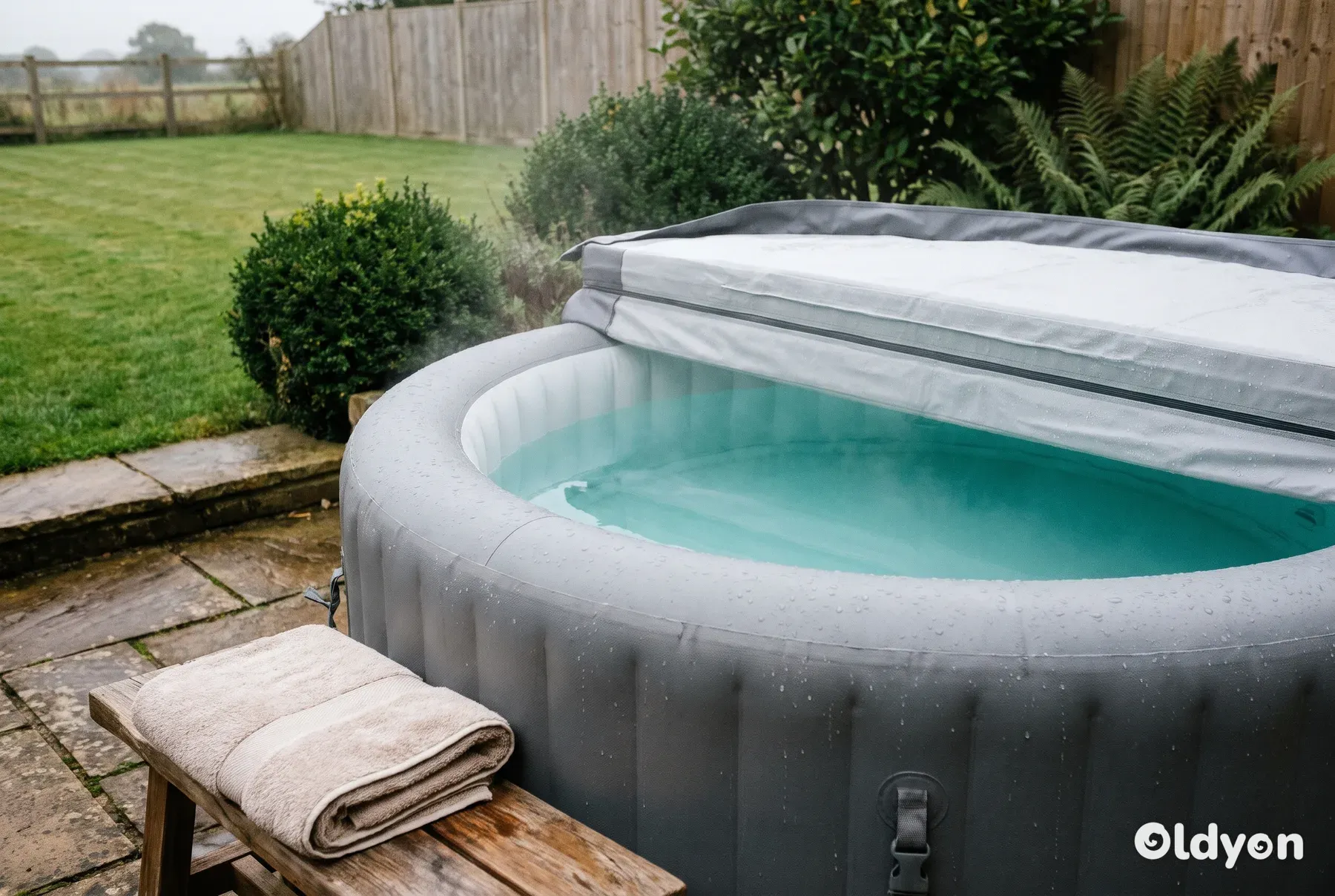
The Intex PureSpa Plus range is a family of round inflatable hot tubs that run from a standard 13 amp socket. A six seater suits four adults comfortably and six only for short, sociable soaks. Heating is slow because the plug limits the power available, and the box holds most of what you need to start.
Check every figure in this guide against Intex's own specification sheet or manual for the exact model you are looking at, because details can change between production years and regions. Where a number matters, this guide tells you where to find it and how to read it.
What is the Intex PureSpa Plus range?
Intex is a large manufacturer of inflatable pools and spas, and PureSpa is the name of its hot tub line. The Plus models share one basic design: a reinforced inflatable wall, an insulated cover and a control base that holds the pump, heater, air blower and filter in a single unit.
Models in the range differ mainly in size, wall finish and the extras in the box. A colour or finish name is cosmetic. What changes your experience is the inside diameter, the features of the control unit and the water capacity.
Finish colour does affect how the tub looks over time, though. A white wall tends to show marks from chemical residue and weather sooner than a darker grey or wood-effect finish, so choose a darker finish if you want the tub to look tidy with less cleaning.
The range is marketed with a built-in hard water treatment system, air bubble jets and a maximum water temperature of 40°C (104°F). Confirm that the listing you are reading names these features, because older stock and versions sold in other regions can differ.
The Plus range is listed with a wireless control panel. It lets you set the water temperature anywhere from about 20°C (68°F) up to the 40°C maximum, and switch the heater, filter and bubbles on or off without leaning over the control base.
Compare the bundles, not just the price
The same tub is often sold in several bundles that differ only in their extras. Some include two or four cushioned foam headrests that clip to the wall for neck support. Others add clip-on cup holders or refreshment trays.
In the current six person Plus line-up, the finish usually decides the extras. The Greywood (tan) finish is sold with two headrests plus a four-pack of clip-on cup holders and refreshment trays. The white finish comes with four cushioned foam headrests and no trays. Check the contents list, as bundles can change.
If you prefer the white bundle but still want somewhere to put drinks, compatible clip-on cup holders and refreshment trays are sold separately. Add their cost to the price of the white bundle before you compare it with the Greywood bundle, which already includes them. Check that any accessory you buy is listed as compatible with your model.
Match the headrest count to the number of people who usually soak together. A four-headrest bundle gives every main seating position neck support at the same time, while a two-headrest bundle leaves some seats without it.
The clip-on refreshment trays sold in some bundles typically hold two standard drink cans or bottles each, plus an open area for snacks or small personal items. Use plastic cups rather than glass near the tub, because broken glass is very hard to find in water.
Two listings with different prices may contain the same tub with different accessories. Compare the full contents list of each bundle, and decide which extras you would actually use, before you compare prices.
If you are still deciding which kind of tub to buy, our guide on how to choose the best inflatable hot tub covers the wider market and the questions to ask before you compare brands.
How many people does a round six seater really fit?
The person count on the box comes from the overall size of the tub, not from how many adults can sit with room to stretch out. A round inflatable tub has no moulded seats, so everyone sits on the floor with their back against the wall and their legs pointing towards the centre.
The six seater holds about 1,098 litres, which is a large volume for a tub of 216 cm (85 inches) across. As a result, the water sits higher on your body than in shallower entry-level tubs. Seated positions feel deeper, and the bubble jets work closer to the waterline, where your shoulders and upper back are.
Outside diameter and inside diameter
Intex lists two diameters for each model. The outside diameter tells you how much ground the tub needs. The inside diameter tells you how much room bathers actually get.
The inside figure is noticeably smaller because the inflated wall is thick. When you compare tubs, always compare inside diameters, since two tubs with similar outside sizes can have different wall thicknesses.
Test the space at home
- Find the inside diameter for the model on Intex's specification sheet or the product listing.
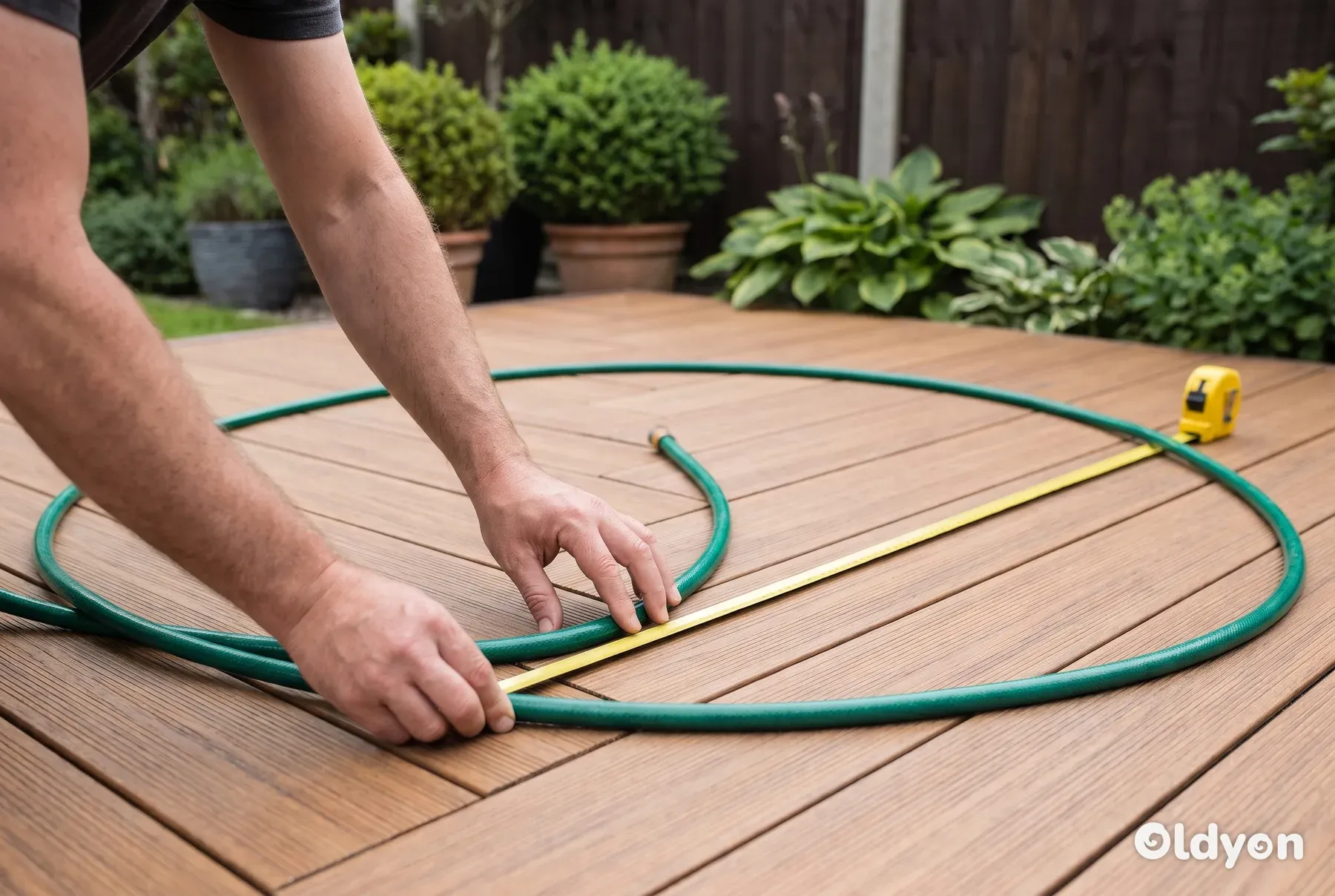
- Mark a circle of that diameter on the floor or lawn with a garden hose, string or chalk.
- Sit inside the circle with your back to the edge and your knees bent, as you would in the tub.
- Add family members one at a time and note when feet start to overlap in the middle.
- Decide how many people you would be happy sitting with for 15 to 20 minutes, not just for a photograph.
A realistic way to think about seating
- Two to four adults: usually comfortable, with room to stretch your legs.
- Five adults: workable if everyone is happy to sit close together.
- Six adults: possible for short soaks, but legs will touch in the middle.
- Adults with children: six people is far more realistic when some are smaller.
More people also raises the water level. The manual shows a maximum fill line, so fill with your usual number of bathers in mind to avoid water spilling over the wall and soaking the ground under the tub.
If you regularly expect six or more adults, compare the inside diameter of larger tubs too. Our article on 8 person inflatable hot tubs and their real capacity applies the same sizing method to bigger models.
What does a 13 amp supply mean for heating?
A UK 13 amp socket on a 230 volt supply can deliver about 3 kW at most (13 amps multiplied by 230 volts is 2,990 watts). The heater, filter pump and air blower all have to share that limit.
Because of this, plug-in tubs use modest heaters, and many cannot run the heater and the bubble blower together at full power. Some pause heating while the bubbles are on. Your manual explains exactly how your control unit behaves, so read that section before your first soak.
For a wider comparison of tubs that run from an ordinary socket, see our guide on how to choose a 13 amp plug and play hot tub.
How long will the first heat up take?
Before heating starts, the tub has to be filled. To estimate filling time, divide the water capacity by the flow rate of your hose. For example, about 1,100 litres at 15 litres per minute (about 4 US gallons per minute) takes roughly 75 minutes.
To find your hose flow rate, time how long it takes to fill a bucket of known size, such as 10 litres, and work out the litres per minute. Water pressure varies between homes, so this simple check is more reliable than a general figure.
Intex publishes an approximate heating rate, in degrees per hour, in the manual and product specification. Treat it as a guide measured with the cover on and in mild weather, not a promise for a cold British spring.
For the six person PureSpa Plus, Intex quotes a heating rate of roughly 0.5-1°C (1-2°F) per hour. Heating from a fill of about 16°C (60°F) to the 40°C maximum therefore takes roughly 22 to 44 hours, depending on the air temperature and whether the cover stays on.
You can make your own estimate. Subtract the temperature of your fill water from your target temperature, then divide by the heating rate. For example, if tap water arrives at 10°C (50°F) and you want 38°C (100°F), the water needs to rise by 28 degrees. At a rate of about 1°C per hour, that would take more than a day.
Cold air, wind, a missing cover and running the bubbles will all slow heating down. Fill the tub in the morning, put the cover on straight away and plan your first soak for the following day.
How to estimate running costs
Electricity use depends on the heater rating, how many hours it runs, the outdoor temperature and how well the tub keeps its heat. The heater rating in kilowatts is printed on the specification sheet and on the label of the control unit.
A 2 kW heater running for one hour uses 2 kWh. Multiply the rating by the hours of heating, then by the unit price on your electricity bill, to estimate the cost. Expect a clear rise in winter, when the heater works hardest.
Inflatable walls insulate less well than the cabinet of a hard shell tub. In cold weather, an inflatable tub therefore usually costs more to run each month than a hard shell tub, because its heater has to replace lost heat more often.
A cover that fits well, a sheltered position out of the wind and an insulated mat under the tub reduce heat loss more than any other change. Keeping the water at a steady temperature is usually cheaper than letting it cool fully and reheating from cold.
Using the 13 amp plug safely
Plug the tub directly into a suitable outdoor socket. Intex manuals warn against extension leads, because a long or coiled lead can overheat and connections left on the ground can get wet.
The UK plug supplied with Intex tubs normally includes a built-in residual current device (RCD). Press its test button as the manual describes, and stop using the tub if the device does not trip and reset correctly.
In the UK, any new outdoor socket or circuit should be installed by a registered electrician to BS 7671, with RCD protection. In England and Wales the work may be notifiable under Part P of the Building Regulations. Other countries have their own wiring rules. The charity Electrical Safety First has clear guidance on outdoor electrics and on finding a registered electrician.
Never run a hot tub from an extension lead, a cable reel or a multi-way adaptor. If you do not already have a weatherproof outdoor socket close enough to the tub, ask a registered electrician to fit one before the tub arrives.
If the tub trips the RCD or stops heating more than once, read our guide on what to check when an Intex hot tub keeps shutting off before you call for help.
What should you check on the box before buying an Intex PureSpa Plus?
The box and the product listing tell you most of what you need to compare models. Read both closely, because two tubs that look the same in photographs can differ in their control features and accessories.
Specification | What it tells you | Why it matters |
|---|---|---|
Outside diameter | Ground space needed | Leave room to walk round and lift the cover |
Inside diameter | Space for bathers | A better guide to seating than the person count |
Water capacity | Litres at the fill line | Affects heating time and chemical doses |
Heater rating | Power used when heating | Sets heating speed and running costs |
Heating rate | Approximate degrees per hour | Lets you plan the first heat up |
Bubble outlets | Number of air holes | A rough guide to bubble coverage only |
Plug and voltage | Supply the unit expects | Must be a UK 230 volt version with a UK plug |
Model number | Exact version and year | Confirms you are not buying older stock |
Starting figures for the six seater
The six person PureSpa Plus round model is listed with an outside diameter of about 216 cm (85 inches) and a water capacity of about 1,098 litres (290 US gallons). Use these as starting figures, then confirm them on the specification sheet for the exact model number you are buying.
The six person Plus model is listed with 170 bubble jets around the inside wall. Earlier and entry level PureSpa models usually list about 140. If a listing shows a lower jet count, check the model number to make sure you are not buying an older version.
What usually comes in the box
Intex lists the contents in the manual and on the packaging, and they can vary between versions. A PureSpa Plus box typically includes the following items.
- The inflatable tub itself.
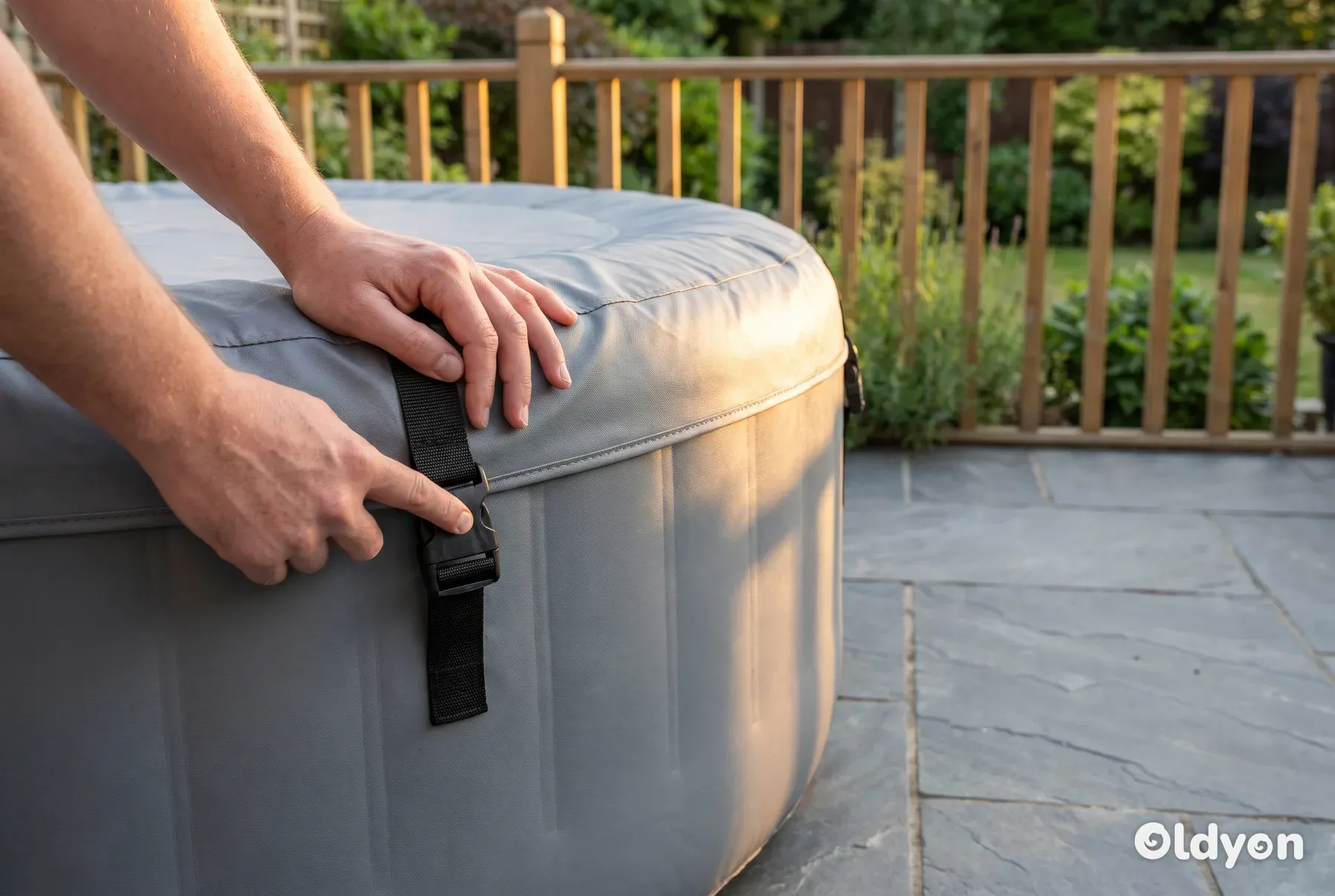
- An insulated cover with locking clips or straps.
- The control base, which holds the heater, pump, air blower and filter housing.
- Filter cartridges, usually two.
- An inflation hose that connects to the control base.
- A multi-colour LED light.
- A storage bag for packing the tub away.
- On some versions, cushioned headrests.
- On many versions, a chemical floater, test strips and a ground cloth.
Check the contents against the list before you throw away any packaging. Count the filter cartridges and note the filter type, because you will need spares sooner than you expect and the wrong size will not seal properly.
Check the space you need
The outside diameter is only part of the space the tub needs. Allow extra room outside the wall for the control unit, plus enough space to walk all the way round the tub and lift the cover.
For the six seater, that means a clear area of roughly 3 m by 3 m (about 10 by 10 feet). Measure your chosen spot before you buy, and check that the socket and a drainage point are within reach.
Check the weight and the base
A filled tub with people in it is very heavy. The manual gives the filled weight, so check that your patio, slab or base can carry it and that the surface is flat and level.
Do not place a filled tub on a balcony, a roof or raised decking unless a structural engineer has confirmed that it can take the load. Sharp stones, roots and uneven paving can also damage the floor of an inflatable tub over time.
Always lay the supplied thermal ground cloth under the tub, on a flat, non-slip surface. It protects the floor of the tub from wear and reduces the heat lost into the ground.
How does the hard water treatment system work, and is it enough?
The PureSpa Plus range is marketed with a built-in hard water treatment system designed to reduce limescale on the heater and inside the plumbing. Many parts of England, especially the south and east, have hard water, so this is a helpful feature for UK owners.
Water is called hard when it carries a lot of dissolved calcium and magnesium. When the water is heated, these minerals come out of solution and form scale. The built-in treatment system is meant to reduce that scale on the heating element, where it does the most harm.
Scale from hard water is a common cause of heater and pump failure in long-term use. That is why the hard water system and regular filter care matter so much for the life of the control unit, which is usually the most expensive part to replace.
It does not replace testing and balancing your water. You still need to keep the water sanitised and its chemistry in range. Widely accepted targets for hot tubs are listed below.
- Free chlorine: 3-5 ppm, or bromine 3-5 ppm if you use bromine instead.
- pH: 7.2-7.6.
- Total alkalinity: 80-120 ppm.
- Calcium hardness: 150-250 ppm.
Intex's manual may give slightly different ranges or recommend particular products. Where they differ, follow the manual so that you stay within the warranty terms, and ask a pool and spa supplier if you are unsure.
Balancing the water after the first fill
- Fill the tub to the marked line with a clean filter cartridge fitted.
- Switch on the filter pump and let the water circulate for at least an hour.
- Test the water with fresh test strips or a liquid test kit.
- Adjust total alkalinity first, because it helps hold the pH steady.
- Adjust the pH into the 7.2-7.6 range.
- Add sanitiser until free chlorine or bromine reads 3-5 ppm.
- Retest before anyone gets in, and test again before each soak.
Clean water also protects your health. Warm water can allow bacteria such as Legionella to grow if the sanitiser level falls too low. The Health and Safety Executive explains the risk; for home owners, the message is to keep sanitiser in range, clean the filter often and change the water regularly.
Is an inflatable hot tub durable enough for long-term use?
Inflatable tubs are designed to be portable and affordable, and they generally have a shorter working life than a hard shell tub. How long yours lasts depends much more on care than on the model you choose.
The Plus walls use Intex's Fiber-Tech construction. Internal fibres make the inflated wall stiffer, so it flexes less when people lean on it. The outer skin is a puncture resistant three-ply laminated material, which helps the wall stand up to everyday knocks.
- Set the tub on a flat, level base free of stones and sharp edges.
- Check the wall pressure regularly and top it up as the manual describes.
- Keep the cover on and locked whenever the tub is not in use.
- Keep the water balanced, because high sanitiser levels and low pH can damage the material and seals.
- Rinse filter cartridges often and replace them when they are worn or torn.
- Keep pets, garden tools and sharp objects away from the wall.
- If you will not use the tub in winter, drain, clean, dry and store it indoors as the manual instructs.
What the E90 error code means
On Intex spas, the E90 error code means water flow is restricted. The usual causes are a clogged filter cartridge or a pump inlet narrowed by scale.
- Switch off at the plug before you touch the filter housing.
- Remove the filter cartridge and rinse it thoroughly, or fit a new one if it is worn.
- Check the inlet and outlet screens for debris or scale.
- Refit the cartridge, switch on and check whether the code clears.
- Test the calcium hardness and keep it in range to stop scale coming back.
Cleaning or replacing the cartridge and keeping calcium in range clears most cases. If the code returns straight away, contact Intex support or your retailer rather than opening the control unit.
Warranty terms differ between the tub and the control unit, and they can vary by country and retailer. Read them before you buy and keep your proof of purchase somewhere safe.
If you are weighing a longer lifespan against a lower price, our article comparing inflatable and hard shell hot tubs sets out the trade-offs honestly.
What safety checks should you do before your first soak?
- Keep the water at or below 40°C (104°F), and use a lower temperature for children.
- Never try to modify or bypass the thermostat or heater to go above 40°C, because hotter water risks overheating the body.
- Keep soaks short at first, especially at higher temperatures.
- Always supervise children, and lock the cover when the tub is not in use.
- If young children live in or visit the home, consider a fence or barrier around the tub as well as a locked cover.
- Do not use the tub after drinking alcohol.
- Check that the RCD on the plug works before use.
- If you are pregnant, speak to your midwife first. The NHS advises avoiding getting too hot during pregnancy.
- If you have a heart condition, high or low blood pressure, or take regular medication, ask your GP or pharmacist before using a hot tub.
If you feel dizzy, sick, faint or uncomfortably hot, stop and get out slowly. Sit somewhere cool and drink some water. If the symptoms do not settle quickly, contact your GP or NHS 111.
What mistakes should you avoid when buying?
- Choosing by the person count alone instead of comparing inside diameters.
- Expecting the tub to be ready to use on the day it arrives.
- Forgetting the ongoing costs of chemicals, test strips, filters and electricity.
- Setting the tub on grass, gravel or uneven paving without a proper base.
- Planning to use an extension lead instead of a suitable outdoor socket.
- Buying an imported version without checking that it has a UK plug and is rated for 230 volts.
- Comparing bundle prices without checking which accessories each one includes.
Inflatable tubs like the PureSpa Plus sit in the lower price band of the hot tub market, usually a few hundred pounds depending on size and extras. Allow a separate budget for a base, a test kit, spare filters and chemicals, and for an electrician if you need a new outdoor socket.
Summary
The PureSpa Plus range offers round inflatable tubs that run from a 13 amp socket. A six seater is comfortable for four adults and workable for six on short soaks, so check the inside diameter rather than the number on the box.
The 13 amp supply limits heater power, so the first heat up takes many hours and running costs rise in cold weather. Use a suitable outdoor socket, never an extension lead, and keep the water balanced even with the hard water system. Confirm every figure on Intex's own specification sheet before you buy.
Frequently asked questions
Can I keep using an Intex PureSpa Plus through a UK winter?
Some owners do, but heating takes longer and costs more in cold weather. Intex's manual sets a minimum outdoor temperature for using the tub, and this varies between versions, so check yours. If you plan winter use, keep the cover locked, shelter the tub from wind and never let the water freeze. If you will not use it, drain, dry and store it indoors.
Can I use a salt water system with the PureSpa Plus?
Intex makes a salt water system for its spas, and some PureSpa models are listed as compatible with it. Compatibility depends on the model and the control unit, so check the manual or Intex's official compatibility list first. A salt system still makes chlorine, so you need to test the water and keep free chlorine, pH and alkalinity in the normal ranges.
How often should I clean and replace the filter?
Rinse the filter cartridge with a garden hose every few days when the tub is in regular use, and more often after busy soaks. Replace it when the pleats are torn, flattened or will not come clean. Intex's manual gives its own schedule, so follow that for your model. Keeping a spare cartridge means you can swap one in while the other dries.
How often should I change the water?
It depends on how many people use the tub, how often and how well you keep the water balanced. Many owners change the water every one to three months. Change it sooner if the water stays cloudy, smells strongly or will not hold its sanitiser level despite testing and adjusting. Check the manual for Intex's own recommendation and for safe draining instructions.
Can I set up an Intex PureSpa Plus indoors?
It is possible, but think carefully first. A filled tub is very heavy, so a structural engineer should confirm the floor can carry it. Warm water releases a lot of moisture, which can cause condensation and mould without good ventilation. You also need a safe socket, a waterproof floor and a way to drain the tub. Check Intex's manual for its guidance on indoor use.
Will a PureSpa Plus bought outside the UK work at home?
Not always. Versions sold in other regions may be built for a different voltage or come with a different plug and safety device. Never use a travel adaptor or rewire the plug yourself. Buy a version specified for UK 230 volt supplies with a UK plug, and check that the warranty is valid in the country where you will use the tub.
Filed under