Hot tub tips for beginners in the first month
Hot tub tips for beginners covering the first fill, house rules, cover care, safe temperatures, a simple routine and what is normal in your first month.
The best hot tub tips for beginners are simple: fill through the filter, heat slowly with the cover on, keep the water no hotter than 40°C (104°F), agree a few house rules, handle the cover with care and follow a short weekly routine. Most odd noises, smells and foam in the first month are normal and easy to fix.
This guide covers the parts of ownership that chemistry guides tend to skip. You will find a step-by-step first fill, sensible temperatures, rules for family and guests, cover handling, a routine you can actually keep, and a clear list of what is normal and what needs a technician.
What should you check before the first fill?
A few minutes of checks before the water goes in saves a lot of trouble later. Most first-fill problems come from a missed drain valve, a loose pipe union or a filter left in its packaging.
- The hot tub sits on a flat, level base that can carry its full weight when filled with water and people.
- The power is switched off at the isolator, and the installation has been signed off by a qualified electrician.
- The drain valve is closed and its cap is on.
- Any pipe unions under the side panels are hand tight (some arrive loose after shipping).
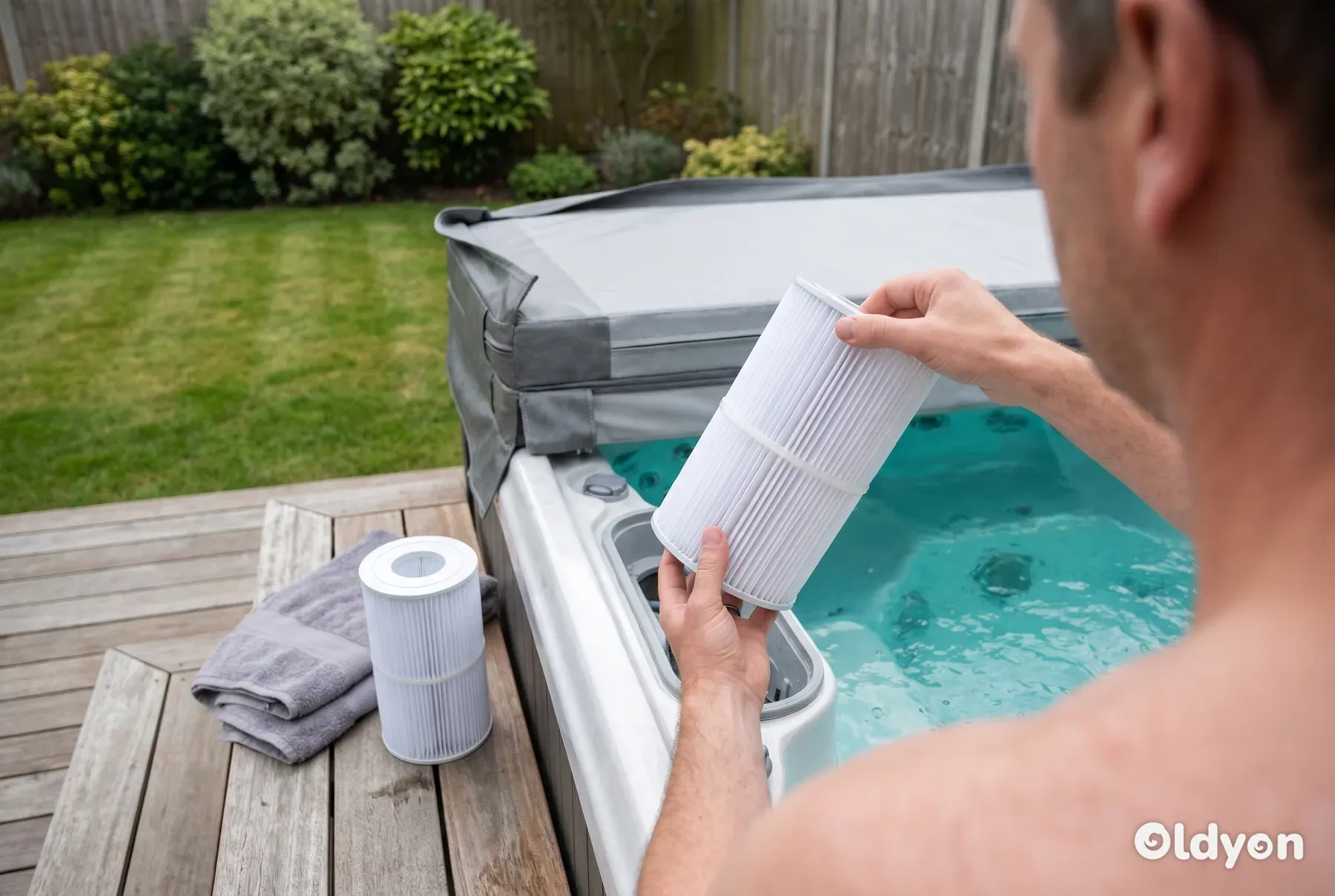
- The filter cartridges are unwrapped, rinsed and fitted in their housings.
- Your garden hose reaches the tub and is clean inside. Run it for a minute first to flush out stale water.
- Your hose does not have brass fittings. Brass can release metals into the water, which can later stain the shell and upset the chemical balance. Plastic fittings are a safer choice.
- You have test strips or a test kit, a sanitiser (chlorine or bromine), pH and alkalinity adjusters and a non-chlorine shock (oxidiser) ready.
- A metal sequestrant (stain preventer) is in your starter kit, so it is ready to add as soon as the tub is full.
Wipe the shell with a soft cloth and plain water to remove dust from delivery. Do not use household cleaners, washing-up liquid or glass spray, because they leave residues that cause foam and can damage the acrylic.
Base and weight
A filled hot tub with people in it can weigh roughly 1,400 to 2,700 kg (about 3,100 to 6,000 lb). A deck or patio must be rated to carry that load. If you are not sure that yours is, ask a structural engineer before you fill.
As a general guide, a deck, patio or concrete slab under a hot tub should be rated for at least about 490 kg per square metre (100 lb per square foot). Give that figure to whoever checks or builds the base, along with the filled weight from your manual.
The base should be level to within about 1 cm (about 0.4 in) across the whole tub. An uneven base puts stress on the shell and frame, and over time that can cause cracks and leaks. Check it with a long spirit level in both directions.
Power supply
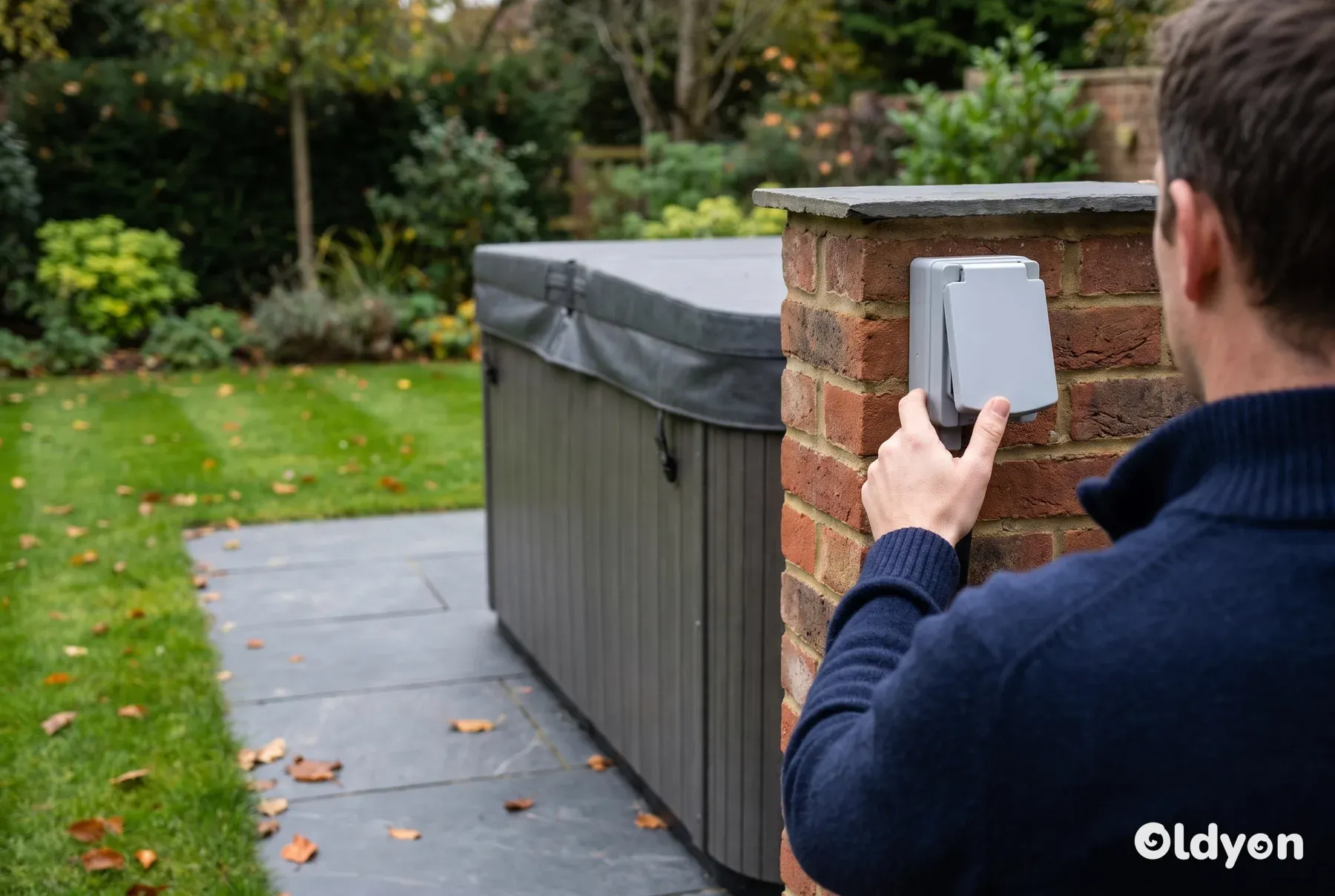
Never power a hot tub through an extension lead. It needs its own dedicated circuit with RCD protection. In the UK the work must meet BS 7671 and should be done by a registered electrician, and in England and Wales it is notifiable under Part P of the Building Regulations. Other countries have their own rules, so use a qualified local electrician. The Electrical Safety First charity has general advice on outdoor electrics.
Space and access
Leave about 90 cm (about 3 ft) of clear space around the tub so you can open the side panels and reach the filter for maintenance. If you plan to use a cover lifter, allow extra room behind the tub for the cover to swing back.
Water and starter kit
A pre-filter that attaches to the end of your hose removes metals and some minerals from tap water as you fill. This helps prevent staining on the shell and makes the first balance easier. Keep your starter chemicals together so everything is ready once the water is warm.
Tap water can also contain chloramines, which some water suppliers use as a disinfectant, alongside metals such as iron and copper and minerals such as calcium. All of these put stress on the water chemistry from the very first fill. That is another good reason to fill through a hose pre-filter, ideally one with an activated carbon stage, which helps reduce chloramines.
How do you fill a hot tub for the first time?
A typical four to six person tub holds somewhere around 1,000 to 1,500 litres (about 260 to 400 US gallons). Your manual gives the exact volume, and you need that figure to dose chemicals correctly. Filling usually takes a few hours, depending on your water pressure.
- Confirm the power is off at the isolator and the drain valve is closed.
- Place the hose inside the filter housing, not loose in the tub. Filling through the filter pushes water through the pipework from the bottom up and helps prevent airlocks. Fit your hose pre-filter now if you have one.
- Fill until the water reaches the level marked by the manufacturer. This is usually around the middle of the skimmer opening, about 5-8 cm (2-3 in) above the highest jet. If the water is too low, the pump can draw in air and be damaged. If it is too high, the tub will overflow when people get in.
- Walk around the tub and look under the panels for drips while it fills. Tighten any union that weeps.
- Switch the power on at the isolator. Let the pumps run and watch the jets.
- If a jet is weak or a pump hums without moving water, you may have an airlock. Run the jets on and off a few times. If that does not clear it, follow the bleed procedure in your manual.
- Let the pumps circulate the fresh water for about 15-20 minutes before adding any chemicals, so the system is primed and any air is purged.
- Add the metal sequestrant (stain preventer) first, before anything else, especially if your tap water is high in iron or copper. A typical dose is roughly 30 ml per 400 litres (1 oz per 100 US gallons), but always follow the product label. Let it circulate for about 30 minutes.
- Set the temperature, put the cover on and let the tub heat up.
- Once the water is circulating, test it. Adjust total alkalinity first, then pH, then add sanitiser. Run the jets for about 30 minutes after each product and retest before adding the next one.
- Retest after a few hours and only get in when all readings are in range.
Never add chemicals to an empty tub or to still water. Always add them to water that is circulating with the jets running, so each product mixes evenly and does not sit in one spot on the shell or in the pipework.
For the chemical side of the first fill, the targets are simple. Free chlorine or bromine 3-5 ppm, pH 7.2-7.6, total alkalinity 80-120 ppm and calcium hardness 150-250 ppm. Within the pH range, aiming for 7.4-7.6 gives the most comfortable and stable water. Our guide to hot tub water care for beginners explains each reading and how to adjust it.
Total alkalinity is corrected first because it acts as a buffer that holds pH steady. If alkalinity is too low or too high, pH will keep bouncing around no matter how often you adjust it. Once alkalinity is in range, pH becomes much easier to control.
pH matters for comfort and for safety. Below 7.2, the water stings eyes and skin and slowly corrodes metal parts. Above 7.8, the sanitiser becomes far less effective, so bacteria can survive even when the sanitiser reading looks fine.
Many owners also give fresh water a sanitising shock dose once it is warm and balanced. Whether you need one depends on your sanitiser and your source water, and we cover that in should you shock a hot tub after refilling. Do not get in straight after a shock dose. Wait until the sanitiser reading has come back down into the normal range.
If your home has a water softener, fill from an outside tap that bypasses it where you can. Very soft water tends to be low in calcium, which can make the water aggressive to the heater and fittings.
What temperature should a hot tub be?
Never set the water above 40°C (104°F). That is the widely accepted upper limit for healthy adults, and most tubs cannot be set higher. Most owners find 37-39°C (99-102°F) comfortable for a relaxing soak.
Heating from cold takes time. A standard heater often raises the water by roughly 1-2°C per hour with the cover on, so a full first heat-up can take most of a day or longer. Check your manual for your model, and keep the cover closed while it heats.
Situation | Suggested temperature | Notes |
|---|---|---|
Upper limit for adults | 40°C (104°F) | Do not exceed |
Everyday relaxing soak | 37-39°C (99-102°F) | Most popular range |
Children using the tub | 35°C (95°F) or lower | About 5 minutes, always supervised |
Warm summer evenings | 35-37°C (95-99°F) | Cooler water feels refreshing |
Away for a week or more | Economy or holiday mode | Check your manual for settings |
Young children cannot regulate their body temperature as well as adults, so they overheat much faster. A more cautious setting of 35°C (95°F) or lower, with sessions of around 5 minutes, is safer for them. Turn the temperature down before children get in, not while they are in the water.
Leaving the tub at a steady temperature with the cover on is usually more practical than heating it from cold each weekend. Large swings in temperature use energy and can take many hours to recover. Your manual will show the economy and filtration settings for your model.
A floating thermometer is a cheap way to confirm the real water temperature. The reading on the control panel can drift over time, and a second check matters most when children are using the tub.
How long should you stay in a hot tub?
At 38-40°C, around 15-20 minutes is a sensible session for most healthy adults. Warm water raises your body temperature, and after a while that can make you feel light-headed, tired or sick. At lower temperatures you can comfortably stay in longer.
Overheating in a hot tub is called hyperthermia. In water at 40°C, your body temperature can climb towards dangerous levels within 15-20 minutes, which is why that is the usual limit for a hot soak.
Hot water widens your blood vessels and lowers your blood pressure. That can make you faint, especially when you stand up, and fainting in water can lead to drowning, even in healthy adults. Stand up slowly and hold the rail or edge as you get out.
Get out sooner if you feel dizzy, overheated, faint or unwell. Sit on the edge or step out, cool down, and drink some water. You can return later once you feel normal again.
If you feel tempted to stay in beyond about 15-20 minutes, treat that urge as an early sign that your body is already overheating. Heat makes you drowsy and relaxed, which makes it easy to lose track of time and harder to notice warning signs. Get out for a break rather than pushing on.
These are signs that you have been in the water too long:
- Dizziness or feeling light-headed
- A racing heartbeat
- Feeling flushed or very hot
- Heavy sweating
- Nausea or a headache
If you want a longer soak, split it into sessions:
- Get out after about 15 minutes.
- Cool down out of the water for at least 10 minutes.
- Drink a glass of water.
- Get back in only if you feel completely normal.
Drink a glass of water before and after each soak. You sweat in hot water without noticing, so it is easy to become dehydrated. First-time users and older adults should take extra care, starting with shorter sessions and a slightly lower temperature.
Keep a small spray bottle of cool water by the tub and mist your face now and then during a soak. Hot, humid air can feel drying on your face, and a cool mist makes the session more comfortable.
Alcohol is best avoided by everyone using the tub, not only by adults who are supervising children. Even one or two drinks noticeably raise the risk of fainting, overheating and drowning in hot water.
Alcohol makes overheating and fainting more likely, and it slows your reactions. It also dulls your ability to notice that you are overheating, and it adds to the drop in blood pressure caused by hot water. If you have a heart condition, high or low blood pressure, or take medicine that affects your circulation, speak to your GP or pharmacist before using a hot tub.
Some medicines can interact with heat, including anticoagulants (blood thinners), antihistamines and blood pressure tablets. People with diabetes or a neurological condition should also check with their GP before using a hot tub regularly.
Anyone who is pregnant should speak to their midwife or GP before using a hot tub. NHS pregnancy guidance advises avoiding getting too hot, particularly in the early months.
Early pregnancy needs particular caution because raising core body temperature above about 38.3°C (101°F) in the first trimester has been linked to a higher risk of neural tube defects in the baby. Hot tub water can raise body temperature past that point within a normal-length soak.
What house rules should every new hot tub have?
Agree the rules on day one, before friends and family get used to doing things their own way. Write them down near the tub if that helps. Our full guide to hot tub safety rules everyone should know goes into more detail.
- Shower with soap for at least a minute before getting in. Everyone carries tiny traces of faecal matter on their skin, and sweat, lotions, make-up and deodorant use up sanitiser and cause foam.
- Keep your head above the water. Do not dip under or put your face in the water.
- Tie up long hair and keep it away from the suction fittings.
- Check that the suction covers are intact and in place. Do not use the tub if one is broken or missing, because suction can trap hair or limbs.
- No glass near the tub. Use plastic cups only.
- Children are supervised by an adult at all times, and the cover is locked when nobody is using the tub.
- Children under five should not use a hot tub. Older children should have much shorter sessions, around 5 minutes and never more than 10, with an adult in the tub or right beside it.
- No alcohol before or during a soak for anyone who will be in charge of children.
- Stay out if you have an upset stomach, an open wound or a skin infection.
- Add chemicals only when nobody is in the water, and wait until they have mixed before getting in.
The shower rule is about more than comfort. According to the US Centers for Disease Control and Prevention (CDC), each person carries on average about 0.14 g of faecal matter on their skin. A short soap shower removes most of it before it reaches the water.
Sunscreen and hair products such as gel, spray and conditioner also use up sanitiser. Showering them off first means less foam, fewer greasy scum lines at the waterline and less clogging in the filter. It also lowers how much you spend on chemicals.
Keeping your head above the water matters for two reasons. Warm water can carry germs that cause ear, eye and lung infections, and hair can be drawn towards suction fittings. The HSE guidance on legionella explains why warm, sprayed water needs good care.
Poorly sanitised water can also cause 'hot tub rash' (folliculitis), an itchy, bumpy skin infection caused by Pseudomonas bacteria. It is often worst on skin covered by swimwear. If anyone gets a rash like this after a soak, they should speak to a pharmacist or GP, and the water should be tested and corrected before anyone uses the tub again.
Storing and handling chemicals
Store hot tub chemicals in their original containers, away from other products, in a cool, dry place out of direct sunlight and out of reach of children. Never mix different products together, even in a measuring cup. Always add chemicals to water, never water to chemicals.
Never leave a child alone in or near a hot tub, even for a moment. Lock the cover with its safety clips every time the tub is not in use.
How should you handle the hot tub cover?
The cover keeps heat in, rain and leaves out, and children safe. It is also one of the easiest parts to damage. Treat it with a little care and it will last much longer.
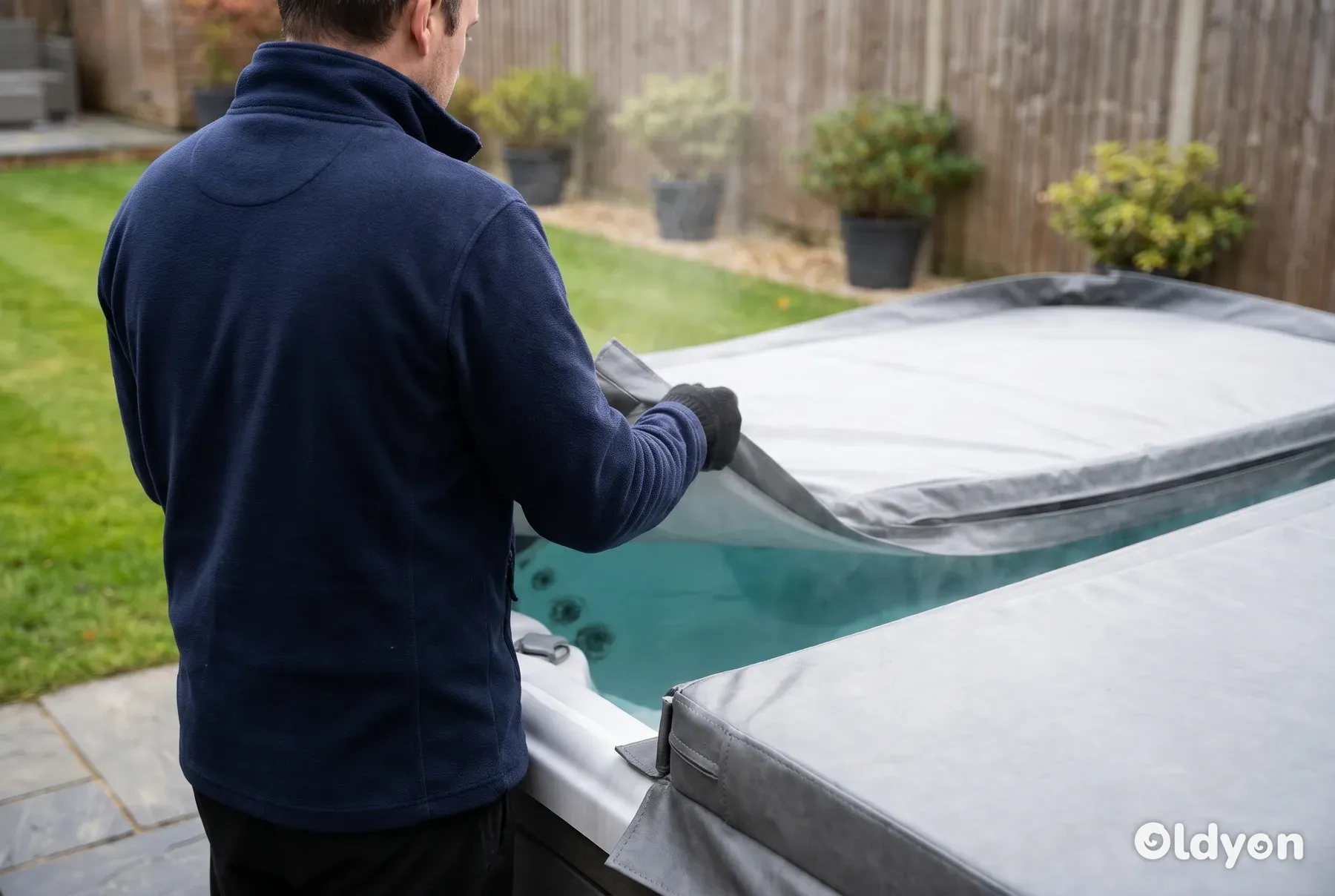
- Unclip all the safety straps before lifting. Pulling against a clip can tear the vinyl.
- Fold the cover in half along its hinge, then slide or lift it off. Lifting by the edge of one corner strains the seams.
- Use a cover lifter if you can. It makes the cover a one-person job and keeps it off the ground.
- Never sit, stand or let children climb on the cover, and do not let snow build up on it.
- Do not leave the cover lying on grass or gravel, where it can be scratched or punctured.
- After adding sanitiser, leave the cover off for about 15 minutes with the jets running. This applies to every dose, not only a shock.
- Leave the cover open for 20-30 minutes after a shock dose so gas can escape, as long as someone stays nearby.
- Wipe the top and the underside once a month with plain water or a cover cleaner.
A cover that feels heavier each month is absorbing water into its foam core. Lift it off on dry days now and then so the underside can air out. If it stays heavy, sags in the middle or smells musty, it is losing its insulation and will need replacing.
A heavy, waterlogged cover that is a struggle to lift is one of the most common reasons owners stop using their tub through the winter. On a cold, dark evening, wrestling with the cover is enough to put people off. A cover lifter takes most of that effort away and helps you keep the habit going all year.
Chlorine or bromine: which sanitiser should you choose?
The sanitiser is what kills bacteria, viruses and algae in the water. If it falls too low, even water that is otherwise well balanced can grow harmful bacteria within hours. That is why it is the reading to check most often.
Both chlorine and bromine keep hot tub water safe when they are held at 3-5 ppm. Some manufacturers recommend one or the other for their tubs, so check your manual before you choose.
- Chlorine is cheaper and acts faster, but it breaks down more quickly in hot water and sunlight, so it needs topping up more often.
- Bromine is more stable in heat, tends to be gentler on skin and has less smell. A shock dose reactivates used bromine in the water.
- Bromine costs more than chlorine and acts more slowly, so it takes longer to bring a low reading back up.
- Chlorine is usually sold as granules or tablets. Bromine normally comes as tablets that sit in a floating dispenser and dissolve slowly.
If your tub sits in direct sun, chlorine will be used up much faster. Test it more often, or consider bromine, which holds up better in heat.
If you choose chlorine for a tub in direct sun, a stabilised chlorine that contains cyanuric acid holds up better against sunlight than unstabilised chlorine. Check the sanitiser level every 2-3 days, because sun and heat can still use it up quickly.
Never mix chlorine and bromine products. If you decide to switch from one to the other, drain the tub completely, clean it and refill with fresh water before starting with the new sanitiser.
Hot tub tips for beginners: a simple routine for the first month
You do not need a complicated schedule. A few small habits each week keep the water clear and catch problems early. For a printable version, see a hot tub maintenance checklist you can follow.
Print a copy of your routine and keep it in a waterproof sleeve near the tub. Having it in sight makes the weekly checks a habit, and once you are used to them they take about ten minutes.
Every time you use the tub
- Check the sanitiser level with a test strip before getting in.
- Shower before your soak and rinse off after.
- Run the jets for a few minutes after everyone gets out to circulate the water.
- Put the cover back on and fasten the clips.
Two or three times a week
- Test sanitiser and pH, and top up sanitiser as needed.
- Look at the water level and top it up with the hose if it has dropped below the skimmer line.
- Skim out leaves or insects.
Once a week
- Test total alkalinity as well as pH and sanitiser, and correct it if needed.
- Add a non-chlorine shock once a week, and again after a busy weekend. It oxidises body oils, sweat and lotions that the sanitiser alone cannot fully break down, and that is what keeps the water clear. Follow your sanitiser instructions if they say otherwise.
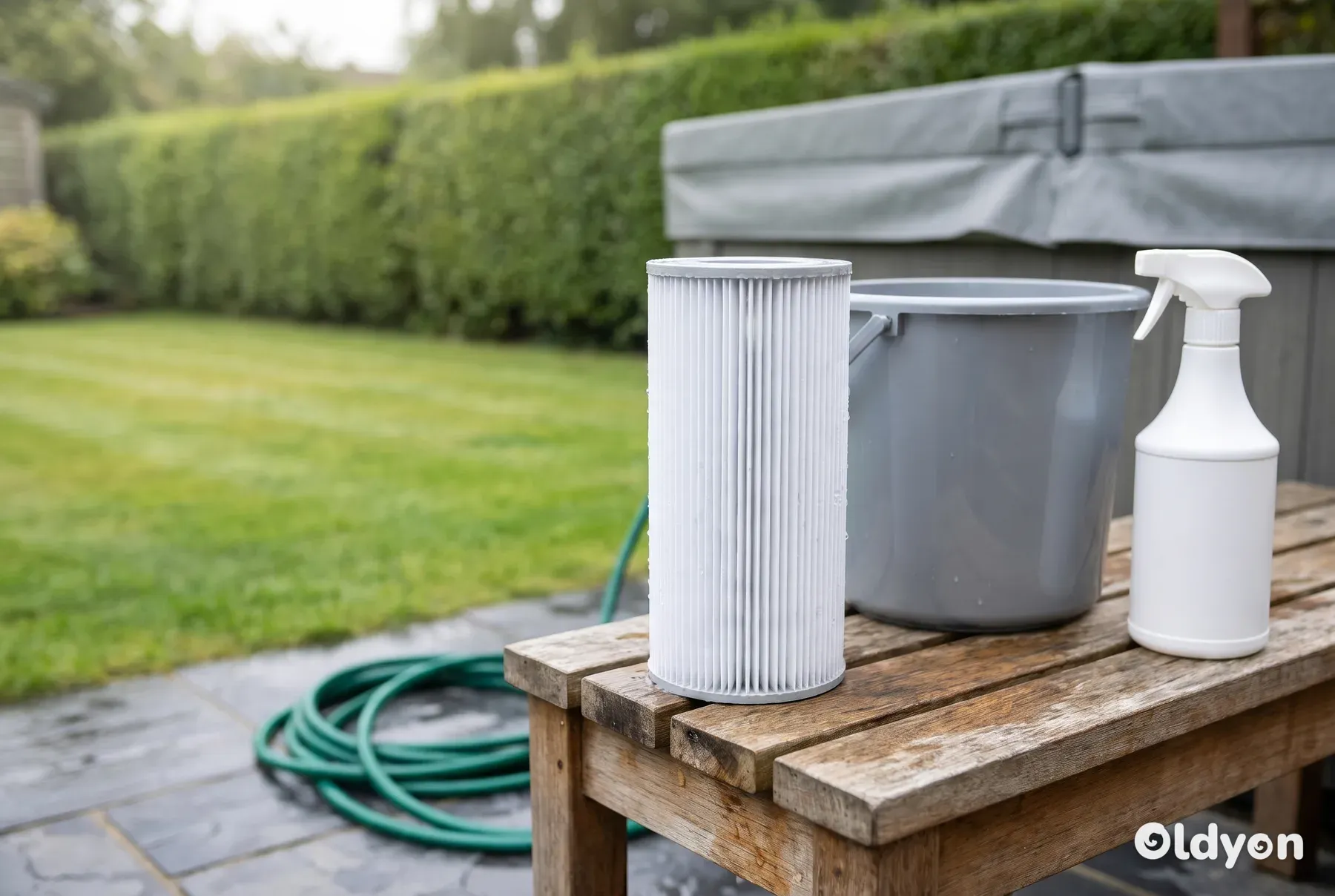
- Take out the filter and rinse it with a hose, working between the pleats from top to bottom.
- Wipe the waterline with a soft cloth and a cleaner made for hot tub shells to remove any greasy ring. Plain water alone is not enough, because the oily ring hardens into a biofilm that is hard to remove if left.
- Inspect the cover for splits, cracks or signs of waterlogging. A damaged cover lets heat escape quickly and can sharply increase your running costs.
Once a month
- Soak the filter overnight in a filter cleaner solution (never washing-up liquid), rinse it until the water runs clear, and let it dry fully before refitting. Keeping a spare filter makes this easy.
- Check calcium hardness.
- Clean the cover and look under the side panels for any drips.
Reading your test results
A simple traffic-light approach makes test results easy to act on:
- Green: every reading is in range. Soak as normal.
- Amber: a reading is slightly out. Adjust it and retest within 24 hours.
- Red: a reading is well out of range. Stay out of the water until it is fixed.
These thresholds show where each colour starts for the readings that move most often:
- Free chlorine or bromine: green at 3-5 ppm, amber at about 1-2 ppm or just above 5 ppm, red below about 1 ppm (too little to protect you, so stay out) or at roughly 6 ppm or more (too strong to soak in, so wait until it drops back towards 5 ppm).
- Total alkalinity: green at 80-120 ppm, amber at 70-79 ppm or 121-150 ppm, red below 70 ppm or above 150 ppm.
- pH: green at 7.4-7.6, amber at 7.2-7.3 or 7.7-7.8, red below 7.2 or above 7.8.
A high sanitiser reading usually falls by itself over a day or two with the cover off for part of the time and the jets running. Do not add more products to bring it down, and retest before anyone gets in.
Write down each test result, even in a note on your phone. A simple record helps you spot trends early, such as sanitiser that falls steadily between doses or pH that keeps rising.
pH increaser is usually sodium carbonate, and pH decreaser is usually sodium bisulfate. Checking the ingredient on the label helps you pick the right product, because brand names vary.
pH decreaser also lowers total alkalinity, so it is the right product when both readings are high. When alkalinity is low, use an alkalinity increaser (sodium bicarbonate), then recheck pH after it has circulated.
When to drain and refill
Water needs replacing because dissolved solids from chemicals, minerals and bathers build up over time. Eventually balancing stops working, however clear the water looks.
A rough rule is to divide the tub's volume in litres by about 11 to get the number of days between drains. For a 1,300 litre tub, that is around 120 days, or about four months. You can also match the interval to how much the tub is used:
- Light use (one or two people, once or twice a week): about every four months.
- Moderate use (about three or four soaks a week by two to four people): about every three months.
- Daily use by four or more people: about every two months.
Most tubs need a full drain and refill every three to four months, depending on how often they are used and how many people use them. Some manufacturers suggest a different interval, so follow your manual.
Switch the tub off at the isolator before draining. If you use a submersible pump, plug it only into an RCD-protected socket and keep the plug, lead and any connections dry.
What is normal in the first few weeks?
New owners often worry about things that are completely ordinary. Here is what you can expect, and what to do about it.
- Foam on the surface. Usually caused by soaps, lotions or detergent left in swimwear. Rinse swimwear in plain water and shower before soaking. An anti-foam product helps in the short term.
- A strong chlorine smell. This usually means the sanitiser is used up, not that there is too much. Test the water and shock if levels are low.
- pH that keeps rising. Fresh water often drifts upwards for the first few weeks. Check alkalinity, then adjust pH in small steps.
- Slightly cloudy water after the first fill. This normally clears within a day of filtering once the water is balanced.
- Pumps starting on their own. Most tubs run automatic filtration cycles and heat when the temperature drops, even with nobody in them.
- The water level dropping a little each week. Evaporation and splashing are normal, especially in warm or windy weather.
- Condensation under the cover. Warm water against cool air always creates some moisture.
If you are unsure about your own test results, many local pool and spa shops will test a water sample for free and explain what the results mean.
Some things are not normal, and these are best left to a qualified technician or electrician. Switch off at the isolator and call for help if you see any of the following.
- The RCD or breaker trips when the tub starts or heats.
- Water collects under the tub or keeps dropping faster than evaporation explains.
- An error code on the control panel that does not clear after the steps in your manual.
- A burning smell, scorch marks or any sign of heat around the electrics.
- The water will not heat at all, even with the cover on and the filter clean.
If the RCD trips repeatedly, do not keep resetting it. Have an electrician find the fault.
Book a hot tub technician if you notice any of these:
- The water stays cloudy or green even though your test readings are correct. This can point to a plumbing, filtration or biofilm problem.
- The jets stay weak even with a clean filter.
- The pump or heater makes unusual grinding or rattling noises.
- The tub loses heat faster than usual, even with a cover in good condition.
Never open the control box or remove electrical covers yourself. Switch off at the isolator and call a qualified electrician or hot tub technician.
Which beginner mistakes cost the most?
A few common mistakes in the first month cause most early repairs and wasted chemicals. You can read more in hot tub maintenance mistakes that cost you money.
- Running the pumps with no water or very low water. This can damage the pump seals and heater quickly.
- Running the tub without its filter fitted, which lets debris reach the pump and heater.
- Neglecting the filter. A clogged filter is the most common cause of cloudy water, weak jets and pump strain, and a filter that is never cleaned can wear out within months.
- Adding several chemicals at once. Add one, let it circulate, then test before adding the next.
- Adding sanitiser before alkalinity and pH are balanced. Sanitiser works far less well in unbalanced water, which tempts you to use as much as twice the amount to compensate. Keep to this order: sequestrant, alkalinity, pH, then sanitiser.
- Guessing doses instead of working from your tub's volume in litres.
- Adding extra chemicals 'to be safe'. Too much chlorine irritates skin and eyes, and too much pH increaser pushes pH high enough to stop the sanitiser working properly.
- Forgetting the water when nobody uses the tub. It still needs testing and dosing every week, so when you go away, ask someone to check it or use a slow-release floating dispenser.
- Leaving the cover off for long periods, which wastes heat and lets in leaves and rain.
- Using household cleaners on the shell or cover.
- Ignoring a small leak or a weak jet until it becomes a bigger repair.
Your first month in short
Fill through the filter, check for leaks, and balance alkalinity, then pH, then sanitiser before anyone gets in. Keep the water at 40°C (104°F) or lower, and limit hot soaks to around 15-20 minutes.
Agree house rules early, lock the cover every time, and handle it gently. Test a few times a week, rinse the filter weekly, and expect a little foam, pH drift and automatic pump cycles while everything settles. Anything electrical or leaking is a job for a professional.
Frequently asked questions
Can I use my hot tub on the same day I fill it?
Usually not. A first heat-up from cold often takes most of a day or longer, and the water needs time to circulate before you can balance it properly. Wait until the water is at temperature and your tests show sanitiser at 3-5 ppm and pH at 7.2-7.6. Getting in before then means sitting in unsanitised water.
Do tennis balls really help keep hot tub water clean?
A tennis ball floating in the skimmer or the water can soak up a little surface oil from skin and lotions. The effect is modest and does not replace showering or keeping sanitiser right. Purpose-made oil absorbers work better. Replace any of them when discoloured. Some cheap tennis balls release yellow dye, so for light-coloured shells use felt walker or chair-leg glides, which are undyed. Each glide absorbs a little less, so use several to match one ball.
How do I use tennis balls in a hot tub?
After a soak, drop two or three clean, new tennis balls into the water with the jets running. Take them out after 30-60 minutes, squeeze out the water and let them dry before storing them. Replace them after about four to six uses, or sooner if they look dirty. Never leave them in unattended for long, because they can drift into the skimmer and block the flow.
What happens if I stay in a hot tub for two hours?
At normal soaking temperatures, a long session can raise your body temperature enough to cause dizziness, nausea, dehydration or fainting. If you have overstayed, get out slowly, sit somewhere cool, and drink water. Most people recover quickly. If you feel confused, very unwell or faint repeatedly, seek medical help and contact NHS 111 for advice.
Can a hot tub help with sciatica or back pain?
Many people find warm water and gentle jets soothing for stiff muscles, and the NHS sciatica page lists heat among self-care options. Warm water widens blood vessels and increases blood flow, which eases muscle tension, and the jets gently massage the lower back and buttocks, where the sciatic nerve runs. That is why many people feel short-term relief. A hot tub is not a treatment, though. Heat can sometimes worsen symptoms, so ask your GP before regular use if you have a diagnosed slipped disc, spinal stenosis or acute nerve inflammation. Get urgent help for numbness around your bottom or changes in bladder or bowel control.
Should I leave my hot tub switched on all the time?
In most cases, yes. Leaving the tub on with the cover closed lets it run its filtration cycles and hold a steady temperature, which keeps the water healthier. Turning it off for long periods lets the water go stale. If you are away for a while, use the economy or holiday mode described in your manual.
When should I do my first full drain and refill?
Most owners drain and refill every three to four months, but heavy use, lots of guests or water that stays hard to balance may mean doing it sooner. Some owners refill after the first month because fresh tubs can shed residue from manufacturing. Follow your manual, and clean the filter and pipework when you drain.
Filed under