Hot tub water care for beginners
Hot tub water care for beginners: the minimum kit, a simple weekly routine, a first-week testing schedule and the three readings that matter most.
Hot tub water care for beginners comes down to three habits: keep your sanitiser in range, keep your pH in range, and keep total alkalinity steady so the pH stays put. You need a small kit, a few minutes every couple of days, and a closer eye during the first week while new water settles.
Below you will find the minimum kit to buy, how to start up a fresh fill, a day-by-day testing plan for week one and a simple routine for after that. When a reading is out of range, our guide to hot tub water balance and the right order for adjustments explains how to correct it step by step.
What is the minimum kit you need?
You do not need a shelf full of bottles. A beginner can keep water clean and safe with a short list of products, and add extras only when a real problem calls for them.
- Test strips or a liquid test kit that reads sanitiser, pH and total alkalinity. A kit that also reads calcium hardness is useful.
- One sanitiser: chlorine granules (usually a stabilised type called dichlor) or a bromine system. Choose one, not both.
- pH increaser (often sodium carbonate) and pH reducer (often sodium bisulphate).
- Alkalinity increaser (usually sodium bicarbonate).
- Shock: either non-chlorine shock (potassium monopersulphate) or chlorine shock granules. Choose a product labelled as non-foaming, because some shocks can add to surface foam in hot tub water.
- Filter cleaner and, ideally, a spare filter cartridge so one can dry while the other is in use.
- A measuring scoop used only for hot tub chemicals, plus gloves and eye protection.
- A clean bucket used only for hot tub chemicals, so you can pre-dissolve granules in water before adding them.
- A cool, dry, lockable space to store chemicals away from children and pets.
Products such as calcium increaser, foam remover, clarifier and pipe cleaner can be helpful later, but they fix specific problems. They are not part of the everyday routine. For a fuller breakdown of what each bottle does, see hot tub chemicals you actually need.
How do you start up a hot tub on its first fill?
Many four to six seat hot tubs hold somewhere around 1,000 to 1,600 litres (roughly 260 to 420 US gallons). Your manual will give the exact volume, and you need that number to measure every chemical dose correctly. Write it inside the lid of your chemical box.
- Switch the hot tub off at the isolator before you start.
- Check the shell is clean, the drain valve is closed and the filters are fitted.
- If you can, fit a hose pre-filter to the end of your garden hose. This in-line cartridge removes iron, copper and some calcium from tap water as you fill, which makes the first balance easier and helps prevent metal staining and scale.
- Fill with a garden hose. Many manufacturers recommend filling through the filter housing to reduce airlocks, so check your manual.
- Fill to the level marked by the manufacturer, which is usually around the middle of the skimmer opening.
- Switch on at the isolator. Run the pumps and listen for airlocks, which show up as a pump humming with weak or no flow. Follow your manual to clear them.
- Let the water circulate with the cover open for at least 30 minutes before adding any chemicals, so it is fully mixed and starting to warm. Then test it.
- Adjust in this order: total alkalinity, then pH, then calcium hardness, then sanitiser, then shock. Add one product at a time with the jets running, and wait for the time on the label before the next one.
- As a rule of thumb, allow about 30 minutes with the jets running between each chemical addition before you retest or add the next product, unless the label gives a different time.
- Close the cover and let the water heat. This can take a day or more depending on the size of the tub and the starting water temperature.
- Test again before your first soak and make sure sanitiser and pH are both in range.
Always add chemicals to water, never water to chemicals. Never mix two products together, even in a dry scoop, and never add more than one product at a time. Some combinations, especially chlorine products with acids or other oxidisers, can react dangerously.
If you are refilling a tub that has been used before, run a pipe cleaner through the old water before draining it. This lifts residue from inside the plumbing so it does not end up in your fresh water. Run the jets for about 20 to 30 minutes with the product in the water so it can lift biofilm, the slimy layer of bacteria that grows inside the pipes, and then drain.
Which three readings matter most?
Test kits can show many numbers, but three do most of the work for a beginner: sanitiser, pH and total alkalinity. Calcium hardness matters too, but it changes slowly, so you check it at each fill and roughly once a month.
Reading | Typical target | What it does | Check after week one |
|---|---|---|---|
Free chlorine | 3-5 ppm | Kills germs | Before each use, at least 3 times a week |
Bromine | 3-5 ppm | Kills germs | Before each use, at least 3 times a week |
pH | 7.2-7.6 | Comfort and sanitiser strength | Before each use, at least 3 times a week |
Total alkalinity | 80-120 ppm | Holds pH steady | Once a week |
Calcium hardness | 150-250 ppm | Protects surfaces and heater | At each fill and monthly |
These ranges are widely used, but manufacturers do not all agree. Some suggest a lower chlorine level for light use, and some give different calcium targets. If your manual gives different numbers, follow the manual, because it is written for your heater and surfaces.
Sanitiser: the reading that keeps water safe
Sanitiser is the reading that protects your health. Warm water and skin oils are ideal for bacteria, so sanitiser needs to stay in range all the time, not just on test day. If it reads zero, do not use the tub until you have brought it back up.
With chlorine, the number that matters is free chlorine, which is the chlorine still available to work. If your kit also shows total chlorine and it is clearly higher than free chlorine, the difference is used chlorine. That is what causes the strong swimming pool smell, and a shock treatment clears it.
This means a strong chemical smell usually points to too little free chlorine, not too much. The smell comes from used chlorine, called chloramines. The answer is to shock the water, not to cut back your regular dose.
Too much chlorine is a problem as well. Above about 5 ppm, chlorine irritates skin and eyes, fades swimwear and can degrade the shell over time. Dose to the label for your water volume and retest before adding more.
The same applies to bromine. Bromine above its target range irritates skin and eyes just as too much chlorine does, so do not add extra to be safe. Let the level fall back into range with the cover off before anyone soaks.
pH: the reading that protects skin and equipment
pH measures how acidic or alkaline the water is. The scale runs from 0 to 14, and pure water is neutral at 7.0. Hot tub water is kept slightly alkaline, in the 7.2-7.6 range.
Low pH can sting eyes and damage metal parts. High pH can cause cloudy water and scale, and it makes chlorine work much less effectively.
Low pH does its damage slowly, so it is easy to miss. Over time, acidic water corrodes the pump seals and the heater element as well as the shell, and those parts are expensive to replace.
At pH 8.0, chlorine loses roughly 80% of its sanitising power. So keeping pH in range does more than protect equipment: it directly protects the people using the tub.
In hot tubs, pH tends to creep upwards over time, especially when the jets and air blowers run a lot. A pH reducer is often the product beginners use most after sanitiser.
As a rough starting dose, use about 1 tablespoon of pH reducer (sodium bisulphate) per 500 litres (about 130 US gallons) when pH reads around 8.1. When pH reads around 7.0, use the same amount of pH increaser (sodium carbonate). Retest after 30 minutes with the jets running, and never exceed the single-dose amount on the label.
Total alkalinity: the reading that holds pH steady
Total alkalinity works like a buffer. When it is in range, pH stays where you put it. When it is too low, pH swings up and down with every dose, and when it is too high, pH keeps drifting upwards and is hard to bring down.
High alkalinity causes other problems too. As well as pushing pH upwards, it can lead to scale and cloudy water.
That is why you set alkalinity before pH. If you correct pH first and alkalinity is wrong, pH will simply move again within a day or two.
What about calcium hardness?
Calcium hardness depends a lot on where you live. In hard water areas, much of south and east England for example, tap water can arrive with high calcium, which can lead to scale on the heater and shell. In soft water areas, owners may need to add calcium increaser to protect surfaces. Your water supplier usually publishes hardness figures for your postcode.
Low calcium hardness can make water foamy and can etch or pit the shell over time. High calcium hardness leaves white scale on the shell, the jets and the waterline.
- Very hard water (tap water above about 300 ppm calcium): fill through a hose pre-filter to reduce scale.
- Soft water (tap water below about 100 ppm calcium): add calcium increaser (calcium chloride) during startup, following the label dose for your volume.
Should a beginner choose chlorine or bromine?
Both sanitisers work well when kept in range. The best choice is the one you will use consistently. Switching back and forth causes problems, and moving from bromine to chlorine normally means draining and refilling.
Chlorine granules act quickly, are easy to measure and are easy to adjust up or down. They need topping up more often, usually after each soak, and the water can smell if used chlorine builds up. Our guide on how to use chlorine in a hot tub covers dosing in detail.
Sunlight breaks chlorine down quickly. Keeping the cover on between soaks helps an outdoor chlorine tub hold its level for longer.
Bromine stays more stable in hot water and many people find it has a milder smell. It usually works as a two-part system: you build a reserve of bromide in the water, then a floating dispenser or oxidiser keeps it active. It is slower to raise and slower to lower, so it suits people who prefer fewer, smaller adjustments.
Bromine also stays effective at a slightly higher pH than chlorine. That makes it practical in tubs where pH keeps creeping upwards.
For a tub kept indoors, in a garage, conservatory or spa room, bromine is often the better choice. Part of the reason is that it gives off less chemical smell, which matters in an enclosed space with limited fresh air.
As a general guide, chlorine is usually the cheaper option and suits tubs that are used occasionally. Bromine suits people who soak often and people with sensitive skin.
How do you test hot tub water correctly?
A test is only useful if it is accurate. Most wrong readings come from testing at the wrong time or reading colours in poor light.
- Test before you add any chemicals and before anyone gets in.
- Run the jets for a few minutes so the water is evenly mixed, then turn them off.
- Take the sample from about elbow depth, away from jets and away from any floating dispenser.
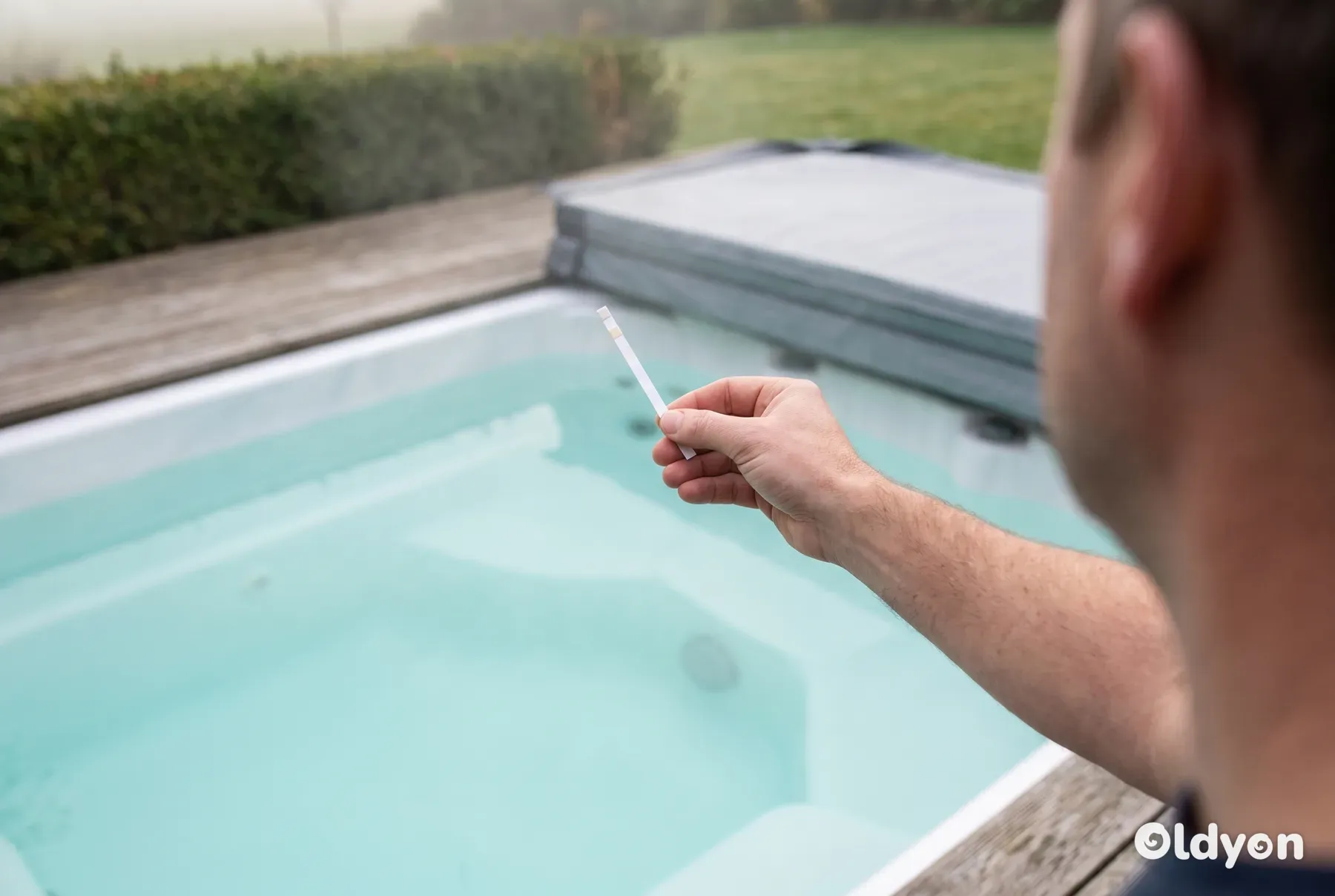
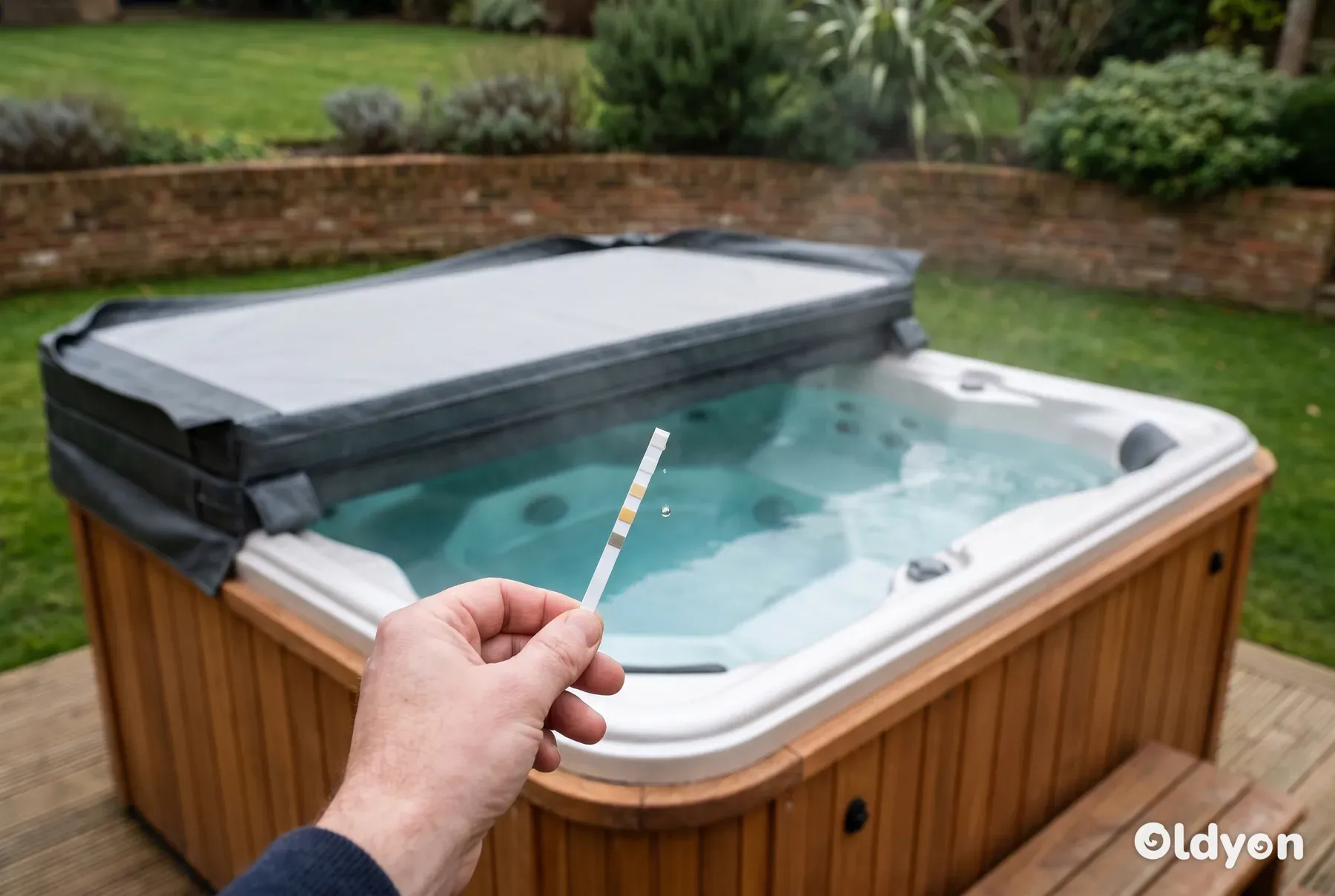
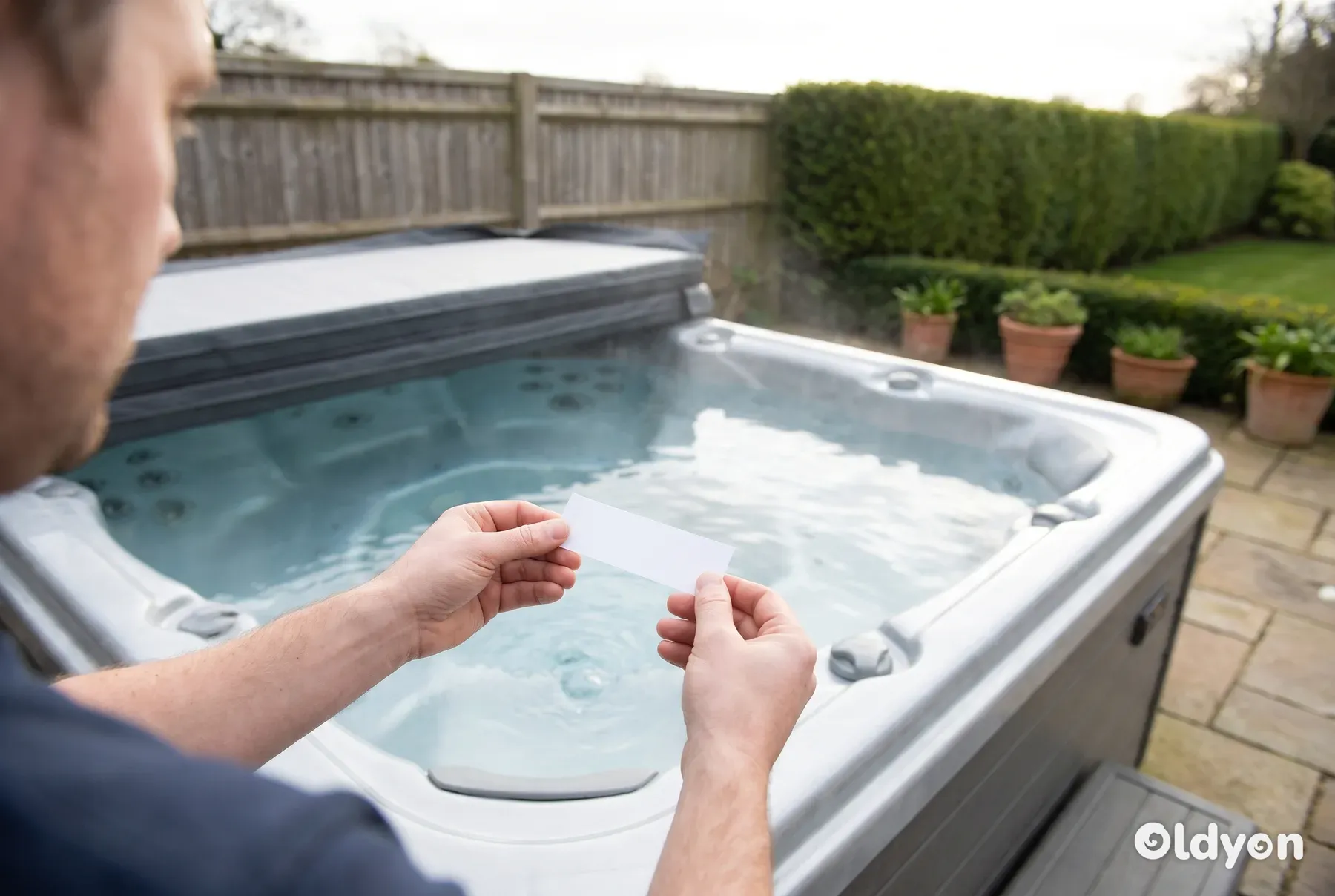
- For strips, dip for the time stated on the pack, then hold the strip flat. Do not shake off the water, because that can wash reagents from one pad to another and distort the colours. Compare colours in daylight within the stated time. For a liquid kit, fill to the line, count drops carefully and compare against a white background.
- Write the results down with the date, in a notebook or on your phone.
- Adjust one reading at a time, wait for the time on the product label with the jets running, then test again.
Keep strips in their sealed tub, take them out with dry fingers and check the expiry date. Damp or out of date strips can show colours that look normal but are wrong. For more on kit types and timing, see how to test hot tub water and when.
If strip colours are hard to read, read them in daylight rather than under warm indoor lighting, and compare within the time on the pack. If a pad sits between two colours on the chart, take the reading between them. If you still struggle, a liquid drop kit gives clearer results.
Liquid test kits are more accurate than strips for sanitiser, especially at low concentrations. Many owners use strips for quick checks and a liquid kit when a reading looks borderline.
Digital testers are a third option. These are electronic strip readers or small photometers that measure the sample and show a number. They take the guesswork out of reading colours, which helps if you find shades hard to tell apart. Follow the maker's instructions for calibration and reagents.
Many hot tub dealers and pool and spa shops will test a water sample for you. Taking one in every one to two months is a useful cross-check on your own results, especially in your first year.
What should you test during the first week?
New water moves around a lot while it heats up and gets its first use. Testing more often in week one shows you how your tub behaves, which makes every week after that easier.
- Day 1 (fill day): test after circulating. Set alkalinity, then pH, then calcium hardness, then sanitiser, then shock. Test again before your first soak.
- Day 2: test in the morning and again before use. Expect pH to rise as the water heats and the jets run. Top up sanitiser after use.
- Days 3 and 4: test once a day, before use. Note how much sanitiser you add after each soak.
- Day 5: test sanitiser and pH, and check calcium hardness once.
- Day 6: test before use. By now the readings should be drifting less from day to day.
- Day 7: test everything, shock the water, rinse the filter and read back through your notes.
By the end of the week you should see a pattern. For example, you may notice that pH rises a little every two days, or that a typical evening soak for two people uses a certain amount of chlorine. That pattern is your starting point for the regular routine.
Hot tub water care for beginners: the weekly routine
Once the first week is done, most tubs settle into a routine that takes a few minutes, a few times a week. Heavy use, hot weather and lots of bathers will mean more frequent checks.
Rain, temperature swings and the number of bathers all shift water chemistry between tests. That is why testing before each soak matters, even when last week's readings were perfect.
In practice, the weekly routine takes about 5 to 10 minutes. A monthly filter deep clean adds about 10 minutes plus soaking time, and a full drain and refill takes about two to three hours.
- Test sanitiser and pH before each use, or at least three times a week if the tub sits unused.
- Top up sanitiser as needed. With chlorine, dose after each soak. With bromine, check the dispenser setting and refill it.
- Test total alkalinity once a week.
- Shock once a week, and again after a busy session with several bathers.
- Rinse the filter with a hose once a week, or as your manual suggests.
- Wipe the waterline with a soft cloth. Do not use household cleaners, which can cause foam.
- Check the water level and top up if it has dropped below the marked line.
- Wipe the cover and let it air dry to stop mould.
Wiping the waterline does more than keep the tub looking clean. Body oils and sunscreen collect in a film at the waterline, and that film feeds bacteria and uses up sanitiser. Removing it regularly helps your sanitiser keep working at full strength.
How to shock your hot tub
Shocking means adding a larger dose of an oxidiser to break down sweat, oils and used sanitiser. It refreshes the water and helps your regular sanitiser work properly.
- Test the water and correct pH first if it is out of range.
- Open the cover fully and switch on the jets with the air controls closed.
- Measure the dose from the product label for your water volume. A typical dose is around 35 g per 1,500 litres, but products differ, so always check the label for your product and volume.
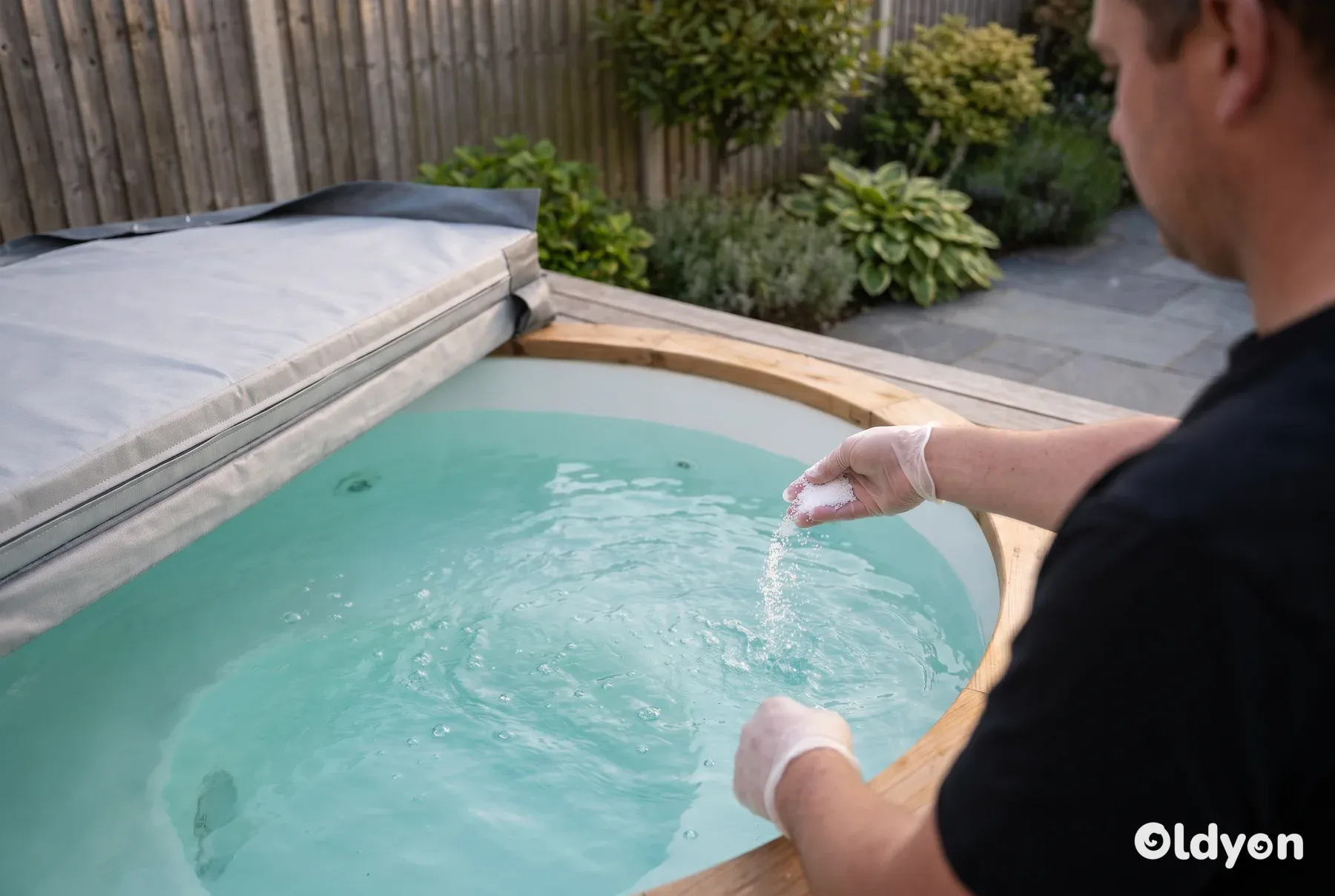
- Always dissolve granular shock in a bucket of water first, because undissolved granules sitting on the shell can bleach or mark it. Use warm rather than cold water in the bucket so the granules dissolve fully. Then pour it slowly into the water near the jets, and follow any other instructions on the label.
- Leave the cover off for about 20 to 30 minutes, or the time on the label, so gases can escape.
- Wait the time on the label before anyone uses the tub, then test before the next soak.
Non-chlorine shock oxidises waste without adding much chlorine, so you can often use the tub sooner afterwards. Chlorine shock oxidises and sanitises at the same time, which helps if the water has been neglected. Bromine users usually choose non-chlorine shock.
How often should you clean the filter and change the water?
Filter care
The filter catches hair, skin flakes and debris, so a dirty filter undoes good chemistry. Switch off at the isolator before removing it. Rinse it with a garden hose at an angle so the water runs between the pleats.
Around once a month, soak the filter in a purpose-made filter cleaner to remove oils that a hose cannot shift. Never use a pressure washer, a dishwasher or washing up liquid. Many manufacturers suggest replacing a cartridge every one to two years, or sooner if the pleats are torn or flattened.
- Switch off at the isolator and remove the cartridge.
- Rinse it with a garden hose to remove loose debris.
- Soak it overnight in filter cleaner mixed to the label strength.
- Rinse it again until the water runs completely clear, with no foam or cleaner left in the pleats.
- Refit it, or let it dry and fit your spare instead.
Replace a cartridge if it stays discoloured or no longer comes clean after soaking. A worn filter passes particles straight back into the water, however good your chemistry is.
Draining and refilling
Common guidance is to drain and refill every three to four months. Do it sooner if the tub is used heavily, has many different bathers, or if the water stays cloudy or will not hold its balance despite correct dosing.
Water needs changing because total dissolved solids build up over time. Sweat, lotions and every chemical you add leave something behind, until the water becomes hard to balance and sanitiser stops working well, however much you shock.
Before draining, let sanitiser fall close to zero. Never let hot tub water run into a stream, pond or surface water drain. If you are unsure where your water should go, check with your local water company or council. A hot tub maintenance checklist you can follow puts all of these jobs on one timeline.
A submersible pump drains the tub much faster than the drain valve alone. Switch the tub off at the isolator before you start, and keep the pump's own cable and plug well away from the water's edge.
While the tub is empty, clean the shell with a non-abrasive spa surface cleaner. Pay attention to the waterline, the jets and the filter housing, then rinse well so no cleaner residue is left before you refill.
After refilling, treat the water as a completely new fill. Rebalance it from scratch in the same startup order: total alkalinity, then pH, then calcium hardness, then sanitiser, then shock. Do not assume your old doses still apply, because fresh tap water starts from different readings.
How do you stay safe in the water?
Clean water is one part of safety. Temperature, time in the water and your own health are the other part.
- Keep the water no hotter than 40°C (104°F).
- Keep sessions short. Many manufacturers suggest around 15 to 20 minutes at the highest temperatures, which is what people mean by the 15-minute rule. Check your manual.
- After a 15-minute session at 40°C, get out, cool down for at least 5 minutes and drink water before getting back in.
- Get out straight away if you feel dizzy, sick, faint, confused or too hot.
- Shower before you get in to remove lotions, deodorant and sweat.
- Do not drink alcohol before or during a soak.
- Supervise children at all times, lower the temperature for them and keep their heads above the water.
- If you are pregnant, speak to your midwife before using a hot tub.
- If you have a heart condition, high or low blood pressure, or take regular medication, ask your GP first.
- If you have a heart condition, low blood pressure or take medication that affects circulation, never use a hot tub alone.
If anyone feels unwell in the water, help them out slowly, sit them somewhere cool and give them water to drink. If symptoms do not settle quickly, call NHS 111, or 999 in an emergency.
Temperature, time and overheating
For everyday soaking, 38 to 39°C is comfortable and allows longer sessions. At that temperature, most healthy adults can comfortably soak for about 20 to 30 minutes per session. At 37°C or below, with regular breaks, you can stay in longer still.
In hot water your body cannot cool itself by sweating, so your core temperature rises quickly. You can also become dehydrated without feeling thirsty, which can lead to heat exhaustion.
Hot water also makes blood vessels dilate and the heart rate rise. This puts extra demand on the heart and can lower blood pressure, which is why people with heart or blood pressure conditions face extra risk and should ask their GP before soaking.
Warning signs of overheating include dizziness, nausea, faintness and confusion. Anyone showing any of these should get out straight away.
Very long soaks of several hours over-soften the skin, which makes it more vulnerable to infection. They also raise the risk of dehydration and overheating.
Many manufacturers advise that children under 5 should not use a hot tub at all, because young children cannot regulate their body temperature well. Older children should have only short soaks at lower temperatures.
As a cautious guide, children over 5 should soak at no more than about 37°C (99°F) and for no longer than about 5 minutes at a time. Let them cool off out of the water between soaks, and check your manual for any age or temperature advice it gives.
Hot tub rash
Hot tub rash is a common name for folliculitis caused by bacteria in poorly sanitised warm water. It usually shows up as itchy red bumps or small spots, often in areas covered by swimwear, from a few hours to a couple of days after a soak.
The usual cause is a bacterium called Pseudomonas aeruginosa, and the rash most often appears 12 to 48 hours after a soak.
The best prevention is good water care. Chlorine or bromine held in range, at a correct pH, kills the bacteria behind hot tub rash within minutes of contact. That is why keeping pH and sanitiser in range before every soak is the main way to prevent rash.
It often clears on its own. A pharmacist can advise on easing the itch. Speak to your GP if the rash spreads, becomes painful, does not improve, or comes with a fever. Stop using the tub until you have tested the water, shocked it and cleaned the filter.
Mild hot tub rash usually clears within 7 to 10 days, and a warm compress can ease discomfort. If it is severe or does not clear, a GP may prescribe antibiotics. Stay out of the hot tub until the rash has fully healed.
An over-the-counter antibacterial wash containing chlorhexidine or benzoyl peroxide may help a mild rash clear faster. Ask a pharmacist which product suits your skin, and follow the instructions on the pack.
Home remedies such as tea tree oil or apple cider vinegar are not proven to treat hot tub rash. Do not rely on them instead of speaking to a pharmacist or GP, especially if the rash is spreading or painful.
- Shock the tub. After a rash outbreak, use a double dose of non-chlorine shock rather than a normal dose, as long as the label allows it.
- Hold sanitiser at the top of its range for 24 hours.
- Clean the filter, or replace it if it is worn.
- If problems continue after 48 hours, drain, clean and refill the tub.
Legionella
Warm water that sprays into the air can spread Legionella bacteria if it is not kept clean. The Health and Safety Executive publishes guidance on Legionnaires' disease, including for spa pools. At home, the best protection is to keep sanitiser in range at all times, clean filters regularly and never leave water standing untreated.
Legionnaires' disease can start with flu-like symptoms. The NHS explains the symptoms of Legionnaires' disease. If you become unwell after using a hot tub, tell your GP that you have been in one.
What mistakes do beginners make most often?
- Adding sanitiser before setting alkalinity and pH, so the sanitiser works poorly.
- Adding several products at once, or mixing them in the same scoop.
- Overcorrecting with large doses, then chasing the reading back the other way.
- Testing straight after adding a chemical, before it has mixed in.
- Shocking when pH is above 7.8. Much of the shock then reacts with the alkaline water instead of breaking down waste, so most of the dose is wasted. Check and correct pH before every shock.
- Using household products such as bleach, washing up liquid or general cleaners in or on the tub.
- Forgetting the filter, then blaming the chemicals for cloudy water.
- Shocking with the cover closed, which traps gases that can damage the cover and headrests.
- Switching between chlorine and bromine without draining.
- Getting in with fake tan, make-up or swimwear washed in detergent, all of which cause foam and cloudiness.
The filter deserves extra attention. A blocked filter does not just let debris back into the water: it also restricts flow, so chemicals spread unevenly around the tub. That is why a dirty filter is the hidden cause behind most cloudy water complaints, even when the test readings look fine.
Do tennis balls help?
Some owners drop a tennis ball into the skimmer or the water to soak up surface oils. It may pick up a small amount of oil, but it does not replace filter care, and fibres from the ball can shed into the filter. Showering before use and rinsing swimwear in clean water do far more.
When should you call a technician?
Water chemistry is a job you can do yourself. Faults with the equipment are not. Switch off at the isolator and call a qualified hot tub technician if you notice any of the following.
- The tub keeps tripping the electrical supply, or the same error code keeps coming back.
- The water will not heat, or heats very slowly.
- You can see water leaking from under the cabinet.
- A pump is very noisy or does not start.
- The water stays cloudy or green even though readings are in range and you have shocked it and cleaned the filter.
- The water stays cloudy for more than 48 to 72 hours despite correct readings.
- A chemical smell persists after shocking.
- The jets lose noticeable pressure.
- You see green or black marks on the shell, jets or filter housing, which can indicate algae or mould.
- You notice a burning smell or see scorch marks near the controls.
For water problems that keep coming back despite home treatment, a one-off professional water analysis is worth considering. It measures more than a home kit can and can pinpoint the real cause. That can save you money that would otherwise go on repeated chemical doses that do not fix the problem.
If you are unsure whether a water problem is fully resolved, get the water checked before a child, an older person or someone with a health condition uses the tub.
Summary: a simple rhythm for clean water
Start with a small kit: a test kit, one sanitiser, pH and alkalinity adjusters, shock and filter cleaner. On a new fill, circulate for at least 30 minutes, then set alkalinity, pH, calcium hardness and sanitiser, and finish with a shock, one product at a time.
Test every day for the first week, then before each use. Watch three readings: sanitiser 3-5 ppm, pH 7.2-7.6 and total alkalinity 80-120 ppm. Shock weekly, rinse the filter weekly, deep clean it monthly and refill every few months. When a number drifts, correct one thing at a time and retest.
Frequently asked questions
How often should I change hot tub water?
Common guidance is every three to four months. Change it sooner if the tub is used daily, has many different bathers, or the water will not stay balanced even when you dose correctly. Signs include persistent cloudiness, foam that keeps coming back and sanitiser that disappears unusually fast. Run a pipe cleaner through the old water before draining, and always check your manual for the manufacturer's own interval.
Can I use my hot tub twice a day?
Yes, as long as you keep each session short and the water stays in range. Every soak adds sweat and oils, so test sanitiser and pH before each use and top up after. Sanitiser is used up much faster, so plan to shock after every second or third day of double sessions, and clean the filter more often. Drink water, keep sessions short and get out if you feel too hot.
Do I need to shock a brand new fill?
Many owners shock once at the start of a fresh fill to clear anything that came in with the tap water or out of the pipes. Set alkalinity and pH first so the shock works properly. If you used a pipe cleaner before draining, a shock on the new fill helps remove any traces left behind. Follow the label dose for your water volume.
What should I never put in a hot tub?
Avoid household bleach, washing up liquid, bath products, essential oils and anything not made for hot tub use. These can damage surfaces, cause foam or upset the water chemistry. Never mix pool and hot tub chemicals unless the label says they are suitable, and never combine two products before adding them. Glass bottles and food also have no place in or near the water.
Can I add soap or a scent to my hot tub water?
Do not add soap, bubble bath or shower gel. Many ordinary soaps contain phosphates, which feed algae and bacteria, and they also cause heavy foam. If you want fragrance, use only spa-specific aromatherapy products. These are made to dissolve without leaving an oily residue or affecting your sanitiser. Add them sparingly, follow the label and test the water as normal afterwards.
Can a hot tub help with stress?
Soaking in warm water may help lower the stress hormone cortisol and trigger the body's relaxation response, which is why many people feel calmer afterwards. Effects vary from person to person, and a hot tub is not a medical treatment for stress or anxiety. If stress, low mood or anxiety is affecting your daily life, speak to your GP.
Should I top up with water from the hose?
Yes, topping up from the mains with a garden hose is normal. Small top-ups barely change the balance, but a large top-up can shift alkalinity, pH and calcium. Test after topping up, once the water has circulated for a few minutes. If you are in a hard water area, keep an eye on calcium hardness over time.
Filed under