Does a hot tub need an isolator switch?
Does a hot tub need an isolator switch? Learn what a hot tub isolator switch does, where it should go, which IP rating to pick and the UK rules.
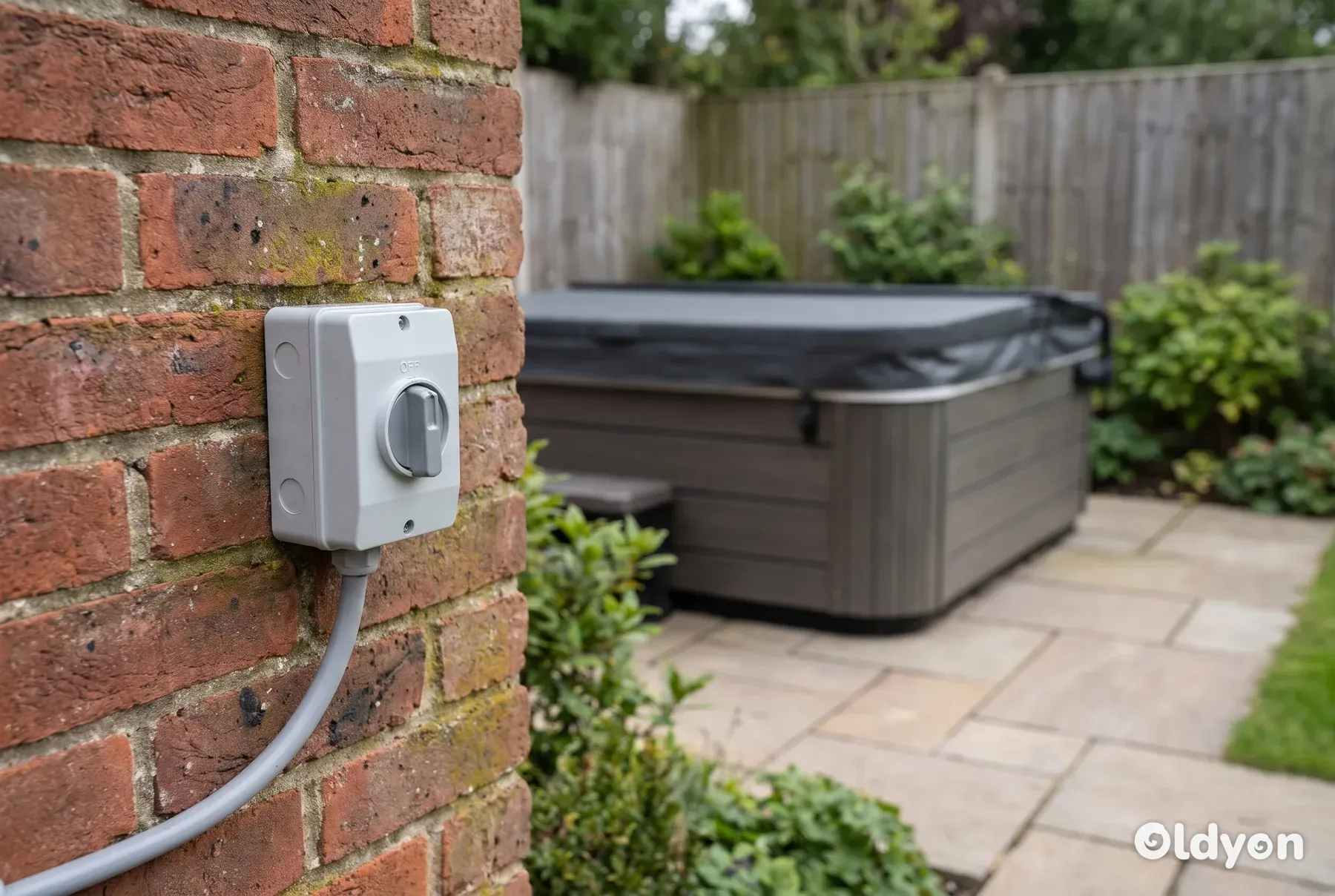
Yes. Almost every permanently wired hot tub in the UK needs a local isolator switch: a weatherproof, double-pole switch near the tub that cuts all power to it. A hot tub isolator switch lets you or a technician make the tub electrically dead before opening panels, draining or servicing, without walking back to the consumer unit.
Below, you will find what the isolator does and how it differs from an RCD, where it should be mounted, why rotary isolators are the usual choice, which IP rating suits an outdoor wall and what UK wiring rules expect. The aim is to help you understand the job, not to replace a registered electrician.
What does a hot tub isolator switch actually do?
An isolator is a manual switch that disconnects a circuit from its supply. On a hot tub it breaks both the live and the neutral conductors, so nothing inside the tub's control pack, heater or pumps is connected to the mains when the switch is off.
It does not trip by itself. It has no way of detecting a fault, and it will stay on during a short circuit or an earth leakage. Its only purpose is to give a person a safe, reliable way to switch the tub off at the tub.
That matters because hot tub work often happens outdoors, with wet hands and the consumer unit at the other end of the house. With a local isolator, the person working on the tub can switch it off, see that it is off and, on a lockable model, make sure nobody switches it back on.
Isolator, RCD and circuit breaker: three different jobs
People often mix up the devices on a hot tub circuit. Each one protects against something different, and a safe installation normally has all three. The table below shows how they compare.
Device | What it does | Operates automatically? |
|---|---|---|
Isolator switch | Cuts all power at the tub for safe work | No, you switch it by hand |
RCD (30 mA) | Trips if current leaks to earth, protecting people from electric shock | Yes |
Circuit breaker (MCB) | Trips on overload or short circuit, protecting the cable | Yes |
RCBO | Combines an RCD and a circuit breaker in one device | Yes |
Some installers fit an outdoor enclosure that contains both an RCD and a switch, sometimes sold as a hot tub RCD box. That can work well, but the RCD inside it is still protection, not a replacement for isolation. You can read more about how the shock protection works in our guide to hot tub RCD protection.
If your consumer unit has no 30 mA RCD or RCBO that can protect the new circuit, for example because it is an older board, a combined outdoor enclosure is often the simplest answer. One weatherproof box near the tub then holds both the 30 mA RCD and the isolating switch, giving shock protection and local isolation together. Your electrician will confirm whether this suits your installation.
A 30 mA RCD acts very quickly. It must disconnect the supply within 300 milliseconds when leakage reaches its rated 30 mA, and within 40 milliseconds when leakage reaches five times that, 150 mA. That speed is what protects a person from a dangerous shock. The isolator plays no part in it.
When is a plain isolator enough?
The question that decides whether a simple isolator is enough is where the 30 mA RCD protection sits. The isolator only needs to switch. The RCD has to be somewhere on the circuit, either at the consumer unit or in the outdoor enclosure.
- Acceptable: an RCD or RCBO at the consumer unit, plus a separate outdoor isolator near the tub
- Acceptable: an outdoor enclosure that combines a 30 mA RCD and an isolating switch
- Not acceptable: an isolator on a circuit with no RCD anywhere
- Not acceptable: an RCD with no local isolator near the tub
If you are not sure which arrangement you have, look in the consumer unit for a device marked with a test button and 30 mA, and check whether the outdoor box has a test button too. If you still cannot tell, ask an electrician to confirm it.
Does every hot tub need an isolator?
Hardwired hot tubs, which usually run on a dedicated 16 A, 32 A or 40 A circuit from the consumer unit, should have a local means of isolation. In practice this is a double-pole isolator switch mounted near the tub. Most manufacturers' installation manuals ask for one, and electricians fit one as standard.
Plug-and-play hot tubs, which run from a standard 13 A socket, are different. Unplugging the tub disconnects it, so the plug itself acts as the isolator. The socket still needs to be outdoor rated, protected by a 30 mA RCD and positioned according to the manufacturer's instructions.
Many plug-in tubs come with an inline RCD on the lead. Treat that as an extra layer, not a reason to skip RCD protection on the socket circuit. If the socket is a long way from the tub or hard to reach, some owners ask an electrician to add a dedicated switched outlet nearer the tub.
Inflatable spas follow the same plug-in logic. Never use an indoor extension lead to reach the garden, and never leave a plug or connector lying on wet ground.
Is an isolator the same as a US AC disconnect?
Broadly, yes. In the United States, the wiring code asks for a disconnect within sight of a hot tub, and many installers use the same pull-out disconnect box that serves an outdoor air conditioning unit. That is why owners search for an "AC disconnect for a hot tub".
In the UK, the equivalent device is a weatherproof double-pole isolator, usually a rotary switch. US guidance and the US distance figures do not apply here, because UK installations follow BS 7671 and the tub manufacturer's instructions. The idea is the same, though: a switch close to the tub that makes it dead.
You may notice that the rotary isolators sold for air conditioning units in the UK look exactly like the ones used for hot tubs. There is nothing wrong with that, as long as the switch is double pole, rated for the circuit current, has a suitable IP rating and your electrician is happy it meets the manufacturer's requirements.
Where should a hot tub isolator switch go?
The isolator needs to be close enough to the tub that the person working on it can see it and reach it quickly, but far enough away that nobody sitting in the water can touch it. Those two needs pull in opposite directions, so the position is a balance.
How far from the water?
A common rule used by UK installers and many manufacturers is that the isolator should be at least 2 metres (about 6.5 feet) from the water's edge. That keeps it out of reach of anyone in the tub and of anyone standing next to it with wet hands.
Some manufacturers and electricians prefer a greater distance, and some installers apply the zone approach used for pools in BS 7671, which can push equipment further out. Requirements differ between makes, so always check the installation manual for your model and follow whichever distance is greater.
There is also a practical upper limit. If the isolator is round the corner of the house or behind a locked gate, it stops being useful. Aim for a spot where someone standing by the tub's control panel can see the switch.
Height, access and protection
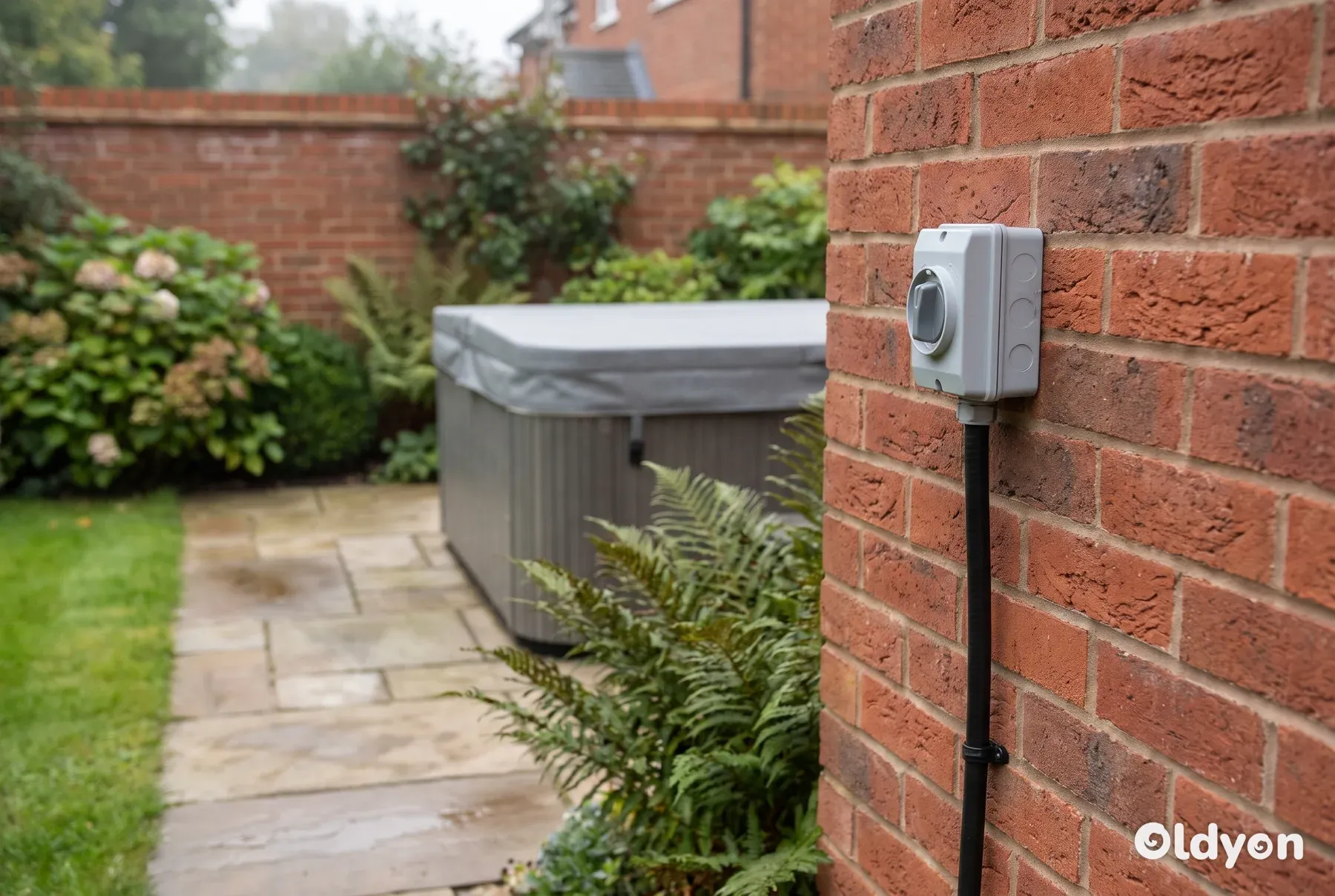
Most installers mount the isolator on a wall, fence post or purpose-built post at a comfortable working height, roughly between waist and shoulder level. That keeps it clear of splashes, standing water and garden equipment.
As a practical guide, aim for the switch to sit about 1.2 to 1.5 metres (roughly 48 to 60 inches) above the ground. At that height it is easy to reach and operate during servicing, and it stays well above splashes, puddles and standing water. If your tub manual gives a different height, follow the manual.
Keep the area in front of it clear. Planters, log stores and furniture tend to creep in front of switches over time, and you want to reach it in seconds if something goes wrong. Avoid mounting it where a hose, sprinkler or pressure washer is regularly aimed.
- At least 2 metres from the water, or further if your manual says so
- Visible from the tub's equipment bay or control panel
- Not reachable by anyone sitting in the tub
- Mounted on a solid, dry surface at a comfortable height, about 1.2 to 1.5 metres above the ground
- Clear of planters, furniture and anything that blocks access
- Out of the direct path of hoses, sprinklers and roof run-off
Never mount an isolator, socket or any other electrical accessory where it can be reached from inside the hot tub. If you are unsure whether the switch is far enough away, ask your electrician to check it against the tub manufacturer's installation manual.
Why is a rotary isolator the usual choice?
A rotary isolator has a large handle that you turn a quarter turn between on and off. It is easy to operate with cold or wet hands, and the position of the handle shows clearly whether the circuit is on or off.
Most outdoor rotary isolators are housed in a sealed plastic enclosure designed for weather exposure. Many also have a lockable off position, where you can fit a small padlock through the handle. That stops someone switching the tub back on while another person is working inside the cabinet.
Ordinary indoor rocker switches and fused spurs are not designed for outdoor use on a hot tub circuit. Even if they are rated for the current, they are rarely weatherproof enough, and they are easy to knock on by accident.
Choosing the right current rating
The isolator must be rated for at least the current of the circuit protecting it. If the tub is on a 32 A breaker, the isolator must be rated 32 A or higher. Many electricians fit a 40 A or 63 A isolator on a 32 A circuit to give a comfortable margin.
The circuit breaker itself works the other way. It must match the rating the tub manufacturer gives on the rating plate or in the manual, and it must never be upsized beyond that figure. A larger breaker may stop nuisance tripping, but it removes the protection for the cable and the tub's equipment, which can lead to overheating.
It should be double pole, meaning it breaks both live and neutral. For the rare three-phase hot tub installation, the isolator needs to suit the three-phase supply, which is a job your electrician will specify. Your tub's manual will list the supply it needs.
- Double pole (switches live and neutral)
- Current rating equal to or above the circuit breaker
- Circuit breaker matching the manufacturer's rating, never higher
- Lockable off position, ideally
- Suitable IP rating for outdoor mounting, clearly marked on the enclosure or packaging
- Cable entries sealed with the correct glands
What IP rating does an outdoor isolator need?
The IP rating (Ingress Protection) is a two-digit code. The first digit shows protection against solid objects such as dust, on a scale up to 6. The second digit shows protection against water, on a scale up to 8 for the ratings you will meet on switches.
For an isolator mounted outdoors near a hot tub, electricians commonly use enclosures rated IP65 or IP66. IP65 means dust tight and protected against water jets from any direction. IP66 means dust tight and protected against powerful water jets. Some rotary isolators are rated IP56, which offers similar water protection with slightly less dust protection.
As a minimum for equipment near water, BS 7671 sets lower figures (such as IPX4 for splashes), but an exposed garden wall faces driving rain and possibly a hose. A higher rating is the sensible choice outdoors, and some manufacturers specify one in their manuals.
Before you buy an isolator, or accept one your installer has supplied, check that the IP rating is actually printed on the enclosure label or the packaging. A box with no marked rating, or one sold for indoor use, should not be fitted outdoors, however solid it looks. If you cannot find the rating, ask your electrician to show it to you.
The rating only holds if the enclosure is installed properly. Cable entries should use the correct glands, unused knockouts should stay sealed, and the lid should close fully. Most installers bring cables in from the bottom so water cannot run down the cable into the box.
Water inside the box causes more than a shock risk. In an indoor-type or poorly sealed enclosure, moisture slowly corrodes the terminals, and corroded connections can overheat under the heavy current a hot tub draws. Signs such as discoloured plastic, condensation inside the lid or a handle that feels warm mean an electrician should check the isolator.
What do the UK rules say about hot tub isolation?
In the UK, electrical installations follow BS 7671, the IET Wiring Regulations. It requires a means of isolation for circuits and equipment, and it treats locations with water as special, with extra requirements. For hot tub circuits this normally means a dedicated circuit, 30 mA RCD protection and a local double-pole isolator.
In England and Wales, adding a new circuit for a hot tub is notifiable work under Part P of the Building Regulations. The usual route is a registered electrician in a competent person scheme, who can self-certify the work. The GOV.UK guidance on Approved Document P explains what counts as notifiable.
If the person doing the work is not registered with a competent person scheme, you as the homeowner must notify your local authority building control before the work starts, usually by submitting a building notice. Building control charges a fee for this, and it will then inspect the installation to check it complies. Using a registered electrician avoids this extra step.
When the work is finished, you should receive an Electrical Installation Certificate and, later, a Building Regulations compliance certificate. Keep both with your house documents, as they are useful for insurance and when selling the property.
Cable size, earthing and supply capacity
The supply cable must be sized for both the breaker rating and the length of the run. Cable that is too small for the current can overheat, which is a fire risk. On long runs, the electrician will also carry out a voltage drop calculation, and that may mean using a larger cable than the breaker alone would suggest.
The circuit's earthing must be in place and tested. Where the tub manufacturer or the electrician requires it, metal parts of the tub and nearby metalwork are also connected together with supplementary bonding. Bonding is a separate step from earthing the circuit, so check your manual to see whether your model asks for it.
A 32 A or 40 A hot tub circuit is a large extra load on a house. If the consumer unit has no spare way, is too old to take a modern RCBO, or the incoming supply is limited, the job may need a consumer unit upgrade or a supply assessment first. That is a decision for your electrician to make after inspecting the installation.
Scotland and Northern Ireland have their own building regulations, and other European countries follow their own national wiring standards. The principle of local isolation is very common, but the details differ, so always use a qualified local electrician.
For the full picture of cable sizing, supply ratings and protection, see our guides to hot tub electrical requirements in the UK and hot tub wiring regulations in the UK. The charity Electrical Safety First also publishes clear advice for householders on finding a registered electrician.
How is a hot tub isolator installed?
A hardwired hot tub circuit has two lengths of cable. The first runs from a dedicated way in the consumer unit, through its breaker or RCBO, to the outdoor isolator. The second runs from the isolator's load terminals to the tub's control pack or junction box.
Cable running outdoors must be protected against damage. Electricians typically use steel wire armoured (SWA) cable, either fixed along a wall or buried in a trench. A buried cable should be deep enough to stay clear of spades and garden digging, with marker tape laid above it to warn anyone who digs there later.
Buried armoured cable is commonly laid at a depth of around 600 mm (about 24 inches) under lawns and flower beds. Under driveways, or anywhere vehicles pass, it is usually laid deeper. Warning tape is normally placed about 150 mm (about 6 inches) above the cable, so a spade hits the tape before it reaches the cable. Your electrician will confirm the right depth for your route.
The final short run from the isolator into the tub base also needs protection, for example armoured cable or a suitable conduit, and it should enter the tub cabinet through a proper gland. Loose cable trailing across a patio or under decking is easily damaged.
The electrician should also label the hot tub circuit breaker or RCBO clearly in the consumer unit. In an emergency, anyone in the house should be able to find it quickly without guessing.
The typical installation sequence
- Check the tub's manual and rating plate for the supply it needs, including the breaker rating and any bonding requirement.
- If the installer is not registered with a competent person scheme, submit a building notice to local building control before any work starts.
- Fit the breaker or RCBO in a dedicated way in the consumer unit, and label it.
- Mount the isolator in a suitable spot, at least the required distance from the water, visible from the tub and about 1.2 to 1.5 metres above the ground.
- Run the cable from the consumer unit to the isolator, then from the isolator to the tub, burying it at a suitable depth with warning tape above it where it goes underground, and make the connections.
- Test the circuit, including earthing, insulation and a check that the RCD trips correctly.
- Issue the Electrical Installation Certificate and notify the work where required, or arrange the building control inspection if a building notice was used.
A typical hot tub circuit with an isolator takes a registered electrician roughly half a day to a full day (about 4 to 8 hours). The main factors are the distance from the consumer unit to the tub and how difficult the cable route is, for example whether a trench has to be dug or walls drilled.
What mistakes should you watch out for?
Most problems with hot tub isolators come from treating them as an afterthought. These are the issues technicians see most often on site.
- Isolator mounted within reach of someone sitting in the tub
- Isolator hidden round a corner or behind a gate, so it cannot be seen from the tub
- Isolator mounted so low that it sits in splashes or standing water
- Single-pole switch that leaves the neutral connected
- Isolator rated below the circuit breaker
- Circuit breaker rated higher than the tub manufacturer specifies
- Supply cable undersized for the breaker rating or the length of the run
- Buried cable laid too shallow, or with no warning tape above it
- Missing earthing, or missing bonding where the manufacturer requires it
- Indoor switch or fused spur used outdoors
- Enclosure with no IP rating marked on its label or packaging
- Open knockouts or missing glands, letting water into the enclosure
- No RCD on the circuit because the owner assumed the isolator gave protection
- Work by an unregistered installer with no building notice given to building control
- Extension leads or connectors lying on the ground for plug-in tubs
Wiring a hot tub is not a suitable DIY job. Beyond the shock risk, unnotified work can cause problems with insurance and when you sell your home. If you are planning a new tub, our guide to what a hot tub electrical installation involves explains what to expect from start to finish.
Questions to ask your electrician
- Will the isolator be double pole and rated above the circuit breaker?
- What IP rating will the enclosure have, and where is it marked?
- How far will it be from the water, and does that match the tub manual?
- At what height will it be mounted?
- Will it have a lockable off position?
- Will the circuit have 30 mA RCD protection, and of which type?
- Does my consumer unit have capacity for the new circuit, or does it need upgrading?
- What size cable will you use for the length of this run?
- How deep will any buried cable be, and will you lay warning tape above it?
- Are you registered with a competent person scheme, and will you notify the work and provide certificates?
How do you use the isolator safely?
The isolator is only useful if you use it at the right times. Switch it off before draining, before opening the equipment bay, before changing a heater or pump, and whenever a technician is working on the tub.
- Switch the hot tub off at its control panel first, if it has an off or standby mode.
- Turn the rotary isolator to the off position with dry hands.
- If it has a lockable handle, fit a padlock and keep the key with you.
- Check that the control panel is dark and that pumps and lights have stopped.
- Wait a few minutes before opening the equipment bay, as some components can stay hot.
- When the work is finished and the bay is closed, remove the padlock and switch the isolator back on.
- Check that the tub restarts normally and that the RCD has not tripped.
Seeing a dark control panel is a good sign, but it is not proof that every part is dead. Only an electrician with a proper voltage tester should confirm that before working on live parts. For the full shutdown routine, including winter care, see our guide on how to turn off a hot tub safely.
If the RCD trips repeatedly, or the isolator feels warm, smells of burning or shows signs of water inside, switch off and leave the tub off. Do not reset it again and again. Call a registered electrician to investigate.
Make a habit of looking at the isolator a few times a year. Check that the lid closes properly, the enclosure is not cracked and the handle turns smoothly. Plastic enclosures can become brittle after years of sunlight, so replace one that looks damaged.
Summary
A hardwired hot tub should have a local, weatherproof, double-pole isolator, usually a rotary switch. It is the UK equivalent of the American AC disconnect, and its job is to let you make the tub dead at the tub before any work.
Mount it at least 2 metres from the water, or further if your manual asks, about 1.2 to 1.5 metres above the ground, where it can be seen from the tub but not reached from inside it. Choose an outdoor rating such as IP65 or IP66, marked on the enclosure, a current rating above the circuit breaker and, ideally, a lockable handle.
The isolator does not replace RCD protection. In England and Wales the circuit is notifiable work under Part P, so have it installed and certified by a registered electrician. If the installer is not registered, notify building control before work starts.
Frequently asked questions
Can I fit a hot tub isolator switch myself?
It is not recommended. Fitting an isolator means working on the hot tub circuit, which in England and Wales is usually part of notifiable work under Part P. A registered electrician can install it, test the circuit and issue certificates. Doing it yourself without notification can cause problems with insurance and when you sell your home, as well as creating a shock risk.
Does a plug-in hot tub need a separate isolator switch?
Usually not, because unplugging the tub disconnects it and the plug acts as the isolator. The socket must still be weatherproof, protected by a 30 mA RCD and placed where the manufacturer says. If the socket is hard to reach from the tub, ask an electrician whether a dedicated outdoor switched socket nearer the tub would make shutting it off easier.
Can the isolator be inside the house or garage?
It can be, if it is still close to the tub and visible from where someone works on it, which is rare with an indoor position. The purpose of local isolation is that the person at the tub can switch it off and see that it is off. A switch indoors behind a closed door rarely meets that aim. Check your tub manual and ask your electrician.
Should I switch the hot tub off at the isolator every night?
No. Hot tubs are designed to stay on, heating and filtering the water on their programmed cycles. Switching off nightly lets the water cool and means the heater works harder to recover, and in cold weather it risks freezing the pipework. Use the isolator for maintenance, draining, repairs and emergencies, not as a daily on and off switch.
What happens if my isolator is too close to the hot tub?
A switch within reach of someone in the water, or of someone with wet hands standing beside the tub, increases the risk of electric shock and may not meet the manufacturer's installation requirements. It could also cause problems with warranty claims or an electrical inspection. If yours looks too close, ask a registered electrician to assess it and move it if needed.
How long does a rotary isolator last outdoors?
There is no fixed lifespan, as it depends on sunlight, weather and how often it is used. Plastic enclosures can fade and become brittle over several years. Check it a few times a year for cracks, a loose lid, a stiff handle or moisture inside. If you notice any of these, switch off and have an electrician replace the isolator.
Filed under