How many amps does a hot tub use in the UK?
How many amps does a hot tub use in the UK? Compare 13 amp plug-in and 16 to 40 amp hardwired tubs, and see what your consumer unit needs to handle.
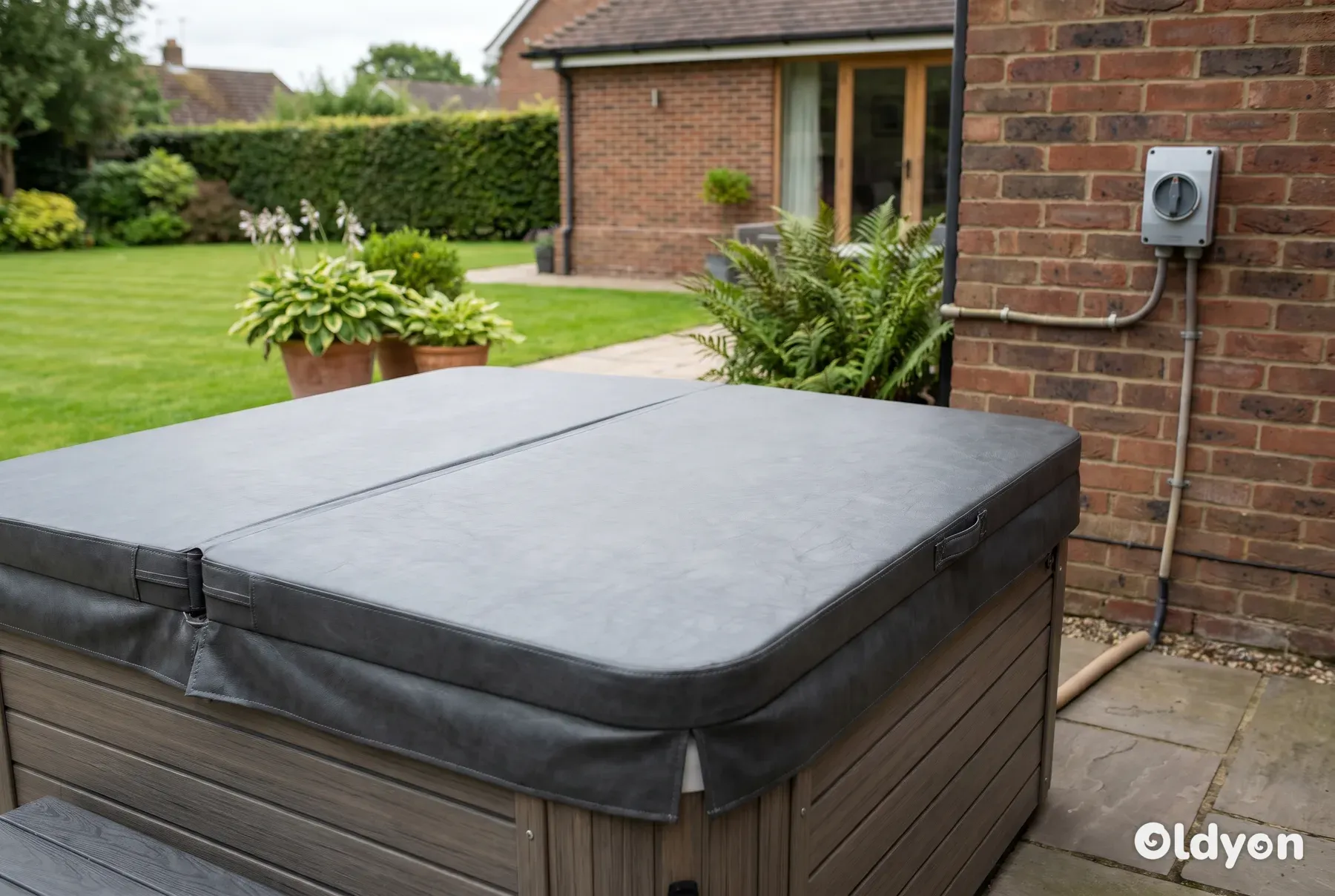
In the UK, how many amps a hot tub uses depends on how it is supplied. Plug-in tubs, including inflatables, draw up to 13 amps from a standard socket. Hardwired tubs run on a dedicated circuit, usually rated at 16, 32 or 40 amps, with 32 amps the most common choice for a full-size acrylic tub.
The number that matters is not just the tub's rating but what your home's supply can spare. Below, you will see how the heater and pumps add up to that figure, why American advice about 50 to 60 amps does not apply here, and what to check on your consumer unit before you book an electrician.
How many amps does a hot tub use on a UK supply?
UK homes run on single-phase mains at a nominal 230 volts. At that voltage, every 1 kilowatt (kW) of load draws roughly 4.3 amps. A hot tub's current draw is simply the total power of whatever is running at that moment, divided by 230.
Hot tubs sold in the UK fall into two groups. Plug-in models are designed to stay within the 13 amp limit of a normal plug, which caps them at about 3 kW in total. Hardwired models connect to their own circuit from the consumer unit and can draw more, so they can heat water and run powerful jets at the same time.
For a sense of scale, think of a kettle. A typical kettle draws about 13 amps, but only for a few minutes at a time. A 32 amp hot tub can draw well over double that current, and during heat-up it can keep drawing it for hours. That sustained load is why the circuit has to be designed for it.
The figure on the tub's specification plate or in its manual is the one to trust. It tells you the supply the manufacturer designed the tub for, which might be 13, 16, 20, 32 or 40 amps. Some tubs can be set up for more than one of these, which we cover in the FAQ.
Why do UK and US hot tub figures differ?
American guides often say a hot tub needs 50 to 60 amps. That figure is usually the size of the circuit breaker for a US tub on a 240 volt supply, not the current the tub draws every minute it runs.
There are two reasons the US number is higher. Many American tubs are built with larger heaters than typical UK tubs, and US wiring rules size the breaker with extra headroom above the expected load. UK tubs are designed around British circuits and British wiring rules, so their ratings are different.
The practical lesson is simple: do not size a UK installation from an American article. Use the rating your tub's manufacturer gives for the UK version, and let a registered electrician design the circuit to BS 7671, the UK wiring regulations.
How do the heater and pumps add up?
A hot tub is a collection of separate electrical loads. The control pack switches them on and off, and the total current at any moment is the sum of whatever is running. Knowing the parts helps you understand why one tub needs 13 amps and another needs 32.
Converting watts to amps
To turn a power rating into current on a UK supply, divide the watts by 230. A 3,000 watt heater draws about 13 amps. A 2,000 watt jet pump draws about 8.7 amps. This is a good estimate for planning, although motors draw a short burst of extra current when they start.
Typical loads inside a hot tub
Ratings vary by manufacturer and model, so treat these as typical ranges rather than fixed values. Check the specification sheet for your own tub.
- Heater: often 2 to 3 kW (about 9 to 13 amps). Some larger tubs and swim spas use bigger or multiple heaters.
- Jet pumps: often 1.5 to 2.2 kW each (about 6.5 to 9.5 amps) on high speed. Larger tubs may have two or three.
- Circulation pump: a small pump, often a few hundred watts (around 1 amp or so). It runs either continuously or on a timer to filter the water, so its small draw is present most of the time, not only when you are using the tub.
- Air blower: often around 0.7 to 1 kW (about 3 to 4.5 amps), on tubs that have one.
- Lights, control panel, ozone or UV sanitiser: small loads, usually well under 1 amp combined.
Two-speed pumps
Many jet pumps are two-speed. On low speed, a pump draws much less current than on high speed, because the motor is doing far less work. Low speed is often used for gentle circulation and filtering, and high speed for full-strength jets.
This explains a common question from owners. Some tubs can keep the heater running while the jets are on low, but switch the heater off when the jets go to high. The control pack is simply keeping the total current within the tub's rating.
A worked example
Take an example hardwired tub with a 3 kW heater, two 2 kW jet pumps and a 0.2 kW circulation pump. If everything runs together, that is 7.2 kW. Divided by 230, the tub draws about 31 amps, which is why a tub like this is designed for a 32 amp supply.
If the same tub also had a 0.9 kW blower, running everything at once would push it past 32 amps. Manufacturers handle this with load management: the control pack will not allow certain combinations, or it switches the heater off while the blower and both pumps run. Your tub never exceeds the rating it was designed for, provided it is set up correctly.
The heater is usually the largest single load, and it is also what drives your running costs. Our guide to how hot tub heaters work, from element to heat pump explains the different types and how they affect current draw.
What does a 13 amp plug-in hot tub draw?
A plug-in tub must stay under 13 amps, or about 3 kW, at all times. To do that with a 2 to 3 kW heater and a jet pump, the control system has to share the power. On most plug-in acrylic tubs, the heater switches off while the jets run on high speed, then switches back on when the jets stop.
This has a real effect on use. In cold weather, a long session with the jets on can let the water cool, because the heater is paused. Heating up from cold also takes longer than on a hardwired tub, since only one main load can run at a time.
The 13 amp limit also shapes the tub itself. Because it restricts how many pumps can run, plug-in tubs tend to be smaller, typically seating two to four people, with fewer jets than a hardwired tub of a similar price.
How long does a plug-in tub take to heat from cold?
Heating a freshly filled tub takes many hours. As a guide, a 3 kW heater warms about 1,500 litres (about 400 US gallons) by roughly 1.5 to 2°C per hour. Getting from tap-cold water at about 10°C (50°F) to 38°C (100°F) can therefore take 15 to 24 hours, longer in cold or windy weather.
Keep the cover on throughout, and avoid running the jets during the first heat-up on a plug-in tub, because that pauses the heater. Smaller tubs with less water heat faster, and hardwired tubs with larger heaters can be quicker too.
Inflatable hot tubs
Inflatable hot tubs work the same way. Their heaters are usually around 2 kW, and the control unit shares power between the heater, filter pump and air bubbles. Most come with a plug that has a built-in residual current device (often called a PRCD). This should be plugged directly into a suitable socket, never bypassed.
Inflatable tubs usually have a maximum water temperature of 40°C (104°F). With smaller heaters and thinner insulated walls, they heat more slowly than hard-shell tubs, and they generally have a shorter lifespan. Check your manual for the exact limits of your model.
A plug-in tub should still go on a weatherproof outdoor socket protected by a 30 milliamp residual current device (RCD). Many electricians recommend a dedicated socket circuit for it, because a tub drawing close to 13 amps for hours can overload a socket circuit that is also feeding a kitchen or utility room.
When does a hot tub need a 16, 32 or 40 amp supply?
Hardwired tubs are rated to suit their size and features. A higher rating allows more loads to run together, so the heater can keep working while you use the jets. Our comparison of 13 amp vs 32 amp hot tubs goes into the day-to-day differences in more detail.
Supply type | Typical tub | Heater with jets on? |
|---|---|---|
13 amp plug | Inflatable or small plug-in acrylic | Usually no, power is shared |
16 or 20 amp hardwired | Smaller tubs, one jet pump | Often yes, at low or single speed |
32 amp hardwired | Most full-size acrylic tubs | Usually yes |
40 amp hardwired | Large tubs with several pumps | Yes, with more pumps running |
Above 40 amp or two supplies | Swim spas and some large models | Check the manufacturer's spec |
The rating is set by the manufacturer, not chosen by you. If your tub is specified for 32 amps, it needs a circuit designed for that load. Fitting it to a smaller circuit risks nuisance tripping, overheated cables and a voided warranty.
Brand does not change the electrics. A premium tub has the same electrical requirements as a budget tub of the same size, heater and pump count. Plan your installation around the rating on the specification sheet, not around the name on the cabinet.
Can your consumer unit handle a hot tub?
A 32 amp tub is a big addition to a home's electrical load, comparable to an electric shower or an electric vehicle charger. Before you commit to a hardwired tub, it is worth checking what your supply can support. You can gather the basic facts yourself, then let an electrician make the decision.
What to check before you call an electrician
- Find your main fuse rating. It is printed on the sealed service head (the cutout) where the supply cable enters your home, often near the meter. UK homes commonly have 60, 80 or 100 amp main fuses. Look only, and never break the seal or open the cutout.
- Look at your consumer unit. Note whether it has a spare way for a new circuit, and whether the circuits are protected by RCDs or RCBOs (combined breakers with built-in RCD protection). Check only the front of the unit and its labels. Never remove its cover or touch anything inside, and leave anything behind the cover to the electrician.
- List your other large loads: electric shower, electric cooker or oven, immersion heater, heat pump, electric vehicle charger, tumble dryer. For each one, note its rating in amps or kW from the rating plate or the manual, so the electrician works from real figures rather than guesses.
- Find the hot tub's rated current and supply type in its manual or specification sheet.
- Book a registered electrician to survey the installation and calculate your maximum demand. Share everything you have written down.
- Ask the electrician for the maximum demand calculation in writing as well as the quote. This gives you proof that your supply can take the tub before you buy it.
The maximum demand calculation is the key step. Not every appliance runs at full power at the same time, so electricians apply recognised allowances for this, known as diversity. A home with a 100 amp main fuse and gas heating can often take a 32 amp tub without difficulty. A home with a 60 amp fuse, an electric shower and an EV charger may need changes first.
Homes heated by electricity have the least room to spare. If your house has storage heaters, an immersion heater, an electric cooker and an electric shower, much of the supply is already in use, and you are the most likely to need a supply upgrade before a hardwired tub can be added.
A simple maximum demand example
The figures below are illustrative only, to show how the sum works. Your electrician will use the actual ratings in your home and their own diversity allowances. Imagine a gas-heated home with these loads, after diversity has been applied:
- Lighting and socket circuits: about 20 amps.
- Electric cooker: about 15 amps.
- Electric shower (9.5 kW): about 40 amps.
- New hot tub: 32 amps.
That adds up to about 107 amps. On a 60 amp main fuse, the home is clearly over its limit and needs changes. On a 100 amp main fuse it is still slightly over on paper, so the electrician might suggest load management or a main fuse upgrade. Remove the electric shower and the total drops to about 67 amps, which a 100 amp supply can usually handle.
Warning signs your supply is already stretched
Some homes show signs of strain before a hot tub is even added. If you notice any of these, mention them to the electrician before you buy a tub:
- Breakers or RCDs that trip often.
- Lights that flicker or dim when a large appliance, such as a shower or oven, switches on.
- Sockets, plugs or switches that feel warm to the touch.
- A buzzing sound or burning smell near the consumer unit.
If your home still has an old fuse box with rewireable fuses (fuse wire in ceramic holders), it will almost certainly need a new consumer unit before a hot tub can be added. Older boards like these usually lack RCD protection, which a hot tub circuit must have.
When an upgrade is needed
If the survey shows your supply is too tight, there are several possible solutions. Your electrician will recommend the right one for your property.
- Adding a new circuit to your existing consumer unit, if it has space, suitable RCD protection and is in good condition.
- Fitting a small separate consumer unit for the hot tub, fed from the main supply through a switch. This is a common approach for garden installations.
- Replacing an older consumer unit that lacks RCD protection or does not meet current regulations.
- Asking your distribution network operator (the company that runs the local power network, not your energy supplier) to upgrade the main fuse. Your electrician can usually advise on how to request this.
- Using load management, where a device limits the tub or another large appliance when the home's total demand is high.
In older properties, the survey may show that the existing wiring itself is dated. In that case, a partial or full rewire may be needed alongside a new consumer unit, which costs far more than adding a single circuit. It is better to find this out before you buy the tub.
Think ahead when you decide. If you might add an EV charger, a heat pump or another large load in the next few years, tell your electrician now. Upgrading the supply or consumer unit once, with spare capacity, is usually cheaper and less disruptive than doing it twice.
Costs vary widely with the cable route, the distance from the house and the work needed at the consumer unit. A straightforward hardwired installation often runs to several hundred pounds, and a long buried cable run adds more. As a broad guide, a consumer unit replacement typically costs around £500 to £1,000. A main fuse upgrade to 100 amps by the network operator is often free or low cost, unless a new service cable is needed. Get a written quote that lists every part of the job.
Any consumer unit replacement or main fuse upgrade is charged on top of the cost of installing the hot tub circuit itself. If the survey shows an upgrade is needed, budget for both jobs, not just the hot tub circuit.
If you notify building control yourself instead of using a registered electrician who can self-certify the work, the local authority charges a building control fee. This adds to the total cost, so check your council's current fee before you decide which route to take.
Never connect a hardwired hot tub yourself, and never run a 32 amp tub from a plug or socket. In England and Wales, adding a new circuit outdoors is notifiable building work under Part P. Use a registered electrician who can certify the work, or notify building control yourself before work starts. Scotland, Northern Ireland and other European countries have their own rules.
What cable, breaker and isolator does a hot tub circuit need?
A hardwired tub needs its own circuit from the consumer unit. That circuit has a circuit breaker sized to the tub's load, 30 milliamp RCD protection, and a cable sized for the current and the length of the run. Outdoor cable is usually steel wire armoured (SWA) and must be buried or fixed in a protected route.
RCD protection matters more near water than anywhere else in the home. An RCD constantly compares the current going out and coming back. If it detects current leaking to earth, for example through a person, it cuts the power within milliseconds. An ordinary circuit breaker cannot detect this kind of leak, because it only reacts to overloads and short circuits. The RCD is what prevents an electric shock.
A shock in a hot tub is especially dangerous. A faulty or unprotected supply can give a shock to someone in the water, which can incapacitate them so they cannot get out, and this can lead to drowning. RCD protection therefore guards against drowning as well as burns.
Cable size depends on more than amps. A long run causes voltage drop, and buried or bunched cables cannot shed heat as easily, so a 32 amp tub at the end of a long garden may need thicker cable than one beside the house. Our guide to what size cable a hot tub needs explains the factors your electrician will weigh up.
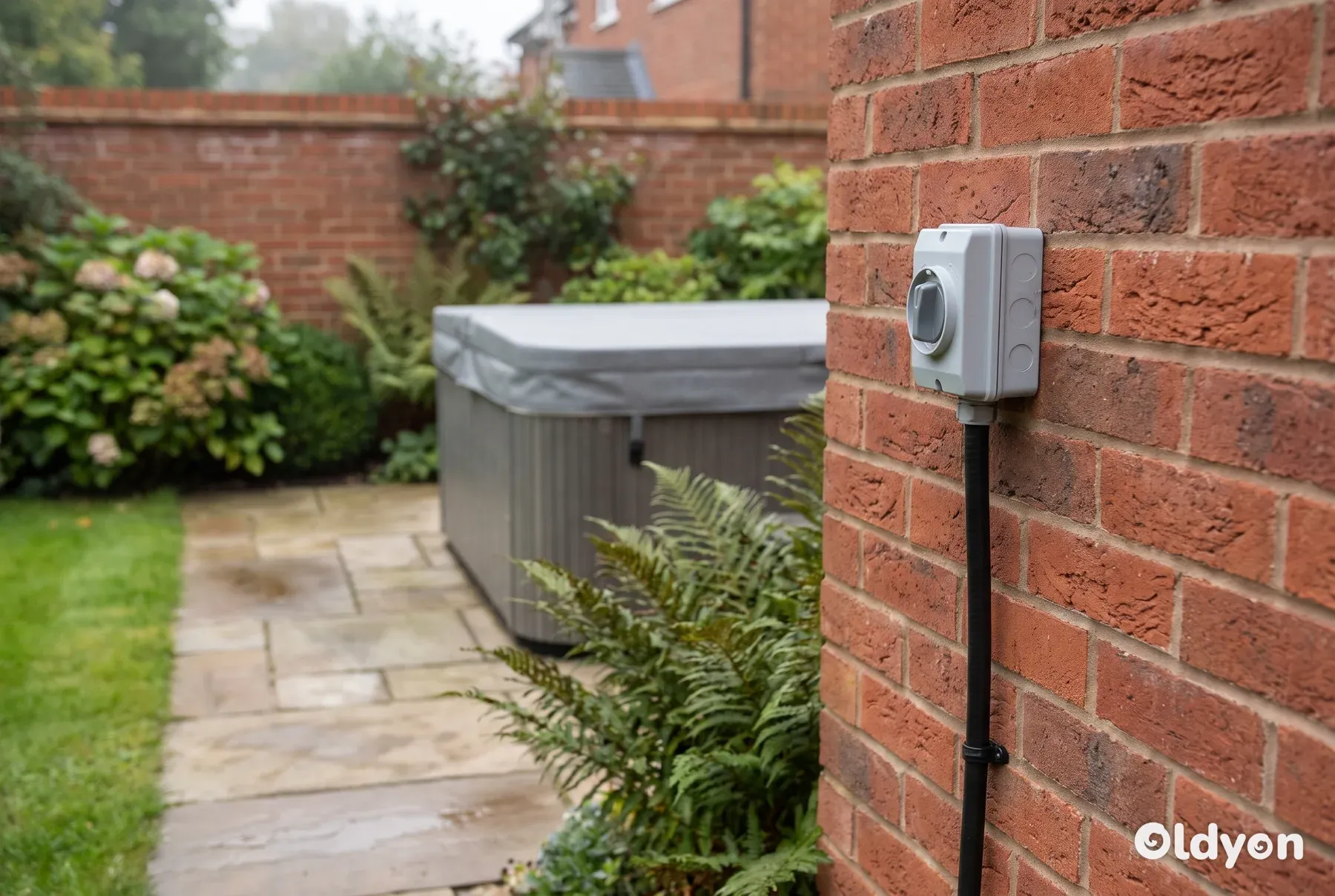
You also need a way to switch the tub off locally, usually a weatherproof rotary isolator. It should be within sight of the tub but out of reach of anyone sitting in the water. Many manufacturers and installers recommend at least 2 metres from the water's edge, but follow your manual and your electrician's advice. The full picture is in our guide to hot tub electrical requirements in the UK.
The isolator is there for emergencies as well as maintenance. If something goes wrong, anyone nearby can cut the power to the tub in seconds, without going back indoors to find the consumer unit. It also lets a technician work on the tub safely knowing the supply is off.
The government's guidance on Approved Document P sets out the electrical safety rules for homes in England. In Wales, Scotland and Northern Ireland, check the equivalent rules that apply where you live.
Does a higher amp rating mean higher running costs?
Not directly. Amps describe how much current flows at one moment. Your bill depends on energy used over time, measured in kilowatt hours (kWh). A 3 kW heater running for one hour uses 3 kWh, whether it is in a 13 amp tub or a 32 amp tub.
Most of a hot tub's energy goes into replacing heat lost through the cover, the shell and the water surface. A well insulated 32 amp tub with a good cover can cost less to run than a poorly insulated plug-in tub. The higher rating mostly means the tub heats up faster and keeps heating while the jets run.
Water volume matters too. Raising 1,500 litres of water by 1°C (about 1.8°F) takes about 1.75 kWh. A larger tub holds more water, so it needs more energy and more time to heat from cold, whatever its amp rating.
Most domestic hot tubs hold roughly 950 to 1,900 litres (about 250 to 500 US gallons). Compact two-seat tubs sit at the lower end, and large eight-seat tubs can reach around 2,250 litres (about 600 US gallons). This volume decides how much energy and time the first heat-up takes. Check your manual for the exact capacity of your tub.
Compare standby energy figures
When you compare tubs, check each manufacturer's published standby energy figure. It shows how much energy the tub uses simply to hold its temperature with the cover on, which is a fairer guide to running costs than the amp rating.
An efficient, well insulated model can use around half the energy of a poorly insulated one, and older, poorly insulated tubs can cost roughly double to run. Manufacturers may test in different conditions, so check how each figure was measured before you compare them.
What the first heat-up costs
Filling and heating a tub from cold has its own cost, separate from daily running. Warming 1,500 litres from about 10°C to 38°C takes roughly 49 kWh. At 25p per kWh, that is about £12, before any day-to-day running costs are added.
A worked running-cost example
To estimate your own costs, multiply the kWh the tub uses by your unit rate in pence per kWh. For example, a tub that uses 6 kWh a day at 25p per kWh costs about £1.50 a day, or about £45 a month. Your figures will depend on your tub, your tariff and the weather.
Do not work out costs by multiplying the heater's full rating by 24 hours. Once the water is up to temperature, the heater cycles on and off to replace lost heat, so real daily use is well below that figure. Our guide on how much electricity a hot tub uses walks through this in detail, with practical ways to bring usage down.
Keeping the tub at temperature while you are away for a long weekend costs only a few pounds. Using the same figures, three days at 6 kWh a day and 25p per kWh comes to about £4.50. That is usually cheaper than letting the water cool fully and paying for a full reheat when you return.
Ways to bring usage down
- Keep the cover on and in good condition whenever the tub is not in use.
- Choose a well-fitting, high-density foam cover. It is the single biggest factor in how long the heater has to run, and it is often quoted as cutting heat loss by up to around 75%, depending on the cover and the tub.
- Use economy or filter-cycle settings if your tub has them, and check that filter cycles are not running longer than needed.
- Keep the water at a steady temperature rather than letting it cool and reheating it each time.
- If you will not use the tub for several days, lower the set temperature by 2 to 3°C for a modest saving, but avoid a full cool-down and reheat.
- If you only use the tub at weekends, lowering the set temperature by about 3°C during the week is commonly estimated to cut energy use by roughly 10 to 15%. Results vary with the weather and the tub's insulation.
- Put an insulating ground mat or base under an inflatable tub to cut heat lost through the floor.
- When choosing a hard-shell tub, look for full-foam cabinet insulation, which reduces heat lost through the sides and base.
- Shelter the tub from wind, which strips heat from the cover and the cabinet.
- If your tariff has cheaper off-peak hours, check whether your control panel lets you schedule heating for those times.
- On a time-of-use tariff, schedule the filter cycles for the cheap overnight hours as well as the heating, for example between 11pm and 6am, if your control panel allows it.
What electrical mistakes should you avoid?
Most hot tub electrical problems come from shortcuts at installation. These are the mistakes technicians see most often.
- Using an extension lead or adaptor for a plug-in tub. They can overheat under a long, heavy load and are not designed for wet outdoor use.
- Running a plug-in tub from an indoor socket with the cable through a window or door.
- Connecting a hardwired tub to an existing ring circuit or spur instead of a dedicated circuit.
- Leaving out RCD protection, or bypassing the PRCD on an inflatable tub's plug.
- Using cable that is too thin for the load or the length of the run.
- Fitting the isolator inside the tub's cabinet or equipment bay, or within reach of the water. It must be reachable from outside the tub in an emergency.
- Choosing a tub before checking whether your supply can support it.
- Hiring someone who cannot certify the work, which can cause problems with insurance or when you sell the house.
- Wiring the tub yourself, or having it connected by someone unqualified. This usually voids the manufacturer's warranty, as well as putting your home insurance at risk.
Undersized cable deserves a special warning. It can run hot for months without any visible sign, slowly damaging its insulation, before it becomes a fire risk. You cannot judge cable size by eye, which is why it must be left to the electrician's calculation.
Call an electrician if the RCD trips repeatedly, if you notice a burning smell, scorch marks or a warm plug or isolator, or if the tub shows an error code relating to power or voltage. Switch the tub off at the isolator and do not keep resetting the breaker. The Electrical Safety First charity has clear advice on outdoor electrical safety at home.
If a breaker or RCD on the hot tub circuit trips more than once, treat it as a warning, not a nuisance. Switch off at the isolator, keep everyone out of the water, and have a registered electrician find the cause before you use the tub again.
Amps and your hot tub: the summary
Plug-in and inflatable tubs draw up to 13 amps and share power between heater and jets. Hardwired tubs usually need 16, 32 or 40 amps on a dedicated circuit, with 32 amps the most common. American figures of 50 to 60 amps do not apply to UK tubs.
Before you choose a hardwired tub, check your main fuse, your consumer unit and your other large loads, then ask a registered electrician to confirm your supply can cope. A correctly designed circuit keeps the tub safe, reliable and within its warranty.
Frequently asked questions
Can I plug a hot tub into my existing outdoor socket?
Only if the tub is designed for a 13 amp plug, and only if the socket is weatherproof, protected by a 30 milliamp RCD and on a circuit that can carry close to 13 amps for hours. Older outdoor sockets often share a circuit with indoor sockets. Ask an electrician to check the circuit before you rely on it, especially if it has ever tripped or the plug feels warm.
Can I use an extension lead with an inflatable hot tub?
No. Inflatable tub manufacturers generally tell you to plug directly into a suitable socket. An extension lead carrying a heavy load for long periods can overheat, and connections outdoors can let in moisture. If the socket is too far away, have an electrician fit a new weatherproof outdoor socket closer to where the tub will stand.
Can a hot tub be switched between 13 amp and 32 amp?
Some tubs can be configured for different supplies through settings or connections inside the control pack. This varies by model, and some tubs offer only one option. Any change must follow the manufacturer's instructions and be done by a qualified electrician, because the circuit, cable and protection must match the new rating. Check your manual before buying if you might upgrade later.
Why does my hot tub keep tripping the RCD?
Common causes include moisture in a connection, a failing heater element, a damaged cable, or the tub sharing an RCD with other circuits that also leak small currents. Switch off at the isolator and do not keep resetting it. A registered electrician or hot tub technician can test the circuit and the tub's components to find the fault safely.
Does a 32 amp hot tub cost more to run than a 13 amp one?
Not necessarily. Running costs depend on how much energy the tub loses as heat, which comes down to insulation, the cover, the weather and how you use it. A 32 amp tub heats faster because it can run the heater and jets together, but the energy needed to keep the water warm is similar. A well insulated tub with a good cover usually matters more than the amp rating.
Do I need to tell my energy supplier about a new hot tub?
Usually not for a typical installation. Your energy supplier sells you electricity but does not manage the cables to your home. If your electrician finds that your main fuse is too small, an upgrade is requested from your distribution network operator, which owns the local network. Your electrician can explain the process and whether it applies to you.
How long should I stay in a hot tub at 40°C?
This is a health limit, not an electrical one. At the maximum of 40°C (104°F), keep sessions to about 15 to 20 minutes, and less if you feel dizzy, sick or too hot. Hot water raises your core body temperature quickly, which can lead to heat exhaustion as well as dizziness and nausea. Take extra care if you are older, pregnant or have a heart condition, and speak to your GP or midwife first if you are pregnant or have a medical condition.
Filed under