Choosing a 4 person hot tub
Choosing a 4 person hot tub: compare layouts, loungers, footprint, plug and play power and family safety so four people really fit and stay comfortable.
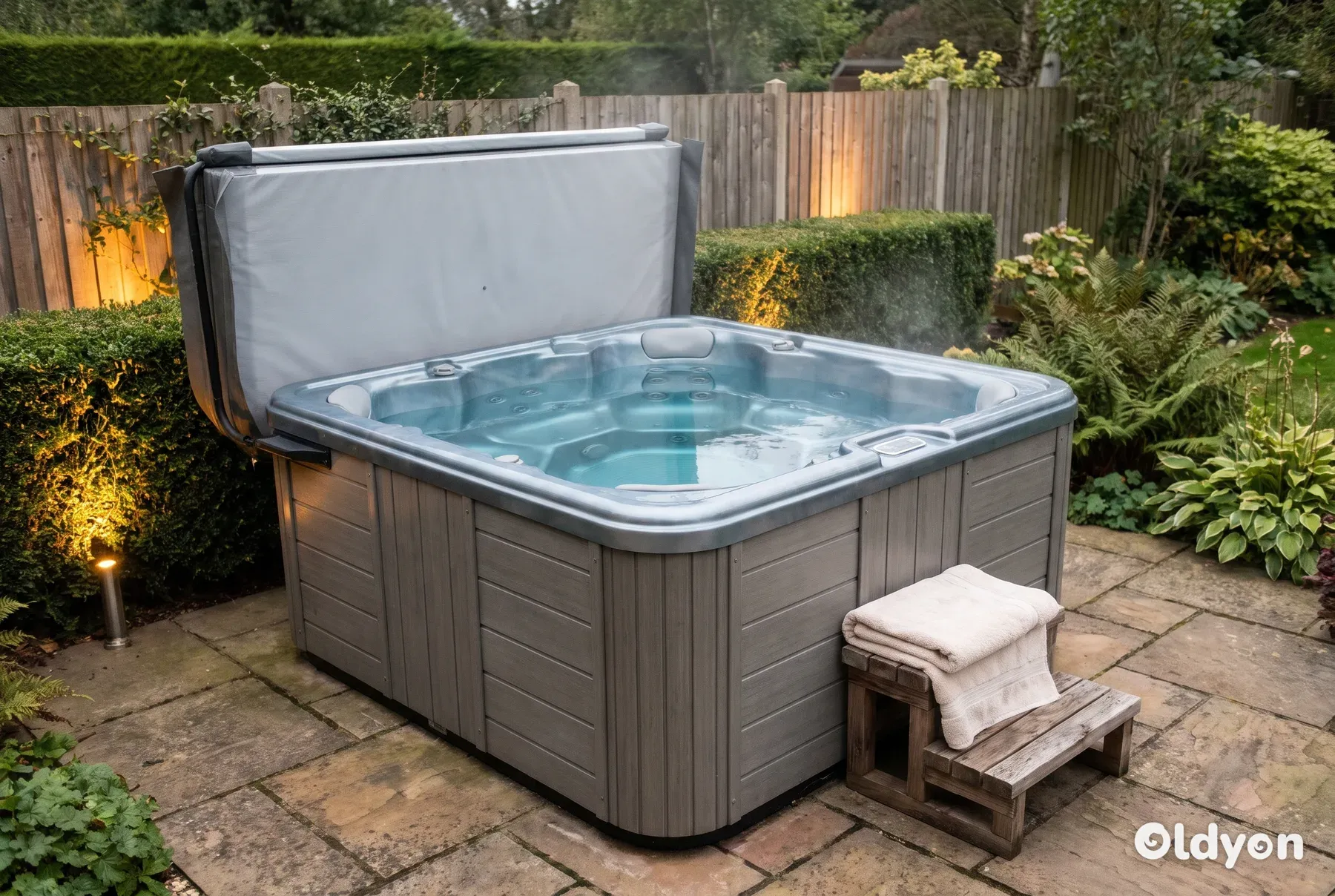
A good 4 person hot tub seats four adults without anyone sitting on a step or folding their legs. Look for a footprint of roughly 1.8 to 2 metres square, a layout that matches how you sit, and a power supply that can heat the water while the jets run. Check the seat count with a lounger counted honestly.
This guide covers seat layouts, how much space and weight to plan for, the difference between plug and play and hardwired tubs, and what changes when children use the tub. It also covers what to compare in the showroom and the mistakes that most often lead to regret.
What does 4 person actually mean on a hot tub?
The seat number on a hot tub is a manufacturer's figure, and there is no shared standard behind it. One maker may count every moulded seat, while another counts the space where four adults could fit if they sat close together. Two tubs both sold as four person can feel very different once you are in the water.
Many makers work out the rated number from a minimum shoulder width per person around the inside of the tub. That tells you how many people can physically fit side by side, not how many can sit back and relax. Treat the label as a maximum, not a comfort rating.
For inflatable tubs, the figure is often the maximum number of people who can squeeze in, not the number who will be comfortable. Inflatables have no moulded seats, so everyone sits on the floor with their backs against the wall. Four adults with long legs will tangle their feet in the middle.
A useful test is to ask how many people would use the tub together on an ordinary evening. If the answer is four adults, many owners find a tub sold as five or six person is more comfortable. If the answer is usually two, with guests now and then, a four seat tub is often the right size. Our guide to choosing a hot tub for couples covers that pattern of use in more detail.
- Count the moulded seats yourself, rather than relying on the label.
- Check whether the figure includes the cool-down seat or a step.
- Look at the footwell: four pairs of legs need room in the middle.
- Ask whether the capacity assumes adults or a mix of adults and children.
A better guide to comfort is the interior width, measured across the inside of the tub from wall to wall. An inside width of about 195 cm (77 in) gives four adults real elbow room. A tub of about 180 cm (71 in) inside is comfortable for two or three adults and snug for four.
The gap between those two sizes is only about 15 cm (6 in), but with four adults seated you will notice it. It decides whether legs meet in the middle and whether elbows touch along the wall. When two inflatables look similar, compare their inside widths before anything else.
Specification sheets often list the outside size first, and thick inflatable walls can take up a large share of it. Look for the inside measurement, and if it is missing, ask the seller for it before you compare tubs.
Which layout is better: all seats or a lounger?
Hard-shell tubs in this size usually come in two broad layouts. The first has four or five upright seats around the edge, often with different depths and jet patterns. The second swaps two seats for a full-length lounger, where one person lies back with their legs stretched out.
An all-seat layout suits social use, because everyone faces inwards and sits at a similar height. A lounger suits someone who uses the tub alone after work and wants jets along the back, calves and feet. Neither is better in general, so start with how you plan to use the tub most weeks.
When a lounger costs you a seat
In a tub of around 2 metres (about 6.5 feet), a lounger takes up the length of one side and part of the footwell. That space could otherwise hold one or two upright seats. A four person tub with a lounger therefore often seats three adults comfortably, plus a fourth person who sits with their feet tucked to avoid the lounger.
Loungers also do not suit every body. Shorter people can slide down or float up, because water makes your body buoyant and the foot rest may be out of reach. Taller people may find their feet hit the far wall before their back reaches the jets. If you can, sit in a lounger in a filled showroom tub before you decide.
- Choose a lounger if one person often uses the tub alone and wants to stretch out.
- Choose all seats if four adults will regularly use the tub together.
- Avoid a lounger if the household includes both very tall and very short users.
- Remember that the person in the lounger faces away from part of the group.
Seat depth, corners and the footwell
Good four seat layouts usually offer seats at different depths. A deeper seat brings the water up to your shoulders, which helps on cold nights. A shallower seat, or a raised cool-down seat, lets you sit with your shoulders out of the water when you feel too warm.
Corner seats tend to be the roomiest, because the wall curves around you. Seats in the middle of a side can feel narrow when the people next to you are larger. Check the footwell too: if it is small, four people will end up with their knees bent and their feet touching.
Square or round?
Square tubs let people tuck into the corners, so the inside often feels roomier for the same seat count. A square shape also fits more neatly against a wall or fence, which leaves less wasted space in a small garden.
Round tubs seat everyone along one continuous curve, so everyone faces the middle. However, a round tub usually takes more floor space for the same number of seats. With four adults, the curve can also feel more cramped, because shoulders and knees meet sooner.
How much space does a 4 person hot tub need?
Most hard-shell tubs in this size have a footprint of roughly 1.8 to 2 metres square (about 6 to 6.5 feet). Inflatable four person tubs are often round or square with an outside size of a similar range, though the inside space is smaller because the walls are thick. Always check the exact measurements on the specification sheet.
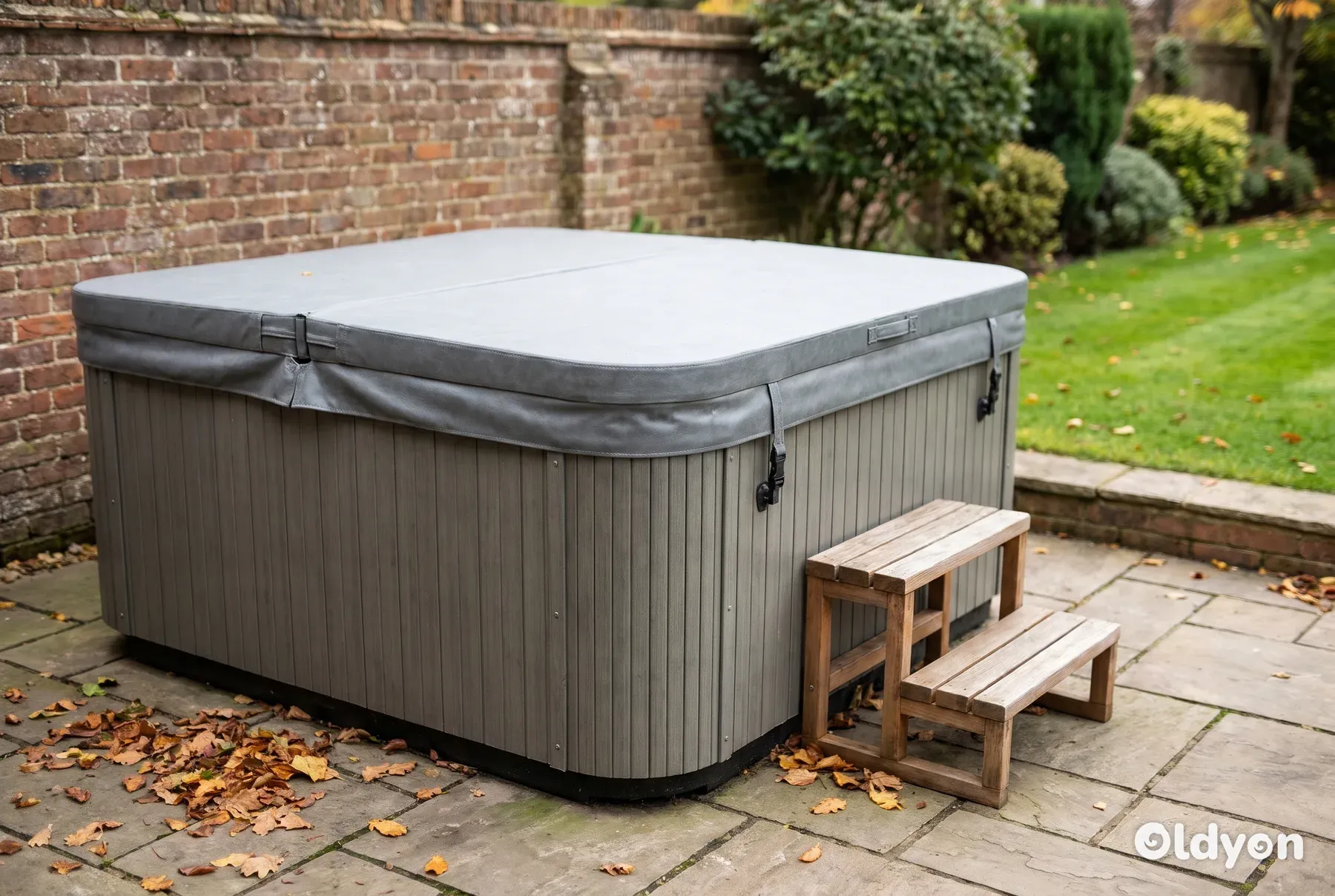
The tub itself is only part of the space you need. Allow room on at least one side for steps, room to lift and fold the cover, and access to the side panel that hides the pump and controls. Technicians need to reach that panel for repairs, so do not push the tub hard against a wall or fence on the service side. Our article on hot tub dimensions and how much space you need gives clearances for each part.
Delivery and access
Hard-shell tubs are heavy and bulky even when empty, so plan for professional delivery and installation. Delivery teams often move the tub on its side on a trolley, which needs a wide, firm path.
- Measure gates, side passages and doorways along the whole route to the final position.
- Look for tight corners, steps, low branches and overhead cables that could block the way.
- Ask the retailer what width and height the tub needs when it is on its side.
- Ask whether a crane or lifting service is needed if there is no clear route, and what it costs.
Weight and the base
Water weighs about 1 kilogram per litre. A four person hard-shell tub often holds somewhere around 800 to 1,200 litres, depending on the model. At 1,000 litres (about 260 US gallons), the water alone weighs about 1 tonne, before you add the tub and four people.
That load needs a flat, level and solid base, such as a concrete slab, a properly built paving base or a purpose-made spa pad. A tub on uneven ground can crack its shell or stress its frame over time. Inflatables also need a level surface, free of stones, as sharp objects can damage the floor.
Never put a filled hot tub on a raised deck, balcony or roof terrace unless a structural engineer has confirmed it can carry the full weight of the tub, the water and the people using it.
Inflatable or hard-shell: which suits four people?
Inflatable tubs are the cheapest way in. They are light, quick to set up and can be packed away for winter. The trade-offs are less insulation, fewer and weaker massage jets, no moulded seats and a shorter working life.
Hard-shell tubs come in two main types. Rotomoulded tubs have a single moulded plastic body and are often sold as plug and play. Acrylic tubs have a shiny moulded shell over a frame, usually with more jets, better insulation and a dedicated electrical supply.
Type | Usual power supply | Winter use | Rough price band |
|---|---|---|---|
Inflatable | 13 amp plug | Slow to heat, loses heat faster | Hundreds of pounds |
Rotomoulded hard-shell | 13 amp plug, sometimes hardwired | Fair, depends on insulation | Low thousands |
Acrylic hard-shell | Hardwired dedicated circuit | Best, if well insulated | Several thousand upwards |
Prices vary widely between makers and retailers, so treat these bands as a rough guide only. A cheap tub with poor insulation can cost more to run every year, which narrows the gap over time. Compare the full cost, including the cover, base and electrical work.
Water jets or air bubbles
Hard-shell tubs use water jets: a pump pushes pressurised water through nozzles aimed at particular muscle groups, such as the shoulders, lower back and calves. Inflatables push air bubbles through the water instead, which gives a gentler, full-body effect rather than a targeted massage. If you are new to hot tubs, check which one you are buying, as the two feel very different.
On hard-shell tubs, the number of pumps matters as much as the number of jets. A tub with two or more pumps can keep the pressure steady across all jet zones at once. A tub with a single pump has to share its flow, so the pressure drops when the jets are split between several seats, which four people will notice.
Adjustable jets help when four different people share the tub. Jets that each bather can aim, or turn up and down by twisting the face, let a tall adult and a smaller teenager both set a massage that suits them. Check how many of the jets in each seat can be adjusted, not just the total jet count.
How inflatable walls are built
The wall construction of an inflatable decides how well it resists punctures and how firmly it holds its shape with four people leaning on it. Look for reinforced, laminated or multi-layer PVC rather than a single thin layer.
Inside the wall, internal beams or drop-stitch construction tie the inner and outer surfaces together. This keeps the walls straight and firm, so they do not bulge or sag when the tub is full. Walls without this support can feel soft and may lose shape over time.
Depth and getting in
Depth affects both access and comfort. Shallower inflatables, around 63 cm (25 in) deep, are easier to step into, which helps anyone with limited mobility. The trade-off is less full-body immersion than a tub around 71 cm (28 in) deep, which covers more of your body when you sit.
Lifespan and moving house
Working life differs sharply between the two types. With good care, an inflatable typically lasts roughly 3 to 7 years, while a well maintained hard-shell tub can last 15 to 20 years. Figures vary by maker and by how the tub is used, so read the warranty to see what each manufacturer expects.
Inflatables are easy to move. The built-in pump usually inflates the tub in roughly 20 to 30 minutes, and once drained it can be deflated and folded away within minutes. That suits renters, or anyone who may move house in the next few years.
Is a plug and play hot tub enough for four people?
A plug and play tub runs from a standard 13 amp socket. That supply has limited power, so the heater and the jet pump often cannot run at full power at the same time. On many models, the heater switches off while the jets are on high, and the water slowly cools during a long session.
With two people for 20 minutes, that rarely matters. With four people on a cold evening, and the cover off for longer, the temperature can drop noticeably. If you expect regular full sessions in winter, a hardwired tub that heats and pumps together is often the better choice. Our guide on how to choose a 13 amp plug and play hot tub explains how to read the heater and pump ratings.
Budget for the wiring as well as the tub. Hardwiring adds an electrician's cost on top of the purchase price, typically several hundred pounds, and more if the tub sits far from the consumer unit. A plug-in inflatable needs no electrical work, as long as you already have a suitable RCD-protected outdoor socket.
UK electrical rules
In the UK, hot tub electrics must meet the wiring regulations, BS 7671. Even a plug and play tub should be plugged into an outdoor socket protected by an RCD (residual current device). A hardwired tub needs its own dedicated circuit, often rated somewhere between 16 and 32 amps, so check the manufacturer's specification.
Use a registered electrician for any new circuit or outdoor socket. In England and Wales, this kind of work falls under Part P of the Building Regulations, and a registered electrician can certify it for you. Other countries have their own rules, so check with a local qualified electrician. The charity Electrical Safety First has clear guidance on outdoor electrics.
Do not run a hot tub from an extension lead or a cable reel. Plug it directly into a weatherproof, RCD-protected outdoor socket, and switch off at the isolator before removing any panel or touching the equipment.
Is a 4 person hot tub good for a family?
Many families find four seats work well for two adults and two children. Children take up less space, so a tub that is tight for four adults can be comfortable for a family. Seats at different depths help, because a child on a shallow seat can keep their head and shoulders well clear of the water.
Children overheat faster than adults, so keep their sessions short and the water cooler. Many manufacturers advise a lower temperature for children and give a minimum age, so check your manual. Always supervise children in and around the tub, and lock the cover when it is not in use.
- Keep the water no hotter than 40°C (104°F) for adults, and cooler for children.
- Make sure children can sit with their feet on the floor or on a seat, not standing on tiptoe.
- Stop the session if anyone feels dizzy, sick, too hot or unwell.
- Do not let children put their heads under the water or play near the suction fittings.
- Use a lockable cover and keep steps away from the tub when it is closed.
- Look for a child lock on the control panel, which stops children changing the temperature or other settings.
Warm water may ease joint stiffness for some people with arthritis, because buoyancy takes some of the load off the joints. However, some people with psoriatic arthritis find that water above about 38°C (about 100°F) can trigger a flare. Anyone with arthritis should ask their GP about a suitable temperature and session length, and stop if their joints become more painful.
If anyone in the family is pregnant, or has a heart condition or high or low blood pressure, they should speak to a GP or midwife before using a hot tub. The NHS has guidance on hot water and pregnancy among its pregnancy pages.
Water care with more bathers
A smaller tub holds less water, so each person has a bigger effect on the water. Four people in 800 litres use up sanitiser faster than two people in the same tub. Test the water before each use and keep it in range: free chlorine 3 to 5 ppm, or bromine 3 to 5 ppm, with pH 7.2 to 7.6 and total alkalinity 80 to 120 ppm.
Ask everyone to shower before getting in, as this removes much of the sweat, lotion and dirt that cloud the water. The HSE publishes guidance on keeping hot tub water safe in its Legionnaires' disease pages.
Inflatable filter cartridges need replacing after a set number of hours of use, around 120 hours on some models. With four people using the tub often, you reach that point sooner. Some control panels show a reminder or a filter alarm, so check your manual to see how your model signals it.
What does a 4 person hot tub cost to run?
Running costs depend mostly on insulation, the cover, the weather, how often you use the tub and your electricity tariff. A well insulated hard-shell tub with a thick, well fitted cover loses heat slowly. An inflatable on a cold winter night can lose heat quickly and run its heater for much longer.
The difference grows in winter. As a rough guide, a poorly insulated tub in cold weather can cost around two to three times as much per month to run as a well insulated tub in milder conditions. Actual figures vary with the tub, the weather and your tariff, but insulation pays back most in the coldest months.
To estimate your own cost, find the heater's power in kilowatts on the specification sheet. Multiply that by the number of hours it is likely to run, then by your unit price per kilowatt hour. The result is only an estimate, but it helps you compare two tubs fairly.
- Look for full-foam or multi-layer insulation in the cabinet.
- Check that the cover is thick, tapered for rain and seals well at the edges.
- Ask whether the tub has an insulated floor tray, which stops heat escaping into the base.
- Keep the cover on whenever the tub is not in use, and replace it when it becomes waterlogged.
How the tub heats also matters. Circulation heating, where the water is warmed as it flows through the filter loop, is more efficient than heating it separately. A well fitted insulated cover can cut energy use noticeably on any type of tub.
Some inflatables include a smart controller or app, plus a power-saving timer that can schedule the water temperature days ahead. Used well, this avoids heating the tub when nobody will use it and has it warm when you want it, which can cut running costs.
Size also matters. A smaller tub holds less water to heat, which is one reason four person tubs suit many gardens. If you only ever use the tub as a pair, our guide to 3 person hot tubs and who they really suit may help you decide whether to go smaller.
Inflatables in freezing weather
Inflatable tubs generally cannot be left to cope with sub-freezing weather on their own. Frozen water can damage the pump, the heater and the pipework. Many manuals give a minimum air temperature for use, so check yours before winter.
- Use an insulated cover and keep it on whenever the tub is not in use.
- Soak less often during spells of extreme cold, as every session lets heat escape.
- Look for a freeze-protection mode that runs the heater and pump automatically in cold weather.
- In a hard winter, drain, dry and store the tub until the weather improves.
How should you compare tubs before you buy?
Specification sheets help, but sitting in a tub tells you more. Many dealers will let you try a filled tub, often called a wet test. Bring the people who will use it most, and follow these steps.
- Measure your space, including room for steps, the cover and the service panel, before you visit.
- Shortlist tubs by their interior dimensions, not the advertised person count, because two tubs of very different sizes can both claim to seat four adults.
- Count the seats yourself and decide honestly how many adults will fit at once.
- Sit in every seat, including the lounger, and check whether your feet reach the floor or foot rest.
- Ask whether the heater runs while the jets are on high, and for how long.
- Check the power supply needed and get a quote from a registered electrician if it is hardwired.
- Ask about the cover, insulation and floor, and how each one is built.
- Read the warranty for the shell, the equipment and labour, as each is often covered separately.
- Confirm how filters are changed and how easy it is to drain the tub.
Features worth checking
Inflatable warranties are often short, commonly around one year. Check the length, and read what it actually covers: the liner, the seams, the pump and heater unit may each be treated differently. Some warranties also exclude punctures or frost damage, so read the terms before you buy.
If you live in a hard-water area, plan for limescale. Scale builds up in the heater, pipes and jets, restricts water flow and shortens the life of the equipment. Look for a built-in hard water treatment feature, or plan a scale-control routine and keep calcium hardness around 150 to 250 ppm.
With an inflatable, check what comes in the box, because buying extras separately adds up. Useful items to look for include:
- A cover with a child lock.
- Spare filter cartridges.
- A repair kit for punctures.
- A non-slip floor mat or ground cloth, which also protects the base from abrasion by sharp stones.
- A chemical floater for sanitiser tablets.
A well-known make has another advantage: replacement pumps, covers and filter cartridges are usually easy to find. An unbranded tub may be cheaper at first, but it may have limited warranty support and no parts network when something fails.
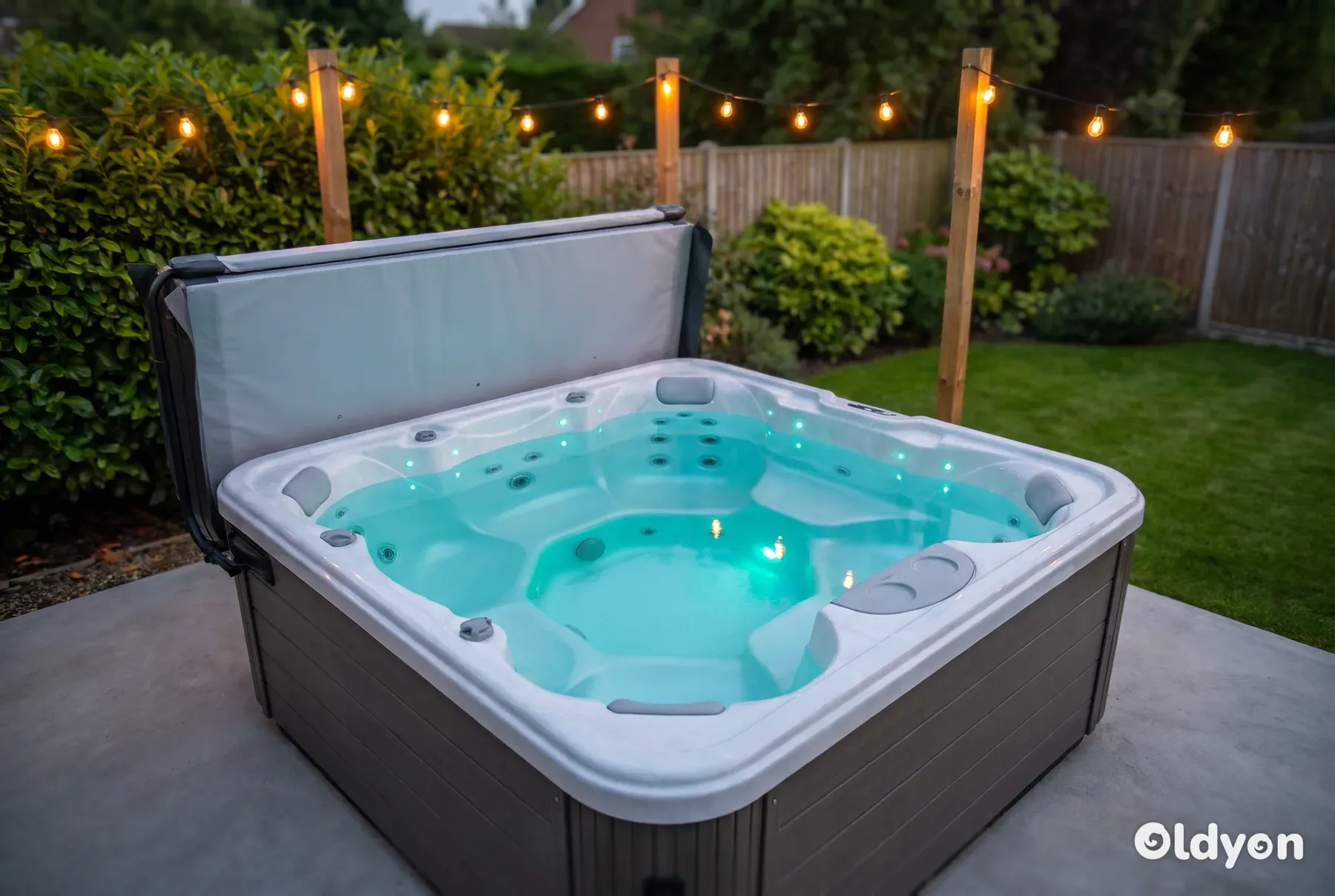
Think about comfort extras for long soaks too. Contoured headrests, LED mood lighting, Bluetooth audio and a waterfall feature are all available on many tubs. Headrests in particular are often missing from budget inflatables, so check for them if you like to lean back.
Common mistakes to avoid
- Trusting the seat count without checking how many adults really fit.
- Choosing a lounger for looks when four adults will use the tub most of the time.
- Forgetting the weight of the water when planning the base.
- Buying plug and play for heavy winter use with four people, then finding the water cools.
- Leaving no room to reach the service panel.
- Ignoring the cover, which does much of the work of keeping heat in.
- Buying an inflatable without checking how easily the pump unit and the seams of the PVC bladder can be repaired or replaced, as these are the commonest failure points.
If your household is growing, or you often have friends round, look at a larger tub before you settle. Our guide to choosing a 6 person hot tub explains what the extra space gives you and what it costs.
Choosing a 4 person hot tub in short
Count the seats yourself, and expect a lounger to cost you about one seat. Plan for a footprint of roughly 2 metres square, a base that can carry about a tonne of water, and room to reach the service panel.
Plug and play suits couples and small families who use the tub in short sessions. A hardwired tub suits four adults using it often in winter. Either way, use a registered electrician, keep children's sessions short and cool, and sit in the tub before you buy if you can.
Frequently asked questions
Can four adults fit comfortably in a 4 person hot tub?
Often yes, but it depends on the layout and the people. An all-seat hard-shell tub of around 2 metres usually fits four adults if the footwell is roomy. A lounger layout often fits three adults comfortably. Inflatables sold as four person can feel tight for four adults with long legs. If four adults will be the normal group, try a five or six seat tub too.
How long does a 4 person hot tub take to heat up?
It depends on the heater power, the water volume, the starting water temperature and the weather. As a rough guide, an inflatable often takes around 8 to 12 hours to reach 40°C from a fresh fill, while a hardwired hard-shell tub takes about 3 to 6 hours. Fill on a mild day if you can, keep the cover on, and check the manufacturer's figures, which are usually given for set conditions.
Why does my inflatable hot tub heat so slowly?
Inflatable heaters are small. A heater of about 1,350 W typically raises the water only about 1 to 1.5°C per hour, and running the heater and the bubble function together slows heating further. To speed things up, start with warm fill water if your supply allows it, keep the cover on, and leave the bubbles off until the water reaches temperature.
Do I need planning permission for a hot tub?
In most UK gardens, a portable hot tub does not need planning permission, but there are exceptions. Listed buildings, conservation areas, flats and tubs inside new buildings such as gazebos may need consent. Rules also differ between England, Scotland, Wales and Northern Ireland. Check with your local council before building a base or structure, especially if it is close to a boundary.
Can I put a 4 person hot tub on grass or gravel?
Not directly. Grass sinks unevenly under a tonne of water and can hold damp under the tub. Loose gravel can shift and press into the floor. A concrete slab, a well laid paving base or a purpose-made spa pad on firm, level ground is much safer. Check your manual, as some warranties require a specific type of base.
Is a 4 person hot tub cheaper to run than a 6 person tub?
Usually, because it holds less water and has a smaller surface to lose heat from. However, insulation and the cover matter more than size alone. A well insulated six seat tub can cost less to run than a poorly insulated four seat one. Compare heater power, insulation type and cover quality, then estimate using your own tariff.
How often should I change the water in a 4 person hot tub?
Many manufacturers suggest draining and refilling every three to four months, but heavy use shortens that. Four people using a small tub often adds more sweat and lotion, so the water may need changing sooner. Signs include cloudy water that will not clear, foam, or sanitiser that disappears quickly. Your manual gives the interval for your model.
Filed under