How to remove a stuck hot tub filter
Learn how to remove a stuck hot tub filter: why filters jam, gentle methods with the power off, how to protect the standpipe and stop it sticking again.
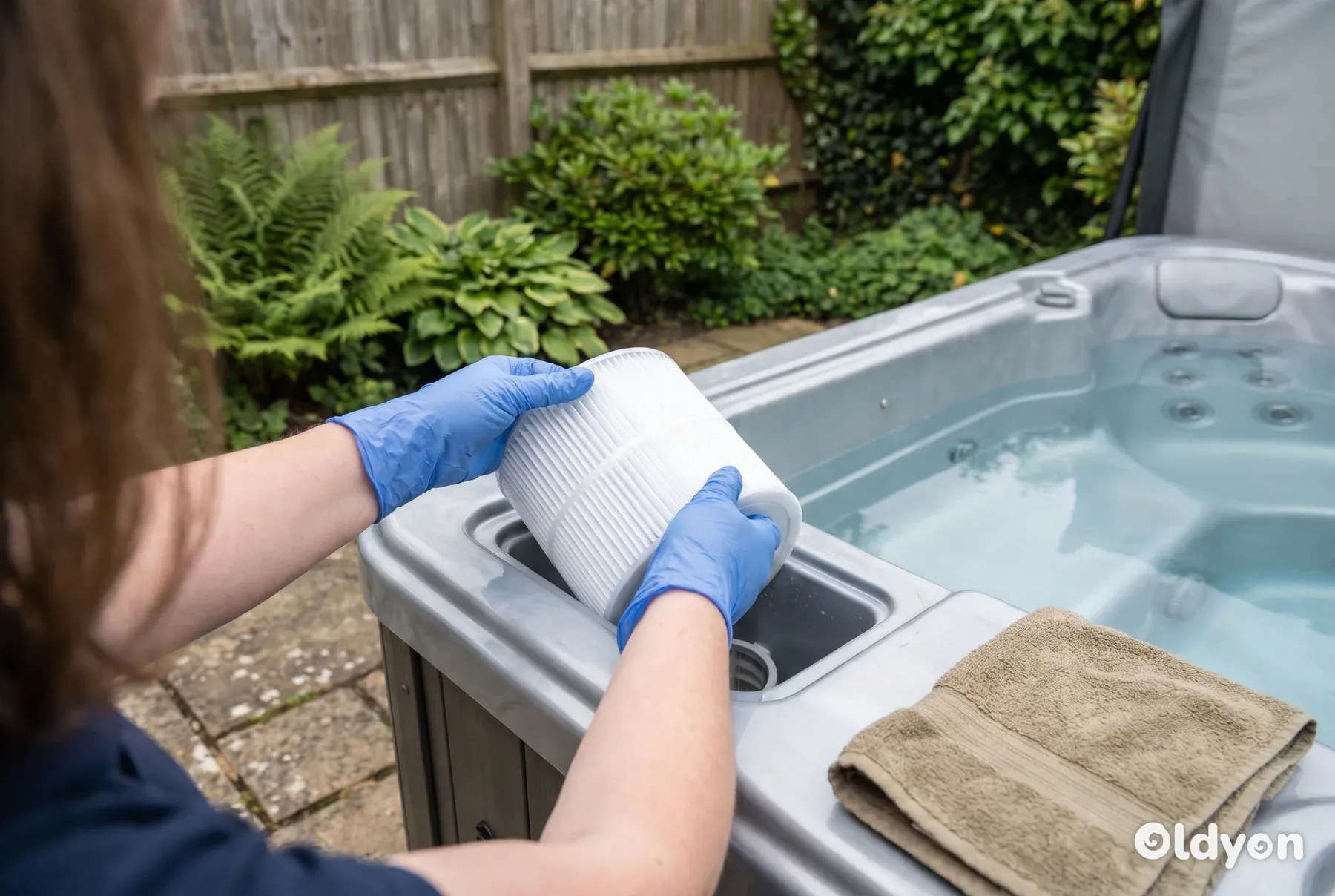
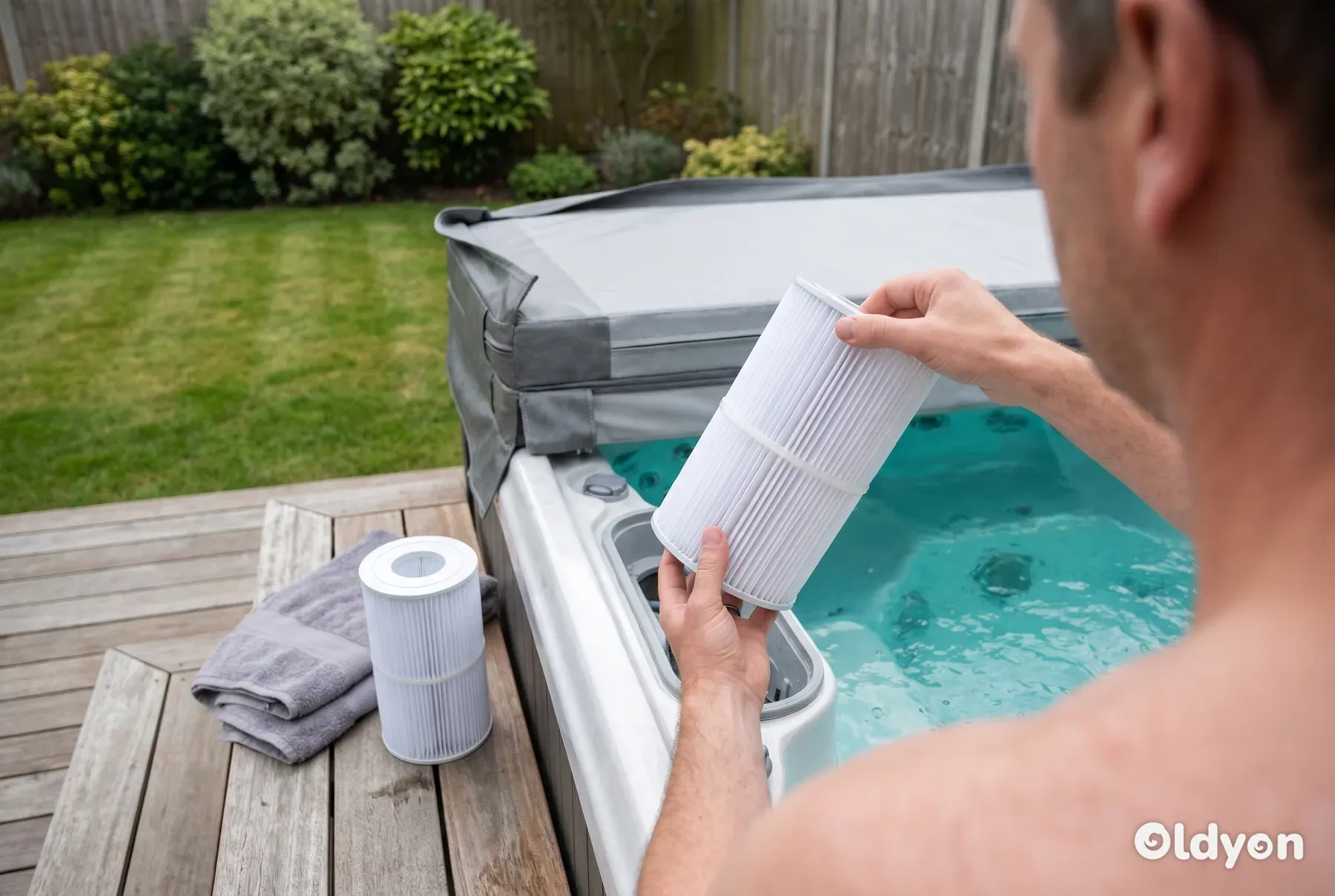
To remove a stuck hot tub filter, switch the tub off at the isolator, wait a few minutes for the suction to settle, then grip the filter low down near its base and turn it anticlockwise with steady pressure. If that fails, use rubber gloves, warm water or a strap wrench, and never use a tool that levers against the standpipe.
Most stuck filters come free with patience rather than strength. The real risk is not the filter but the plastic standpipe it screws onto, which can crack if you force it. Below you will find why filters jam, how to escalate gently, what to do if something breaks, and how to stop it happening again.
Why does a hot tub filter get stuck?
Filters rarely stick for just one reason. Usually two or three small things combine, and working out which ones apply to your tub tells you which removal method is most likely to work.
- Suction: the pump pulls water through the filter, and the pressure difference can hold the filter firmly against its seat while the tub is running or just after it stops.
- Scale: in hard water areas, mineral deposits can build up on the threads and around the seal, cementing the filter in place over time. Hot tub scale is mostly calcium, but magnesium deposits form part of it too, so hard water carrying either mineral can lock the threads together.
- Overtightening: a filter screwed in hard, often by someone worried about leaks, can bind on its threads after a few weeks in warm water. It also squashes the O-ring at the base of the filter against the housing, creating a near-airtight seal that makes the next removal much harder.
- Cross-threading: a filter that was screwed on at a slight angle at its last fitting can feel seized even if very little force was used, because the threads are jammed against each other rather than meshing properly.
- Long gaps between removals: a filter left in place for six months or more builds up layers of scale, biofilm and compacted debris that bond it to its seat, so infrequent removal is a cause in its own right.
- Grit and debris: sand, hair or small pieces of leaf caught in the threads act like a wedge and make the filter drag as you turn it.
- Heat and time: plastic parts that sit at 37-40°C (99-104°F) for weeks can settle slightly and grip each other more tightly than when they were fitted.
- A dry or swollen seal: an O-ring or gasket that has dried out, or swollen from contact with the wrong products, can drag against the housing.
If the filter only sticks while the tub is running, suction is almost certainly the cause and switching off will solve it. If it is still stuck with the power off and the water settled, the cause is more likely to be scale, overtightening, cross-threading or grit in the threads.
What should you do before you touch the filter?
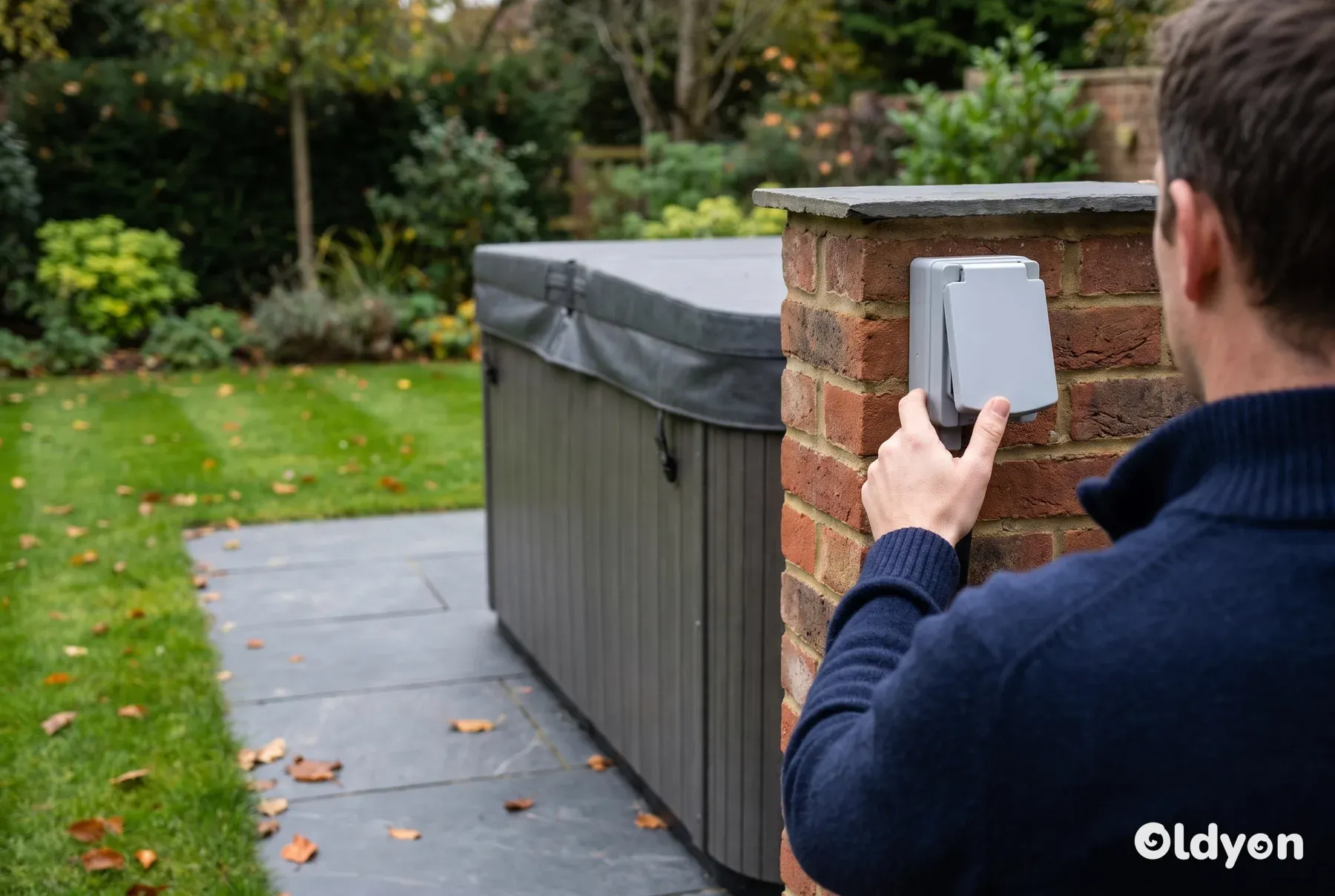
Switch the hot tub off at the isolator switch before you put your hands into the filter compartment, not just at the control panel. A control panel can restart a pump or filtration cycle on its own, and you want no suction and no moving water while you work.
If your tub has no separate outdoor isolator switch, or you cannot find it, switch off the hot tub's dedicated circuit breaker (an MCB or RCBO) in the consumer unit instead. The spa's own power button on the control panel is not enough, because it leaves the electronics live and able to start the pump.
Once the power is off, wait five to ten minutes. This lets the water settle and any remaining suction around the filter release. Many filters that feel welded in place with the pump running lift out easily once the system is quiet.
Before you reach into the filter well, confirm that nothing is circulating. Listen for any pump noise, and look at the water around the filter and the jets for movement. If you hear the pump or see water moving, check the isolator again before going any further.
Next, remove any parts that sit on top of or around the filter. Depending on your tub, that may be a weir door, a skimmer basket, a floating weir, a filter lid or a locking ring. It is surprisingly common to fight a filter that is actually being held down by a lid or clip that has not been released.
Put on gloves before you handle the filter. As well as improving your grip, they protect your hands from sanitiser and chemical residue that collects on the filter. Rubber washing-up gloves work well, and nitrile gloves are a good alternative if you prefer a closer fit.
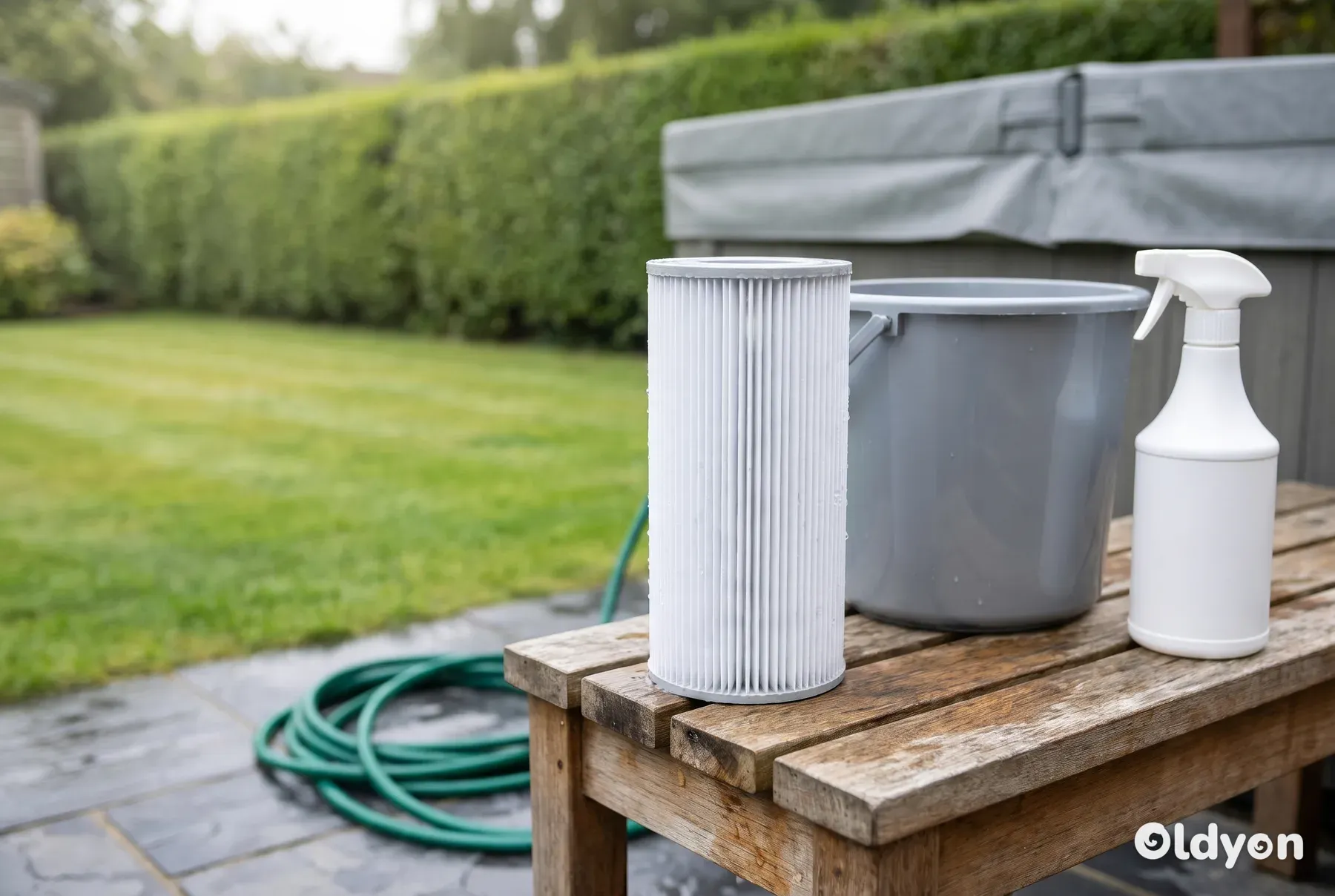
Finally, put a towel and a bucket within reach. A wet filter full of water is heavier than you might expect, and you will want somewhere to set it down. If you have never had the filter out before, look at the diagram of the filter compartment in your manual so you know what you are dealing with.
Which way does a hot tub filter unscrew?
Most screw-in hot tub filters undo anticlockwise when you look down at them from above, in the same way as a jar lid. Turn to the left to loosen and to the right to tighten. Some lids and end caps have an arrow moulded into the plastic to confirm the direction.
If the filter will not turn anticlockwise, do not assume it has a reverse thread and force it clockwise. Turning it clockwise only tightens it further and makes the job harder. Move on to warm water or a strap wrench instead.
Not every filter screws in, though. Before you apply real force, check which type of fitting you have, because twisting a filter that is not designed to turn can damage the filter, the housing or both.
Common filter fittings
- Threaded standpipe: the filter has a threaded end cap that screws onto a plastic pipe rising from the bottom of the filter well. This is the type most likely to jam.
- Push-fit or drop-in: the filter sits on a spigot or in a recess and is held in place by a lid or weir. It lifts straight up and does not turn at all.
- Twist-lock or bayonet: common on inflatable and some portable tubs, the filter or its housing turns a short distance, often about a quarter turn, then lifts out.
- Filter canister: some tubs have a sealed canister with a screw-on lid. In this case it is often the lid that sticks rather than the filter itself.
If you cannot find your manual, check the manufacturer's website for your model, or compare your filter with a replacement of the same size to see whether its end cap is threaded. Knowing the fitting type before you start saves a lot of wasted effort.
How to remove a stuck hot tub filter step by step
Work through the methods below in order, starting with the gentlest. Each one adds a little more grip or loosening power, and most filters come free at the first or second stage. If a method has not worked after a few firm attempts, move on to the next rather than repeating it harder.
Set aside roughly 15 to 30 minutes to work through the methods. Having that time available means you are not tempted to rush, which is when people use too much force and damage the standpipe.
Method 1: Rubber gloves and a low grip
- Make sure the tub is off at the isolator and the water has settled for at least five minutes.
- Put on rubber washing-up gloves, nitrile gloves or textured gardening gloves. They stop your hands slipping on wet plastic and pleats.
- Reach down and grip the filter as low as you can, around the bottom end cap rather than the top. Twisting from the top twists the pleated material and can tear it away from the end cap.
- Turn steadily anticlockwise with firm, even pressure. Avoid sudden jerks.
- If the filter moves even slightly, rock it a little back and forth, then continue anticlockwise. Small movements help to break scale and grit free from the threads.
- Give each attempt about 30 seconds of firm, steady effort. If the filter has not moved by then, go to the next method rather than pushing harder.
Method 2: Warm water around the base
Plastic is slightly more flexible when warm, which can help a tight thread let go. This method does not always work, but it is gentle and costs nothing, so it is worth trying before you reach for tools.
There is a second reason warmth helps. The filter end cap and the standpipe or housing are often made from slightly different plastics, and these expand by different amounts when they warm up. That small difference can open a tiny gap in the threads and crack the scale seal between them, with little or no extra force from you.
- If the tub has been switched off and cooled, or the filter is stuck in cold weather, let the water heat back up to its normal temperature first, then switch off at the isolator again before you reach in.
- If the tub is drained or the filter well is above the water line, pour about 4-8 litres (about 1-2 US gallons) of hot tap water slowly over the base of the filter. Aim for about 49-54°C (120-130°F), similar to a very hot shower, and keep it below 60°C (140°F), because hotter water can warp the plastic parts. Never use boiling water from a kettle.
- Wait three to five minutes for the heat to soak through the housing and reach the end cap and the threads. Allow the full five minutes if the plastic is thick or the weather is cold, because the warmth takes longer to get through.
- Grip low with gloves and try turning anticlockwise again with steady pressure.
- If the filter still does not move, repeat the pour once, wait another three to five minutes, then try again.
If you cannot pour water onto the joint, for example because the filter sits in a narrow or awkward recess, soak a cloth in hot water of the same temperature and wrap it around the base of the filter. Leave it for a few minutes to warm the threads, then try turning again.
Do not use boiling water, a heat gun or a hairdryer on the filter compartment. Too much heat can warp the standpipe, distort the filter end cap or damage the shell around the filter well. A hairdryer near water is also an electrical hazard.
Method 3: A strap wrench
A strap wrench uses a rubber or fabric band that wraps around an object and tightens as you turn the handle. It spreads the force evenly around the end cap instead of pinching one point, which is exactly what plastic needs. Oil filter strap wrenches and plumbing strap wrenches both work, and some manufacturers sell their own filter removal tool.
- Wrap the strap around the lowest part of the filter, ideally the solid plastic end cap rather than the pleats.
- Pull the strap snug so it cannot slip when you turn.
- Turn the handle anticlockwise with smooth, steady pressure, using your other hand to keep the top of the filter upright.
- Hold the pressure for 5-10 seconds, then release and re-grip. Repeated short efforts are safer than straining continuously.
- If you feel the whole assembly flexing, or hear creaking from below the filter, stop. This usually means the standpipe is twisting or bending rather than the filter turning.
- Once the filter starts to turn, take the wrench off and finish unscrewing it by hand, so you can feel any resistance and stop if it binds again.
Avoid metal pipe grips, locking pliers and adjustable spanners. Their jaws crush plastic end caps and concentrate force in one small area, which is a common way to crack both a filter and a standpipe.
Method 4: Loosening scale with a mild acid
If you live in a hard water area and can see a white, chalky crust around the base of the filter, scale is probably what is holding it. A mild acid can soften the deposit, but only if it can reach the threads without being diluted into a full tub of water.
Stick to white vinegar or a cleaner made for spa filters. Do not use household limescale removers, rust removers or strong acid cleaners, because they can damage the filter media and contaminate the hot tub water.
White vinegar works because it dissolves the calcium carbonate that makes up most scale, while being mild enough not to harm the ABS plastic used in filter end caps and housings. Stronger acid cleaners can attack that plastic, which is why vinegar is the safer choice here.
- Lower the water level until it sits just below the base of the filter, using a submersible pump or your normal draining method. If that is not practical, skip this method, because the acid will simply disperse into the tub.
- Mix roughly equal parts white vinegar and warm water, or use a spa descaler or filter cleaner according to its label.
- Pour or spray the solution slowly around the joint where the filter meets the standpipe.
- Use a small brush or sponge to work the solution into the threads at the base of the filter.
- Leave it for 15 to 30 minutes so it can work into the scale.
- Rinse the solution off the joint with clean water before you try turning the filter, so that as little acid as possible ends up in the tub water.
- Try again with gloves or a strap wrench, using steady anticlockwise pressure.
- Once the filter is out, rinse the threads and filter well with clean water, refill if needed, and test the water. Acidic products lower pH, so rebalance before using the tub.
Method 5: Drain, inspect and decide
If none of the above has worked, drain the tub fully. With the water gone you can see exactly what is happening: whether the filter turns at all, whether the standpipe moves with it, and how much scale or debris is in the joint.
With a clear view, try Methods 1 to 4 once more. If the standpipe turns with the filter or the joint will not move at all, this is the point to call a hot tub technician rather than adding more force. Replacing a filter is far cheaper than repairing a cracked fitting in the base of the tub.
Method | Best for | Risk to standpipe |
|---|---|---|
Gloves and low grip | Suction, light grit | Very low |
Warm water or hot cloth | Cold tub, mild binding | Low |
Strap wrench | Overtightening | Low to moderate |
Mild acid on threads | Scale in hard water | Low |
Metal grips or levers | Not recommended | High |
Can you use WD-40 or other lubricants on a stuck filter?
No. Petroleum-based sprays and oils, including general maintenance sprays such as WD-40, should not go into hot tub water. They can make rubber seals and O-rings swell, leave an oily film that clogs the filter, and cause foaming and cloudy water that is hard to clear.
The damage is not limited to the seals. Petroleum products can also weaken the ABS plastic used in most filter housings and end caps, which makes them more likely to crack the next time you turn them.
If petroleum products do get into the water, filtering and shock treatment will not reliably remove them. A full drain, clean and refill is usually the only way to get rid of the contamination.
If your filter threads need lubricating, use a silicone-based lubricant sold for pool, spa or plumbing seals. Apply it sparingly to clean threads and seals once the filter is out, not to a stuck filter sitting in water, where it will mostly wash away. Some manufacturers advise against any lubricant on filter threads, so check your manual first.
Washing-up liquid is another common suggestion, but it is best avoided. It adds detergent to the water, which causes foaming that can take days of filtering or a partial drain to clear.
How do you avoid snapping the standpipe?
The standpipe is usually a fairly thin plastic tube, and it is often the weakest part of the whole filter area. When a filter is jammed, the force you put on it travels straight down into the standpipe. If the filter will not turn, the standpipe may twist, crack or unscrew from its own fitting at the bottom of the well.
If the filter and standpipe start turning together, or you hear a crack from below, stop straight away. Continuing to turn at that point is the most common way a simple stuck filter becomes a repair job.
- Grip the filter at the bottom end cap, as close to the standpipe as possible, so the force goes into the threads.
- Turn the filter, but do not pull upwards or rock it sideways. Sideways force is what snaps standpipes.
- Use steady pressure, never sudden jerks or blows with a hand or a tool.
- Never put a bar, a length of pipe or a screwdriver through the filter core to use as a lever. The extra leverage can easily exceed what the plastic can take.
- Stop if the filter tilts, if you hear cracking, or if you can see the standpipe moving with the filter.
- Stop and reassess if you feel a grinding sensation as you turn. Grinding usually means the filter is cross-threaded, and further force can strip the threads or crack the housing.
If the filter grinds, ease it back a little in the tightening direction, keep it upright and try the anticlockwise turn again slowly. If it still grinds, drain the tub so you can see the joint clearly, and call a technician if the threads look damaged.
On many tubs the standpipe is designed to unscrew from the base for replacement. If yours comes out still attached to the filter, that is not necessarily a disaster. Lift both out together and separate them on a bench or table, where you can hold the standpipe firmly while you turn the filter.
What if the filter or standpipe breaks?
Sometimes, even with care, an end cap snaps off or a standpipe cracks. Do not run the tub with a broken standpipe or with no filter in place. Debris can be drawn into the pump and heater, and unfiltered water is harder to keep safe. The Health and Safety Executive's guidance on Legionella control treats filtration and disinfection as core controls for spa pools, and the same principle applies at home.
If the filter end cap breaks
- Switch off at the isolator if you have not already done so.
- Lift out the loose parts of the filter, including any pleated material that has torn away.
- With the pleats gone, try unscrewing the remaining end cap by hand or with a strap wrench. It is often easier to grip on its own.
- If the cap still will not move, a technician can cut it free. Some owners carefully cut a slot in the old cap with a hand-held hacksaw blade so it can be prised open, but this risks scoring the standpipe threads, so only try it if a replacement standpipe is easy to get for your model.
- Clean the standpipe threads thoroughly and fit a new filter.
If a broken threaded ring is left on the standpipe
Sometimes the end cap breaks away and leaves only its threaded ring screwed onto the standpipe. Work through these options gently, and stop if the standpipe starts to turn or flex.
- Look for an edge or lip on the ring. Wrap the jaws of a pair of needle-nose pliers in a thin cloth, grip that edge and turn anticlockwise gently.
- If the ring is too smooth to grip, press a wide rubber band or a flat piece of rubber against it with your palm and turn anticlockwise. The extra friction is sometimes enough to move it.
- If neither works, an internal pipe or fitting extractor from a hardware shop can grip the inside of the broken fragment and turn it out. Use hand pressure only, and do not drill into the fitting.
- If the ring still will not move, call a hot tub technician rather than cutting or prising near the standpipe threads.
End caps break most often on older filters, typically those more than about 12 months old, or on filters that have become brittle from chemical exposure. A filter that snapped under normal hand pressure was probably near the end of its life anyway. Our guide on when to replace a hot tub filter covers the signs, and choosing the right hot tub filter explains how to match the size and end cap type.
If the standpipe cracks or snaps
A cracked standpipe needs replacing rather than gluing. On many tubs it unscrews from a fitting in the base of the filter well, and replacements are available from the manufacturer or your dealer. Note your tub model, or take the old standpipe with you, so you get the correct thread and length.
If the standpipe has snapped off level with its fitting, or the fitting itself has cracked, the tub will usually need draining and the repair is best left to a hot tub technician. A leak below the water line can soak the cabinet and reach the electrics, so do not refill until the repair is sound.
How do you stop the filter sticking again?
A filter that comes out regularly and goes back in clean and hand-tight almost never sticks. A few simple habits make the difference.
- Hand-tight only: screw the filter in until it stops, then give it no more than a gentle extra nudge. The seal stops leaks, not the force you use.
- Start the thread by hand: lower the filter onto the standpipe, turn it gently until you feel the thread catch, and check that it sits upright before turning it further. A filter that leans to one side is cross-threading.
- Clean the threads: rinse grit and hair from the standpipe and end cap threads every time the filter comes out.
- Take the filter out often: a filter removed every week or two rarely has time to bind. Our guide on how often to clean a hot tub filter gives a sensible routine.
- Clean on a schedule: give the filter a full clean every four to six weeks, and roughly every three months soak it for about 24 hours in a filter cleaner, or in one part white vinegar to five parts water, to dissolve deposits before they harden.
- Hose the pleats: as part of that four-to-six-weekly clean, rinse between the pleats with a garden hose, working from top to bottom. It takes under 10 minutes and stops debris and scale building up to the point where the filter binds on its seat.
- Replace on time: many manufacturers suggest replacing cartridge filters about once a year, though advice varies, so check your manual. Older filters are more likely to break during removal and filter the water less well. A clogged old filter also makes the pump work harder to push water through it, so replacing on schedule reduces the strain on the pump motor.
- Keep water balanced: aim for pH 7.2-7.6, total alkalinity 80-120 ppm and calcium hardness 150-250 ppm, as balanced water is far less likely to deposit scale.
- Test weekly: check and balance the water every week. Calcium hardness above about 400 ppm greatly speeds up scale forming on the filter threads.
- Look after the seal: check O-rings for cracks or swelling. Where the manufacturer allows it, apply a thin, even coat of food-grade silicone grease to the O-ring each time you refit the filter, which keeps the seal supple and less likely to swell or bind in the threads.
- Keep a spare filter: rotating two filters means you are never tempted to leave one in for months.
If you live in a hard water area, scale is the cause most worth tackling. Our article on hot tub calcium hardness in hard and soft water areas explains how to test and adjust it. A periodic soak in a filter cleaner or descaler also keeps the end caps free of deposits, as described in how to clean a hot tub filter properly.
Getting a stuck filter out safely: the key points
- Switch off at the isolator, or at the tub's dedicated breaker in the consumer unit, check that nothing is circulating and wait for the water to settle before you start.
- Check whether your filter screws, twists or lifts out before applying force.
- Grip low, turn anticlockwise and use steady pressure, escalating from gloves to warm water to a strap wrench.
- Never use petroleum lubricants, harsh acid cleaners, metal grips or levers on the filter.
- Stop if the standpipe moves with the filter or you feel grinding, and call a technician rather than forcing it.
- Prevent repeats with hand-tight fitting, a straight start to the thread, clean threads, regular removal and balanced water.
Frequently asked questions
How tight should a hot tub filter be?
Hand-tight is enough. Screw the filter in until it stops, then add only a light extra turn with your fingers. The seal at the base does the work of keeping water in the right path, so extra force adds nothing except a filter that is hard to remove next time. Never use a tool to tighten a filter.
Why is my filter only stuck when the hot tub is running?
That is suction. While the pump runs, water is being drawn through the filter and the pressure difference holds it firmly in place. Switch off at the isolator, wait five to ten minutes for the water to settle, and it should come out normally. Never try to remove a filter with the pump running, as it is unsafe and can damage the filter.
Can I run my hot tub without a filter while I wait for a replacement?
It is best not to. Without a filter, debris can reach the pump and heater, and the water is much harder to keep clear and safe. Some manufacturers say a short circulation run is acceptable in an emergency, but check your manual. If you must wait several days, keep the tub covered, keep sanitiser levels correct and avoid using it.
Do I need to drain the hot tub to remove a stuck filter?
Usually not. Most stuck filters come out with the power off, gloves and a strap wrench while the tub is full. Draining helps only if scale is the problem and you need to apply a descaler directly to the threads, or if you need a clear view to check whether the standpipe is moving. Treat draining as a later step, not the first.
Is a stuck filter a sign it needs replacing?
Not necessarily. A stuck filter tells you more about scale, grit or overtightening than about the filter itself. Once it is out, check it properly: torn or flattened pleats, a cracked end cap or a filter that stays discoloured after cleaning all suggest replacement. A filter in good condition can go straight back in once the threads are clean.
Can cold weather make a hot tub filter harder to remove?
Yes, it can. Plastic is stiffer when cold, and if the tub has been switched off for a while the filter and standpipe may grip each other more firmly. Let the water come back up to its normal temperature, switch off at the isolator, wait for it to settle, then try again. Never use boiling water or direct heat to speed things up.
Filed under