How to clean a hot tub cover and make it last
Learn how to clean a hot tub cover safely, protect the vinyl from UV and mildew, help it shed rain, use a lifter well and spot when it needs replacing.
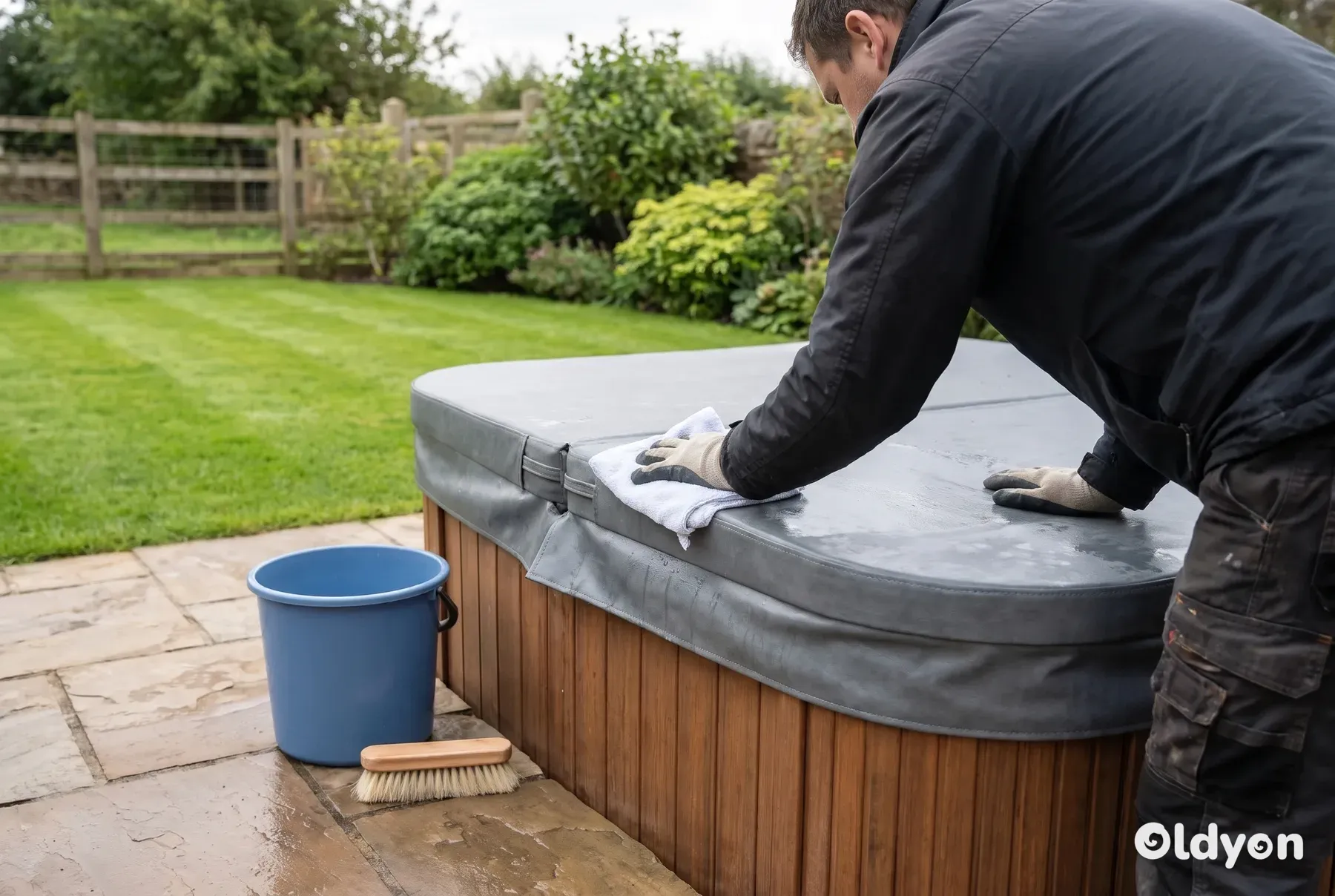
To clean a hot tub cover, rinse off loose dirt, wash the vinyl with a mild, non-abrasive cleaner and a soft cloth, rinse it thoroughly, then dry it and apply a water-based UV protectant. Do this every one to three months, wipe the underside too, and the cover will stay supple and watertight for longer.
Cleaning is only part of the job. A cover lasts longest when it is protected from sunlight, kept free of mildew, allowed to shed rainwater, and lifted on and off correctly. This guide covers each of those, plus the signs that tell you cleaning will no longer help.
How to clean a hot tub cover, step by step
Pick a dry, mild day when the cover is out of direct midday sun. Hot vinyl dries cleaner too quickly and leaves streaks, and a cold, wet day makes it hard to dry the cover before you close the tub again.
- Remove the cover and stand it on its edge against a wall or lean it on the cover lifter. Do not lay it flat on gravel, rough paving or grass, because grit scratches the vinyl and grass traps moisture.
- Brush or rinse off leaves, pollen and loose dirt with a garden hose on a gentle spray setting.
- Mix a small amount of mild, pH-neutral cleaner or the cleaner recommended by your cover manufacturer in a bucket of lukewarm water.
- Wash the top and skirt with a soft cloth or sponge, working in sections. Use a soft-bristled brush only on textured areas or stubborn marks.
- Pay attention to the seams, stitching, hinge area and the folds around the handles, where dirt and organic matter collect.
- Rinse each section with clean water before the cleaner dries on the surface.
- Turn the cover over and wipe the underside with clean water or a very mild solution, then rinse it well so no cleaner can drip into the hot tub.
- Let the cover air dry in shade, or wipe it dry with a clean microfibre cloth.
- Once the top is completely dry, apply a water-based vinyl protectant with UV inhibitors, following the product instructions, and buff off any excess.
- Check the straps, clips and handles while the cover is off, then refit it so it sits square on the tub.
The whole job usually takes under an hour. If you also check the water chemistry while the cover is off, you get two useful tasks done in one visit to the tub.
What should you use on a vinyl hot tub cover?
Most hot tub covers have a marine-grade vinyl top wrapped around a foam core. Vinyl stays soft and flexible because of plasticisers in the material. Harsh products strip those out, and the vinyl then hardens, fades and eventually cracks.
Quality marine vinyl for hot tub covers is usually in the 28-32 oz range, a weight measured per linear yard of material. Heavier vinyl that has been UV-treated during manufacture generally resists sun and wear better, and it copes better with years of regular cleaning.
Safe choices
- A cleaner sold specifically for hot tub covers or marine vinyl
- A mild, pH-neutral soap, used sparingly and rinsed off well
- Soft microfibre cloths, sponges and soft-bristled brushes
- A water-based vinyl protectant that contains UV inhibitors
Products to avoid
- Undiluted bleach and strong chlorine products on the vinyl top
- Solvent-based or petroleum-based cleaners and protectants
- Abrasive pads, scouring powders and stiff wire brushes
- Strong household degreasers and multi-surface sprays
- Pressure washers, which can force water through seams and tear stitching
- Products containing alcohol, which can dry out vinyl
Advice on silicone-based protectants and washing-up liquid varies between manufacturers. Some say they are acceptable in small amounts, while others warn that they leave residue or dry the vinyl over time. Read the care guide that came with your cover, because using a product the manufacturer advises against may affect the warranty.
Never mix cleaning products, and never combine bleach with other cleaners or with hot tub chemicals. Some combinations release harmful gases. Read every label, wear gloves, and follow the HSE guidance on hazardous substances and COSHH for safe handling and storage.
How often should you clean and protect the cover?
How often depends on your garden. A cover under trees or in full sun needs attention more often than one on a shaded, open patio. Use the schedule below as a starting point and adjust it to what you see.
Task | How often | Why it helps |
|---|---|---|
Brush off leaves and debris | Weekly, or after storms | Stops staining and trapped damp |
Rinse with clean water | Monthly | Removes pollen, dust and bird droppings |
Wash with a mild cleaner | Every 1 to 3 months | Lifts dirt before it sets into the vinyl |
Apply UV protectant | Every 1 to 3 months | Slows fading and cracking |
Wipe and air the underside | Monthly | Limits mildew and odour |
Check straps, clips and seams | Every 3 months | Catches wear while it is still repairable |
If the tub is in full sun for most of the day, lean towards monthly protectant in spring and summer. In winter, a gentle clean before the cold weather sets in and another in early spring is usually enough.
How do you protect a hot tub cover from UV damage?
Sunlight is one of the main reasons vinyl covers age. Ultraviolet light breaks down the surface, so the colour fades first, then the vinyl feels stiff, and finally fine cracks appear, often along the fold and on the side that faces south.
Even in the UK and northern Europe, UV levels in spring and summer are strong enough to damage vinyl that is left unprotected for months. Damage builds up slowly, so a cover can look fine for a year and then deteriorate quickly.
- Apply a water-based UV protectant regularly, always on a clean, dry cover.
- Shade the tub where you can, with a gazebo, pergola, sail or nearby planting that does not drop leaves onto the cover.
- Store the cover on its lifter rather than flat on the ground when the tub is open for a long session, so the underside is not baked in the sun.
- If the cover is removed for a long period, store it upright in a dry, shaded place.
- Choose lighter colours when you eventually replace the cover, as darker vinyl tends to absorb more heat.
A lightweight outer fabric cap fits over the insulated cover and shields the vinyl from UV, debris and light rain. It adds very little insulation, so it is no substitute for a proper insulated cover. Choose one with a vent, because a cap without airflow can trap condensation against the vinyl.
Choosing a protective cap
A protective cap usually weighs under about 7 kg (15 lb), so it is easy to handle for someone who cannot lift a heavy foam cover often. It is only a practical option when it is used over an insulated cover, never instead of one, because a cap on its own lets most of the heat escape.
A cap can also suit you if you use the tub every day and want the quickest possible access. Because it is much easier to lift on and off than a heavy foam cover, you can pull the cap away in seconds, then fold back the insulated cover underneath.
- Measure the tub, then choose a cap slightly longer and wider than it, so it fits over the cover and the skirt.
- Look for sealed, waterproof seams, so rain cannot soak through the stitching.
- Check that it has a vent, so condensation can escape.
- Choose straps, a drawstring or an elasticated hem that hold the cap in place in wind.
How do you get rid of mildew on a hot tub cover?
Mildew appears as small black, grey or green spots, often with a musty smell. It grows wherever moisture and organic matter sit for a long time, which on a hot tub cover means the seams, the shaded skirt and especially the underside.
Mildew on the outside
- Brush off as much as you can with a soft brush while the cover is dry.
- Wash the area with a cover cleaner or a mild soap solution and a soft cloth.
- For stubborn spots, use a mildew remover that the label says is safe for vinyl.
- Rinse thoroughly with clean water.
- Dry the cover fully in shade, then apply protectant.
Some manufacturers allow a very weak bleach solution on stubborn mildew, while others say never to use bleach on their vinyl. Check your care guide first, test any product on a hidden area, and always rinse well afterwards.
Mildew and odour on the underside
The underside faces warm, humid air every hour the tub is closed. Wipe it with clean water or a very mild solution, rinse it well, and let it air dry before refitting. Any cleaner left on the underside can drip into the water and cause foaming.
Air the cover every week as well. Lift it onto its lifter for 15-20 minutes, ideally on a dry day, so steam and moisture can escape from the underside and the core. Together with UV protection and balanced water, this simple habit can add a couple of years to a cover's life.
Once or twice a year, and after a wet spell, leave the cover open on its lifter for a few hours on a dry, breezy day. This lets the foam core and the inner wrapping dry out, which slows mildew and odour.
How water chemistry affects the underside
Sanitiser fumes rise straight into the underside of the cover. If levels stay high, or you shock the water and close the tub straight away, the trapped gases can bleach, stiffen and weaken the inner vinyl over time.
- Keep free chlorine at 3-5 ppm or bromine at 3-5 ppm.
- Keep pH at 7.2-7.6, because water outside this range can be harder on the underside and on the tub itself.
- Keep total alkalinity at 80-120 ppm and calcium hardness at 150-250 ppm.
- After shocking, leave the cover open for a while so gases can escape. Many manufacturers suggest at least 15 to 30 minutes, but check your manual.
These ranges reflect widely accepted guidance for pools and spas, including the standards published by PWTAG. Your hot tub manufacturer may give slightly different targets for your model, so follow your manual if it differs.
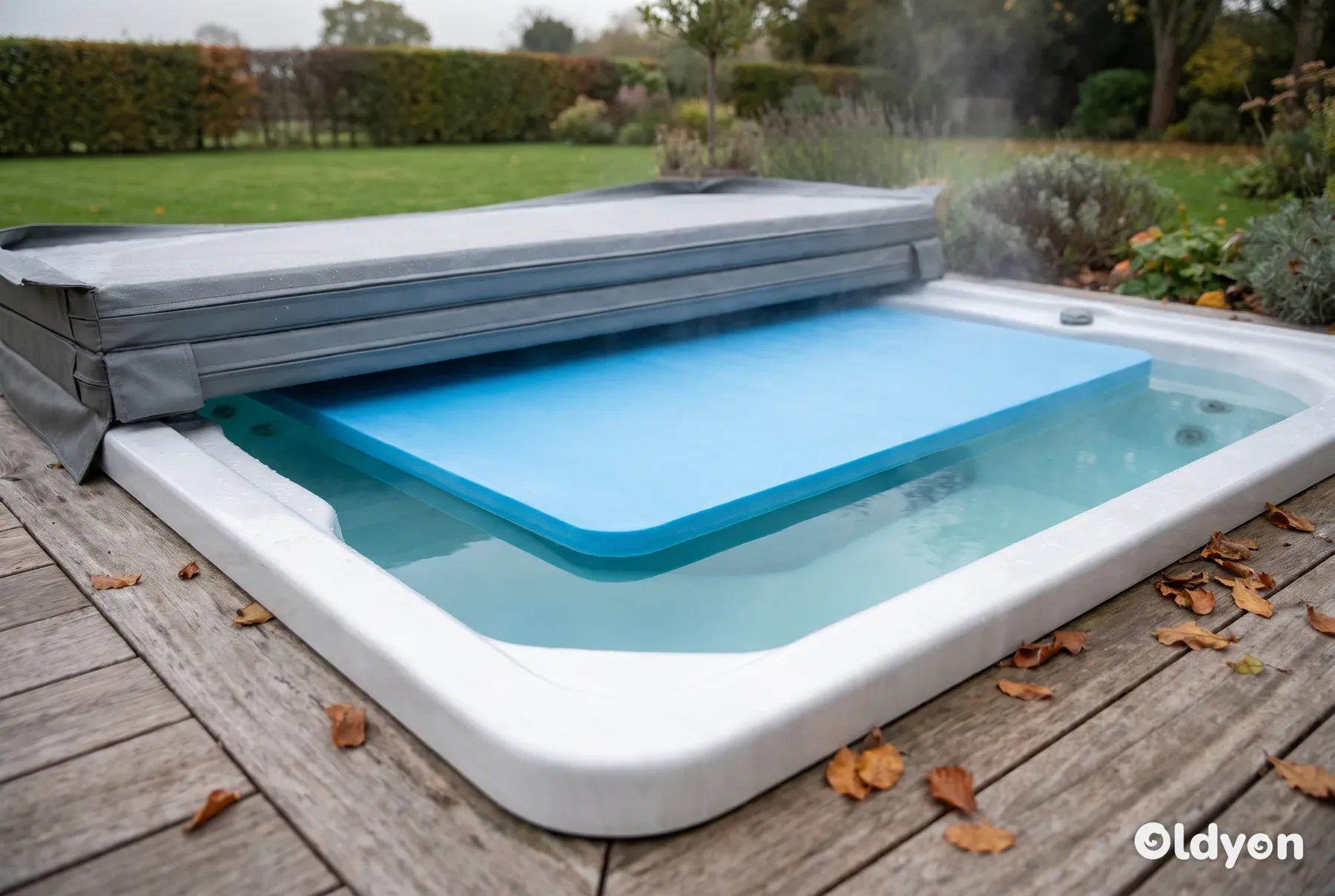
A floating thermal blanket under the cover can also reduce the amount of steam and chemical vapour that reaches the underside. If you are considering one, this guide on whether hot tub thermal blankets save energy explains the pros and cons.
Why does it matter how a cover sheds rainwater?
Most standard covers have a tapered foam core, thicker along the central hinge and thinner at the edges, for example around 10 cm (4 inches) falling to around 7.5 cm (3 inches). The slope lets rain, snowmelt and leaves run off rather than sitting on top.
Water that pools on the cover slowly finds its way through worn stitching, tiny tears and the zips. Once it gets inside the foam, the cover becomes heavier, insulates less well and starts to sag, which then makes more water pool. That cycle is the main way covers fail early.
How water gets into the foam core
Each foam panel is wrapped in a sealed plastic film called a vapour barrier. Waterlogging mostly starts when this film is punctured or its seams split. Steam from the tub then enters the foam, which absorbs it like a sponge.
The foam inside most covers is expanded polystyrene (EPS). It absorbs moisture slowly at first, then faster as more of its structure becomes saturated. If the cover starts to feel even slightly heavier, find and fix the cause promptly rather than waiting.
Even a single pinhole in the vapour barrier can roughly double the weight of a cover within a season or two. This is why small tears in the vinyl and wrapping are worth repairing as soon as you find them.
Water chemistry plays a part as well. Unbalanced water, such as very high chlorine or a low pH, speeds up the breakdown of both the vinyl and the vapour barrier, which makes waterlogging more likely. Keeping the water within the recommended ranges protects the foam core as well as the underside.
Wet foam conducts heat instead of blocking it. A waterlogged core therefore makes the heater work harder, and your electricity bills can climb well before the cover looks damaged from the outside.
Habits that help the cover shed water
- Make sure the cover sits square, with the hinge running across the middle so both halves slope away from it.
- Check that the tub itself is level, because a tilted tub can leave one side of the cover flat or dipping.
- Clear leaves and debris promptly, as they hold water and block the run-off.
- Brush off snow gently with a soft broom. Never use a shovel or chip at ice, which can puncture the vinyl.
- Do not stand, sit or put garden furniture, toys or pots on the cover.
- Look for any dip along the hinge after heavy rain, which is often an early sign of a cracked or waterlogged core.
- Keep the locking straps or clips fastened. As well as keeping children and pets out, they stop wind from lifting the cover off the tub.
The centre hinge is a common failure point on cheaper covers. A reinforced hinge, for example one with an extra metal channel inside, helps stop the fold cracking during freeze-thaw cycles and under the weight of heavy snow.
If your garden gets heavy snow or the cover sits under a tree that drops branches, a stronger cover may be worth considering in future. This comparison of hard hot tub covers and standard covers looks at how each handles load and weather.
A hot tub cover is not designed to take a person's weight, and a cover that gives way can let a child or pet fall into the water. Keep the safety straps or clip locks fastened whenever the tub is not in use, and replace any broken clips straight away.
Does a cover lifter help the cover last longer?
Yes, used correctly, a cover lifter reduces wear in several ways. It spreads the weight across the cover rather than putting it on the handles and hinge, it keeps the cover off the ground, and it makes daily removal easy, so the cover is less likely to be dragged or left on wet grass.
Easy removal protects the cover in another way. A cover that is hard to lift tends to stay on for days at a time, so chemical vapour builds up underneath and the cover is rarely aired. A lifter, or a lighter cover, makes it more likely that you open the tub regularly and let the cover breathe.
Choosing a lifter that suits your cover
Check that the lifter is rated for the weight of your cover. Many lifters handle up to about 45 kg (100 lb), but check the maker's stated limit, especially if your cover is dense or has started to take on water.
A heavy or dense cover is much easier to manage with a lifter, particularly for smaller or less strong users. If one person in the household struggles to open the tub alone, a lifter is usually the simplest fix.
If you are buying a heavy or dense cover, include a lifter in the budget from the start. Lifters typically cost about £100-£250, depending on the design. Because a cover that is easy to remove gets aired more often and handled more gently, the lifter helps the cover itself last longer.
Good habits with a lifter
- Fold the cover in half along the hinge first, then let the lifter take the weight as you slide or roll it back.
- Never pull the cover by the skirt or the flaps that cover the hinge, as these tear easily.
- Avoid lifting by one corner, which twists the foam core and strains the seams.
- Do not leave the cover standing up on the lifter in strong winds, as it can act like a sail and damage both the cover and the lifter.
- Check the lifter fixings, brackets and arms every few months and tighten anything that has worked loose.
- Make sure the lifter arms do not rub against the same spot on the vinyl every time.
Without a lifter, two people lifting together is gentler on the cover than one person dragging it. Lay it on a clean, smooth surface, never on gravel or a rough patio edge.
If you are planning a new cover, check that it will work with your lifter and that there is enough clearance around the tub. The guide on how to choose a hot tub cover covers lifter compatibility alongside fit and foam.
What are the signs a hot tub cover needs replacing?
Regular cleaning and protection will extend a cover's life, but no cover lasts forever. Lifespans are often quoted somewhere between three and seven years, depending on quality, climate and care, so treat any single figure with caution.
These are the signs that cleaning and small repairs are no longer enough:
- The cover feels much heavier than it used to, which usually means the foam has absorbed water.
- It sags in the middle or water pools along the hinge.
- The foam has cracked, so the cover folds down in the centre.
- Steam escapes around the edges, or snow melts faster on the cover than elsewhere in the garden.
- A persistent musty or sour smell remains after cleaning and airing.
- The vinyl is cracked, split or brittle, rather than just faded.
- Stitching has failed along the seams or around the handles.
- The skirt no longer reaches down over the tub edge, so heat and water escape.
- The heater seems to run more often to hold the same temperature.
Weight is the most reliable measure. A new foam cover typically weighs about 9-18 kg (20-40 lb), depending on its size and foam, while a waterlogged one can exceed 36 kg (80 lb). A big jump in weight tells you how much water the core has absorbed.
This matters for running costs. Cover makers commonly say a well-fitted, properly insulated cover can cut the energy needed to heat a hot tub by roughly half or more. A waterlogged cover loses most of that benefit, so the heater runs longer and your bills rise.
One of these on its own may be repairable, for example a small tear or a loose handle. Several together usually mean the cover is costing you more in heat loss than a replacement would. This article on when to replace a hot tub cover explains how to weigh repair against replacement.
If you do decide to replace it, measure the tub rather than the old cover, because an old cover can stretch or shrink. Follow the steps in how to measure for a hot tub cover to get an accurate fit.
When you measure, record the overall length and width, the corner radius and the direction the cover should fold. Common corner radii are about 7.5, 12.5 or 17.5 cm (3, 5 or 7 inches), but measure your own tub rather than assuming.
What to look for in a replacement cover
- Foam density: denser foam resists water and compression better. Lighter foam of around 24 kg/m³ (1.5 lb/ft³) absorbs water faster and often lasts only about 3-5 years, while some covers use foam of about 64 kg/m³ (4 lb/ft³) or denser, which lasts longer with a good vapour barrier.
- Budget covers in cold areas: if a budget cover is your only option and you live somewhere with cold, wet winters, pay for the denser-foam upgrade. The base low-density foam tends to waterlog early in those conditions, so the upgrade usually pays for itself.
- Stated specifications: the listing should give the foam density and the vapour barrier thickness or wrapping. Thicker or double-wrapped film is better. If either is missing, ask the seller, because an unlisted specification usually means the cheapest option.
- Vapour barrier: a good one is typically polyethylene film of about 0.1-0.15 mm (4-6 mil), heat-sealed around each foam panel. A listing that gives no vapour barrier thickness at all is a red flag.
- Seams: heat-sealed (welded) seams on the vinyl make a watertight bond, whereas stitched-only seams can let moisture wick through the thread over time.
- Stitching: as well as heat-sealed vinyl seams, look for double-stitched, reinforced stitching at the seams and stress points, such as the hinge, handles and strap fixings. These areas are under the most strain, and stronger stitching reduces the chance of water getting in there.
- Insulation for your climate: as a rough guide, around R-12 is enough for mild areas, roughly R-16 to R-20 suits moderate climates, and R-20 or more suits cold winters, with higher values paying back in lower heating costs. Makers do not all measure R-value the same way, so compare foam thickness and density too.
- Safety: check that the cover meets recognised safety requirements for foam density, handles and locking straps, not only for insulation. Ask the seller which safety standard the cover meets if the listing does not say.
- Fit: universal or off-the-shelf covers often leave gaps of 2.5 cm (1 inch) or more at the corners and edges. Heat escapes through those gaps and the cover insulates noticeably less well, so a custom-fit cover is usually worth it.
- Shape: custom-made covers are not limited to square or rectangular tubs. Round, octagonal and freeform shapes can also be made to measure, so state the exact shape of your tub when you order.
- Gaps and R-value: cover makers commonly say gaps at the corners and edges can cut a cover's effective insulation by around 30% or more. That loss cancels out much of the benefit of a high-R-value core, so fit matters as much as the foam.
- Source: a replacement does not have to come from your tub's original manufacturer. Good third-party custom covers often fit just as well, cost noticeably less and may insulate better.
- Price: third-party custom covers are often quoted as 30-50% cheaper than the original manufacturer's replacement, while matching or exceeding its insulation specification. Compare foam density, vapour barrier and warranty, not just the price.
- Lead time: custom covers are made to order and can take one to three weeks to arrive. Order before the old cover fails completely, especially ahead of winter.
- Delivery: foam covers are bulky and costly to post, so collecting from a local spa dealer can save a significant delivery charge.
- Warranty: cover warranties commonly range from about one to five years, and a longer warranty usually signals better construction.
Alternatives to a standard foam cover
Rigid hard-shell covers hold no foam to soak up water, so they cannot waterlog. They resist snow load and UV well, and makers often quote a life of 15-20 years. They are heavier than foam covers, however, and normally need a lifter.
If you have already replaced a foam cover more than once within about seven years, consider a hard-shell cover next time. It ends the cycle of repeat replacements, and over its much longer life it can work out cheaper than buying several foam covers.
A hard-shell cover typically weighs about 16-23 kg (35-50 lb), depending on its size. Budget for a lifter when you buy one, and check that there is enough clearance at the side of the tub for the lifter and the open cover.
A hard-shell cover can suit homes with young children, because its locking mechanism is usually more secure than the clips on a standard foam cover. It also suits gardens with heavy snowfall, where the weight of snow can collapse a foam cover. Whatever type you choose, keep it locked when the tub is not in use.
Premium fabric covers, for example in solution-dyed acrylic or heavy polyester, resist UV and cracking in the cold better than vinyl. They can last considerably longer than a vinyl cover, though they cost more and need fabric-safe care.
Premium fabric covers are commonly quoted to last about 8-12 years, compared with the 4-6 years often given for a standard marine vinyl cover, so roughly twice as long. Real lifespans depend on climate and care, so check the warranty for what the maker is prepared to stand behind.
Summary: the habits that make a cover last
Clean the vinyl every one to three months with a mild cleaner and a soft cloth, rinse it well, and finish with a water-based UV protectant. Avoid harsh chemicals, solvents, abrasive pads and pressure washers.
Keep the underside clean and aired, hold sanitiser and pH within the recommended ranges, and leave the cover open after shocking. Help the cover shed water by keeping it square, clear of debris and free of weight, and use a lifter so it is never dragged or lifted by the skirt.
When the cover becomes heavy, sags, smells or lets steam out, cleaning will no longer fix it. At that point, start planning a replacement.
Frequently asked questions
Can I use a pressure washer on a hot tub cover?
It is best not to. Even on a low setting, a pressure washer can force water through the seams and zips into the foam core, and it can tear stitching or lift the vinyl surface. A garden hose on a gentle spray, a soft cloth and a mild cleaner do the job safely. If a mark will not shift, repeat the gentle clean rather than increasing the pressure.
Can I use car or boat vinyl products on my cover?
Products made for marine vinyl are often suitable, because hot tub covers commonly use similar material. Car interior products vary more, and some contain solvents, silicone or alcohol that cover manufacturers advise against. Check the label for a water-based formula with UV inhibitors, test it on a hidden area first, and read your cover care guide to avoid affecting the warranty.
Can I repair a small tear in the vinyl?
Small tears and holes can often be repaired with a vinyl repair kit or patch, ideally in a colour that matches the cover. Clean and dry the area first and follow the kit instructions closely. Repair the tear quickly, because water entering through even a small gap can soak into the foam. Large splits, failed seams or a cracked core usually mean a replacement is due.
How can I dry out a cover that has become heavy?
If the foam is only slightly damp, leaving the cover open on its lifter in dry, breezy weather can help. Some covers have zips that let you remove the foam inserts and dry them separately, but check whether the inner plastic wrapping is torn first. If the wrapping has split and the foam is saturated, drying rarely restores it, and replacing the inserts or the whole cover is more effective.
Do fabric or hard covers need different care?
Yes. Fabric soft tops and outdoor fabric covers often need a fabric-safe cleaner and may need re-proofing with a water repellent spray, so follow the manufacturer's instructions. Hard covers with plastic or composite panels usually need only a rinse and a mild wash, though rubber seals and hinges benefit from a regular check. In every case, the care guide for your specific cover takes priority.
Should I leave the cover on if I drain the hot tub for winter?
If you drain and winterise the tub, keep the cover on and fastened to keep out rain, debris and animals. Make sure the tub is dry inside first, as trapped moisture under a closed cover encourages mildew. Clean and protect the vinyl before winter, check it after storms and heavy snow, and air it on a dry day if it smells musty.
Filed under