Can you put bleach in a hot tub?
Can you put bleach in a hot tub? Learn why household bleach is risky, what spa chlorine does better and why hot tub chemicals must never be mixed.
Can you put bleach in a hot tub? Plain household bleach does contain chlorine, so it will sanitise water, but it is a poor choice. Bleach is strongly alkaline, its real strength is rarely clear from the label, and many bottles contain fragrance or thickeners that cause foam, residue and cloudy water.
Spa chlorine granules do the same job with a known strength and far less effect on pH, which is why technicians use them. Mixing bleach with other hot tub products can also release toxic gas, so the safest habit is simple: use products made for spas, and add them one at a time.
Is household bleach the same as hot tub chlorine?
Both release the same sanitiser in water: hypochlorous acid, the form of free chlorine that kills bacteria. The difference lies in everything else that comes with it, and that is what causes problems in a hot tub.
What is in household bleach
Household bleach is a solution of sodium hypochlorite in water, with sodium hydroxide added to keep it stable in the bottle. That makes it strongly alkaline, typically pH 11 or higher. Many UK bottles state only that they contain less than 5% chlorine-based bleaching agent, which gives an upper limit but not the actual strength.
Thick bleaches, scented bleaches and multi-surface versions also contain thickeners, fragrance and detergents. Those ingredients help when cleaning a toilet bowl, but they have no place in warm water that you sit in.
Pool liquid chlorine is the same unstabilised sodium hypochlorite as bleach, just at a higher strength of roughly 10-12%. It is just as alkaline, so it shares the pH and stability drawbacks of bleach. It is made for large swimming pools, not hot tubs.
What is in spa chlorine granules
Most hot tub chlorine sold in the UK and Europe is sodium dichloroisocyanurate, usually called dichlor. It comes as fast-dissolving granules with the available chlorine stated on the label, so you can dose by weight with confidence.
Dichlor is close to neutral, so it barely moves pH. It also contains cyanuric acid, a stabiliser that slows chlorine loss. Cyanuric acid builds up over the months, which is one reason hot tub water needs changing regularly.
The cyanuric acid in dichlor shields chlorine from sunlight (UV) as well as from heat. That matters if your hot tub is left uncovered in daylight, because bleach has no such protection and sunlight breaks it down quickly.
Dissolved in water, dichlor granules have a pH of about 6.5-7.0, very close to the range your hot tub needs. Bleach starts at pH 11 or higher, which is why one product barely shifts your readings and the other pushes them up with every dose.
Why hot water makes bleach harder to manage
Hot tubs run at around 37-40°C (99-104°F), far warmer than a swimming pool. Heat, jets and air bubbles all speed up chlorine loss, and unstabilised bleach disappears faster than stabilised granules, so you end up adding more of it more often.
For comparison, a heated swimming pool usually sits at around 26-28°C (79-82°F), roughly 10-12°C cooler than a hot tub. That gap is a big reason why chlorine behaves so differently in a spa, and why habits from pool care do not transfer directly.
Warm water also forms scale more readily when pH and total alkalinity climb. The alkaline effect of bleach therefore does more harm in a hot tub than it would in cooler water.
A hot tub also holds far more bathers per litre of water than a swimming pool. Sweat, body oils, cosmetics and sunscreen use up sanitiser much faster as a result, and an unstabilised product like bleach struggles to keep up between doses.
To put that in numbers, a typical hot tub holds about 1,100-1,500 litres (about 290-400 US gallons), while a swimming pool holds tens of thousands of litres. Per litre of water, a few people in a hot tub put in dozens of times more sweat and oils than the same people would in a pool.
Why is bleach a bad idea for hot tub water?
It pushes pH up
Chlorine works best when pH sits between 7.2 and 7.6. Each dose of bleach nudges pH and total alkalinity upwards, and at higher pH more of the chlorine changes into a weaker form. You get less sanitising for the same chlorine reading.
The effect is large. At pH 7.5, roughly half of your free chlorine is in the active hypochlorous acid form. At pH 8.0, only around a fifth is, so a pH rise caused by bleach can more than halve how well the same chlorine reading actually sanitises.
Chlorine weakened in this way can let algae take hold and leave the water persistently cloudy, however often you top up. This can happen even when the free chlorine reading looks acceptable, because a standard test shows how much chlorine is present, not how active it is at that pH.
High pH also leads to cloudy water, scale on heater elements and jets, and skin that feels dry or itchy. You then need pH reducer to bring it back, which adds cost and another chemical to the routine.
Once pH climbs above about 8.0, calcium scale starts to come out of the water and coat heater elements, jets and pipework. Repeated bleach doses can easily push pH that high, especially if you do not correct it after each dose.
Scale on a heater element acts as an insulator. The heater has to work harder to warm the water, runs hotter and fails sooner. That makes heater failure one of the most common costly results of keeping pH too high for too long.
Additives cause foam and residue
Fragrances, thickeners and detergents do not break down neatly in hot tub water. The jets whip them into foam, they can leave a film on the shell and they clog the filter faster. It is the same problem you get if you put bubble bath in a hot tub.
The surfactants in thickened or 'splash-less' bleach are a particular problem. As well as causing foam and clogging the filter, they can coat the pump impeller and contribute to pump seal failure over time.
Some of these ingredients may also affect the cover, headrests and seals over time. Spa products are formulated with those materials in mind, while household cleaners are not.
Trapped fumes can damage the cover
Chlorine fumes rise from the water after dosing, and hot water releases them faster. If you close the cover straight away, the fumes are trapped underneath, where the underside and the foam core can absorb them. Over time this breaks the cover down from the inside. Leave the cover open after dosing until the fumes have cleared.
You cannot dose it accurately
Bleach strength varies between brands and falls as the bottle ages, especially if it is stored somewhere warm. The same amount from an old bottle and a new bottle can give quite different results, which makes it easy to under-dose or overshoot.
Overshooting irritates eyes and skin and can stress soft materials. If your reading ever comes out too high, our guide on how to lower chlorine in a hot tub safely explains what to do.
It may affect your warranty
Many hot tub manufacturers exclude damage caused by chemicals they do not approve, or by water kept outside their recommended ranges. The wording differs between makers, so read your manual before using anything that is not sold for spas.
How do bleach, spa chlorine and bromine compare?
The table below sums up the practical differences for a typical home hot tub. Always follow the dosing guidance on your product and the ranges in your hot tub manual.
Feature | Household bleach | Chlorine granules (dichlor) | Bromine |
|---|---|---|---|
Strength on label | Often only a maximum | Stated clearly | Stated clearly |
Effect on pH | Raises it sharply | Small | Small, tends to lower it |
Additives | Often fragrance or thickener | None in spa products | None in spa products |
Stability in hot water | Poor | Better, contains stabiliser | Good |
Target level | Not designed for spas | 3-5 ppm free chlorine | 3-5 ppm |
Made for hot tubs | No | Yes | Yes |
So can you put bleach in a hot tub in an emergency?
If you have run out of spa chlorine, the water has no sanitiser left and you cannot get any for a day or two, plain bleach can hold the water safe until you can. Treat it as a short stopgap, never as your normal routine.
Freshly refilled water is one of the few situations where this is reasonable. New water has no sanitiser in it yet, so if you have no spa chlorine to hand, a single cautious dose of plain bleach can protect it until you can get granules.
Never in a salt water hot tub
Never use bleach in a hot tub fitted with a salt water chlorine generator. Follow the manufacturer's procedure for raising chlorine in that system instead, which is described in your manual.
Only plain, unscented bleach
Use only regular, unscented bleach with no thickener, fragrance or detergent. The ingredients should show sodium hypochlorite and little else. If you are unsure what is in the bottle, do not use it.
Avoid bleaches labelled 'concentrated', extra-strength, gel, splash-less or 'with added cleaner', even in an emergency. Their higher strength or extra additives make safe dosing in a hot tub much harder.
Protect yourself first
Wear chemical-resistant gloves (nitrile or rubber) and safety glasses or goggles whenever you measure or pour bleach or any other spa chemical. Work outdoors, or with the hot tub cover fully open, so fumes cannot build up around you.
Work out a cautious dose
As a rough guide, bleach that really is 5% sodium hypochlorite adds about 1 ppm of chlorine to 1,000 litres (about 260 US gallons) for every 20 ml. Because the true strength is often lower, start with a small dose and test, rather than calculating straight to your target.
Step by step
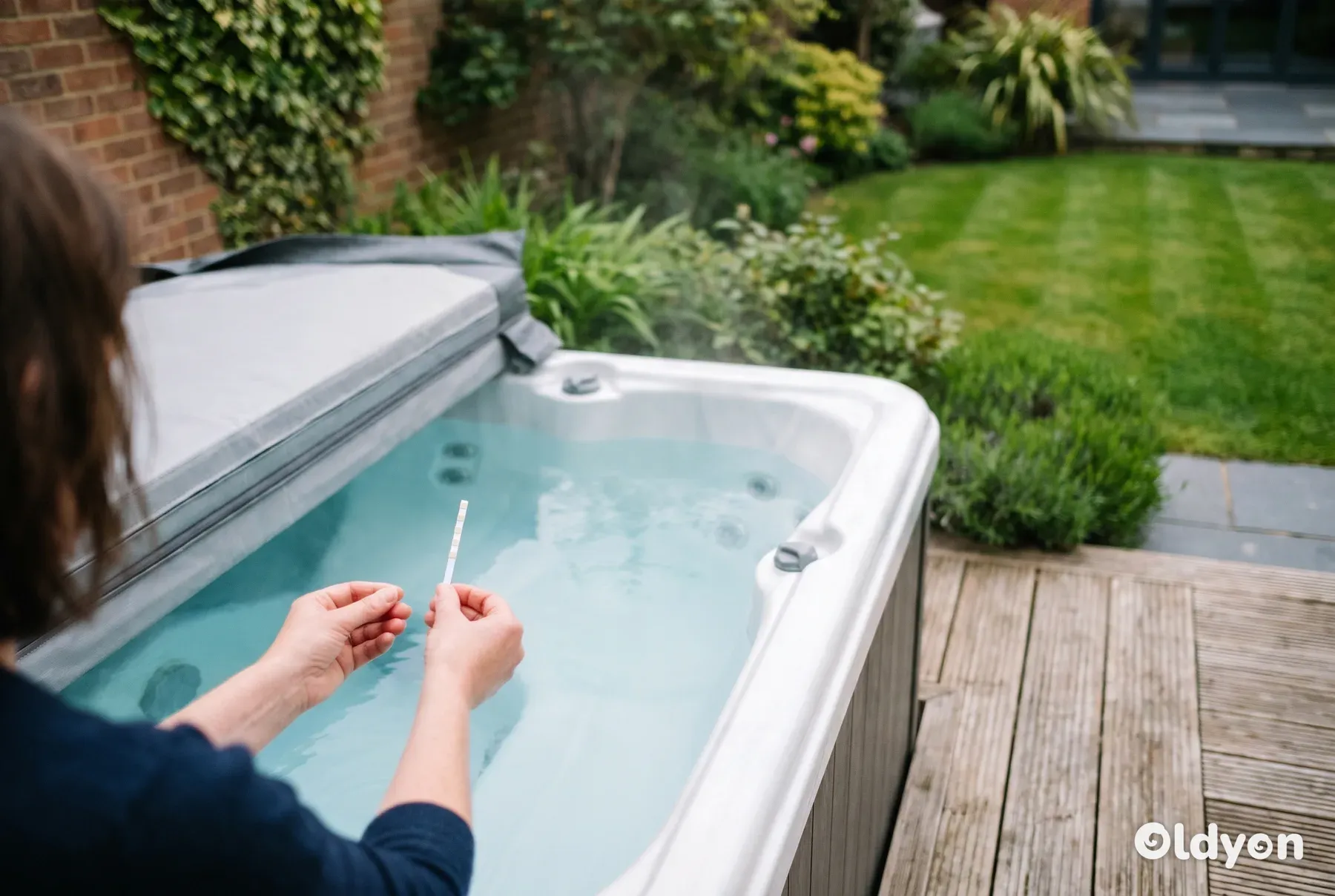
- Test the water first so you know your starting pH, total alkalinity and free chlorine.
- If pH is above 7.6, add pH reducer on its own, run the jets for at least 30 minutes and retest before going further. Never add bleach and pH reducer at the same time.
- Put on chemical-resistant gloves and safety glasses or goggles, and open the cover fully.
- Measure a small first dose in a clean, dry jug used only for hot tub chemicals. For a 1,500 litre (about 400 US gallon) hot tub, 30 ml is a cautious start.
- Fill a clean plastic bucket with about a litre of hot tub water, then add the measured bleach to the water and stir gently. Pre-diluting means no concentrated bleach sits against the acrylic shell and marks it.
- With the cover off and the jets on, start pouring near a return jet (an outlet pushing water back into the tub) so circulation carries the mix away quickly and spreads it evenly. Then pour the rest slowly while you move around the edge of the hot tub, rather than tipping it all into one spot, so no area gets a concentrated dose. Keep your face well away. Never pour bleach into the skimmer or filter compartment, because the concentrated liquid can bleach and break down the filter cartridge media.
- Leave the jets running with the cover open for 20 to 30 minutes so the water mixes and any fumes can escape.
- Retest free chlorine and pH. Add more bleach in small amounts only if needed to reach 3-5 ppm, then correct pH back to 7.2-7.6.
- Do not use the hot tub until free chlorine is within 3-5 ppm and pH is in range. Switch back to spa chlorine as soon as you can.
Shocking with bleach
If you are using bleach to shock water that has been contaminated, or that has sat untreated for several days, aim for free chlorine of about 10 ppm rather than 3-5 ppm. Build up to it in small doses with a test between each one, then wait until free chlorine falls back below 5 ppm before anyone gets in.
Test before every soak
Unstabilised bleach can be largely used up within an hour or so in hot, jetted water. While you are relying on bleach, retest free chlorine shortly before every soak and expect to top up again, sometimes within the same session. Ask everyone to get out before you add more, and wait until the reading is back in range.
After a stopgap like this, check pH more often for the next few days. Our guide on how to use chlorine in a hot tub covers the normal daily and weekly routine once you have proper granules.
Why must you never mix hot tub chemicals?
Chlorine products can react dangerously with other chemicals. Mixing bleach with acids, such as pH reducer (sodium bisulphate), descalers or some toilet cleaners, can release chlorine gas. Mixing bleach with ammonia-based cleaners releases chloramine gases. Both can damage the eyes and lungs.
Solid sanitisers can also react with each other. Different types of chlorine, such as dichlor granules and calcium hypochlorite, should never be combined, and chlorine and bromine products should never be mixed or stored together.
Never mix hot tub chemicals with each other or with household cleaners. Add each product directly to the water, one at a time, with the jets running, and let it circulate before adding the next. Always add chemicals to water, never water to chemicals. If anyone feels short of breath after breathing fumes, move them into fresh air and call 999.
Safe storage prevents most accidents. Keep these habits:
- Store chemicals in their original containers with the lids closed, in a cool, dry place out of sunlight.
- Keep acids and chlorine products on separate shelves, out of reach of children and pets.
- Use a separate clean scoop or jug for each product.
- Never pour unused product back into its container.
- Read the label before each use, even for a product you know well.
What should you use instead of bleach?
For most home hot tubs, the answer is a sanitiser made for spas plus a reliable test kit. Our overview of the hot tub chemicals you actually need lists the short kit that covers almost every situation.
Chlorine granules
Dichlor granules are the usual choice for UK and European hot tubs. They dissolve quickly, work fast and are simple to dose after each use. Aim for free chlorine of 3-5 ppm, and learn how to read hot tub chlorine levels so you can tell free chlorine from combined chlorine.
As a starting guide, 56% dichlor granules raise free chlorine by roughly 1 ppm for every 2 g added per 1,000 litres. Products vary, so always follow the dose on your label and confirm the result with a test.
Dichlor also works out cheap per dose. Any saving from using bleach disappears once you count the extra pH reducer each bleach dose needs, along with the risk of damage to the heater and other equipment.
Bromine
Bromine is usually sold as slow-dissolving tablets, dosed through a floating dispenser or an inline feeder fitted to the plumbing. It stays effective in warm water and many people find it has less smell than chlorine. Keep it at 3-5 ppm unless your manufacturer recommends a different range.
Because a dispenser or inline feeder releases bromine steadily, it suits owners who use the hot tub several times a week and want fewer daily top-ups. You still need to test regularly and adjust the dispenser setting as your use changes.
Bromine suits people with sensitive skin and those who dislike the smell of chlorine. The bromamines it forms with sweat and oils still sanitise, and they do not cause the sharp smell and stinging eyes that chloramines do.
Bromine also stays effective at a higher pH than chlorine, which makes it more forgiving when pH drifts upwards. The trade-off is cost: bromine usually costs more per dose than dichlor granules.
Bromine is harder to bring down quickly if you add too much. Switching between chlorine and bromine usually means draining and refilling first, so check your manual before changing systems.
Built-in salt water systems
Some hot tubs come with a built-in salt water system that makes its own chlorine from dissolved salt. It is an alternative to adding granules by hand, but you still need to test the water regularly and use the salt and settings your manufacturer specifies.
Mineral systems and hydrogen peroxide
Mineral systems, such as silver or copper ion cartridges, can reduce the amount of chlorine or bromine you need. They never replace a sanitiser entirely, so you still need to test and keep a chlorine or bromine level as the system's instructions describe.
Ordinary 3% hydrogen peroxide from a pharmacy is not a hot tub sanitiser, and you would need impractical amounts of it. Only purpose-made non-chlorine spa systems use peroxide-based products, at controlled strengths and with their own test methods.
Baking soda, vinegar and other household products
Baking soda (sodium bicarbonate) raises total alkalinity, which is why it is the main ingredient in many alkalinity increasers. It does not sanitise. Vinegar is a weak acid that will not reliably kill bacteria in a hot tub and adds organic matter to the water.
Vinegar's proper role in hot tub care is descaling, for example soaking a filter cartridge to loosen mineral deposits before rinsing it well. It is not a water treatment, and putting enough in the water to make a difference could harm seals and acrylic.
Washing-up liquid, bath oils and household disinfectant sprays do not belong in a hot tub either. Products not made for spas often cause foam, residue or unpredictable water chemistry.
Can you put Epsom salt or pool salt in a hot tub?
Epsom salt
Epsom salt is magnesium sulphate. Many hot tub manufacturers advise against adding it, because it raises total dissolved solids and may affect metal parts and some sanitiser systems. Guidance differs between brands, so check your manual. If you want an Epsom salt soak, a bath is the safer place for it.
Pool salt
Pool salt is only for hot tubs fitted with a salt water chlorine generator, which turns dissolved salt into chlorine. In a standard hot tub, salt does nothing to sanitise the water and can increase corrosion of heaters, fittings and other metal parts.
If your hot tub does have a built-in salt system, use only the salt purity grade and the concentration your manufacturer specifies. Salt with the wrong additives, or too much salt, can damage the generator cell and other parts.
What happens if a hot tub is not sanitised properly?
Warm water with too little sanitiser lets bacteria multiply quickly. The main reason to keep chlorine or bromine in range is health, not only clear water.
Test free chlorine and pH before every soak. Even a short lapse in sanitiser lets bacteria such as Pseudomonas grow in warm water, and a quick test is the only way to know the water is ready.
Do not get in if the water looks cloudy. Cloudiness is a sign that the sanitiser is not keeping up and bacteria levels may be high, so test and treat the water before anyone uses it.
If the water has sat untreated for several days, or someone has been unwell in it, test it and shock it back to a safe level before anyone gets in. If contamination is serious, for example after vomiting or diarrhoea in the water, drain it, clean it and refill instead.
One common problem is hot tub rash, an itchy, bumpy rash often linked to the bacterium Pseudomonas aeruginosa. It usually appears within about 12-48 hours of using contaminated water. The CDC healthy swimming pages explain how germs like this spread in poorly maintained water.
Hot tubs are the setting where most recorded recreational-water outbreaks of Pseudomonas skin infection happen. The warm water suits this bacterium, and even brief lapses in sanitiser can allow it to grow.
Hot tubs can also spread Legionella bacteria through spray and steam if the water is not treated and maintained. The Health and Safety Executive publishes guidance on controlling Legionella, and the NHS page on Legionnaires' disease describes the symptoms.
Poorly maintained hot tubs can also spread stomach bugs such as Cryptosporidium, which can cause diarrhoea and vomiting. This parasite is hard to kill with normal chlorine levels, so nobody should use the hot tub while they have diarrhoea. The NHS advises not swimming for 2 weeks after Cryptosporidium symptoms stop.
Sexually transmitted infections such as gonorrhoea cannot be caught from shared hot tub water. These bacteria need direct contact between mucous membranes to spread, and they do not survive in properly treated water.
Hot tub water is not a direct cause of urinary tract infections (UTIs). Under-sanitised warm water does carry more bacteria, though, so keep levels in range. If you currently have a UTI, ask a GP or pharmacist before soaking.
Stop using the hot tub and speak to a pharmacist or GP if, after using it, you notice any of the following:
- An itchy rash or red bumps, especially under areas covered by swimwear
- Sore, red or irritated eyes that do not settle
- Ear pain or discharge from the ear
- Flu-like symptoms such as fever, cough or aching muscles
- Diarrhoea, stomach cramps or vomiting
Contact NHS 111 or your GP urgently if you have a high temperature with a cough or shortness of breath, and call 999 if someone is struggling to breathe. Outside the UK, contact your local health service.
Before anyone uses the hot tub again, drain it, clean the pipework and filter, refill it and bring sanitiser and pH back into range.
If you drained and cleaned the hot tub because of a rash, shock the fresh water to about 10 ppm free chlorine once it is refilled. Wait for free chlorine to fall back to 3-5 ppm, with pH at 7.2-7.6, before anyone uses it.
Is it safe to soak for long in a hot tub?
Soaking at 37-40°C raises your body temperature and makes you sweat, often without you noticing because you are already in water. Limit sessions to about 15-20 minutes, then get out, cool down and drink some water before getting back in.
Keep a bottle of drinking water at the side of the hot tub so you can drink during and between sessions. You lose fluid through sweat in hot water without feeling thirsty.
Avoid alcohol before or during a soak. It speeds up dehydration and impairs your body's ability to control its temperature, which raises the risk of feeling faint in hot water.
Children, older people and anyone taking blood pressure or heart medication face a higher risk of heat stress and dehydration, so they should keep sessions shorter. If you are pregnant or have a heart condition, ask your GP or midwife before using a hot tub.
Get out of the water straight away and cool down if you notice any of these signs:
- Dizziness or feeling light-headed
- Feeling sick
- A headache
- Feeling unusually hot, weak or confused
The right chemical for the right job
Household bleach contains chlorine, but its high pH, unclear strength and possible additives make it a poor fit for hot tubs. Plain, unscented bleach can work as a short emergency stopgap if you dose it cautiously and test carefully.
For everyday care, use spa chlorine or bromine at 3-5 ppm, keep pH at 7.2-7.6 and total alkalinity at 80-120 ppm, and add one product at a time. Never mix chemicals, and check your hot tub manual whenever guidance differs.
Frequently asked questions
Can I use bleach to clean an empty hot tub shell?
It is best avoided. Bleach can leave residue and fragrance in the shell and pipework, and strong solutions may dull some acrylic finishes. Use a cleaner made for hot tub surfaces with a soft cloth, then rinse thoroughly with fresh water. Check your manual, as some manufacturers list approved cleaning products and may not cover damage from harsh cleaners.
Why does my hot tub smell strongly of chlorine?
A sharp chlorine smell usually comes from combined chlorine, also called chloramines, rather than too much free chlorine. Chloramines form when chlorine reacts with sweat, skin oils and other waste. The usual fix is to shock the water, run the jets with the cover open and retest. If the smell keeps coming back, the water probably needs changing.
How do you treat a hot tub after someone gets a rash?
Drain the hot tub, flush the plumbing with a pipe cleaner product made for hot tubs, then deep clean or replace the filter. Wipe down the shell, refill, shock the fresh water and wait until free chlorine falls back to 3-5 ppm and pH is in range before anyone uses it. Ask a pharmacist or GP about the rash itself, and mention that it started after using a hot tub.
Why do people put tennis balls in a hot tub?
The fuzzy surface of a tennis ball can soak up a little of the oil from skin, lotions and hair products, which may reduce scum lines at the waterline. It does not sanitise the water or replace the filter. If you try it, use a new ball, replace it every 2-4 weeks, and remove it sooner if it starts to break up or discolour.
How long after adding chlorine can I use the hot tub?
After a normal top-up dose, run the jets for 15 to 30 minutes and then test. The reading is what matters: get in only when free chlorine is at 3-5 ppm and pH is 7.2-7.6. After a heavy shock dose, follow the waiting time on the product label, which can be several hours.
Can I switch from chlorine to bromine?
Yes, but most manufacturers recommend draining, cleaning and refilling first rather than switching in the same water. Chlorine and bromine products should never be mixed or stored together. Once you have refilled, build up a bromine level of 3-5 ppm using the method on the product label, then stick with bromine from that point on.
Filed under