Using baking soda to raise hot tub alkalinity
Baking soda in hot tub water raises alkalinity just like a branded increaser. Learn the dose per 1,000 litres, which product to buy and how it affects pH.
Yes, you can use baking soda in hot tub water to raise total alkalinity. Plain bicarbonate of soda is sodium bicarbonate, the same active ingredient sold as alkalinity increaser. As a rough guide, about 17 g per 1,000 litres (about 264 US gallons) raises alkalinity by 10 ppm, with only a small rise in pH.
Below you will find a dosing table for common tub sizes, the right kind of bicarbonate to buy, a step-by-step method and the mistakes that cause cloudy water or swinging pH. There is also an honest look at when a branded spa product is worth the extra cost.
What does baking soda actually do in a hot tub?
Baking soda adds bicarbonate to the water, and bicarbonate is the main thing a total alkalinity test measures. Alkalinity works as a buffer. It soaks up small amounts of acid so the pH does not jump around every time you add sanitiser, top up with fresh water or have a long soak.
When alkalinity is too low, that buffer is missing. The pH tends to drift and bounce, sanitiser works less predictably, and water with low pH can be harsh on metal parts, heaters and seals. Bathers may also notice stinging eyes or itchy skin.
Over time, unstable, low-pH water can also etch and roughen the acrylic shell, leaving the surface dull and harder to keep clean. Together with corrosion of the heater element and metal fittings, this means correcting low alkalinity protects the tub's surfaces and equipment, not only the water.
A steady buffer also makes the water more comfortable to sit in. When pH swings too low, the water tends to sting the eyes. When it swings too high, it can irritate the skin and cause rashes in some bathers. Keeping alkalinity in range helps hold pH between 7.2 and 7.6, where most people find the water comfortable.
A typical sign of low alkalinity is a pH correction that does not last. You add pH increaser, the reading rises for a while, then it falls back within a day or two. Until alkalinity is fixed, every pH correction is only temporary.
In practice, a tub with alkalinity near 50 ppm may need several pH adjustments in a single week. A tub at around 100 ppm will typically hold a stable pH for 7 to 10 days between adjustments, depending on how often it is used.
Low alkalinity and unstable pH also make chlorine and bromine less effective. That gives bacteria such as Pseudomonas aeruginosa a better chance to multiply, and this germ is the usual cause of hot tub folliculitis.
Is baking soda the same as alkalinity increaser?
In most cases, yes. The chemical in nearly every spa alkalinity increaser is sodium bicarbonate, which is exactly what is in a tub of bicarbonate of soda from the baking aisle. Check the label of any branded product: if sodium bicarbonate is the only listed ingredient, the two will behave the same way in your water.
How is alkalinity different from pH?
pH tells you how acidic or basic the water is right now, on a scale where 7 is neutral. Total alkalinity tells you how much buffering capacity the water has to hold that pH steady. You can think of pH as the reading and alkalinity as the stability behind it.
Because alkalinity controls how easily pH moves, most technicians correct alkalinity first and pH second. Our guide to hot tub water balance in the right order explains why that order saves time and chemicals.
Why hot tubs need more care than pools
Hot tub water sits at around 38-40°C (100-104°F), much warmer than pool water, and should never be hotter than 40°C. Heat speeds up pH and alkalinity drift far more than in cooler pool water, which is why alkalinity matters more in a tub.
A tub also has a small volume of water, a heavy bather load for that volume and jets that constantly mix air into the water. Together these make the chemistry shift much faster than in a pool. Alkalinity can fall by 10 to 20 ppm within a few days of a fresh fill, so test more often in the first week.
This difference shows in how often you need to test. A typical swimming pool is usually tested about once a week, whereas a hot tub in regular use needs testing two or three times a week. Small, frequent checks catch a falling alkalinity reading before it turns into a pH problem.
What should your hot tub alkalinity be?
The widely accepted range for total alkalinity in a hot tub is 80 to 120 ppm (parts per million, the same as mg per litre). Alongside it, aim for pH 7.2 to 7.6, free chlorine or bromine at 3 to 5 ppm and calcium hardness of 150 to 250 ppm.
Some manufacturers recommend a slightly different alkalinity range for their tubs, particularly for certain sanitiser systems. If your owner's manual gives a different figure, follow the manual. If your reading is below 80 ppm, baking soda is a sensible fix.
Readings outside the range cause problems at both ends. Below 80 ppm, pH swings, sanitiser loses effectiveness and the water can slowly corrode metal parts such as heater elements and fittings. Above 120 ppm, pH tends to lock high, the water can turn cloudy and scale can build up on the shell, heater and jets.
Do not add baking soda if alkalinity is already between 80 and 120 ppm. It is only for readings below 80 ppm. Adding it to water that is already in range simply pushes alkalinity towards the high end and the problems that come with it.
How much baking soda in hot tub water per 1,000 litres?
The chemistry gives a simple rule: about 17 g of sodium bicarbonate per 1,000 litres raises total alkalinity by roughly 10 ppm. Dosing charts on spa chemical labels vary a little, partly because of rounding and partly because home test kits are not perfectly precise, so treat any figure as a starting point.
To work out any dose, subtract your current reading from your target to find the deficit. Divide the deficit by 10, then multiply the result by the dose for 10 ppm in your volume of water, which is 17 g for every 1,000 litres.
You need to know your water volume for this to work. If you are not sure, our guide on how many litres are in a hot tub shows how to work it out from the manual or the tub's dimensions.
Water volume | Raise by 10 ppm | Raise by 20 ppm | Raise by 30 ppm |
|---|---|---|---|
800 litres | 14 g | 27 g | 41 g |
1,000 litres | 17 g | 34 g | 51 g |
1,200 litres | 20 g | 40 g | 61 g |
1,500 litres | 25 g | 50 g | 76 g |
2,000 litres | 34 g | 67 g | 101 g |
Here is a worked example. Your 1,500 litre tub (about 400 US gallons) tests at 60 ppm and you want to reach about 90 ppm. That is a rise of 30 ppm, so the full calculated dose is around 76 g.
Start with roughly two thirds of the calculated dose, which is about 50 g in this example. Retest after circulation and add the rest only if you still need it. It is much easier to add a little more than to bring alkalinity back down after an overshoot.
For a large deficit of more than about 30 ppm, split the dose into two treatments several hours apart rather than adding it all at once. A single large dose can push pH above 8.0, which then needs correcting as well.
Here is a second example with a split dose. A 1,500 litre tub tests at 65 ppm and the target is 100 ppm, a deficit of 35 ppm. The full dose is 35 divided by 10, multiplied by 25 g, which comes to about 88 g.
Add about 30 ppm worth first, which is around 76 g. Wait several hours, retest, then add the remaining 5 to 10 ppm worth (roughly 13 to 25 g) only if the reading is still short of the target.
If you have no scales, one level tablespoon of bicarbonate weighs roughly 14 g. That raises about 800 litres by around 10 ppm, so in a small tub one level tablespoon is a reasonable first step. Treat spoon measures as approximate and always retest before adding more.
Do not follow dosing advice written for swimming pools. A hot tub holds a small fraction of a pool's water, so a pool-sized dose would badly overshoot. Always recalculate the dose from your own tub's volume.
To put that in numbers, a typical hot tub holds only about one thirtieth of the water in a typical home pool. Pool advice often suggests about 450 g (1 lb) of bicarbonate or more per treatment, which is roughly 30 to 40 times what a tub usually needs for a 10 ppm correction. Work out every dose from your tub's own volume, never from a pool chart.
Weigh baking soda on kitchen scales rather than measuring it with spoons. Spoon sizes and how tightly the powder packs both vary, and small tubs react quickly to small errors. Add about two thirds of your calculated dose first, then top up after retesting.
Which baking soda should you use?
Use plain bicarbonate of soda that lists sodium bicarbonate as the only ingredient. The food grade product sold for baking is ideal: it is pure, dissolves easily and is easy to find in any supermarket. Larger bags of food grade sodium bicarbonate from bulk suppliers also work well and cost less per kilo.
Several similar-looking products are not suitable. Read the label carefully before anything goes into your water.
- Baking powder: contains an acid and usually a starch, so it will not raise alkalinity properly and can cloud the water.
- Washing soda or soda crystals: this is sodium carbonate, which raises pH sharply. Some household versions also contain other ingredients.
- Scented or cleaning bicarbonate products: these may contain fragrances or additives you do not want in a hot tub.
- Old or caked bicarbonate that has absorbed moisture: it still works chemically, but lumps make accurate weighing and dissolving harder.
How do you add baking soda to a hot tub?
The process takes a few minutes of work and some waiting time. Keep the tub empty of bathers throughout.
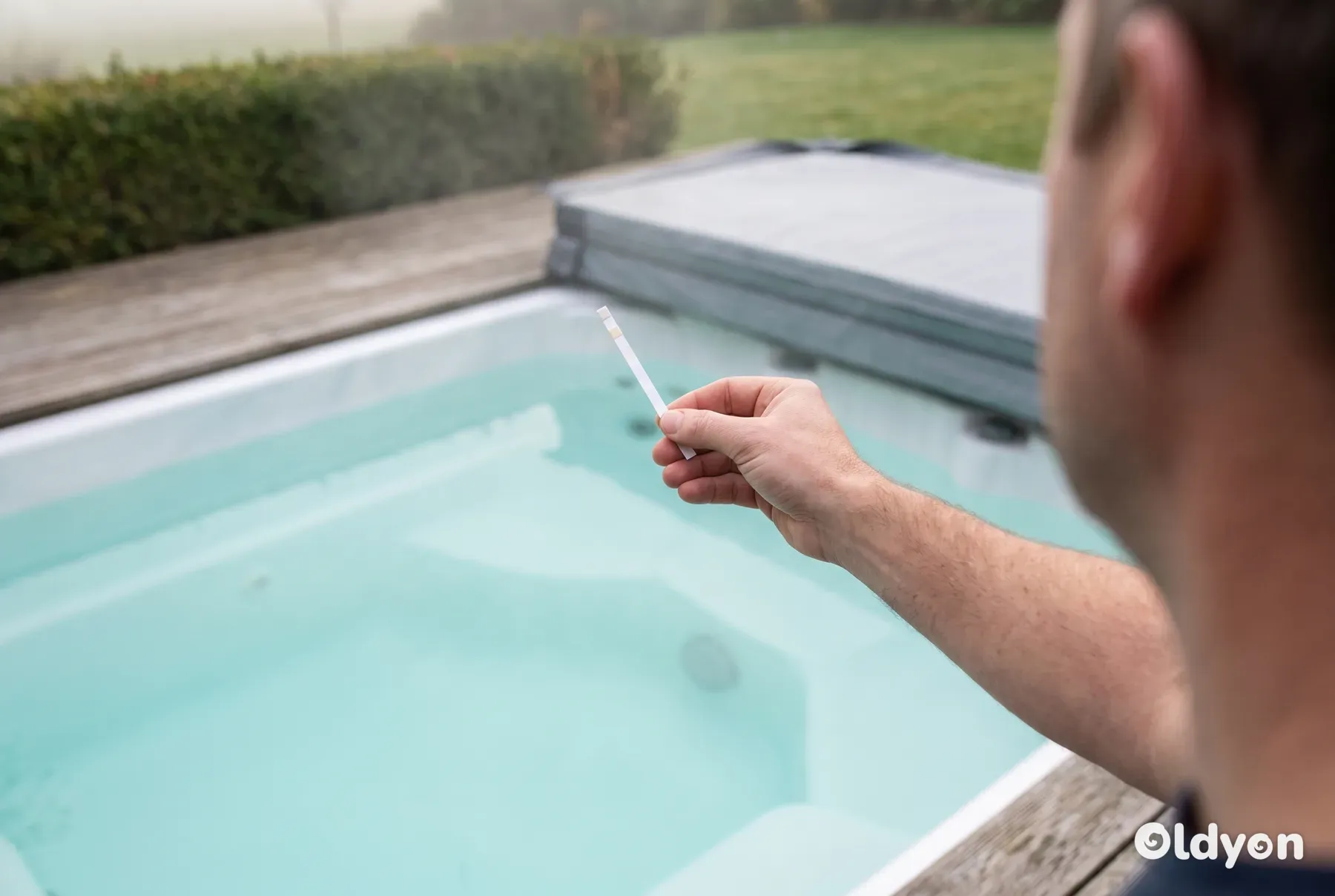
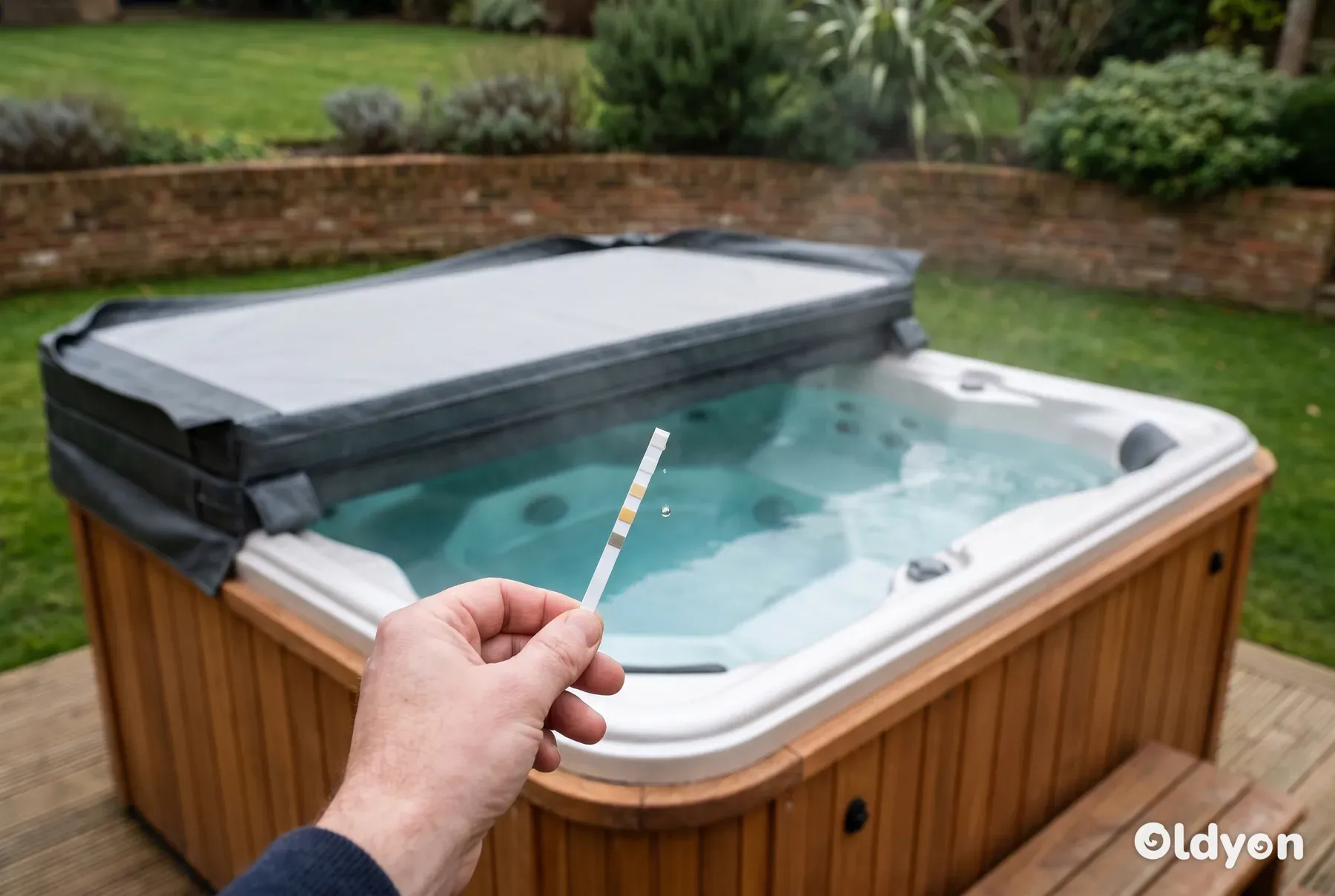
- Test the water with fresh strips or a liquid test kit. With strips, dip the strip for about 2 seconds, then hold it level and still for roughly 15 seconds before reading, unless the pack gives different timings. Write down total alkalinity, pH and sanitiser level so you can compare later.
- Confirm your water volume and work out the dose using 17 g per 1,000 litres for each 10 ppm you need. Plan to add about two thirds of it first.
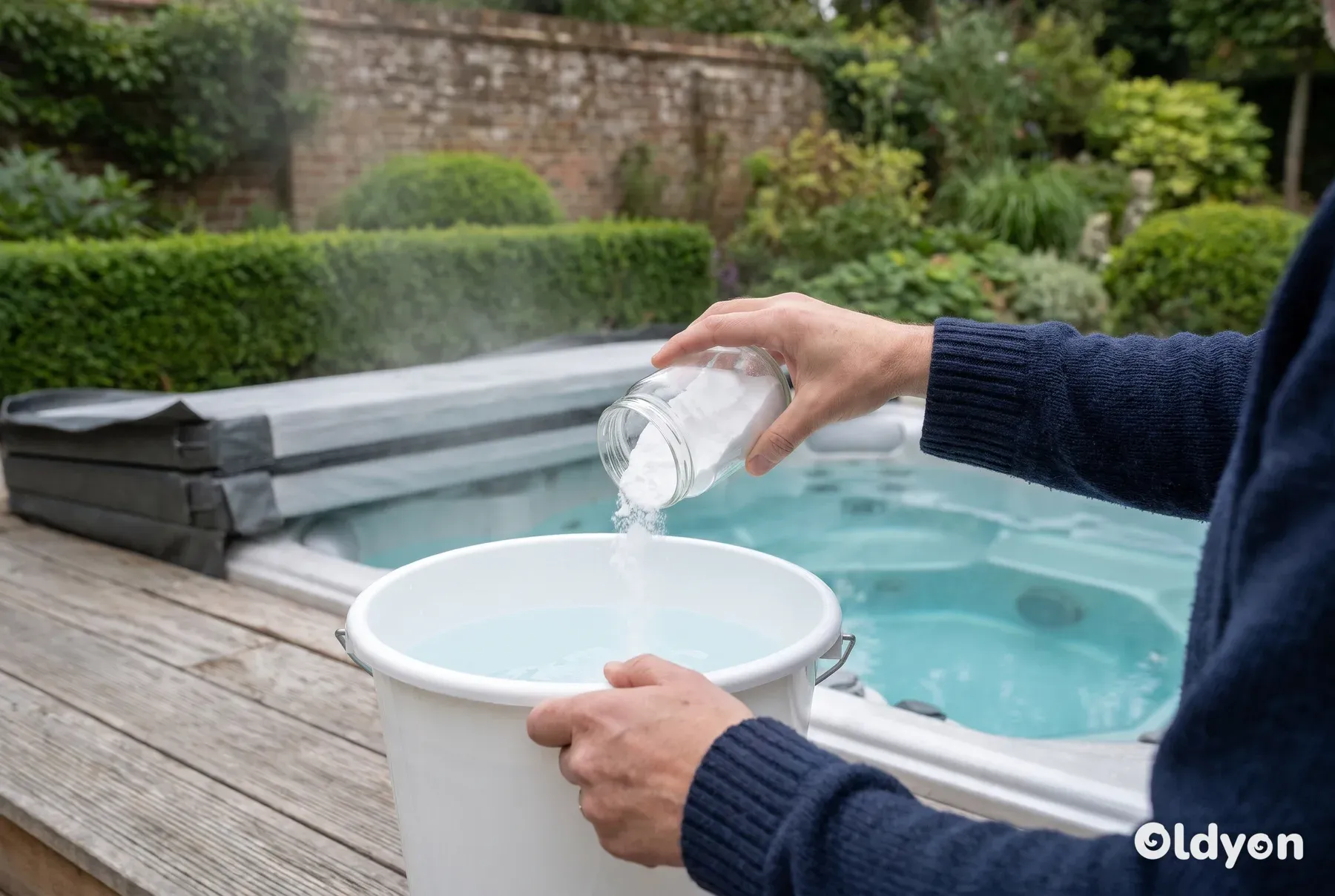
- Weigh the baking soda and stir it into a clean bucket of warm water taken from the tub for about 60 to 90 seconds, until no undissolved powder is visible. Always add the powder to the water, not water to the powder.
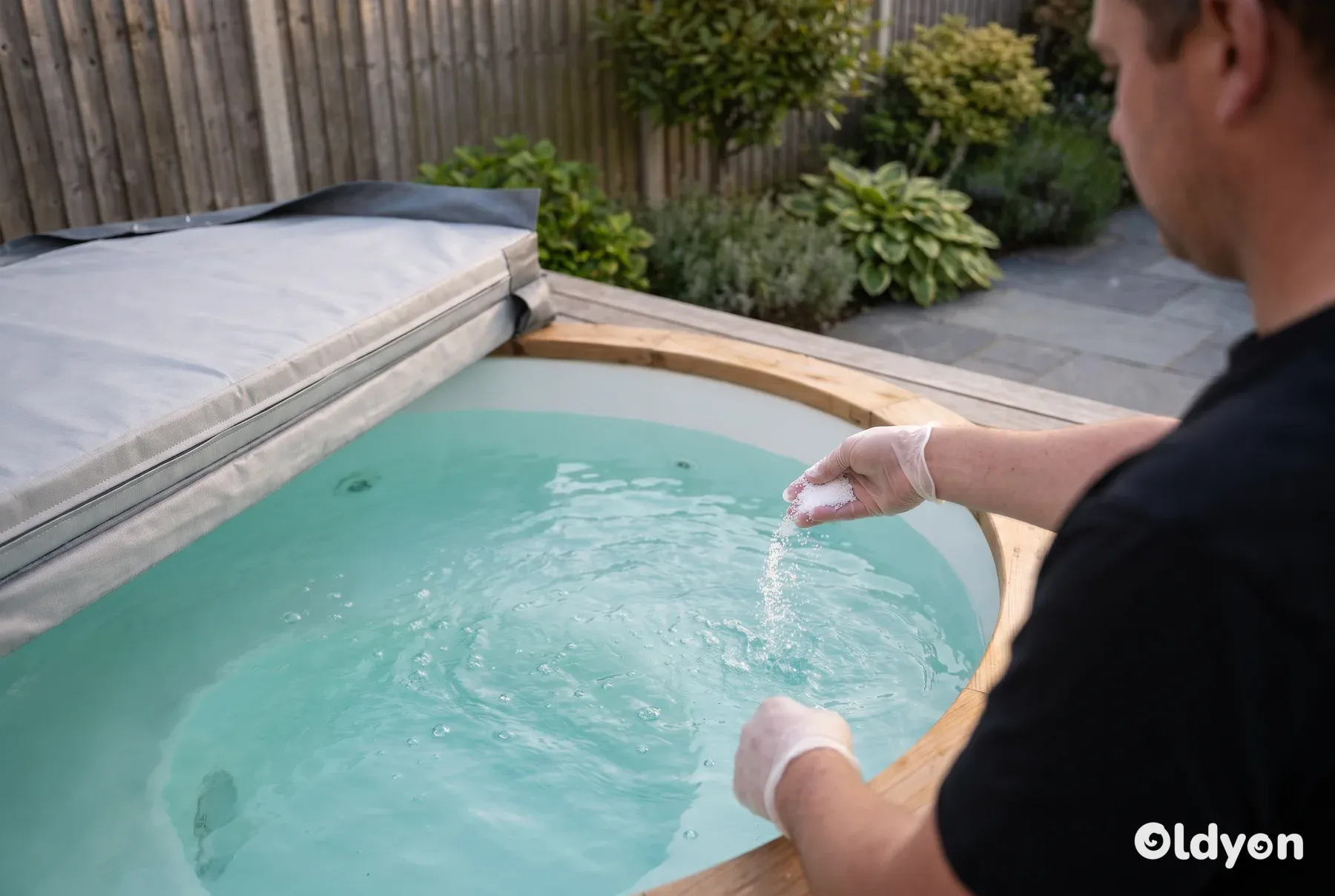
- Remove the cover, switch the jets on high and pour the solution slowly around the edge of the tub, spreading it out. Do not pour it directly over the filter intake, and never pour in dry powder, which can settle on the shell or filter, leave concentrated spots and clog the filter.
- Leave the jets running on high for 20 to 30 minutes, cycling through every jet zone if your tub has more than one, so the bicarbonate mixes through the whole volume. Then let the tub circulate normally with the cover off for at least 30 minutes.
- Retest after at least an hour of circulation. For the most accurate result, wait several hours, or retest the next morning after an evening treatment. Some manufacturers suggest waiting longer, so check your manual.
- If alkalinity is still low, add the remaining dose in the same way and retest. Once alkalinity is in range, check pH and adjust it separately if needed.
Readings taken within the first 1 to 2 hours after dosing can be misleadingly high, then settle back as the water evens out. An early high result does not necessarily mean you have overshot. Do not add pH reducer or any other corrective chemical because of it; wait and retest later.
Uneven mixing is a common cause of misleading retest readings. If a result looks surprisingly high or low, run all the jets again for a while and retest before adding anything else.
Use a bucket that is kept only for hot tub chemicals. A bucket that has held cleaning products can carry residues into your water.
For other ways to raise alkalinity, including when to use a commercial product instead, see our full guide on how to raise alkalinity in a hot tub.
Will baking soda raise the pH as well?
Baking soda raises pH a little, but much less than it raises alkalinity. That makes it the right choice when alkalinity is low and pH is already in range or only slightly low. You can usually fix alkalinity without pushing pH too high.
Baking soda itself has a pH of about 8.3, so it nudges the water upwards gently. A normal dose typically raises tub pH by only about 0.1 to 0.3.
Your starting pH decides what happens next. If pH is low-normal, around 7.2 to 7.4, a dose may bring both alkalinity and pH into range. If pH is already high, around 7.6 to 7.8, the dose may push it above 8.0, so be ready to lower it afterwards.
If both readings are low, correct alkalinity first, then retest pH. Once the buffer is back in place, pH often settles higher on its own. If it is still below 7.2, a pH increaser based on sodium carbonate (soda ash) raises pH more strongly. Our guide on how to raise pH in a hot tub covers that step.
Once alkalinity is in range, check pH again. If it has risen above 7.8, add a small amount of pH reducer (sodium bisulfate), following the label. Never add the pH reducer at the same time as the baking soda.
If pH climbs above 8.0 after the treatment, wait about 24 hours and retest. If it is still high, use pH reducer to bring it back to 7.4 to 7.6. Do not leave it there: above about 8.0, chlorine becomes far less effective, so the water is not being sanitised properly.
Hot tubs also tend to see pH creep upwards over time. Warm water and the bubbling from jets release carbon dioxide, which nudges pH up. This is one reason alkalinity at the higher end of the range can make pH harder to keep down.
Baking soda never lowers alkalinity. If alkalinity is too high, adding bicarbonate makes it worse. The fix is a pH reducer such as sodium bisulfate, often sold as dry acid.
Is baking soda safe to use in a hot tub?
Sodium bicarbonate is one of the gentlest chemicals you can add to spa water. In the small amounts needed to adjust alkalinity, it is safe for bathers and for the tub. The usual care still applies: store it dry, keep it away from children and pets, and never mix it with other chemicals.
- Never mix baking soda with sanitiser, pH reducer or any other chemical in a bucket or as dry powder.
- Add one chemical at a time and let the water circulate before adding the next.
- Do not add baking soda and a shock (oxidiser) at the same time. Leave roughly 15 to 30 minutes of circulation between each chemical addition, or longer if your manual says so.
- Use a separate dissolving container for each chemical, because traces of an incompatible chemical left in a shared bucket can react.
- Wear eye protection and gloves when handling concentrated chemicals such as pH reducers and sanitisers.
- Leave the cover off for about 30 minutes after adding chemicals so any fumes can disperse.
- Keep chemicals in their original, labelled containers in a cool, dry place.
- Keep the tub clear of bathers while adjusting the water and until readings are back in range.
Baking soda does not disinfect the water. It helps by keeping pH stable, which helps your chlorine or bromine work properly. Hot tub folliculitis, an itchy rash of small red bumps, is linked to germs in poorly maintained hot tubs, and the CDC's healthy swimming guidance explains how good sanitiser levels and filtration help prevent it.
Hot tub folliculitis is one of the most commonly reported illnesses linked to hot tubs and spas. That is the main reason to keep alkalinity, pH and sanitiser in range together: balanced water lets the sanitiser do its job, and well-sanitised water gives the bacteria behind the rash little chance to grow.
If you or anyone in your household develops a rash, sore eyes or feels unwell after using the tub, stop using it and speak to a pharmacist or GP. Then test and correct the water, clean the filter and consider draining and refilling before anyone uses the tub again.
What does hot tub folliculitis look like?
Hot tub folliculitis is caused mainly by the bacterium Pseudomonas aeruginosa, which can grow in warm water when sanitiser levels are low. The rash usually appears 12 to 48 hours after using the tub.
- Itchy red bumps, sometimes with small pus-filled spots (pustules).
- Most often on the torso, buttocks and legs, where swimwear holds water against the skin.
- Spots grouped around hair follicles.
What to do if someone has a rash
Mild folliculitis usually clears in about 7 to 10 days without treatment. Keep the skin clean and dry and stay out of the tub. A warm compress, such as a clean warm flannel held on the area several times a day, can ease discomfort. The NHS advice on folliculitis covers self-care in more detail.
For mild folliculitis, an over-the-counter antiseptic applied to the affected skin can also help. A pharmacist can advise on a suitable product and how to use it.
Tea tree oil is often suggested as a natural remedy, but its effectiveness against the bacteria involved is not well established. Do not rely on home remedies alone if the rash is not clearing.
- Speak to a GP or pharmacist if the rash has not improved within about 10 days, or has not cleared within about two weeks.
- See a GP promptly if the rash spreads or the person develops a fever.
- Get medical advice early for anyone with a weakened immune system.
Severe or spreading folliculitis, or a case in someone with a weakened immune system, may need prescription antibiotic tablets. Only a doctor can decide whether these are needed.
How to clean the tub after an outbreak
- Keep everyone out of the tub, switch off at the isolator and drain it completely.
- Clean the shell and headrests, and clean the filter thoroughly or replace it.
- Refill with fresh water and switch the tub back on.
- Rebalance alkalinity first, then pH.
- Shock the water with an oxidiser, following the label.
- Confirm that free chlorine or bromine is at 3 to 5 ppm before anyone gets in.
Do not simply add more sanitiser to unbalanced water. When pH and alkalinity are out of range, extra sanitiser works poorly and bacteria can survive in the filter and on surfaces.
When is a branded alkalinity increaser worth it?
Since the active ingredient is usually identical, plain bicarbonate is often the cheaper choice per kilo by a wide margin. You lose nothing in water quality if you weigh the dose accurately and dissolve it properly.
Plain bicarbonate typically costs a small fraction of a branded spa alkalinity increaser per kilo, especially when bought in larger bags. That price difference is the main saving.
A branded spa product can still make sense in some situations. It comes with dosing instructions written for spa volumes, a measuring scoop and packaging designed to stay dry outdoors. Some owners prefer one range of spa chemicals so every label follows the same style and guidance.
- You want ready-made dosing instructions and a scoop, and do not want to weigh powder.
- Your tub manufacturer recommends a particular chemical system and you want to stay within it.
- The product is a blend that does more than raise alkalinity, and you need that extra function.
- You use a supplied chemical starter kit and want to keep things simple while you learn.
When comparing products, look at the ingredient list first, then the price per kilo, not per tub. If the only ingredient is sodium bicarbonate, you are paying for convenience and packaging rather than different chemistry.
Common mistakes, and when baking soda is not enough
Most problems with baking soda come from adding too much at once or adjusting the wrong reading first. These are the ones technicians see most often.
- Adding the full dose without retesting, then overshooting above 120 ppm.
- Retesting too soon, seeing little change, then adding a second full dose and overshooting into high alkalinity.
- Pouring dry powder straight in, which can leave white deposits on the shell and cause temporary cloudiness.
- Adjusting pH before alkalinity, then chasing pH up and down for days.
- Guessing the water volume, so every dose is wrong by the same amount.
- Using old test strips that give misleading readings.
- Adding baking soda while calcium hardness is already high, which can increase the risk of cloudy water and scale.
If you do overshoot, alkalinity will not come down on its own quickly. Our guide on how to lower alkalinity in a hot tub explains how to bring it back into range with a pH reducer and aeration.
Baking soda is not the answer when alkalinity keeps dropping every few days, the water stays cloudy after balancing, or readings make no sense. In those cases, a partial drain and refill, a filter clean or a check of your fill water may be needed. A local hot tub technician can help, and the HSE guidance on spa pool systems is a useful reference if you run a tub that others use, such as a holiday let.
If alkalinity drops noticeably every week, look for the root cause rather than adding bicarbonate again and again. Common causes include a pH problem such as overusing pH reducer, a heavy bather load or a lot of aeration from jets and air blowers.
If alkalinity is low and pH is also very low, below about 7.0, ask a spa professional for advice. Water that acidic needs a more controlled correction sequence, and it can damage the heater and fittings in the meantime.
If alkalinity will not hold in range after two or three correction cycles, a technician can check calcium hardness, look for equipment faults and test your fill water. Very soft mains water, for example, can make alkalinity harder to keep stable.
Baking soda and your hot tub: the short version
Plain bicarbonate of soda is sodium bicarbonate, the same chemical in most alkalinity increasers. Use about 17 g per 1,000 litres for every 10 ppm you need, add about two thirds first, and retest after circulation. Only add it when alkalinity is below 80 ppm.
Buy a food grade product with sodium bicarbonate as the only ingredient, and avoid baking powder and washing soda. Fix alkalinity first, then pH, then sanitiser. A branded product is worth it only if you value its convenience or your manufacturer asks for it.
Frequently asked questions
Can I use baking powder instead of baking soda?
No. Baking powder is a mix of bicarbonate, an acid and usually a starch such as cornflour. The acid works against the bicarbonate, so alkalinity barely rises, and the starch can cloud the water and feed bacteria. Always check that the label says bicarbonate of soda or sodium bicarbonate, with nothing else listed.
Will baking soda make my hot tub water cloudy?
It can, briefly, if you add a large dose at once, pour in dry powder or your calcium hardness is already high. Pre-dissolving the dose in a bucket and adding it with the jets running usually prevents this. Mild cloudiness normally clears within a few hours of filtration. If it lasts longer, test calcium hardness and pH, and clean or rinse the filter.
How soon can I use the hot tub after adding baking soda?
Wait until the water has circulated and you have retested. In practice, that usually means at least an hour, and longer if you are adjusting several readings. Get back in only when alkalinity, pH and sanitiser are all in range. If you have also added a sanitiser shock, follow the waiting time on that product's label, which is often longer.
How often should I test hot tub alkalinity?
Test alkalinity and pH two or three times a week if the tub is in regular use, because levels move faster than in a pool. Check sanitiser at the same time. Test more often after a refill, a heavy week of use or a large top-up with fresh water. Replace test strips by their expiry date and keep the pot sealed, because damp strips give unreliable results.
Does baking soda work with bromine and other sanitisers?
Yes. Sodium bicarbonate only affects alkalinity and, slightly, pH, so it works alongside chlorine, bromine and most other common sanitiser systems. Some systems, such as certain mineral or salt setups, have their own recommended alkalinity range. Check your manufacturer's guidance for the target figure, then use the same dosing rule to reach it.
Can I use baking soda in an inflatable hot tub?
Yes, the chemistry is the same in an inflatable tub. Inflatables often hold around 600 to 1,000 litres, so doses are small and easy to overshoot. Weigh carefully, add less than the calculated amount first and always pre-dissolve it, because undissolved powder can settle on the floor liner. Check your manufacturer's guidance on recommended chemicals as well.
Filed under